It seems that Citizen is a very widely tentacled Company and this vintage Voken is perhaps proof of this fact. Indeed a true Japanese (Tokyo) watch, very simple Japanese movement and a typical 1970/80’s style. This one is a manual wind, no date, just the time and is in prime condition and has one of the smoothest “sweep” seconds hands I’ve seen in a long time – AND it keeps remarkable time for such a modestly priced watch.
Voken – another Citizen offshoot?
I have seen Voken brand watches before and they seem quite rare today. They don’t seem to have any particular allegiance to brand movements as I’ve seen Russian USSR movements made by Raketa or Slava and nothing wrong in that as these are pretty strong units in their own right. I’ve also seen the odd one from Hong Kong (they had a presence there I understand) with Chinese internals. Made usually for the home and Chinese market it comes as no surprise to see Chinese text along with Russian and also quite often in English. This particular movement is neither USSR nor Chinese, but seems to be a complete Japanese made item – perhaps a classic in it’s own right. Miyota I guess.
Blue strap suits this Voken perfectly!
When I got this some years ago, it had the most awful brownish, muddy and rough textured strap fitted and looked very dull indeed. Which is a real shame as the watch actually looks pretty good. The dial is well made, good hour markers and a cool bluey/violet/purply almost fluorescent colored face. Nicely shaped clear crystal, resin screw back and a smart shaped case mean it’s worth getting decent strap for it I think. So keeping with the ethos of the cheap watch I fitted this smart complimentary colored one with matching gold buckle. I think the color does the whole shebang some justice – so much so that I’m wearing this for the week.
Japanese simplicity = surprisingly accurate watch!
So OK – a cheap, simple little Japanese watch it may be – but in amongst all the wonderful timepieces out there – I really like it. . . . (sad isn’t it?) 😉
My new love of all things vintage digital and especially analogue/digital has really quite excited me over the past while. Indeed my last post but one chatted briefly about my new passion and in that post I mentioned an analogue/digital that was really quite unusual. We know the more common analogue dial coupled with the digital display, both powered by the same quartz movement and battery. But in this case I feature an analogue mechanical hand wound movement with dial but with a separate battery powered digital display and quartz movement. The whole lot “en-bloc” as the French would say –
or perhaps as the Japanese say “Enblok-Digi” – by Q&Q – and here it is. . . .
The oddly named “Enblok-Digi – mechanical AND digital LCD from Q&Q Watch.
Quite a rare little watch this as there are very few around from the 1980’s that feature separate mechanical and digital movements in the same case. Probably not that well known in the UK, the Q&Q is found in many areas of the world. Part of the Japan CBM Corporation, better known now perhaps as a subsidiary of Citizen Watch, it first produced watches under the Q&Q name in 1976 and are actually one of the largest makers of analogue watches.
A neat watch at around 40mm lug to lug, 32mm wide and 12mm depth with a plastic crystal front to the twin displays. On the upper half a conventional analogue hour and minute hands and dial of a mechanical manual wind Japanese movement and on the bottom a digital quartz module LCD display powered by battery. The mechanical watch is wound and adjusted conventionally using the Bullhead style crown @12 and the quartz, hours, minutes, seconds, month and day adjusted using the two pushers on the lower right of the case.
All Japanese Q&QJapan Plastic – metal snap on battery access.
So the watch can be set as an analogue dial watch with an accompanying Day and Date in the LCD display, which is relatively conventional, but intriguingly it can also be used as two quite distinct and separate watches – as for say a Dual time. On the plane quickly adjust the hands to the destination time and leave the digital LCD display alone as the home time. Very handy.
Others can feature this too, but a distinct difference here in that – perhaps you forget to wind the watch – no problem, the LCD quartz display is still showing the correct time. And conversely if your battery dies, then no problem – no worries – because the old mechanical ticker carries on regardless. And in these ever increasingly electronic days – this old and dare I say “cheap” watch, because it is . . . . is actually quite clever.
The case is a plastic resin produced by Asahi Kasei Plastics Corporation and it seems quite tough. The back of the watch features a fairly weak snap on round metal insert, under which the battery is accessible. I managed to remove this easily with my thumbnail so with this kind of back it’s absolutely no surprise that there’s no Water Resistance quoted – it would simply drown. But for everyday use it’s OK.
However I now have this model in my small but growing ana-digital collection purely as, what I would call a “transitional watch” and as an interesting footnote.
And as can happen with any subject, and here it is the digital watch revolution of the 1960’s through 1980’s, every so often a few of these oddities or “footnotes” can turn up out of the blue. Just as often in the context of their finding, they can suddenly disappear, never to be seen again – or maybe just occasionally like this “rare” – and it surely is – this Enblok-Digi by Q&Q – just a small part of the continuing and fascinating world of Ana-Digital.
Note – Q&Q have moved on a bit since those days and here are two of their current offerings –
Q&Q digital watch todayQ&Q ana-digi today – World Timer
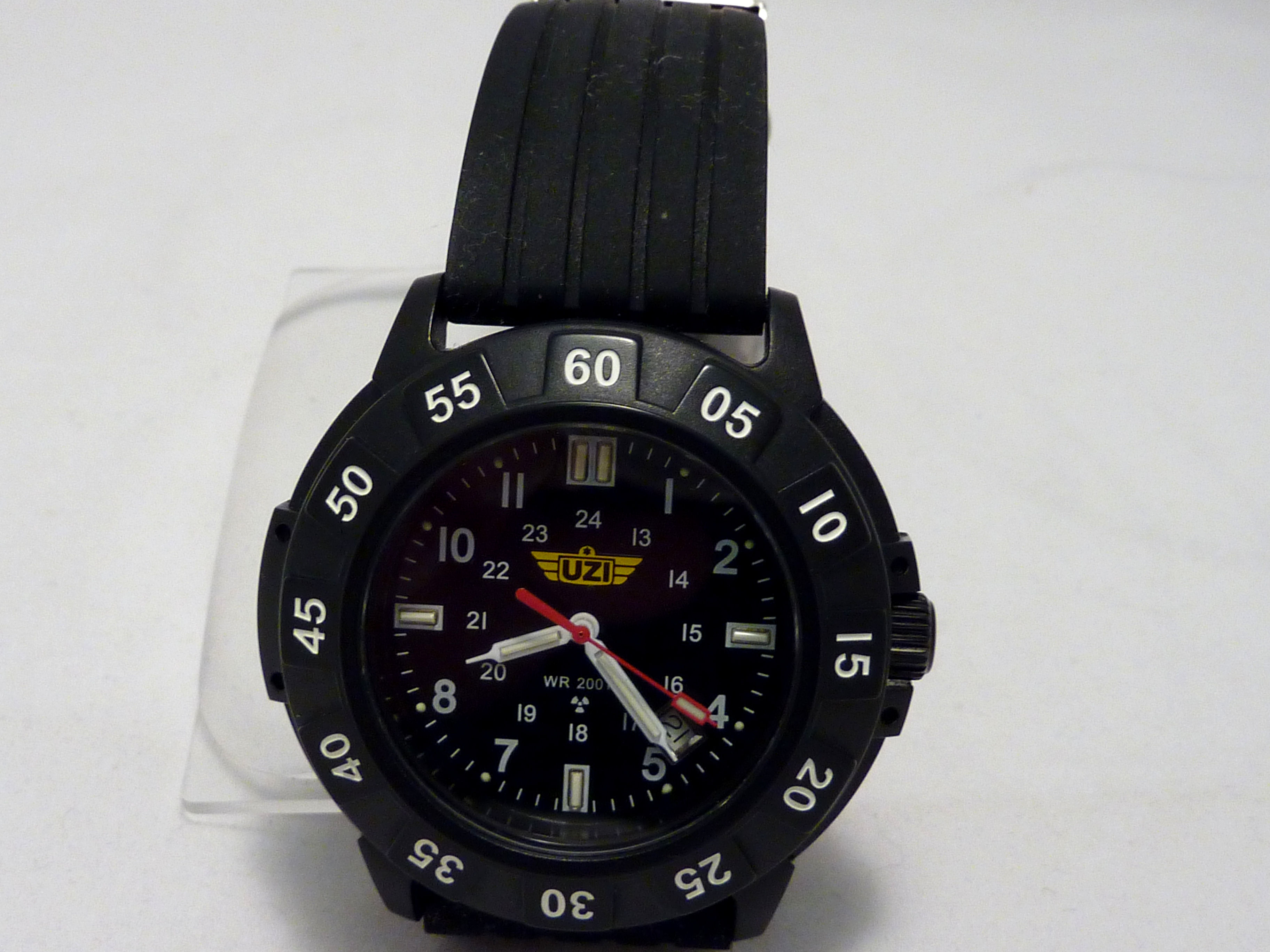
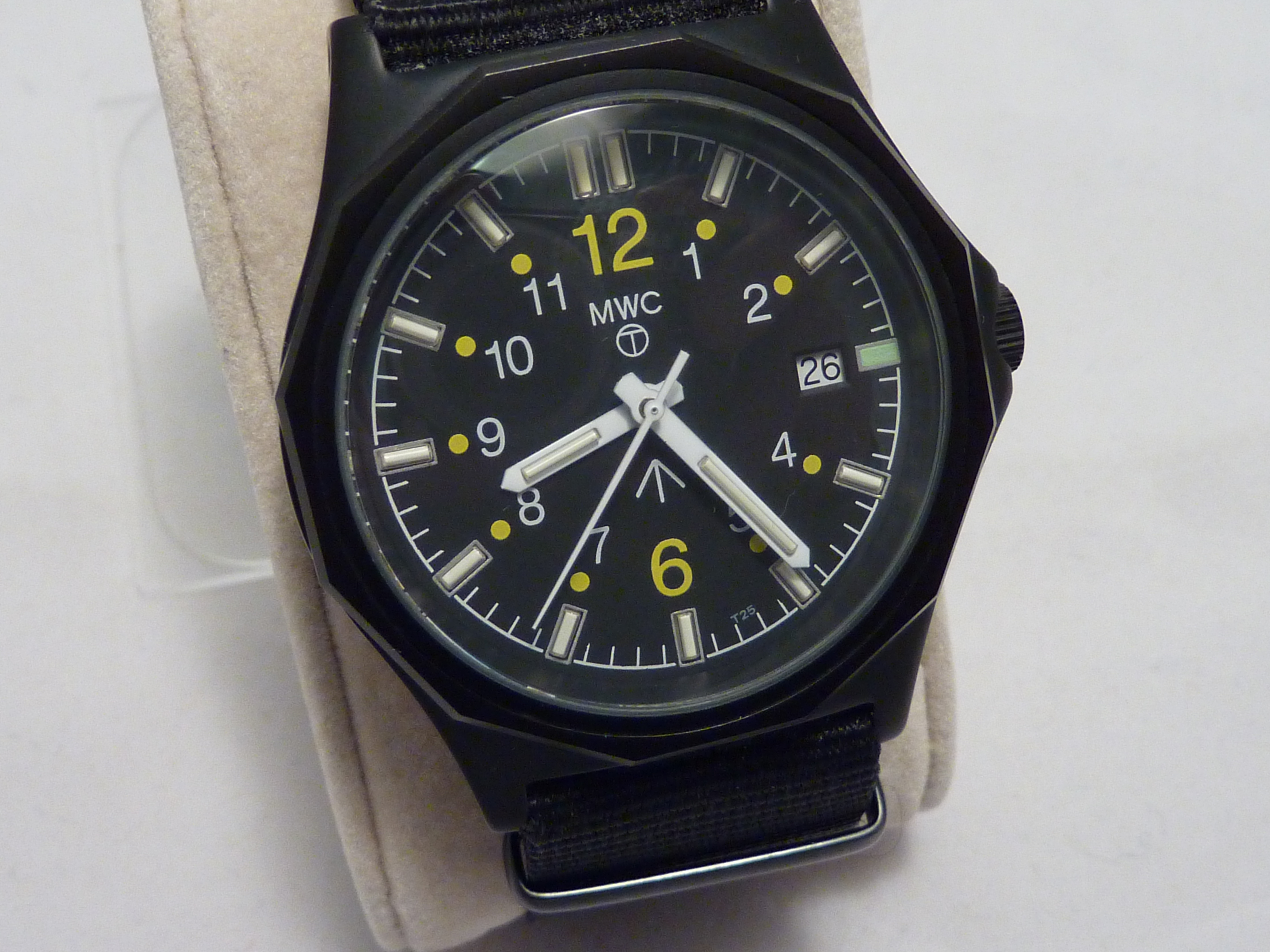
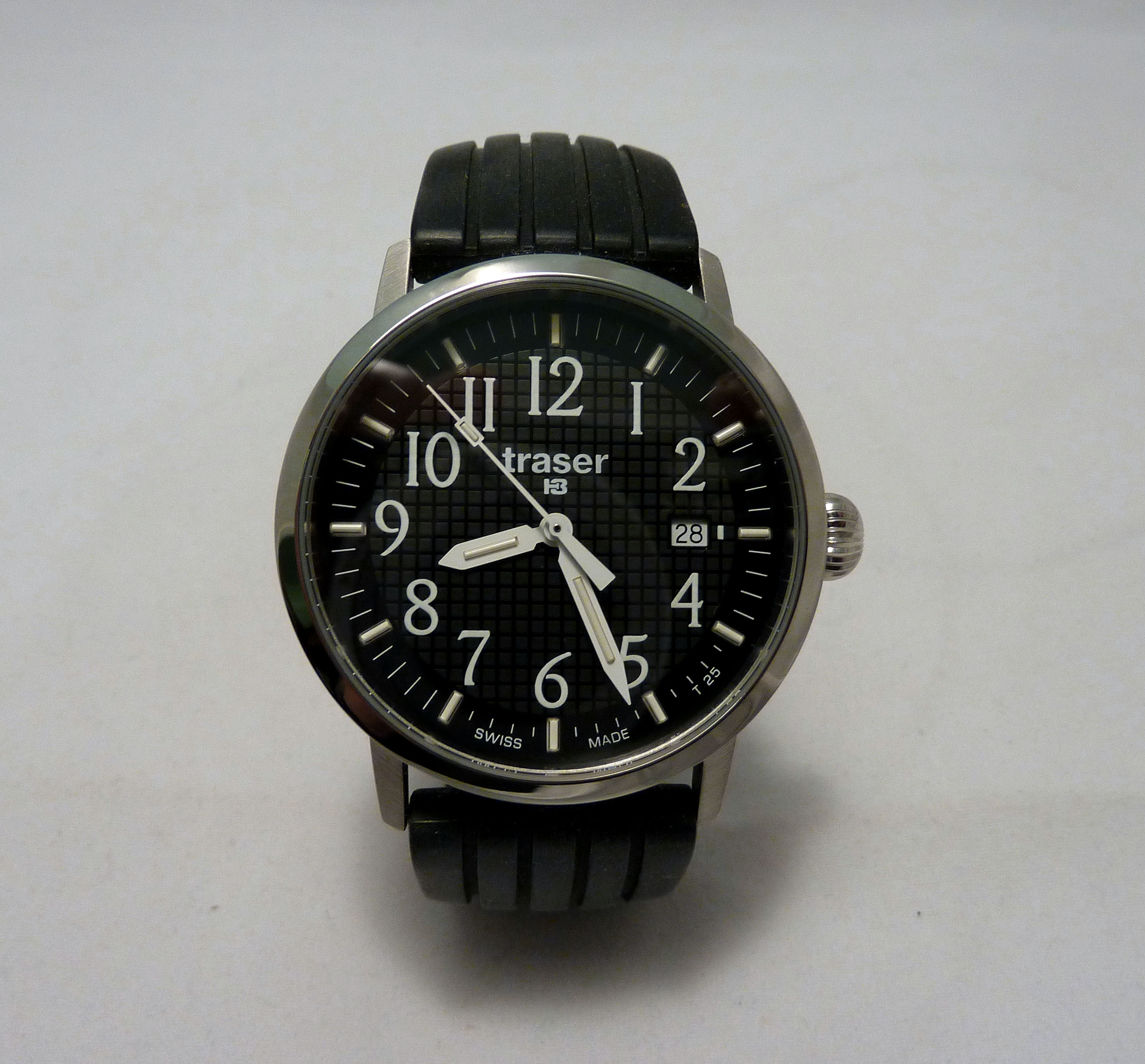
Well 4 actually if I include the Uzi watch I featured two posts ago. But I thought I’d have a look at the four Light Source watches I have as a comparison. Price wise they range upwards from the Uzi, the MWC, the Traser Basic and finally the Traser Big Date. Quality wise I suppose the old maxim “you get what you pay for” is just about right in this case (not always these days I’m afraid). And as far as the light source technology is concerned, all four models feature the excellent Swiss mb Microtec Tritium Capsule system.
Trio of Tritiums – Uzi, MWC and Traser.
I featured the Uzi a couple of posts ago and concluded that it was a very good buy for the money – getting the Swiss Tritium set is about as good as it gets, though not all the hour markers were capsuled. Only 7 in fact. A double orange set @12, one green tube @3, @6 and @9. Plus the hour and minute hands of course. And perfectly acceptable it is too. Superior in my opinion to the more common luminous coatings, so many of which as we all know (and let’s be brutally honest here) fade after an hour or so, whereas the Tritium just keeps shining through. However, I acknowledge that there are a few coated models out there that are very good but against Tritium Tubes?
I’m not doing a comparison here though and leave that for another time – and THAT word TIME is very important!
Uzi Military Swiss mbTritiumMWC W10 military – Tritium
Now the MWC watch in a similar vein to the Uzi as it’s pandering to the more military amongst us and indeed it meets a good few of the US MIL specs re’ build and Luminosity. And here the MWC scores over the Uzi in the fact that it has double the number of tubes – 14 in total. Again 2@12 and all the hour markers except @3 owing to the date window, plus the hour and minute hands which are fully tubed. @3 is not left without though as it has a standard luminous coating marker, but the omission is of consequence as the resultant night viewing very good anyway. My own model is very bright and has been for over 5 years now.
Considering further the MWC model, it has in it’s life been subject to many reviews and comparisons against others, some of which (the reviews I mean) I find often biased and unhelpful.
I take a different view, mainly as a user and wearer of the watches in question. The MWC model I have is the W10 and have found it to be reliable, extremely solid, well built and practical. It is a nice size at 38mm diameter (less crown) and 12.5mm depth and the face diameter is larger than the Uzi at 30mm. The overall case may be slightly smaller than current versions which I think are 40mm. A nice dull black finish stainless steel case with protected screw down crown @3 and a neat military screw down battery hatch for quick battery changes, without compromising the full WR of the watch back. Such a simple idea (Mil Spec’d I understand) and very practical. The WR water resistance of the watch is perhaps a little disappointing at only 5ATM (the Uzi was 20ATM). And as far as reading at night is concerned – well it is excellent and what else can I say. It’s pretty clear and it’s very bright and compared to the Uzi it is a little better of course, but really only owing to the number of tubes use. Again over the years I have had it, the tubes are as bright as ever.
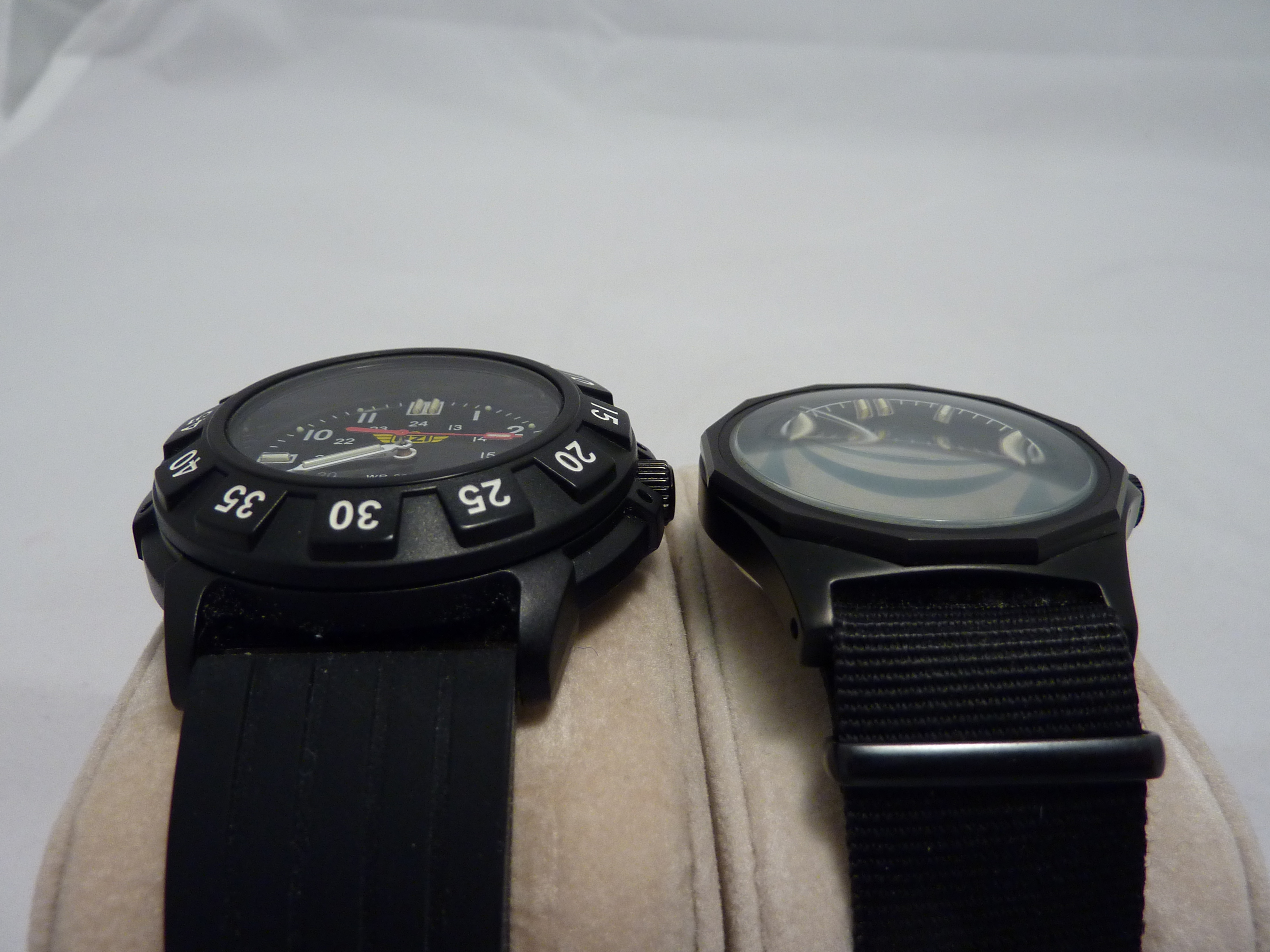
Flat(Uzi) v Domed (MWC) crystal view angles
One point that’s worth mentioning is the fact that the crystal is slightly domed. I personally dislike this feature in a military watch as it means that the angle of view is reduced in comparison to a flat glass. Strap wise I seem to remember it came with a NATO style strap which was in my opinion a bit rough? so I changed it for a neater one, which had melted holes and black metalwork to match the watch. Here a Nato strap is really the only option as it has fixed steel bars in the lugs. The old style run through twin and backing strap can still be found though which would do – but Nato is neater.
I come now to the Trasers – I have two. I’ll start with the oldest one, which incidentally is the first Tritium Light Source watch I bought – the Traser Big Date. This particular model is in my opinion, Traser at their very best. A very solid and beautifully constructed watch with a VERY solid brushed finish stainless Steel case with a considerable weight to it. Coupled with a solid link stainless steel bracelet, fitting to standard spring bars on the lugs, this is one good looking piece of kit.
Now I have heard on one review of Trasers in general that build quality is not as good as some. Well I’ve had 7 Trasers in my day and certainly with those older models and this one , I disagree, as they are or have been as good a quality as I have seen on any watch of this type and in fact, better than most. But more on that later.
Again we have the black dial, though in this instance we have 2 sub-dials – one for the Alarm and one for the Small Seconds. Also there is the double window Big Date @6. So very easy to read and as a watch this is a bit of a step up from the more basic time & date Uzi and single date windowed MWC.
As before though this watch features the Swiss mb Tritium capsules, but unlike the previous two watches these are not applied to the dial surface as hour markers. Here they’re actually sunk into hole/recesses on the perimeter of the dial and set lengthwise as opposed to in line with the numeral markers, which if it had any, would align towards the watch center. And this time we have a complete compliment of capsules – some 15 in all. One at each hour mark, one each on the hour and minute hands and even one on the small seconds hand (and NO it does not affect accuracy in any way I’ve noticed). An advantage of having the capsules partially hidden in recesses means these don’t intrude into the face of the watch at all, which is sensible when you think of it, what with two sub-dials in residence too.
A heavy cased body with a strong flat Sapphire crystal and a screw back, this model has a WR of 100m or 10ATM which is reasonable. It is not a divers watch. And as to it’s night lighting – it’s nothing short of spectacular – very bright and clear and having a completely flat Sapphire crystal is readable at quite acute angles. I also seem to recall it had some Anti-reflection coatings too – but whatever – it is a delight to view. But for more details please check my post HERE for further information.
Lastly I come to a recent purchase and bought only because I wanted a tritium light source watch that was not too military looking. A good daily beater that was as clear to read by both day and night and was good quality without going mad.
This is the Classic Traser Basic which I show next.
This is the most modern Traser I’ve had and just received, so this is it’s first review here. Whilst it’s a big looking watch it’s just 40mm diameter, maybe 44mm with the mid size onion crown and just about 10mm depth, so not so large in actual fact. But I say again it looks big. This is due to the fact that the top bezel part of the case is quite thin so the dial tends to take up much of the watch front at 35mm diameter. And a very clear dial it is too. Large full numbers on the hours, a date window @3, nicely patterned inner face with chapter ring and very neat little mb Tritium capsules as hour markers slightly sunk into small indents on the dial and full Tritium lights on the hour and minute hands plus a small one on the centre seconds hand means it will be (and is) a very easy watch to read in any light. The lights are green except for the 12 o’clock position which is bright red. The crystal is flat mineral glass and pretty reflection free. The Water Resistance is 5bar or 50m with a screw back. Finish wise it is a brushed stainless steel apart from the thin top bezel which is polished.
Here I come back to the quality issue mentioned above. Whilst this model is OK as a whole it is not quite in the same league as my Big Date for example. It just doesn’t have that really smooth brushing of the steel on the case, or the quality of finish and it’s also quite sharp edged in style. But it’s really in the bracelet area which in my opinion is rather poor. It is an expandable stainless steel one with a simple open/close fitting, but the quality of finish is very disappointing.
Traser Basic in Black – Poor quality & finished bracelet lets it down.
It actually grabs the skin and is rough against the wrist – I might expect this from an older ’70’s Chinese watch perhaps, but not what I would expect from Traser. Why they fitted this is a mystery and certainly doesn’t do this watch any favors, especially as the inner dial is so neat and well finished. Incidentally This model (T4102.240.A2.01) or Classic Basic Black features the Swiss Ronda 715, a K1 Crystal mineral glass (flat) and runs sweetly indeed, so no worries there – all in all a nice mid quality watch with a poor bracelet – which if you change to a Silicon deployment black as shown – raises it to another level entirely.
Well those who know me know I’m a sticker for comfort and I removed their rough bracelet and fitted a spare black silicon/neoprene deployment strap – totally different ball game now! The watch lies against the wrist beautifully, is very comfortable AND it looks great too. For night use this watch is perhaps the best of the 4 featured here and though there are differences, these are all very good at what they do. Unlike the Uzi and the MWC there are no luminous reflective pads under the Tritium capsules so the capsules shine extremely precisely with good definition – so for night use – just what I wanted.
Traser Basic Black – re strapped – NOW it looks the business!
Performance of each of the models here are indeed similar, though the construction of the dial arrangements mean they each display in a slightly different manner.
The new Traser Basic – for me has the edge as the larger face or separation of the light tubes gives real clarity. Though that said the red single tube @12 might have been better if a double tube as the Uzi and the MWC, but they are so clear that might be a marginal thing.
The Uzi – bright and whilst the fewest tubes, what it does have is extremely good, bright and well separated and having the double tube @12 very clear indeed. So having fewer tubes doesn’t detract from performance at all. Indeed that separation probably assists.
The MWC – with the full compliment of tubes it is on a par with the Uzi and these are bright, especially with the reflective backing under each tube. The double tube @12 again assists in orientation.
The older Big Date – As good as the others, yes I think so. The hour marker tubes unusually being at right angles to the watch center, and being slightly shrouded make these appear as dots rather than short marker lines in the dark – it looks different because of that, but no less efficient.
So not a lot to choose between them, which is not surprising as they each feature similar mb Tritium tubes anyway. The latest Traser probably has the edge purely as the face being larger, allows better separation of the lights. And I also prefer the tubes pointing in to the watch center. But this is entirely subjective – they are all excellent. The second hand light is also outstanding on this model and better than the Uzi and Big Date.
I think you can probably guess I’m not a great devotee of the various luminous coatings, much preferring the Tritium system and I should give you my reasons. Basically it’s two fold, though before I say too much I must say that there are a few watches I have owned that managed and manage pretty well with the coatings. My old Breitling Aerospace 1999 model which actually does very well at night and that’s all night too. It never fades away totally and has never let me down. I currently have a Laco 1925 model which is very good and also manages a complete night – so of course there are a few around.
However my reservations on coatings has merit and reason No.1 is that the majority of the coated systems are simply not bright enough and certainly not bright long enough. I have had many a watch with coatings and the variation in quality is nothing short of spectacular. Some are maybe just OK and others plainly not fit for purpose in reality. Some can be seen for an hour or maybe longer with a slow decay and some 10 minutes or less. Some not at all.
And reason No.2 is all about – location, location, location! – or where you, or specifically I, live!
I do not live in a sunny climate, not the USA or even mainland Europe and sun is a precious and scarce commodity. I live in Scotland. It is generally wet and cold, so arms are rarely exposed (except in high summer – whatever that is!!!) so the wristwatch is basically covered for 90% of it’s life. A similar issue for Solar powered watches here – they even sometimes stop – you then have to take them off and stick them in the window for days, sometimes weeks to get them sufficiently charged to start again and preferably with strong sunlight. Just daylight here often won’t cut it. Give you an example – in my car I have a Sat Nav and today and that is all day, it was lit up as for night viewing – in other words it thought it was night as it was so darned dull!
But getting back to luminosity – the covered arm and watch just doesn’t get enough light exposure to charge at all and when it comes to night? – well it’s a non starter.
With Tritium this seems to solve the problem. I can have my wrist covered all day and every day and it does not affect the night viewing capabilities one iota! – I also don’t worry over much about the quality of the capsules as the majority of light source systems are very good indeed. I have not had a poor one – all my own Tritium light watches are Swiss mb which is coincidental and not because I specifically requested this before buying, it was simply what they came with!
However, there is a BUT – remember that word TIME I mentioned at the start of this Post – Well, Tritium has a life and if you keep your watches for more than that period, then suddenly your nice luminous watch loses it’s light! The Tritium light source decays until it’s out.
Let’s see how these models fare in what? – another 10 years perhaps – Watch this Space!
Can’t think why I haven’t posted this watch before as I wear it often enough, especially when off on weekend trips and so on. Somewhere that I don’t have my bedside clock and need or certainly prefer in the middle of the night to be able to tell the time immediately. Of course Tritium light source watches are the answer. Non of this Super-luminova that seems to vary in consistency between manufacturers, but a light emitting source that is bright, bright, bright! To this end I have to show you the UZI –
The Uzi Defender – 001-N – Tritium
Not a bad looking watch at all and especially when you consider it has Tritium illumination, a military look and here fitted to a black matching silicon deployment strap. I’ve had this one for quite a few years now and it still impresses me as to it’s accuracy and it’s ability to still look as new as the day I bought it!
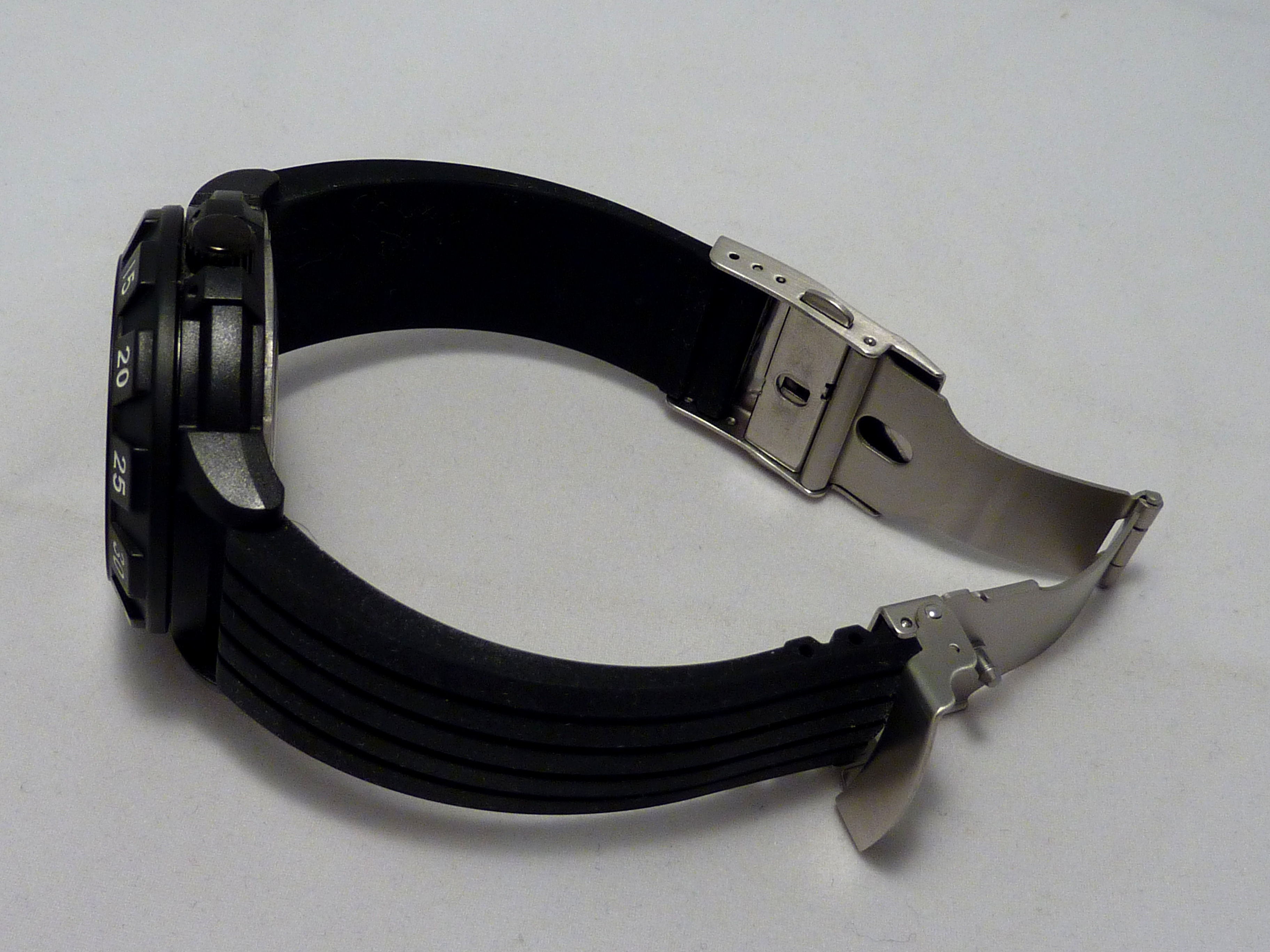
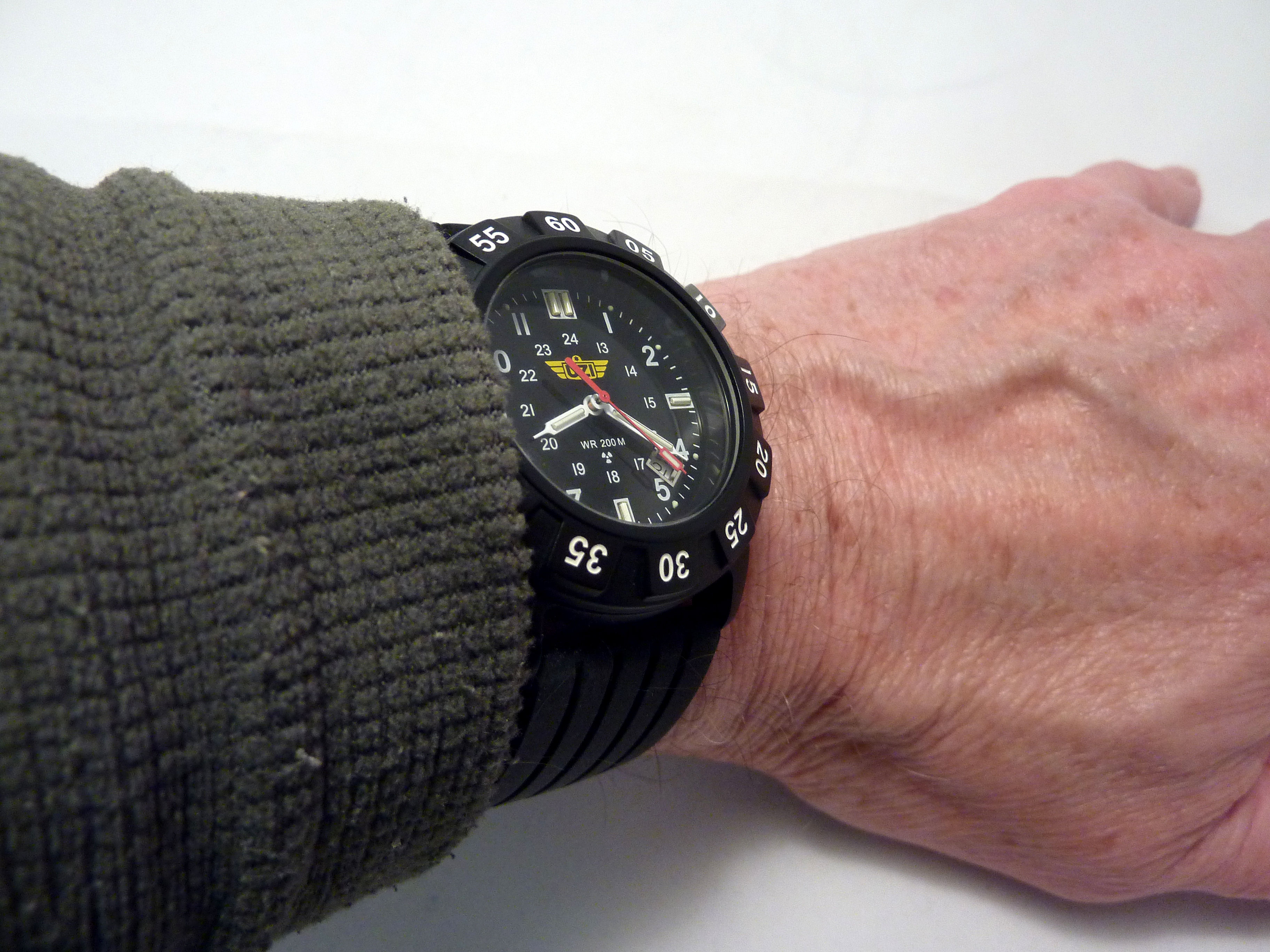
Hardened Mineral Crystal in a tough resin case, screw down crown with a Water Resistance of 200m (that’s 660ft), a black dial plus a one way rotating outer bezel, can’t be at all bad and especially for the price – I seem to recall somewhere around £70.00. It is a decent size too at 43mm diameter and 14mm depth, but it wears SMALL – it simply does not look big – probably as across the crystal face is only 28mm – but that doesn’t seem to detract from the fact that it’s really quite easy and clear to read despite the UZI yellow logo just below 12.
Easy read face of the Uzi Defender – Note the light source points.
This particular older model is all black unlike I believe the current ones which have an olive green bezel perhaps? though I prefer the darker look and the night ability is exceptional. The tritium light source capsules are @12, 3, 6 and 9 – the hour and minute hands are also “tubed” light source and the natty centre second hand is red tipped with a luminous coated tip, which although in the dark is not as bright – it can be seen. The @12 position has double tubes and is not green as the other points, but orange. Note there are also luminous dots on the hours. So this watch is definitely for those who like the darker side!
Mated to a black ribbed silicon deployment strap.
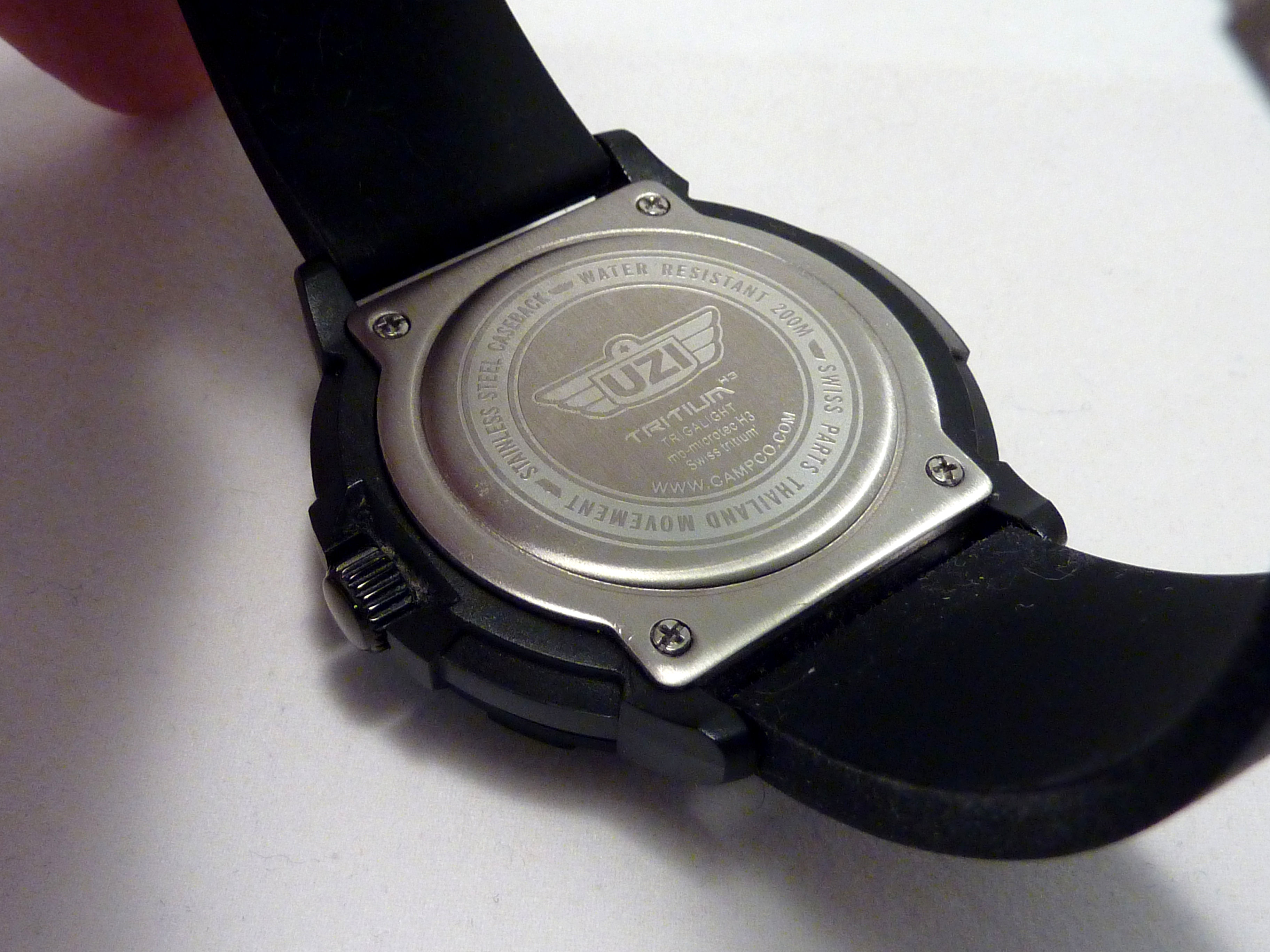
A screw down crown (as you would expect with this WR), and interestingly as I understand it this particular model at the time I bought it stated just a quartz movement (maybe Thai?) with Swiss components. I have to say whatever it is, it has been superb. Maybe not a Ronda, but it works VERY well and the proof as they say . . . .
The fact that this is resin cased means it is very light indeed and very, very tough. No marks on this one at all, so it wears extremely well. And here I have to mention the price again.
This is one really good value watch, especially when you consider it has Tritium and when put against others with this system – and I even mean the others in the Uzi range. It is available currently in Stainless steel – but at a premium £150.00, then there’s black stainless steel at £165.00 and to cap it all, a Titanium one at up around £230.00!
To me I really can’t see these premiums at all – this model shown here at the price I bought it for, does the business – hands down. And most metals scratch with use – and this? – well – it doesn’t! It’s also very lightweight and tough and with the silicon strap it will certainly do me a long, long time.
And against other manufacturers, such as Traser, or Nite, or Smith and Wesson, or Swiss Military and Luminox and so on, it represents tremendous value and I have to applaud them for it.
4 point screw down sealed back – 200m WR.
Now after all this – I was sure I had posted this watch here before, but I’m unable to find it on my site at all – so maybe this was one I deleted inadvertently a year or so back – whatever. I post or re-post it here anyway and I’ll treat it as a “re-visit” after some years of quite extended use and say again what a smart, value watch this has and continues to be. I’m off on a trip soon and guess what? I’ll be taking this with me – Oh Yes!
Addendum – 6th August 2023
Last reviewed 2012 and it’s still working perfectly and the last battery fitted was way back in 2019 and it’s still going, so power wise it seems to be very low usage. Perhaps as everything about this watch is so light.
The Lume (Tritium) so far, is still good and accuracy is as good as I need. Shows the time and the date and is still very water resistant at 200m, not a bad spec’ for a cheap watch at the end of the day.
It’s one of these models that appears to have got everything right at the best possible price – and that is worth a lot!”
However as with all Tritium light source Capsule dials, they do indeed have a shelf life. By that I mean is that the often quoted 20 years is simply not on. Some Tritium models quote a light guarantee of 10 years and for me that’s just about right. I have others and after 12 years they are dead – so at night forget it. You will need a torch!
I am going to check it out in 2025 – I will post the results here.
And here we are it’s March 16th 2025, 13 years later and I tested it out last night. The result was pretty good I have to say. I can’t make out the little seconds tip, that’s gone, but the hour and minute hands and the 4 x markers at 12, 3, 6 and 9 are easily visible. And this really pleases me as it looks like this watch might just out perform the more expensive Traser models I have. This Uzi Defender model cost around £70 when I bought it and I note the current model called the Protector, which seems identical to me, costs around £148 now and it looks like the same minimal Tritium arranged dial display. Once again great value. Next test in 2 years (2027)
Uzi on the wrist – even my small wrist – looks OK for a 43mm diameter.
Maurice Lacroix are an interesting Watch Company today in that they are one of the few Independent Swiss Watchmakers around. A luxury watch supplier for many years they came into their own I suppose around 1989 when they took over case maker Queloz S.A who were based in Saignelégier. As a Company they were formed as part of Desco von Schulthess of Zurich in around 1975, but since the early to mid 1990’s have expanded to become one of the leading Watch brands today.
They make a wide range of models from high end mechanical to mid range quartz – such as this one – the Sphere.
Maurice Lacroix Sphere in stainless steel
I managed to get this pre-owned model in an auction recently as a sort of “yours or mine Dear” watch for day or evening wear. I say this as this particular one is a mid size or unisex as they say today at 34mm diameter and suits my 170mm wrist perfectly, but also fits my Wife! So what could be more even handed that that!
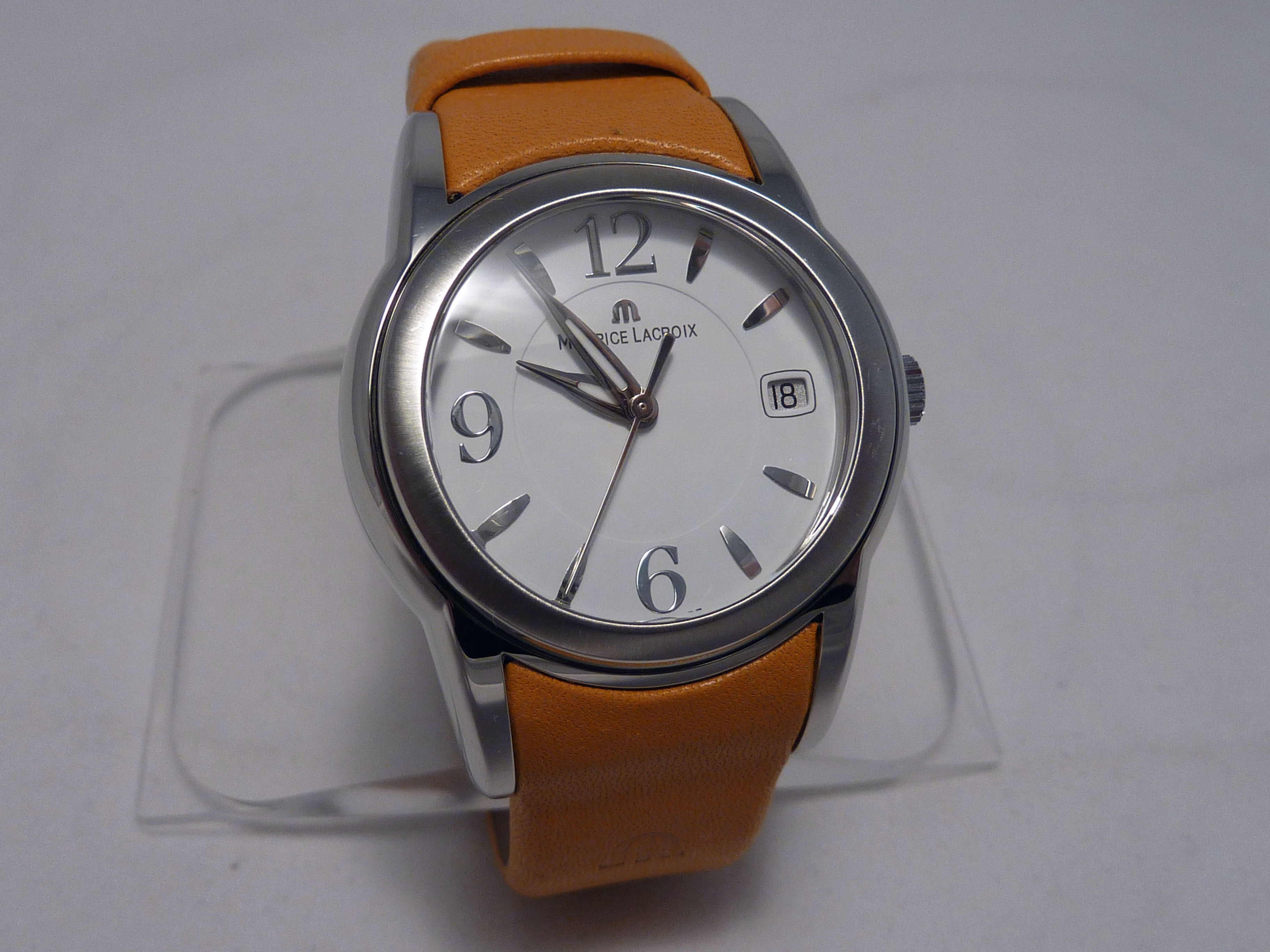
This is a really neat looking watch in stainless steel with a highly polished case and subtly contrasting brushed stainless top bezel, with interesting elongated lugs and case design. The round faced case has a pronounced curve and the original tan soft leather strap is specially formed to fit this as the spring bars actually fit a little back from the end of the strap.
As to the watch face, the dial is white with hourly applied silvered markers, quarterly applied Arabic numerals and owing to the thickness of these are quite clear to see. It has a date aperture @3 with a slightly off white/silvered textured background for clarity which is effective.
Extreme curved case & elongated lug design
The hour and minuted hands are a slightly chunky (lanzenform) infill style, though whether specified as luminous is doubtful, being as easily seen as my wallet last night! The stainless steel case is very solid in appearance and as an ensemble is a high quality construction with a strong textured “snap on” back also in stainless steel. It is marked 50m Water Resistance. The crystal is a strong looking Sapphire and the crown unobtrusive @3 but with a decent knurled profile for setting.
This model is certainly not a current one, though I have noticed it is still around and for sale in a couple of different sized versions as new old stock I assume, so can be had for, I would hope, discounted prices.
Mid size Maurice Lacroix on a 170mm wrist – looks good.
Well – as I said, when it’s fitted to my wrist I think it looks pretty good and I’ll certainly wear this on occasion I’m sure. However I’m also sure my Wife will wear it too and I just have this feeling that she may acquire it as her new “daily beater” and I might just never see it again –
I’ve revisited this watch and posted it here today again as I decided this morning to wear it for a while as my “daily beater”. And not for the first time as I put it on, I realized this is a darned good watch, especially in these darker days here in the UK. I can also confirm that I’ve had it for a few years now and it has been utterly faultless in every respect.
AstroAvia R705L Alarm
No fancy studio shot here, but a quick (today) snapshot of it on my wrist, indoors on a very dull day and it certainly shows that it’s a pretty clear watch to read. The slight blurry look is me and my camera by the way, not the watch!). The Superluminova coated hands already starting to glow in the low light conditions. Now whilst this watch came with a bracelet and a leather strap, which has to be great value, I’ve since put on a Silicon deployment strap, simply because I find them so easy to put on and take off and they are very comfortable.
I must have used the chronograph functions last time it had an outing and this morning the small seconds/1/20th counter sub-dial hand @6 was not zeroed. Nor was it ticking off the seconds, though the watch was keeping perfect time. Of course I had forgotten how comprehensive the OS80 Miyota Quartz movement is – and it IS an excellent movement by any standards. It’s quite an interesting one and the first thing I remembered was that the sub-dial in question has a double function – firstly as a seconds hand and also when the chronograph is used, as a 1/20sec counter.
So I reset the hand to zero by pulling the crown out to position 2, pressed button A (@2) to ensure the large center second chrono hand was at 12, then pressed button B (@4) to reset the little seconds hand to top position – so everything looked good. I then returned the crown to the normal position.
So now the watch was functioning or indicating correctly, but with no seconds hand visibly ticking away it’s always slightly disconcerting at first glance, as to whether the watch is going or not. With the OS80 movement however, simply pressing button B (@4) again starts the small seconds hand ticking away just fine. So now we have the watch functioning just as I like it. Use the chronograph function however and the small seconds hand instantly reverts to the 1/20sec counter which really races round the small dial.
Now I have no connection to AstroAvia whatsoever, but I really have to hand it to them. They produce really good looking watches that are practical and of very good quality – what I would call “honest” watches – or what you see is what you get watches – good value and very reliable.
In fact I’m so pleased with it now that I’m wearing this one again – it’s prompted me to check out their new range, and who knows I might, just might get myself another one!
Yesterday was a busy day here in the UK as any watch collector might tell you. It was – put the clock back day! – Where BST or British Summer Time ( Summer has to be a joke right?) officially ended on Sunday morning at 2am. So a good part of the day was setting the quartz clocks and watches and one or two mechanical watches that I wear through the week. Now trying to remember how all these different movements like to be changed can sometimes be a bit of a challenge. Especially on some of the Moonphase or Complication movements, where you definitely end up rummaging around for either the instructions or those “notes” you took all those years ago.
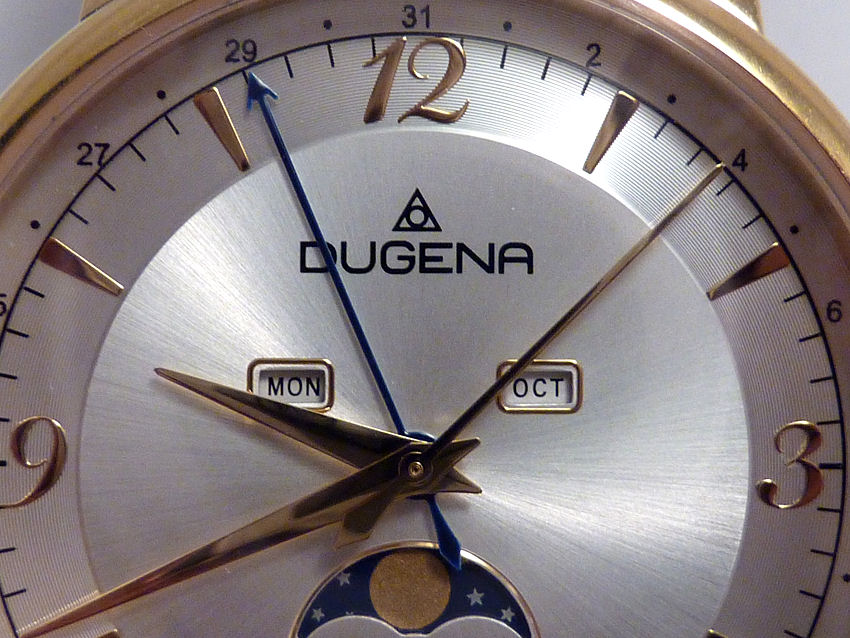
Anyway it was during this “changing the clock” business that I came across my lovely and elegant Dugena Triple Date Calendar Moonphase. And OK I’ve posted much of this information in a previous post, way back in March 2009, but I felt I had to feature it again and as I thought I’d have trouble setting it, I might have to feature an instructional post.
Dugena Moonphase
But no as fortunately I didn’t get round to altering the time until today. Could be a problem I thought as it also had not been worn for a few months and the date was out by some margin (I think it was at the 25th) plus the moon was nowhere in sight! BUT I say fortunate – as today is a full moon and this is SO useful when adjusting a Moonphase watch.
Moonphase close up – Dugena
So all I had to do was change the Moonphase to the top position and that was it really, then alter the date as the Day and the Month were still OK. I remember that this Dugena uses the Miyota 6P80 movement and as with quite a few of this series you have to be careful as to when you set anything. For example the Date can change anywhere between midnight and about 5.30am and can’t set the Date between 9pm and midnight and as for the month – well you can’t set it between the 26th and the 31st, or certainly not the quick set feature. So a tricky watch usually to remember what you’re doing, but fortunately this time not only did I have the original instruction booklet, but it was also a Full Moon – so easy!
Anyway at 10:30am this morning I pulled the crown out to the 1st position and clockwise turned the Moon to the top position, then in the same crown position turned it anti-clockwise to set the date pointer to the 29th. Pulling the crown out further to the 2nd position adjusted the hour and that was it! I didn’t set everything with the second hand at 12 however, as I simply don’t need to be that accurate. One of the side effects I think of now owning a One Hand watch (a very recent acquisition) which I hope to review in a future post.
The elegant Dugena Moonphase
For those unfamiliar with the name “Dugena” I repeat my old post information here – The watch Brand of DUGENA has its origin in the Union Horlogre, a coalition of Swiss watchmakers in 1900. Some 17 years later watch manufacturers Biel-Genf and Glashuette joined to form the Vereinigten Glashuette ALPINA, which quickly started producing in Germany under the name of “Alpina Deutsche Uhrmachergenossenschaft”.
In 1942 Berlin, Alpina was finally changed to DUGENA, and since then the triangle-in-circle logo has stood for watch manufacture of the highest standard in Germany.
I note that looking at the various Dugena models available today, whilst there are some very smart watches there, none appear to match the sheer elegance of this model with it’s sleek and rounded case and Moonphase. Such a real pity as it is a really beautiful watch and one of my very favourite Quartz dress watches.
When I first started collecting I wanted a watch that was absolutely accurate and to the second – so a Radio Controlled one it had to be, then I got the mechanical bug and accuracy went out the window (well almost) and now I’m “estimating” with One Handed watches.
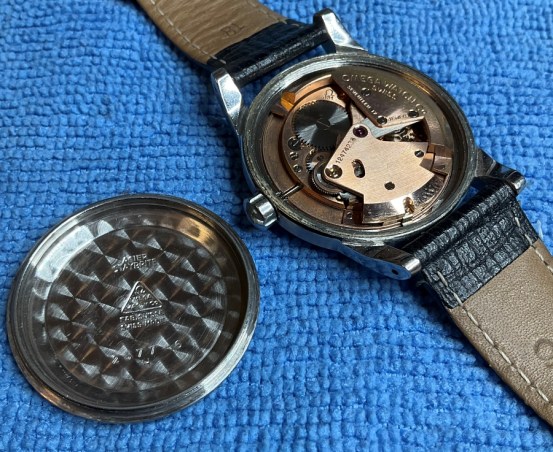
Delving into my vintage collection I came across one of my old favourites – the Omega Seamaster. This particular model according to serial number is the 1950 collection series steel version with sweep second hand.
Classic Omega Seamaster 2577-6 – Cal 351 – 17 jewel Auto
I particularly like this model as it is about as good pre-owned condition as it gets – The serial number dates it to the beginning of 1950 and it has a great condition Cal. 351 auto mechanical “Bumper” 17 jewel movement inside. This has an early bumper rotor with a fairly short range of perhaps 300 degrees as Omega originally designed. It has around 36 hours spring reserve which is pretty decent. It is matched nicely by the classic detail of the outside.
Omega Cal 351 model 2577-6 17 jewel Automatic Seamaster circa 1950
It has a wonderful dial face with applied dagger batons and numerals. I note it has the original luminous ‘Radium’ dots applied to the markers (not the numbers). The hands are also still ‘Radium’ filled and and unusually (I’ve not seen one before) and amazingly the luminous infill hands, apart from being intact, are actually still visible in total darkness and this from a 74 years old watch
Then there is the sweep red coloured second hand with arrowhead pointer. Very unusual, but in closeup looks absolutely of the time – I find that just so cool!
The naturally aged patina of the dial itself gives it a nice 2-tone pan effect owing to the dial curvature and if you look closely you can see in the centre, the Omega logo directly embossed logo on to the original Hesalite crystal directly above the hand pivots (Hesalite initially named and used back in the 1940’s by Omega – which is basically an acrylic, so fairly soft but shatter proof – note there are no scratches on this one).
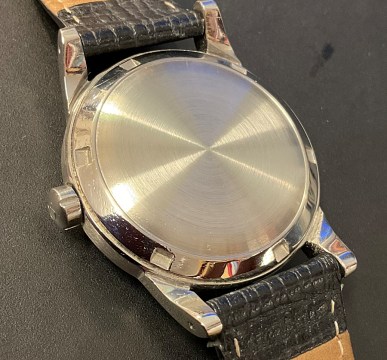
The case is stainless steel and in very good condition and the back is a very clean screw down original back.
The crown is original with Logo and the leather strap a standard Omega 18mm fitting, which completes the whole thing.
Dimension wise it’s just 35mm diameter and 42mm lug to lug, so a compact size for today and of course – there are many versions of the 2577 series and always good value as they are a quality and classic watch. Just shop around for the best quality and finish you can get and you won’t go far wrong.
In short, this is an absolute classic early model Seamaster and as it’s still in good original condition I am pretty pleased to own it. For me it is a true collectors choice.
My “Single Handed” watch model choice (well this week anyway!) would have to be the MeisterSinger Perigraph, which I think embodies the best of the Modern and the Classic. A most elegant steel cased Single Handed Date Watch.
MeisterSinger Perigraph
Whilst the rest of the affordable Single and One Hand 24hr offerings appear to offer a more modernist approach, the MeisterSinger has that classical look, that as a watch collector I just love. What I call a “proper watch” and one that I can wear both for everyday and for evening wear – in essence a rather refined, under-stated and elegant watch.
Two sizes are available, 43mm and my personal preference this 38mm model, with it’s slightly old world Ivory coloured dial face and with the neatl date ring complication (the Date Perigraph) is about as refined as you can get. It is also a really Traditional time piece sporting a good mechanical Automatic movement – the Swiss Sellita SW200 (similar and as good in my opinion as the ETA calibre). With a 48hr power reserve, a full 50m Water resistance, scratch resistant Sapphire Crystal and the very precise 144 markers denoting 5 minute intervals on the outer chapter, it’s a cracking watch.
The date ring is very clear, the days nicely figured and the single hand is blued steel – showing excellent contrast and no worries reading this watch. When the date changes it makes a nice satisfying click as it moves to the next day. The large and properly knurled crown, exhibition crystal back and decent leather strap completes what for me, so far, is my very favourite Single Handed watch.
However with reference to the previous post and the Botta series of more modernist watches, there are quite a few others on the scene – such as these shown below.
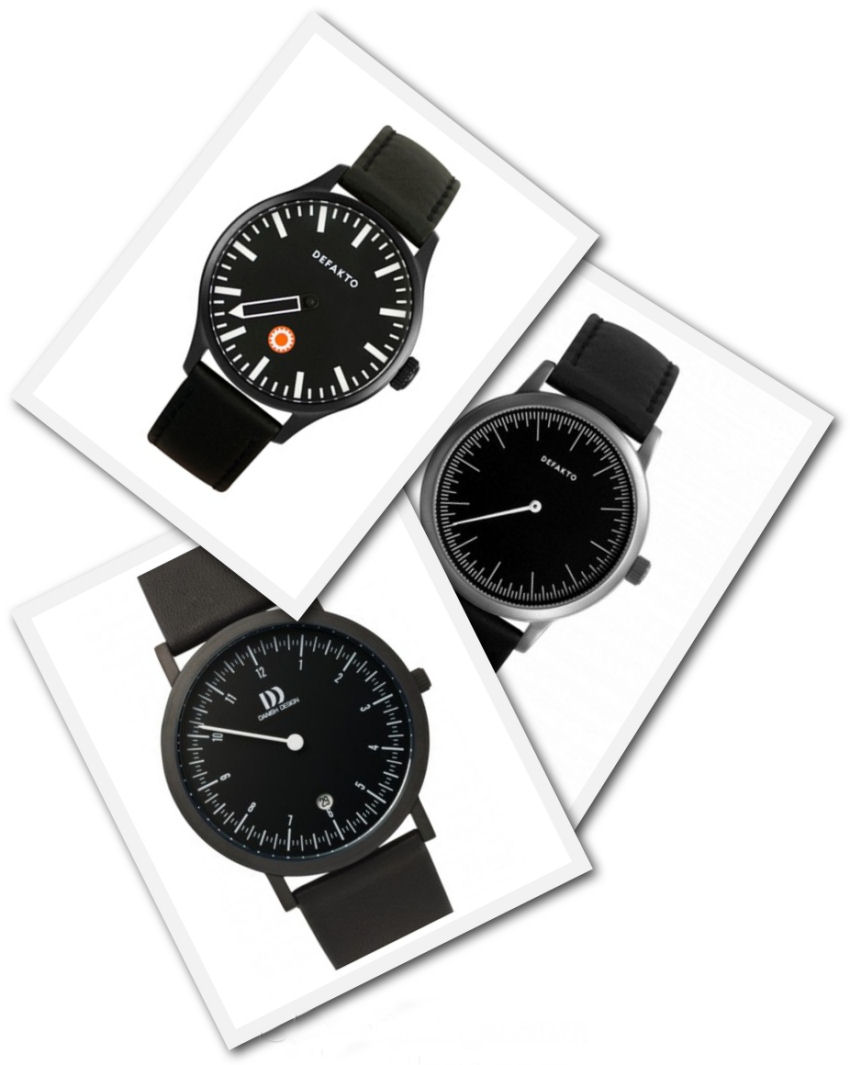
Defakto Uno, Detail & Danish Design – 24hr Single Hands
The models in the above montage are –
The Defakto Eins Automatic Swiss movement ETA 2824-2. At 42mm diameter Stainless PVD coated case, 9.8mm depth and 50m Water Resistance, Luminous hand and indexes with leather strap. With 15 minute indexing, but a little clunky for my personal taste. Note – this is Single Hand AND a 24hr watch.
The Defakto Detail model is a much finer affair with indexes at 5 minute intervals (short lines), 15minutes (medium lines) and Hour markers (the longest), which are very fine, so a high degree of accuracy is achieved in comparison to the Previous model. The case body carrying a Ronda Quartz 715 inside means the sizing is neater at only 6.6mm depth. A Sapphire crystal with an inner Anti-reflection coating completes the specification and I understand this is the latest model to come out of Pforzheim, in Germany. Note – this is Single Hand AND a 24hr watch.
Danish Design (DD) IQ19Q820 Black Titanium Mono – again Quartz powered but with a dial design very like the others with the addition of a date window @6. Also as neater and better dimensionally to the Defaktos at 37mm diameter and only 6mm depth – quite a nice performer. Again Note – this is a Single Hand 24hr watch.
Of these three examples I think I prefer the Danish Design quality look and feel and if in the market for one of the “modern” style 24hr models, I would be looking very seriously at the Botta Uno 24 or the Danish Design.
And of course there are a few more that are much more expensive, such as Pita, Stark, Schauer, Angular Momentum and my out of reach and very expensive – Jaquet Droz Grand Heure. But for now or until I win the lottery and at not too monstrous a price is the MeisterSinger Perigraph, which I think combines both the modern and the classic to perfection.
But really if honest and bearing in mind my budget, it has to be the MeisterSinger every time!
Having owned a Botta Argos for a few years I can confirm these are stylish and neat watches and ones which always draw comments when worn. So I thought I’d check out today’s models to see what’s available.
As always there’s an ulterior motive (watch collectors illness) as I’ve developed a sort of sneaking admiration for the One Handed watch and Botta have a range of models that are really attracting me. And one of the reasons for my interest is my fixation of “legibility” or “can I easily read the time on this thing!” – and in a perverse sort of way these One Handed watches would appear to provide a pretty neat solution – maybe.
Botta Uno 24 One Handed Watch – Black Special Edition
One of my favorites so far is this Uno 24 model – the Special Black Edition, which shows a very clear display indeed with the positioning of the 24hr clock as “the day” – in other words – the time can be seen as an entire day, at a glance.
The single hand completes just one complete rotation over 24hrs and the hand virtually replicates the position of the sun as it travels across the sky in a day – very intuitive actually when you think of it. In fact just a quick glance at the watch indicates roughly the time of day, how the day has flown by in fact and a visual take on how long to go before nightfall – instantly.
The dark lower half of the dial surface suggests evening approaching and night to follow and a very thin vertical line shows when one day changes to the next. As the 24hr hand passes that line at the very bottom of the dial, the date changes instantly to the new day exactly as it should.
This arrangement graphically shows the entire course of a day in analog form – pretty clever I think. And as to clarity, the very precise scaling and numerate markers used shows the time of day with amazing accuracy, certainly within 5 minutes and with a little familiarity you can bring that down virtually to the minute.
Being Botta Design of course the watch is a very neat affair, at 40mm diameter, easy to see but with only a tiny 7.5mm depth, means that the stainless case is still only 43g. The movement is the excellent Ronda Swiss 515.24 Quartz movement and the whole dial visible under a sapphire crystal. Water Resistance at 3 ATM and the complete assembly Made in Germany.
The price is around £250 to £350 bracket +vat in the UK and comes with bracelet or strap options. Not bad in my opinion for a Single Handed 24hr watch.
Now of course I’m in big trouble! I do like this watch the more I speak or write about it – I told you this might cost me money!
But there are others of course that use the more conventional dial arrangement, such as the Botta Solus (below) but for me at least just don’t have that wonderful graphical progress of your day of the Uno 24.
Botta Solus 24hr Watch
More conventional display as a 24hr watch the Solus is a Titanium cased watch, 39mm diameter and that slim profile again at 4.9mm depth. 23g weight this time courtesy of the Ti casing, a Ronda 1003 Swiss Quartz movement and plane Sapphire Crystal.
A big plus however must be the Super Luminova coated hand – something my own Botta nor the Uno have and make no mistake it is a big plus. BUT – that superb graphical, oh so clever dial of the Uno 24 attracts me so much, that I might just fore-go the luxury of waking in the middle of the night and being able to read the time on my wrist. I’ll just have to make use of the nice digital alarm bedside clock my wife bought me some years ago – and being honest? – I use it now anyway!










 The case is stainless steel and in very good condition and the back is a very clean screw down original back.


 Watch space
You must be logged in to post a comment.