A Russian watch from my vintage (2) collection (60’s to 90’s)
A gold plated Poljot “Signal” watch which is maybe from the early 1990’s (further inspection of movement could maybe pin it down more exactly).
Poljot "signal" Alarm watch
Manual wind 2812.1 18 jewel movement from the First Moscow Watch Factory (1MChZ, Kirova, Poljot) with alarm complication.
The hour & minute hands and winding is managed by the crown set @4 and the surprisingly loud mechanical alarm is both wound and set anti-clockwise with the upper crown.
Poljot Alarm - 18 jewels with alarm pointer
Gold plated case with stainless steel screw back with alarm off button inset into the base. The watch is 42mm lug to lug by 37mm width including the crown and 12mm depth. So quite a nice sized watch.
Overall condition is excellent, dial, crystal and plating are all really good and a few cosmetic scratches to the base near a small inset. Not shown here but this little stub contacts the end of the small anvil which is struck by the alarm striker.
Alarm sound post
The sound stub (as I call it) just comes through the case-back and assists in amplifying the sound. The alarm runs for maybe around 10-15 seconds before running down (it may manage longer but I haven’t wound it fully).
And it makes for a pretty loud alarm too (it also vibrates somewhat) – rather like a high pitched cell phone on silent ring and VERY practical (When I first got this watch I set it in the kitchen to try it and my wife heard it in the lounge next door!).
To set for a wake-up call – set the alarm the night before by pulling out the top crown – set the hour – wind it up then push in to set and that’s it.
I have to say it’s far better than most of the quartz alarm watches I have – as I frankly rarely hear the darned things with their little electronic beeps (maybe these are just for the young of hearing!)
I simply have to make a point about many of these older Russian watches in that they really are excellent quality movements and invariably keep very good time – as this one does and they are really not expensive.
Let’s face it – try finding a true mechanical alarm watch today at reasonable cost . . . . . . it is not easy!
The first image by the way shows it sporting a new Birkenstock leather strap which compliments it well and I think it looks pretty good.
There’s no doubt that I’ll be collecting a few more of these Soviet made timepieces – they are classics after all and you don’t see these designs too often. The “before the wall came down” ones are probably more collectable but all of them are certainly different.
A gold plated Dugena hand wound Swiss Made model with an unusual “sunburst” heavily textured dial with Louis XV hour and minute hands.
Shown here with a Hadley USA 12K Gold Filled expanding bracelet with an alternative (last image) open ended calf leather strap..
Dugena vintage gold
Very unusual too are the numeral markings with black infills and signed Swiss Made. All contained in a 20 micron (Geneva) stamped two tone textured gold case, which is a better gold thickness than many watches today.
The bezel holding the glass is satin finished and the rest high polished giving a different tone effect. The back is stainless steel and also marked Swiss Made.
The case also has very small sculpted lugs which has and requires curved spring pins.
Sunburst dial & "grandfather" hands
Unable to get an image of the movement at the moment as the case back is very well fitted and my old Bergeon won’t shift it (I assume it screws there being no slots or apertures visible to suggest press back).
Above shows the Hadley bracelet which I fitted to see how it looked ( and it looks pretty awesome to me!) and the last image shows it with a classic Condor calf leather strap (open ended this one as it had to be very thin at the end to fit the tiny space left around the curved spring bar).
Virtually NOS condition and I have to say it is really perfect. It is also a very neat watch to wear at 34mm dia and 7.5mm depth.
Timekeeping is really good at just seconds per day which is a nice surprise – so I’ll really have to see that movement sometime
I seem to be building a collection of Dugena watches and this is my oldest one to date.
This 1950/60’s model is signed as Swiss Made which is interesting to me as in 1927 (founded 1917) they relocated their manufacturing facilities from Switzerland to Germany. The name is in fact an acronym of (Deutsche Uhrenmacher-Genossenschaft Alpina) or German Watchmaker Association Alpina. Also the Dugena brand when it started life was a actually branch of the Swiss Alpina Watch company, though it became a separate brand later.
In 1948 they relocated again because they were in the east side of the Berlin wall and set up in west Germany at Darmstadt.
So confusing to say the least – but one thing is not confusing or even uncertain – they are fine watches.
A bit of an oldie here this time – another “vintage” watch for my collection and a first for me. A USSR made watch, rebadged in the 1960’s and sold as “Sekonda” – this was a company set up in 1966 by “Chasprom” the USSR watch industry central agency who’s remit was to sell their Russian made watches to a wider audience. And very successfully too…
USSR Sekonda
I bought this as I loved the simple elegance of the dial and the fact that it is a proper USSR marked vintage watch – ie. one that was manufactured before the “wall” came down and the old Soviet regime disappeared.
Now the first thing I should say is that I am no expert on USSR watches, but managed a little research – as one does when just having bought a new “old” watch.
This watch was advertised as 1950’s I seem to recall which maybe wasn’t quite right, as if I’m not mistaken the name “Sekonda” didn’t actually appear until much later when Sekonda was established as I said previously – in 1966 in the United Kingdom and supplied USSR made watches such as the Poljot, Raketa and others – but re-badged them as “Sekonda” to a wider world market.
Classic Sekonda (Raketa) movement
So I have to assume this watch is maybe 1966 or later ( mind you pre-1966 watch movements can be found in Sekonda named watches ). Possibly dependent on available movement stock at the time I suppose.
However after digging around I think this is a type 2609 or a 2609.1 – 17 jewel movement and most likely produced in the Petrodworzowy Factory in Russia. This movement and versions of it were used in Raketa, Sim, maybe Poljot and perhaps other Russian models of the period.
It is in very good almost perfect condition and numbered 70708 but no factory stamp that I can spot without dismantling it anyway. Maybe even assembled in the Masleunikower Watch Factory where often Petro’ factory marks were omitted and sent out as “clean” models.
So far I’m unable to confirm a date. The 2609 movement series seems to have had a long usage from the late ’50’s into the ’80’s. But as said USSR watches have never been my forte and no doubt someone with far greater knowledge than I will kindly let me know.
What is certain however is the quality – which is not an issue here! In the ’50’s to late 70’s period the USSR produced watches of real high quality. In fact there are excellent Russian watches around today that are amazing value for money.
As said I particularly like this model as it has nice thin black coloured high contrast hour & minute hands, plus a centre seconds and the dial is populated with numerals with a slight italic font, thus giving the watch a very simple and clean look. It also has to my mind that English “Smiths” look – simple, understated and elegant that I have to confess I particularly like in a vintage dress watch.
The case is gold plated (marked au 20 for 20 micron I assume) and is a classic and elegant style which eminently suits the period.
Neat crown/back recess
There are nice touches too that you notice after handling it for a bit – like where the round case is flattened on the edge between the lugs so that the strap fits easier to the watch and the fact that the case has a neatly sculpted projection under the crown giving both support and protection – but subtly – a neat touch.
I haven’t bought any Russian watches before though am well aware that there are very keen collectors out there and with very good reason – so maybe this is a start of something new for me ….. We’ll see…!
Note –1992 – End of Soviet Union, Chasprom disperses, privatisation of the Russian Watch Industry and Sekonda (UK) in 1993 abandoned Russian manufacturers and started to market all-Asian watch suppliers.
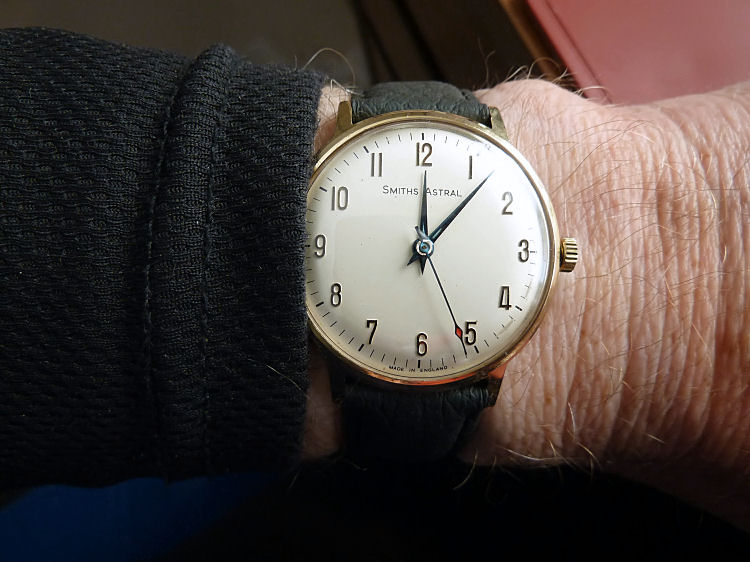
A simple and stylish English under-statement of timekeeping – a Smiths Astral gold plate Gents watch from the 1950’s.
Smiths Astral 17j
An elegant watch indeed and with “Made in England” below the 6 makes it a rarity these days. Produced by the Smiths Watch Company in the 1950’s it shows all the best attributes of English watchmaking.
Lovely blued steel hands on a virtually unmarked clear dial plus a red filled tip centre seconds hand and with neat raised numerals – it is quite simply – a classic.
Smiths 17 jewel lever movement with centre seconds
A neat Smiths 17 jewel hack shockproof lever movement is fitted underneath an unmarked well fitting press stainless steel back keeps this watch ticking along nicely.
Sometimes mistaken for a Jaeger LeCoultre movement, whilst it has some technical similarities it has nothing to do with that Company at all. This is a common misconception as the only link with that company was because Robert Lenoir, Smith’s Technical Director was an ex LeCoultre employee.
High quality models were manufactured at Cheltenham mostly whilst the lower market models were produced at Ystradgynlais in Wales in a joint venture with Ingersol. Usually noted by the dial inscription “Gt Britain” or “Made in Britain” – which is quite a useful way of identifying the origins of particular watch models.
Classic dial Smiths.
So it would appear that this particular model is not a product of the Anglo-Celtic Watch Co of Wales, but from the Smiths factory at Cheltenham.
The Astral model is perhaps not top of the range or as popular as the “everest” models, but I think does represent the classic elegance of a “Made in England” watch to perfection.
This particular movement is going as strong now as when it was new. This one is a manual wound version which feels nice and strong when wound and set. Perhaps a little wear in the hand setting I admit but easily sorted should this be necessary.
The watch is also a good size at 34mm diameter without crown and 39mm top to bottom with a strap size of 18mm and in consequence wears very well –
At 34mm diameter – a nice size for the wrist.
So another nice purchase for my “UK” – “Made in England” vintage collectors cabinet and this one will hold quite a decent position in that box.
Not a UK built or assembled watch with a Swiss movement, but an English watch built with an English movement too – and in reality a darned good one at that – so a bit unique in my opinion. AND as it happens this one is pretty much original and in superb condition – another plus.
I’m sure this one will receive quite a bit of wrist time which is always a good sign as my philosophy on watch collecting is simple – if I get it I must wear it – these watches are for wearing and every watch I own MUST work – that’s what they do best.
My next purchase though may be a little bit different. A choice of two really. One an early “electric” watch (around 1962) and the other a “direct read” watch from about the same era – a mechanical “digital” if you will and somewhat different from their more commonly seen “mystery dial” style.
I’m I’m looking forward to posting both here – so watch this space.
Came across this the other day – liked the look of it and it’s now in my “other watches” display box in my collection. A watch company that perhaps many here in the UK are not aware of but in India they are the largest watch manufacturer with over 7 million units sold every year! Exports to over 40 countries and the 6th largest watch producer in the world.
Quality time from India
Many of their range are Quartz models often with Citizen or other movements but they also produce their own in-house movements and mechanical models too.
This model first introduced in 1998 is called the “FasTrack” and features a French Quartz movement which surprised me and it also surprised me with the overall quality of build.
As can be seen this is a nice sized watch at 36mm diameter and just 7mm depth it sits neatly on the wrist. Nice contrasting white hour, minute and centre seconds hand (with that super red tip) read easily against the black and dark gray face.
Date window @4
A red edged circular date window @4 with black numbers against a white background is large enough to be seen easily. Odd sort of minute and second chapter numerals with the outer ring showing 5, 10 to 60 @12 and the inner ring showing 10, 20 to 120 @12 seems a bit odd, but doesn’t detract from telling the time, so is of little consequence.
The case is a nice dark finish stainless steel, good knurled definition crown and stainless solid back look good. The watch also features a 50m Water Resistance indicated on the case back.
All in all a very clear watch to read which is always a bonus in a watch as neatly proportioned as this one.
The strap is a reasonably good black stitched leather one and for my smallish 170mm wrist is just about the perfect length, though may be a little short for some larger folk. It is 8 inches long and wide enough for comfort at 18mm width.
Solid performer, solid crown
This model came from “overstock.com” and comes with a 1 year Dealer Limited Warranty, though the Titan Guarantee is in the box and is 2 years so it looks as if they stand by their product which gives you confidence in their quality expectations.
Price-wise this watch is very affordable and you get a decent quality – albeit perhaps not a “current” range Titan model but nevertheless a good buy in my opinion.
Note– the lighting on the image opposite is a little brown looking – whilst the dial is sort of two tone it is really much darker than shown.The image above is nearer the colour.
Drawbacks? well there’s usually something – isn’t there?
In this case it is the annoying lack of luminousity – these lovely and clearly defined white hands and NO LUME!!!
This is a real shame as had it good luminous hands this watch would have been 5 star but the lack of it drops it to a 4 star – sad but true.
Perhaps a name to be considered when you’re looking for that new timepiece – IF the price is right. I say this as I’ve noticed that some of the current quartz models, certainly here in the UK are priced maybe just a bit on the high side (see the Indian prices!).
Talking of other models though – I think they have got a real winner in their “thinnest watch in the world” model, the “EDGE” – for what it is – it has to be good value even here in the UK. I mean the movement is only something like 1.5mm depth, which is amazing.
This “FasTrack” though is a nice, neat and well made product and if the “Edge” is as good or even better than this one – then it’s a winner – all the way.
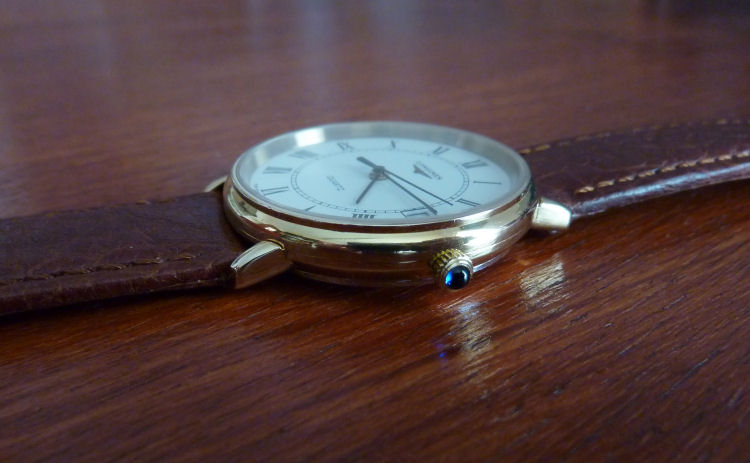
Another dress watch finds it’s way into my modern/vintage collection. This time a neat gents Longines 20 micron Gold plated Quartz model of 1983. The model has changed since and I have to admit I find this one infinitely nicer on the eye.
Longines gents Quartz Gold "Presence" model
I particularly like this version as it has the larger date window @3 whereas the more modern versions the date window is much smaller, though the case is still a lovely sleek and slim shape.
Lovely Cabouchon crown
I picked up this pre-owned watch recently and very pleased too as it has very little wear. An almost perfect unmarked white dial and a nice color contrasting blue Cabochon inset to the crown. Stainless steel back again virtually unmarked.
A great feature of many Longines watches is the movement which here is a top quality Swiss ETA/ESA 7 Jewel quartz , so it is a superb timekeeper.
It came with a black padded leather strap which I personally thought did not do the watch justice – I find so many of the older watches to my mind are better suited to a non-padded flat strap and so I fitted this rather nice high quality flat brown leather stitched strap.
On the wrist - perfect
I think it lifts the watch to another level (a bit like the painting with a decent frame – it can make all the difference).
On the wrist it looks very elegant which is a nice complimentary description to any Longines watch and is a delight.
The dimensions are almost unisex today at 34mm diameter ex crown and 37mm lug to lug so would also suit a lady (the Longines ladies watches are considerably smaller). It is also a very clear watch to “read the time” with the slim black hands and center seconds against the white dial face. The date window being quite large is also very helpful in this respect.
This watch I think confirms my personal opinion that pre-owned watches are so often a much better buy than many a “new” watch. They are usually better value more often than not and also for me they represent a “style” and elegance that seems to have been lost today. Note – I say value – as this watch cost barely a third of the new version – and – it’s more elegant – far easier to read and is virtually as new condition.
What could be better?
——————————————————————————————————————————————
Note – Have you seen the “watch of the week”? – and my new “For Sale” tab – check them out………….top of page.
This week for a change I feature a rather interesting Seiko quartz watch from the ’80’s. The Seiko AGS or Automatic Generating System Model 7M22-6A40 gents watch first appeared in 1988 and was an early automatic quartz forerunner of what’s better known now as the “Kinetic” series. It was first pioneered by Seiko in 1986 as AGM and further altered to AGS when this watch came out.
Early Seiko Automatic Generating System watch
This 1988 April version has a nice white dial with Roman numerals, black coated hour and minute hands with a central gold coloured seconds sweep. A date window – black against white @6 completes the neat easily read dial and a good “Hardlex” crystal to the front. The date features a quick set on the first click of the crown. Finished in satin gold plate with matching gold coloured bracelet it looks very neat indeed. The bracelet which is very smooth to wear can accommodate up to around a 7.75″ wrist.
Seiko AGS 1988
This particular watch shown here was a brand new Old Stock model when I got it recently and has been in storage lying dormant for over 20 years and is in absolute pristine as new condition.
So how does it work?
It works using a rotating pendulum rotor in similar fashion to the rotor in a mechanical automatic watch which is attached to a larger gear which meshes with a very small pinion. It operates on the wrist movement of the wearer and rotates via a 1/100 gearing pinion, transferring energy to a power-generator at high speed to produce an electrical current which in turn charges a capacitor (KESU) which in turn feeds the time circuits. Being one of the earliest models with a 3029110 power capacitor the full charge might last maybe 3 days or 75 hours – however, full charge takes about 800 swings of the rotor, so really has to be worn a lot to get the best capacity reserve out of it.
A feature of this early model is that the second hand operates in 2 second jumps, if the power reserve capacity drops to around 3 hours. Now, as it can take a considerable wear time and wrist movement to build up a sufficient charge, it can sometimes seem as if 2 second jumps are normal! In fact I know of a few owners who thought that was normal!
All is not lost however, as in 1990 owing to charging issues with the older capacitors, they were replaced by the newer 3023 24R capacitor (KESU) module which dramatically improved both the reliability and allowed a whopping 90 days on full charge – much better – and the 2 second warning was not in evidence.
This particular model features a 5 jewel all metal 7M22A movement, which is all metal and before plastic parts is actually better than some modern watches.
The dimension of this watch is very compact for an AGS or Kinetic watch and measures 40mm top to bottom and side to side (without crown) just 35mm. Back to front is just 9.5mm and with a 28mm diameter crystal. Quite neat and unobtrusive and quite dressy and I have to say it looks very good on the wrist.
AGS 7M22A 5 jewel movement
In this image you can see both the rotor and the capacitor, which is a Panasonic MT920 (2.4v) at the left. The watch serial number follows the Seiko numbering system with first digit 8 denoting 1998 and the 4 for April. The next 4 digits represent the model number in that month. Quite useful to see such an unusual and Seiko historic movement mechanism and note the cal. number etc. You can also hear the rotor operating though once against the wrist it’s almost inaudible.
So an unusual model and factually a milestone in Seiko watch terms. This one is in fantastic condition even after just over 20 years since it first came out.
I suppose if I was honest that capacity charging efficiency was low with this original concept. In fact the 2 second jumps can appear all too easily, especially if you take the watch off at night, or if you wear your watches in rotation and leave it in the watch display box for a month. It just takes far too long to get it up and running at full tick, as it were.
But it CAN be changed and upgraded fairly easily and I have the newer replacement capacitor ready to fit.
Anyway not withstanding the above – it’s still an intriguing and to my mind, a historically significant watch and a nice addition to my collection.
February 2015 – update – I changed the capacitor. (however, after 10 years I replaced it as it barely functioned).
So, today I have updated and edited the previous report as follows –
June 18th 2025 – I have just now replaced the power unit with a new 3023 24R which is a direct fit.
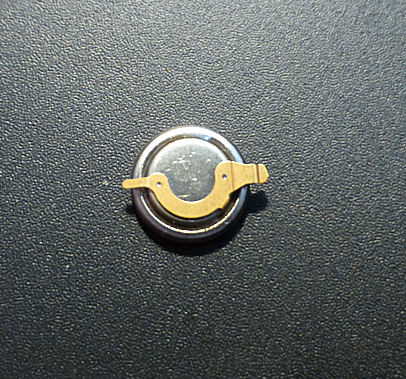
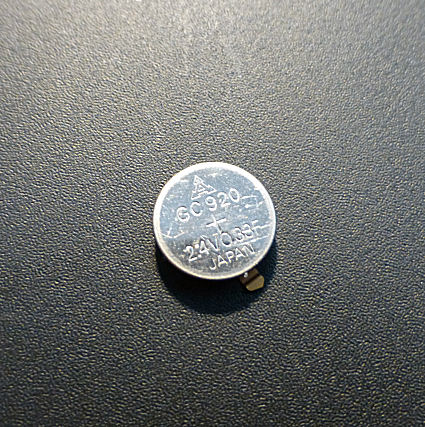
Note how the original capacitor “appears” smaller than the replacement.
Note, it’s a bit misleading when you look at the previously installed capacitor via the exhibition glass back, as the visible top part (negative) of the capacitor is of smaller diameter than the positive side (see image).
Important note – when removing the new capacitor from it’s small blister pack, do not touch it with your fingers, either use nitrile gloves or similar or plastic tweezers. Also don’t be tempted to check it with a voltmeter as this could cause issues.
Anyway, my procedure – I removed the screw case back. Once inside, you can optionally removed the rotor for easier access, or continue as I have without. I found last time it was possible and I’m always wary when re-tightening any rotor screw.
The capacitor is recessed and before you can take it out you have to remove two small screws holding the top plate surround. Using tweezers take off the top plate and underneath there is a small brown insulator gasket. Carefully lift it off from it’s tiny locating points. Take note – don’t pull it, as it is located under the spot welded yellow metal capacitor plate on the left side, but above the wider plate on the right.
However, as I always do, prior to working on it, I take close up pictures of the whole thing in situ, so I can refer to them if I get the orientation wrong.
Note – the gasket sits under the left of the yellow plate and sits on top at the right. Always take photos before to assist in re-assembly.
Fitting the new one is the reverse of the process and once all done up again, in my case, it immediately started. With full tick. Once fully charged it should get at least 30 days and perhaps 60 days as the 90 days quoted may be over optimistic.
(NOTE – if you have removed the rotor, do make sure you screw the rotor back carefully – tight enough to hold, but not too tight – if slack, the rotor is ineffective).
The original capacitor for the AGS.
AGS is called Kinetics now and the science has moved on somewhat since 1986 and whilst Seiko had a Kinetic collection, this was ended in 2020.
However, I believe kinetic might still be available in their Premier range, though I have heard that as of May this year 2025, these may also be discontinued.
It seems that Spring Drive has replaced the whole kinetic idea – check Seiko main web site for details.
You see that’s the trouble with deciding that “this” is the watch for you – or maybe “that’s” the watch…! It’s all about choices and maybe finding a watch you’d never seen before – then your fixed ideas can go right out the window!
Take this one for example –
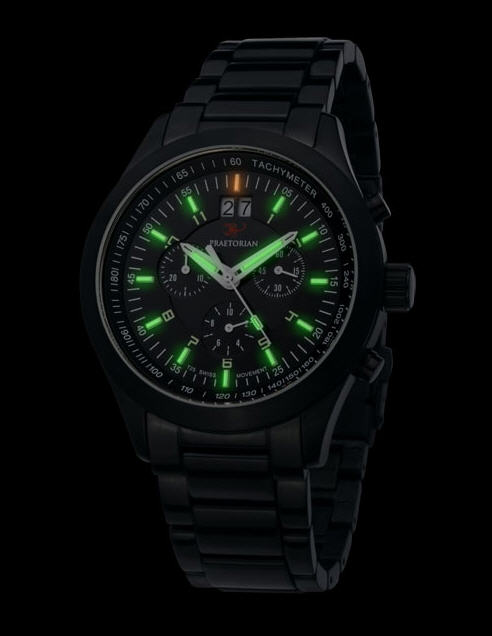
Praetorian Swiss chrono
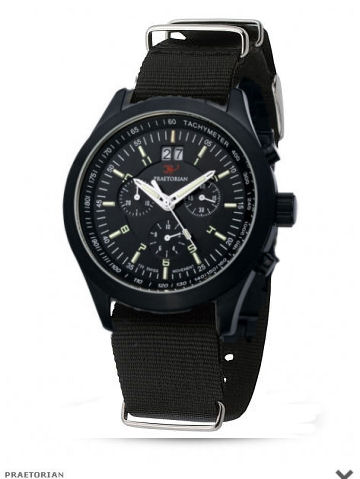
A Praetorian “Centurian”. A 44mm diameter black PVD coated stainless cased Swiss quartz Ronda-Startech 5040B chrono movement, with screw down crown and case back and 100m water resistance. The matching double locking bracelet is also PVD coated stainless and 22mm wide.
Great looking watch and with my favourite Swiss mb-mirotec Tritium illumination again giving super night vision. 12 marker is orange and the 11 others green as are the hour, minute and second hands.
Unusual too in this style of watch is the large double window date @12 making for very clear readability. And yes this is a chrono so has two extra pushers on the side and yes I know I said in my previous post that I didn’t need these – well – they seem to fit rather well on this model and are actually quite unobtrusive. What can I say?
The clear mineral glass is scratch resistant and the watch has a case diameter without crown of 44mm and only 12mm depth, which is pretty neat for a chrono such as this.
The chronograph functions are the central stop seconds hand, “3” second, “6” 1/10th second, “9” minute/hours after 30 seconds.
Tritium illuminated by Swiss Made mb-mirotecMagic of computer – Nato strap fitted
Image left –
Shows the tritium light system in action in a night shot
Image right
Shows magic of computers as I fit a Nato strap in place of the bracelet just to see how it will look.
So a new find for me and a watch I have never encountered before – and I like it!
In fact I like everything about it.
The dial has a nice clear and clean look to it, especially considering the superb double date window (which is a real plus I have to say) – it’s a good gents size without being too thick and cumbersome as so many often are.
Then it has that wonderful night vision capability with the Tritium light source, which I kid you not you really have to experience in comparison with the alternative “paint coated” systems – then to cap it all is the price – it is NOT very expensive.
So yet another one to add to my consideration list – which is growing by the minute – yet again!
Whilst I have quite a number of military watches, it is as you collect over the years that you see what you really want in a watch as opposed to thinking about what you might want. There is a difference!
For military I already have the multi-bezel 12 hour and 24 hour registers, the oversize crown guards and odd coloured dials, chronos and the like. So looking for something simpler but not simplistic (I already have both Nato and Mil spec watches) is actually not as simple as it sounds.
I would prefer no bezel (or if one must it should be relatively unobtrusive) and I like a single crown. It also must be strap changeable or in other words I don’t want a rubber/textile “special” affair that only fits that watch. And I must be able to see it at night.
Here’s one that comes to mind –
Swiss military Watch "Millicurie PVD"
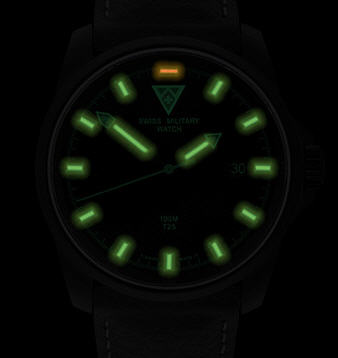
This is the Swiss Military Watch company’s “Millicurie ” pvd coated stainless model. Complete with my favourite H3 technology light source lume – which is simply unbeatable.
The hands and numerals are Tritium tubes – orange for the 12 and green for the numerals and the hour & minute hands.
Slightly odd this one in that the hand tips also have Super-Luminova infills – though I can’t quite see the benefit of this when the hands themselves are Tritium tubed.
Note the image taken in the dark – whilst the Tritium hands and numerals glow brightly, the tips are pretty faint in comparison. What this does show however is the superiority of the self illuminating Tritium system as opposed to the ambient light charged Luminova coating. And this is especially noticeable if like me you wear your watch under your sleeves most of the day – the luminova will never see any light – and therefore will not glow too well.
The rest of the watch features are pretty good – a Swiss Ronda Quartz movement, red centre seconds and date@3. Nice clear black face, no distracting bezels, 100m water resistance with double O ringed crown. It’s also a nice size at a medium 40mm dia and 13mm depth, so not a monster. A 22mm strap completes the ensemble which is a nice “mans’ size and looks good on the wrist.
A 2 year guarantee on the watch and a 10 year guarantee on the “unchanged optical readability” of the H3 Trigalite illumination system.
All in all not a bad offering at all and it’s not expensive at around €180 (Euros) or $240.
H3 illumination
Image 2 Shows the H3 Tritium light source lume used on this model. Note the Orange horizontal marker @12makes for excellent readability.
——————————————————————–
So any negatives?
Well the date maybe could be larger or clearer and the Luminova hand tips a bit of a waste of time, though in fairness the arrow heads are quite clear during the day against the black face so OK I’ll accept that.
But the positives outweight the negatives by a long way – so it’s definitely under consideration.
Note – Check out “Watch of the week” above in the tabbed header.
Seems to me that looking over my watch collection “black dials box” I appear to have quite a few pilot and military style watches – and here is another one that’s due some wrist time.
AstroAvia Alarm Chronograph
This model comes from the value for money German manufacturer “AstroAvia” – the R70SL – there are quite a few models which are similar in general appearance though this is one of their alarm models.
Good solidly built watch with a reasonable quality and a well made case in satin finish stainless 316L steel. Dimensions wise it is 40mm diameter and 11mm height. Lug to lug is approx’ 47mm. The case back is a plain solid screw fit with an internal rubber seal and water resistant to 30m. The crystal is hardened mineral glass.
Interestingly it is supplied with both a stainless steel bracelet AND a padded leather strap which is a useful idea. And this is quite well thought out as the lug strap fixing pins have alternate positions on the lugs to accommodate the two different systems and you certainly don’t see that very often! However being particular about straps and so on I replaced the strap with a Birkenstock Alligator pattern Calf leather and white stitching – as the image above.
Supplied with stainless bracelet AND a leather strap!
This model is Quartz and is powered by the very reliable Japanese Miyota cal OS8O chronograph movement and features 1/20sec timing – an alarm – and an analogue date window @3. Really quite comprehensive for a watch of this price.
The chronograph function displays a 12 hr dial, a 59 min sub-dial and a 59 sec counter and a 1/20 sec sub-dial indicator each sporting a red colored hand.
The dial face is matt black with white markers and numerals and the luminosity is handled by green “Superluminova” coatings. I have to suppose that this “lube paint” is probably the best there is around and it should compliment this clear dial design – though for proper night use “Tritium” would have been my choice, but that’s just a personal thing.
The Alarm feature is simply set unlike some watches firstly by setting the alarm pointer – by pulling out the crown to the first position and turning clockwise to move the pointer to the desired time, then push the crown back in. Next using the small crown control on the opposite side of the watch – pull it out to set the alarm ON – pretty simple. Note there is a small alarm pointer indicator on the dial face to confirm the alarm status. I had a concern the alarm crown control might get pushed back in with movement of the wrist – though I have to confess its never happened yet, so no worries after all. The Alarm indicator hand is red colored with luminous infill at the pointer end which is very clear.
The alarm sounds for 15 seconds, stops for 2 min 45 secs then sounds again for 15 secs etc. which it does several times after that.
Good clear dial considering the functions available.
The date adjusts like most watches as indeed do the hands setting and so on, so pretty conventional.
The battery is a SR927W or equivalent Renata 399 and there’s also another feature of the Miyota movement where if after a battery replacement or if the hands for any reason get out of synch with each other, there is a chronograph reset function which resets and zeros the hands.
So all in all a pretty good and reliable watch at a very affordable price – around 180 Euros or so and you can see them by using Google search and typing in AstroAvia for the latest data. In fact the whole range of AstroAvia watches represent good value and certainly worth having a look at the range available.
So any down sides?
Well not really – you get a great watch for the money – a good alarm that’s easy to set – a working 1/20 sec chronograph, a watch that keeps pretty good time and with a very reliable Miyota movement. A spare strap and a bracelet included it’s hard to beat.











 Watch space
You must be logged in to post a comment.