ELKA vintage

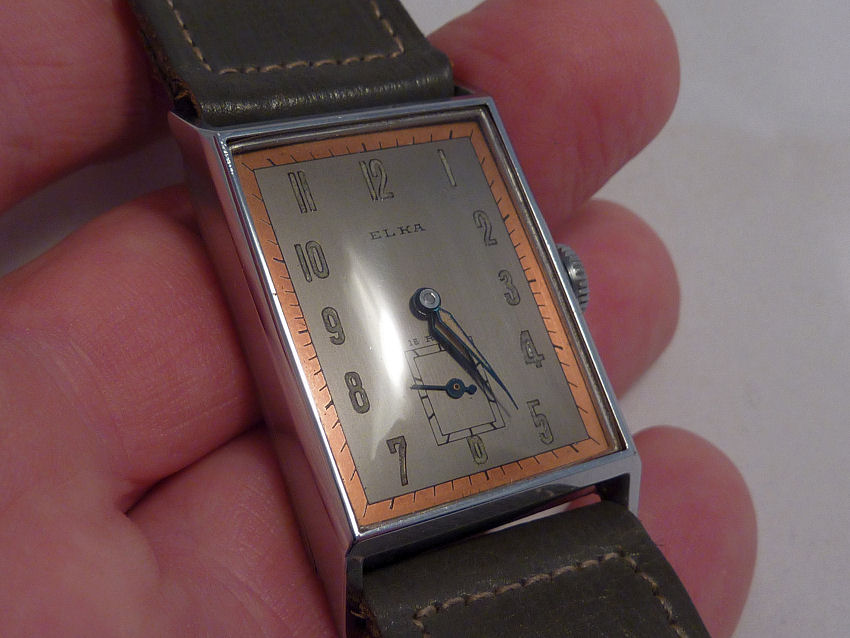
Spotted this the other day and liked the wonderful Art Deco style and thought it might fit well in my “uncommon” watches collection.  A distinctive dial and great condition equals this ELKA 1930’s vintage watch from Amsterdam.

Elka copper dial

This Art Deco gents watch c.1930s has a chrome plated bezel with stainless steel back and is in pristine condition.  Lovely two tone khaki green/ copper dial with striking blue steel lumed hands.  The overall condition is quite excellent with only slight and even mellowing of the face – the two tone color dial is quite striking in the right light.

Inside is a 16J manual wind movement which in superb order.  I haven’t examined it too carefully, but it looks as if it could be an AS Schild movement.  ELKA stands for Eduard Louis Kiek Amsterdam, a Dutch jeweler house from Amsterdam and they were often known to use  generic Schild movements in many of their in-house watches.  The case is chrome plated with a clean stainless steel back, fixed lugs and it measures 36 mm long and 30 mm width excluding crown.  A bonus here is that this watch is a good size for it’s day, as many models from that era were much smaller, so a great watch to wear today.  There is an off green soft leather 21/22mm strap attached to the fixed lug arrangement which suits it nicely.

Copper two tone dial ELKA vintage watch
Slim profile
Pristine movement - excellent time keeper

Very pleased with this new item as it’s that bit different – is nice quality in very good condition and it wears well on the wrist.  Not in the same price league or quality perhaps as the previous purchase, but I like it because it IS that bit unusual and is in such good condition – great for my collection and one that will be worn on quite a few occasions, I have no doubt.

Jaeger LeCoultre vintage

A great era for watches of distinction for me is the 1945 to 1955 period when some of the most wonderful dress watches appeared.  Moving away from the rectangular ’30’s and ’40’s styles towards the round case watches that are probably still the most common today.  Here is a beauty – a solid 18ct Rose Gold Jaeger leCoultre from around 1949-1952 era in perfect condition.

Jaeger LeCoultre 18ct Rose Gold vintage dress watch

This watch has an oyster colored dial with applied gold markers, with an inner ring showing Arabic numbers at 3, 9 and 12, with gold dagger hands, sub second dial and an acrylic glass.  The case is hallmarked on the lugs as 18ct gold and the watch is 34mm diameter (35mm with crown), so a most sensible size in amongst the oversize stuff that seems to be around these days and very wearable.

The back is unmarked and pristine and the watch is fitted to an alligator leather strap and is in about as perfect condition as any pre-owned vintage watch I’ve seen and a worthy addition to my vintage collection.  I have two vintage collections actually – the first comprises items I may pick up at local auctions or fairs, hopefully at low prices and mostly are simple vintage pieces and where the maker does not influence me greatly, but for whatever reason they take my fancy, though obviously I look for reasonably good examples.  The second collection however is for more collectable pieces and of higher quality basically, and here Jaeger LeCoultre certainly fits this category.

Additional images –

Clean back – no inscriptions
Classic Jaeger LeCoultre dress vintage

The problem with my second vintage collection is of course – the cost!  Invariably it means that I have to sell some of the lesser ones to afford to stock my more upmarket display, but that’s life I suppose and part of the fun of collecting.  You get what you can afford at the time and at other times you build up the modest collection as a bank – to be used later when the “must have” item comes along –  and it keeps the watches moving on and gives others the chance to enjoy them for a while.
I’ll post as and when – I have the time!

Xemex XE 5000

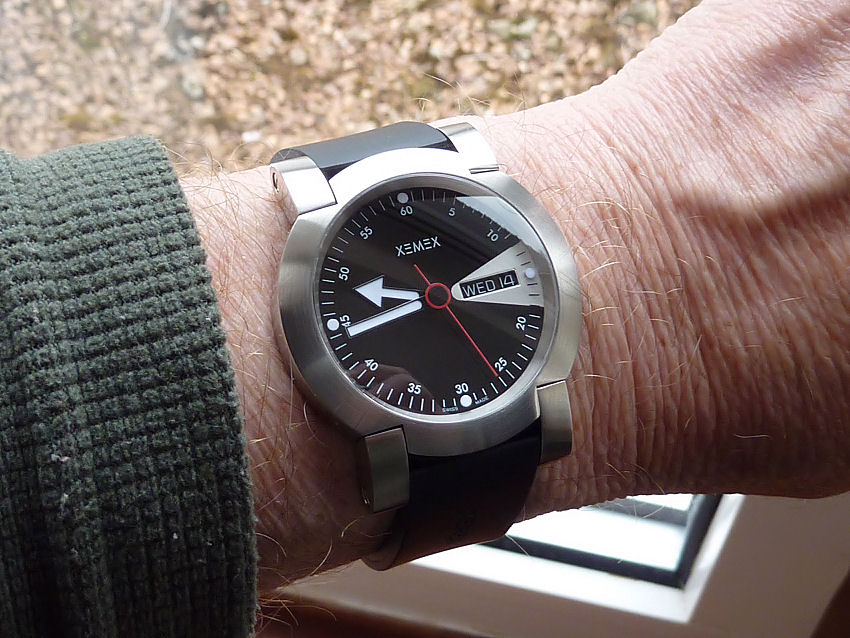
A new addition to my Modern Collection is this neatly designed Swiss made Xemex XE 5000, which I have been looking at for some time as it meets the most important criteria I require for an everyday watch.

Beautifully simple design, large clear hands with lume infill, day and date with great dial contrast and excellent readability – and with the bonus of articulated lugs can fit my smallish 170mm wrist perfectly.

Xemex XE5000

Designed by Ruedi Kulling, this watch simply shouts “design” and whilst initially looking minimalist, is in fact very practical and to my mind pretty good looking too.  At 40mm diameter and 12mm depth it is not a large watch by any means, though the beautifully polished and satin fished case plus the heavy lugs with the large bracelet screws, makes it look much larger that it actually is.
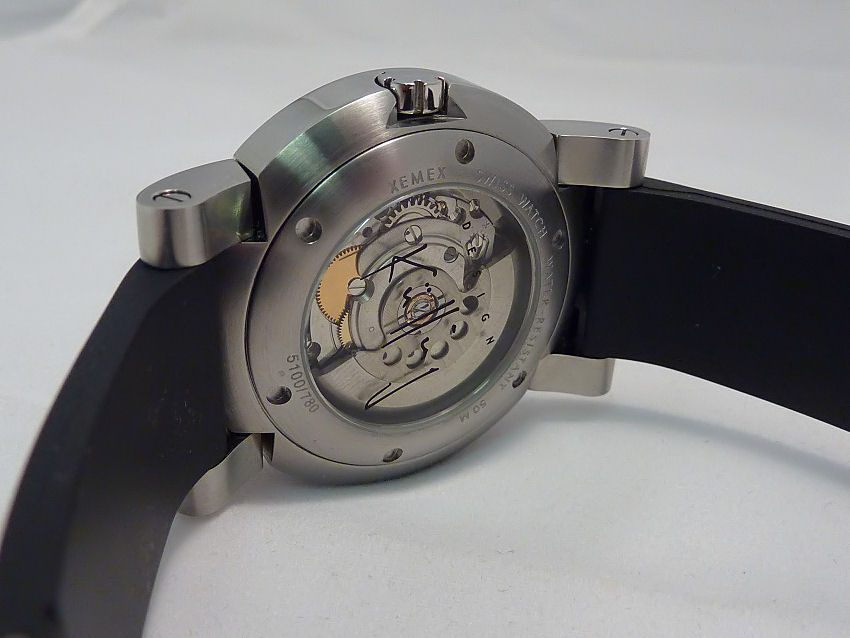
With the solid stainless steel (316l) crystal screw down back with crystal exhibition window inset it is rated as 50m water resistance, assisted by the side screw down and recessed crown – a neat feature allowing the watch to have a very clean profile indeed.

On the wrist too is manages to fit even a small wrist with the movable lugs contributing to the over all “fit” of this watch very well and coupled with the high quality rubber butterfly bracelet, which is adjustable.  I say adjustable as like many straps of this design it requires cutting to shorten if wrists are small.  Not an issue in itself but if selling the watch on at any time, this is a pity for large wrists as a new strap will have to be acquired.

Perfect fit – automatic Day Date Xemex 5100.03 model
ETA 2836-2 with modified rotor

Note the well proven ETA 2836-2 Swiss movement which has a Xemex modified drilled rotor.  Interestingly the watch is signed by the designer “inside” the exhibition glass back.

The movement appears to keep OK time (perhaps a little fast on first usage I have to say) and generally in keeping with this movement though whether the drilled rotor improves accuracy is rather debatable – and the spring reserve is as expected at about 42 hours.

As to the dial – it is an excellent contrasting arrangement with luminous hands and markers and the typical Xemex trademark red sweep second hand.  The day and date are @3 and highlighted in white and is clear to read.  Over the dial is a curved sapphire crystal glass.

This particular design XE5000 was a winner at the “Golden Balance Wheel” awards in 2006 and is still currently available at a reasonable price inclusive of a 2 year Guarantee.

My final verdict on this watch is that it’s a fairly well priced “mid range” model, a little different from the mainstream, well made within this price bracket and actually quite similar in quality to the Traser model I own.  It is excellent to read, clarity being a strong point of the dial design, the rotor movement is relatively quiet and it’s comfortable to wear.

It’s also not been off my wrist for about the last fortnight, so I must like it. . . .as a daily beater at any rate.

Benrus vintage

Been to the auctions again after a long spell out of action and picked up a vintage Benrus sculptured case model in 14c Rolled Gold plate.
Always difficult to date these though by the styling alone could be mid 1940 to 1950 period.

Benrus 17j curved back - circa 1945-50

Benrus started off in 1921 in New York and the name was conjured up by one of the founders Benjamin Lazrus using the BEN and the RUS from his name. The other family members were Oscar and Ralph and were Romanian immigrants who set up in New York to offer the new “wristwatch” for everyone and not just the well off.  I understand the trade mark was registered in Switzerland in 1923 and they imported movements and cased them in the USA.

This particular example is a manual wound model with applied gold colored Arabic numerals and a recessed seconds sub-dial @6.  The logo on the dial says “endurable” – other models were “citation” named after a racehorse I believe and the ladies watch called the “embraceable” (It was a one piece bracelet watch which slipped on the wrist).  The “Endurable” title may also refer to the shock protection feature that some of the Benrus models had but I would really be guessing here.  These days Benrus collectors tend to go for their more elaborate styles such as the “Dial-o-Rama”, but this is a nice example showing some early case shaping and fancy lugs which offered an added attraction.

Benrus 17j curved back mans watch fitted to a Radley 10ct bracelet
Showing the stainless steel curved back

The case is a signed USA Benrus manufacture and the movement is a Benrus signed model BA 4 as shown, which looks to me very like a Swiss ETA variety – it also keeps nigh on perfect time for a watch of this period, which is always a bonus.

Swiss made BA 4 Benrus (possible ETA) movement 17j original.

So maybe not the most exciting of watches, but a nice example of the period and the style of the Benrus name.  And their watch range must have been pretty popular as they were for a period the 3rd largest producer of watches in the USA and a very real threat to Hamilton at the time. I will be fitting a strap to it when I get hold of a 16mm brown leather one from my supplier in the near future.  I’ll post an image of at the end of the post when I get it.

Still not an awful lot known about the Company which is quite typical for watch suppliers and manufacturers at this time, but to see these watches appearing every so often in auctions and so on makes me smile.  I mean what sort of items will you see made today that will still be around some 60+ years from now?

Not many I’ll bet!

NOTE – For the known history of the Benrus Watch Co. I can do no better than to point you to “The Watch Guy” web site, where he has an
excellent history of Benrus – CLICK – HERE

Fitted Di-Modell leather strap 16mm


Longines 1982 homage

This is a rather elegant dress Longines Quartz Watch and stamped “Longines 150” on the back of the case.  This model produced in 1982 the year of the 150th centenary of the Company which originated in 1832 and in homage to their earlier range of mechanical watches of the 1940’s and 1950’s.  It features the L976-2 13 jewel quartz movement, one of the 970 caliber series, which were of true in-house manufacture.

Longines Quartz 150 years Centenary Watch

It is one of the thinnest at only 1.95mm depth and I understand the philosophy follows on from their earlier 1979 “gold feather” 1.98mm quartz movement which Longines initially manufactured in partnership with Ebauche ETA/ETA.
It is as I have already noticed an exceptionally accurate and high quality Quartz and quite rare I understand to find one that’s frankly as good as this today early 30 years later.

L976.2 Longines movement (1.95mm depth)

It appears to have a Lavet-type motor and is powered by a 1.55v battery.  Not tested it but looks as if it may be 9ct gold plated on stainless steel case body and is fitted with a high quality Hirsch genuine Lizard strap with the gold plated Longines Logo engraved buckle.

The dial is gold colored with subtle vertical strips in the centre section with black painted Roman numerals and a square inset second sub-dial @6. Hour, minute and second hands are black steel.  Main dial has an outer minute track and the seconds sub-dial has seconds track with numerals at 10 second numerals.

1.95mm movement & slim case

One of the nicest early Longines Quartz watches I’ve had to date, which I picked up recently at an auction for a very reasonable price indeed.  It will sit nicely in my Longines collection which is growing with the odd model every month or so.  With a few celebrations coming up soon and dinners out a few times this one will definitely be a front runner as my dress watch on these occasions.  I love it

Perfect dress watch – Longines

Any downsides to this watch?  Well none as it happens apart from quite a bit of dust and rubbish inside the dial, which I have yet to clean, the watch is in pretty much perfect condition, plating excellent, no bad marks or scratches, just general wear over the last 30 years.  The watch obviously has been worn quite a bit as the back is wonderfully smooth stainless steel and fortunately the previous owner obviously had great respect for his little Longines and looked after it very well indeed.

As indeed will I. . . .

Raymond Weil retro Quartz

Picked this up at an auction recently simply as I rather liked the retro styling.  I hadn’t seen this one in the current range and for me it evokes an earlier age with the sculpted lugs and the neat checkered dial pattern.

Gold plated retro Raymond Weil in quartz

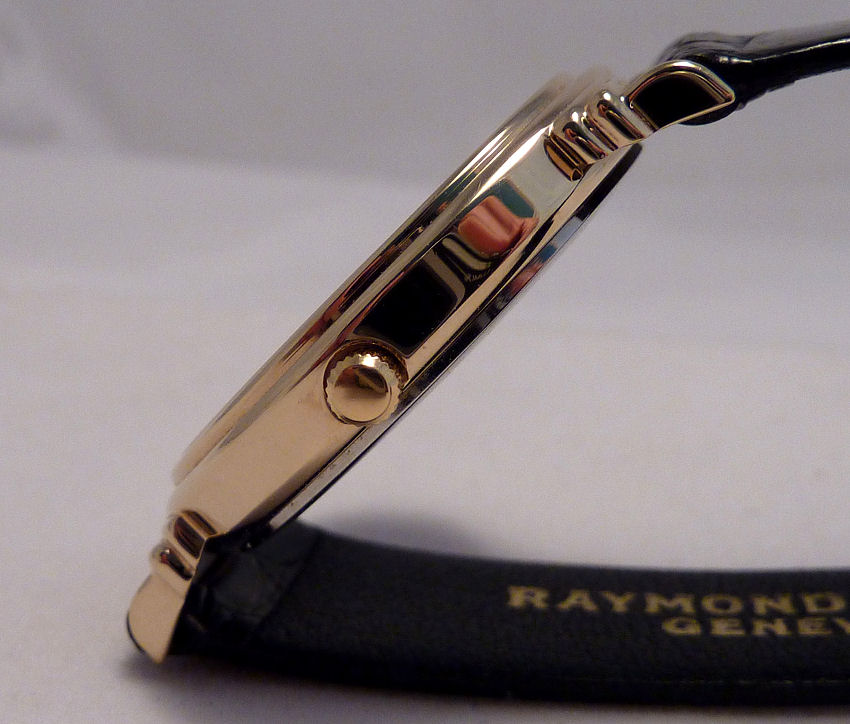
Gold plated quartz with white dial with checked off white design to the inner, hourly applied Roman numerals, small round date aperture @6, bordered by a minute track.  Round case fitted to an authentic black leather Raymond Weil strap with signed pin buckle. The retro lug design looks really neat and sets of the watch quite nicely. The hour and minute hands are black steel and the seconds hand in gold with painted black pointer end for clarity.

Slim at 6mm and Raymond Weil leather strap

The dial is marked with the Raymond Weil name and Geneve – there is a Swiss mark at the foot of the dial and the back plate is marked Raymond Weil, RW, a case number and water resistant.

RW logo plain back

The case diameter is 31mm (37mm lug to lug) and at only just over 6mm this is a very neat dress watch indeed.  Suits my small wrist just about perfectly and this watch would be very wearable for a lady these days.

With older, old stock and pre-owned watch models it is often very difficult to find out the exact model. Details can be very hard to find, such as date of manufacture, retail price when current and even the question of provenance – is the watch genuine?  Auction houses or dealers in general usually try quite hard to ensure that items they sell are genuine and to that end they often remove the back to check the movement, usually a dead giveaway – but for quartz watches this is often not quite so easy.  The quartz movement may or may not be signed and could be of Chinese or Japanese origin.  However it’s fact that a Swiss watch could well have these as perfectly legitimate quartz movement suppliers, so it’s always a “buyer beware”.

On the wrist

This model is a true Raymond Weil and the watch size in keeping with the retro period it suggests.  The strap is certainly made for Gents wear with holes set for about 170mm minimum wrist size without extras added.  Generally the older the watch, the smaller it will be and this one at 31mm is similar in size to many other Gents watches I have of the same and earlier period.

One thing I do know as a collector who wears all my watches at some time or another is that this one looks pretty good on the wrist – and that’s what it was meant to do.

Collectable 1990 Seiko Alarm

A friend of mine passed away last week and I’ve discovered he left me some watches (he knows I collect them) and one of them was this nice Seiko Dual Time Alarm quartz watch from August 1990 – so 21 years old this year.

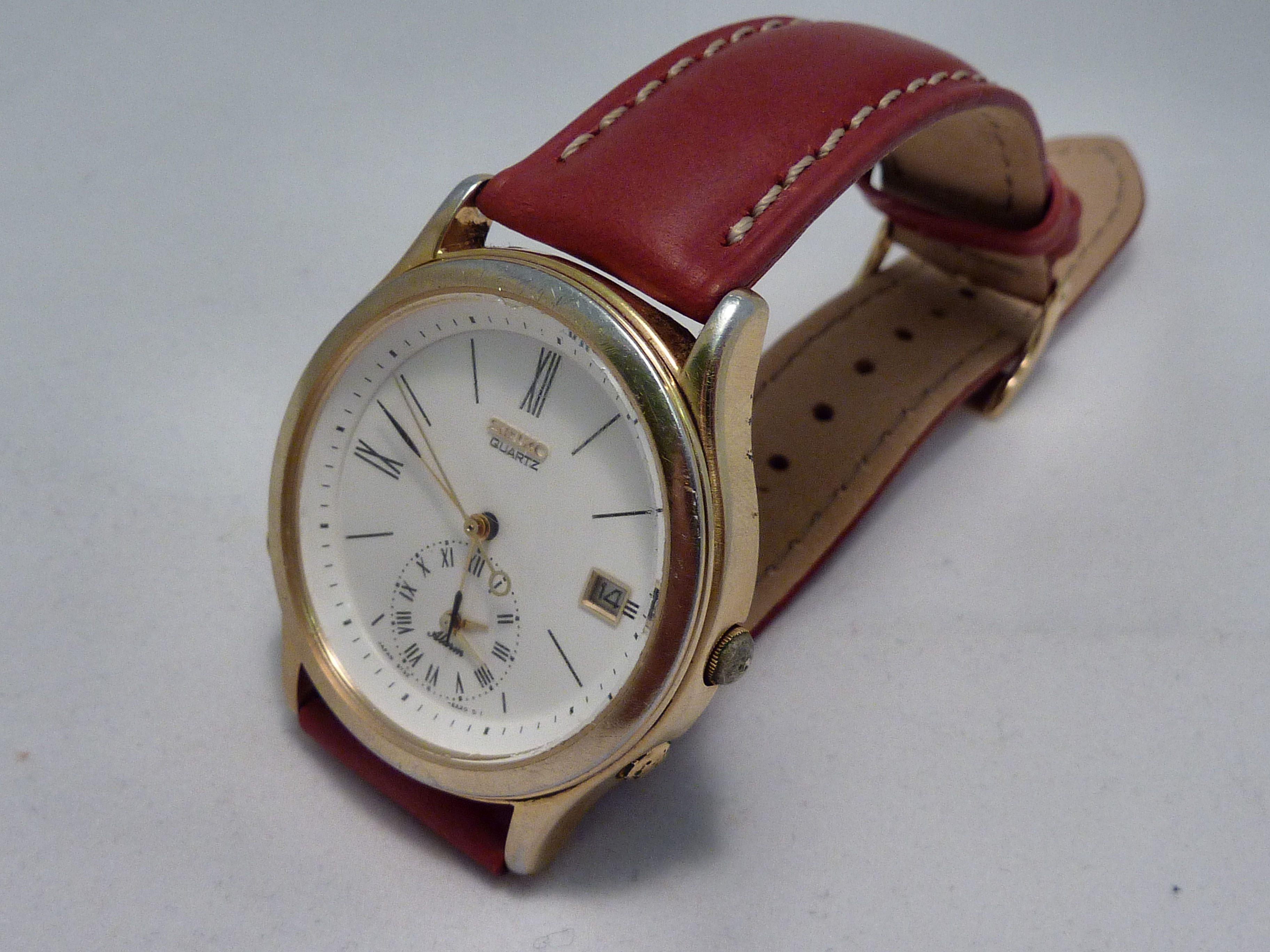
5T32 Alarm Dual Time Seiko

38.5mm diameter and only 8.5mm deep it is a neat watch in gold tone and features both an alarm and a dual time, center seconds hand and sports a very elegant dial indeed.  Quick set date with a window @3, plus an alarm crown @8 – it’s quite comprehensive.

The alarm features two set ups – a single time alarm and a regular alarm and these can be set using the crown @4 and adjusting the sub dial @6 to the time required.  This crown also sets the alarm on/off.  The alarm runs for 1 minute and 20 seconds.  A Dual time can also be set and indicated with the sub dial which is handy.

The 5T32 has a slightly unusual movement in that it has a circuit reset switch which should be operated after any battery change and a battery life indicator using the second hand moving in two-second intervals.  On the inner surface of the case back there is a Piezoelectric element and the case is water resistant to 100m.  Accuracy is around 15 secs per month.

Elegant Seiko 1990 Alarm

This quite rare and even collectable model though has signs of wear as evidenced with some plate loss and rubbing of the gold bezel and the loss of some gold color on both crowns.  The push button is perfect, the case sides too, though some wear through is evident on the lug shoulders.  The Hardlex crystal has minor scratches as expected with normal wear on a 21 year old.  The stainless steel back has a few scratches where less than careful use of back removing tools have been used in the past.

Overall though it’s a very nice and as I said elegant watch, to which I’ve fitted a new Rosario Italian oiled calf leather strap which looks pretty good (the old strap which was not original was split, so it was discarded, as was the buckle which was a rather clumsy affair in poor condition).

All functions appear to work as they should, the alarm sound is nice and loud and I’m delighted with the watch and happy to have it in my collection – a nice example of a fairly rare Seiko – always a good thing to have.

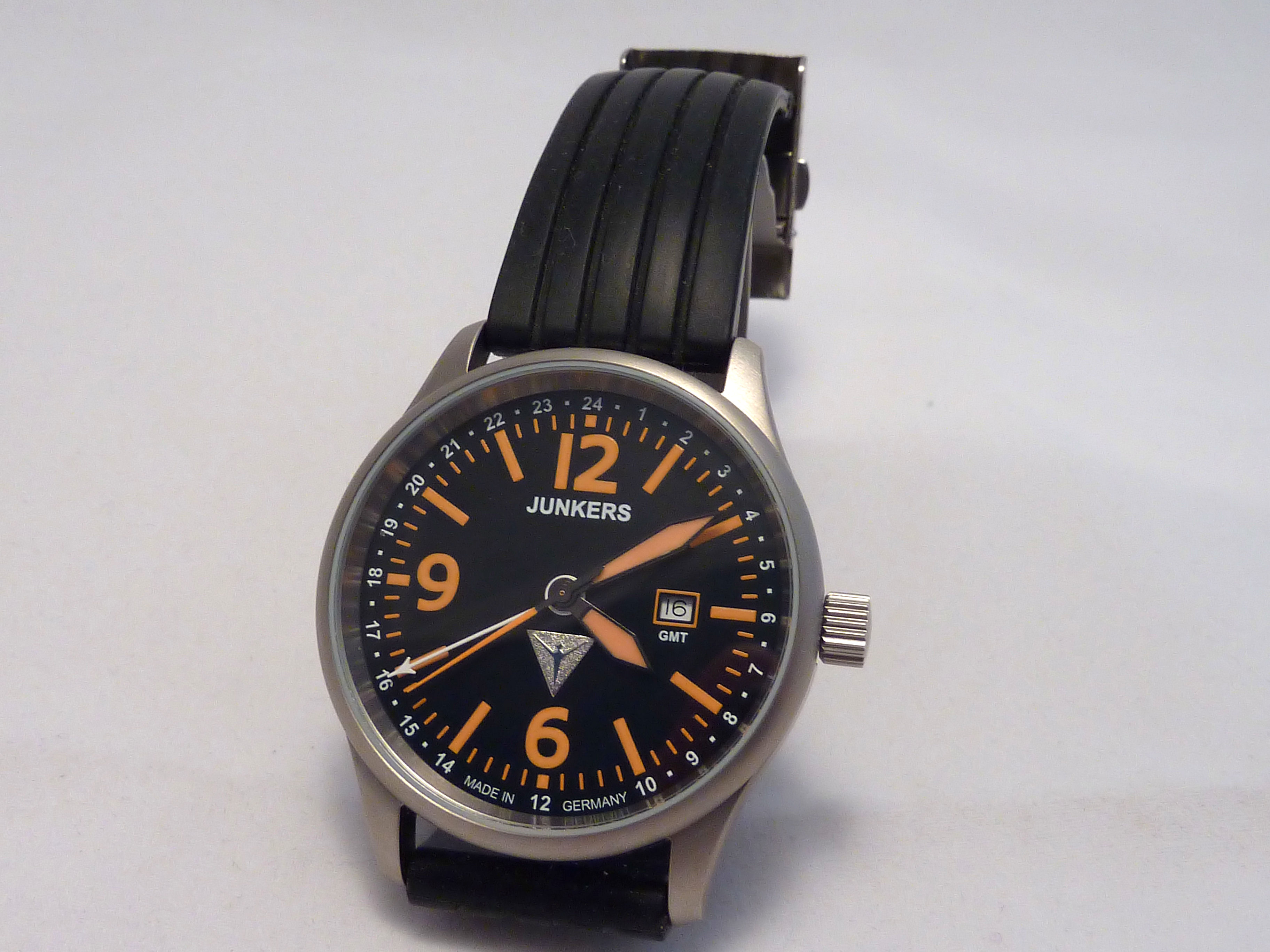
Junkers GMT

Looking through my collection the other day I realized that I had never posted this nice Junkers GMT.  OK it’s a quartz version but nothing wrong in that – it keeps great time and is a good looking watch to wear.

Junkers 6278-5 series GMT

It came with a Titanium bracelet to match the satin finished Titanium case (holds the weight down to only 43gm), but at the moment I seem to have a fetish going – I’m retro-fitting quite a few of my larger watches with Silicon deployment straps, replacing both Nato and OEM straps or bracelets – and don’t they look good!

The proper model name for this version is the 6278-5M and it features a Swiss Ronda 509 Quartz movement which keeps very good time I have to say.  It has a GMT pointer which can be freely adjusted alternatively to give you a dual time zone function, which is quite handy.  Date window @3, black mat finish dial and bright orange markers and hands.  These feature Super Luminova so are readable in low or night light.

GMT on the wrist

Dimensions wise it 42mm x 12mm and has 22mm strap/lug with with standard spring bars, so all strap options are possible.  Water Resistance is 5ATM so don’t try scuba diving with it, just normal wearing.

As said the movement is the Swiss 509 Ronda which uses a 371 battery with a life of over 3 years.  Accuracy around -10/ +20 sec/month.

Great watch to wear and I particularly like my new Silicon deployment strap – it suits it rather well and an awful lot easier to take on and off than the old Nato.  I have to admit to being quite partial to the Junkers range of watches as they are well priced, very well engineered and in my experience extremely reliable too.

So it’s quite possible I might be on the lookout for another one – maybe from their mechanical range this though it depends on what takes my eye!

Bucherer Quartz

Not the most modern Bucherer but one of the older classics, albeit a quartz version which still manages to ooze the elegance and style of the true Bucherer name.

Bucherer classic gents quartz

This model features a rather interesting two tone effect, though absolutely classic Bucherer styled case with brushed stainless front facings and contrasting Gold fluted sides curving gracefully towards integral lugs.  An original bright almost black colored cabochon tops the well defined crown @3 which completes the overall look.  A white dial with Roman numerals and steel contrasting hands covered by a perfectly flat crystal make for a classic looking gents watch.  Full lined original soft leather strap with it’s wide 18mm lug fitting compliments the watch perfectly.

Watch dimensions are 24.25mm wide and 32mm lug to lug and only 5.7mm depth mean it’s a very sleek watch to wear under a shirt etc.  In fact this is without doubt a beautifully understated and elegant timepiece suitable for virtually any occasion.  The snap on back is a plain stainless steel affair with Swiss made and a movement/model number.

Wrist classic

The movement is a 6 jewel ESA ETA 978-001 with a Bucherer label – a movement used quite often in the higher end quartz watches of the day. No longer available I think though there are possibly a couple of interchangeable versions from Ronda (751) and ETA (976-002) which might suit if this original movement had a problem.

However this one is in pretty good and completely original condition apart from some battery corrosive deposits in the battery compartment.  It seems that it was in the event an excellent purchase from a local auction house and well worth the very reasonable amount paid.

As with quite a few of the watches I acquire these days, not a lot seems to be known about this model.  It is perhaps not true “high end”, though the quartz movement is a very good one and the overall look of the watch says an awful lot for it’s pedigree.  Slim, elegant, perfect proportions and a lovely little watch to wear – can’t be bad!

As this model has a movement signed Bucherer, I have to assume it’s one of their own manufacture, or assembled specifically for them as one of the most famous retailers in Switzerland.  Normally their own manufacture models are signed “Carl Bucherer” and this one simply Bucherer.  Started in 1888  by Carl-Friedrich Bucherer in Lucerne, Switzerland and are associated with their distinctive high end stores throughout the world and today they still lead the Swiss watch and jewelry retail sector.

A King in silver

Previously posted in the “under the spotlight” tab – but as a few folks told me they never noticed that tab before I’ve removed it – so instead I’ve moved this article and listed it here as a new Post instead.  Another silver watch from my collection –  the Roy King Classic Watch.

Solid silver Roy King

A relatively late solid Sterling silver Roy king square watch dated 1997 with the classic white enamel dial and Roman numerals in black.  Black stick hour and minute hand, the Roy King signature and Swiss Movement complete the face details.  Clearly seen under the heavy, flat 1mm thick solid crystal.
A solid silver double fluted profile one piece case and signed crown give that retro Art Deco style favored by many of the rich and famous, many of whom sported an RK on their collective wrists over the years.  This one had a relatively poor black strap which I replaced with a rather better quality black camel leather 18mm strap – unfortunately not an original King but I retained the King solid silver buckle.

The dimensions are 28mm square excluding the crown and just 7.4mm height make this a neat watch indeed.

The movement is a Swiss hand wound mechanical one and though unconfirmed is possibly from Beuche Girod as he had a working relationship with this Company in that he sourced movements from them, hence the “Swiss Mov’t” signed at the foot of the dial face.
I say unconfirmed as it’s difficult to be absolutely certain as to the movement of course as to get at it requires the removal of that substantial chunk of glass at the front of the watch.  The case is as stated a solid lump of Sterling Silver and no back access at all, so I’ll reserve full judgment as to the true identity of it until such time as it goes wrong….. and that could be a long, long way off. . .

A bit of a collectors item these days as these are no longer manufactured and becoming more difficult to find in really pristine condition.

So who was Roy King?  I can do no better than attach an article from one of the National newspapers from November 2000 on his death – as follows –

Roy King

12:00AM GMT 09 Nov 2000Comment

ROY KING, who has died aged 87, was a leading British watch designer and jeweller, with customers ranging from Saudi princes to The Beatles and Tom Jones.

King began his career at the age of 14 as an apprentice goldsmith and diamond mounter in Hatton Garden. By 21 he was foreman of a workshop, creating one-off pieces which readily found buyers (including members of the Royal Family) through Bond Street jewellers. Much of his work in the 1930s was also as an uncredited manufacturer for names such as Rolex, Cartier, Asprey and Garrard.

After the war, King began to design and make watches under his own name. When restrictions on the import of Swiss watch movements were lifted in 1960, King decided to integrate these into his own designs, recognising that, whoever the manufacturer might be, people still wanted “Swiss Made” moving parts.

He signed an exclusive agency agreement with Bueche-Girod, the Swiss movement makers, which left him free to design the exterior of the pieces as he wished. He also began to make watches with straps made wholly from gold, then a novel idea.

In 1961, the Roy King workshop swept the board at the British Modern Jewellery Exhibition, winning two first prizes, as well as one second and one third prize. The winning pieces are now in the permanent collection of Goldsmiths’ Hall.

During the 1960s, the workshop produced many designs using a variety of unconventional methods. Molten gold would be poured through tea strainers before being stretched into shapes to satisfy the most avant garde tastes. King’s “bark finish” design for bracelets sparked a craze: when George Harrison married Patti Boyd in 1966, she wore one of King’s bark finish wedding bands.

Roy Cecil King was born in Kentish Town, London, on May 6 1913. His unmarried mother handed him as a baby to an elderly foster mother, Mrs Wells, who eventually adopted him. Mr Wells, a road sweeper, died in the great influenza outbreak of 1919 and soon afterwards young Cecil, as he was then called, found himself standing in a walk-in cupboard while his future was discussed in the cramped tenement room where he lived.

At one time, it seemed as if he would have to be taken in by Dr Barnardo’s, and even as a pupil at Haverstock Hill Central School he had to deliver hand-laundered shirts (at 2d a time) to help with household bills. One of his customers managed a large jewellery firm in Hatton Garden, M J Greengross, and in 1927 he was offered an apprenticeship.

On his first day at the bench, King was put next to a consumptive Italian master craftsman and told to learn what he could before the man died. A tubercular cough rendered King’s taskmaster highly impatient, and he would crush with a mallet any work which fell short of perfection. In the evenings, King went to classes at the Sir John Cass Art School, perfecting his skills at diamond mounting. In his spare time he performed in a jazz band as a pianist and comic master of ceremonies.

During the Second World War, King worked as a planning engineer on the production line of the Hurricane, eventually heading up a 100-strong department at De Havilland. There he used machine tool techniques which he would later apply with great success to jewellery and watch manufacture.

He then set up his own workshop in Watford, where he offered “everything from a tiara to a tiepin”. In 1952 he produced five strawberry leaf tiaras for duchesses to wear at the Coronation. At about this time, King began exporting his pieces to offset the effects of the then 100 per cent tax on luxury goods in Britain. He soon began to concentrate on watch manufacture, or, as he described it, “jewellery that tells the time”.

In 1965, King built his own factory near Watford, where he employed 65 staff who made 25,000 gold and silver pieces a year. In 1971, he won a National Export Council Award, and the same year became a Freeman of the City of London. In 1973, he bought the Swiss watch company La Montre Royale de Geneve. The 18-carat gold and platinum range sold under this brand name were among the most luxurious ever produced, with precious stone dials (such as malachite and onyx) which proved very popular in the Middle East.

King celebrated his 60th birthday in 1974 with a one-man show at Goldsmiths’ Hall and the launch of a collection of silver watches. During the 1980s, he opened a showroom in Mayfair. Here he would entertain clients with his extensive repertoire of jazz songs, particularly Cole Porter and George Gershwin. He had his own bench at the shop and until well into his eighties continued to make one-off pieces.

Away from his workshop, King enjoyed tennis and backgammon, and drove a white Rolls-Royce. He lived to see many of his earlier pieces come up for auction at London salerooms, and in 1999 several items by him were included in a “Treasures of the Twentieth Century” exhibition at Goldsmiths’ Hall.

The legacy of Roy King for me as a watch collector is simply this watch – A classic in every way.