As said at the start I will only include “Digital Only” models IF they come within my diameter limit AND they have obvious clarity – though so far there are very few that meet the criteria.
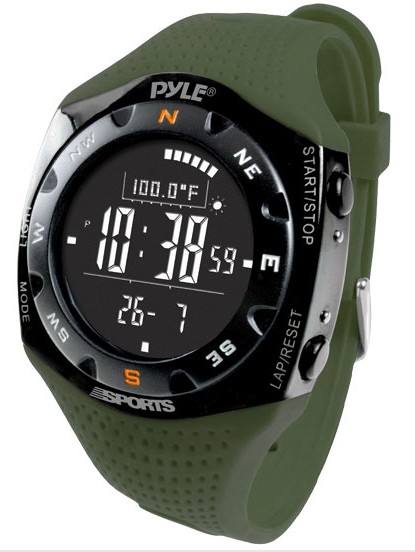
That said my next find is one of the cheapest digital compass models I’ve come across and whilst “Digital Only” model I thought it worth a look. It’s from Pyle and as the image here shows it appears to have great contrast, so clarity may not be an issue and it has for the price a very comprehensive set of functions, including Digital Compass. This is the Pyle Ski Master V Professional Sports Watch Model PSKIW25GN.
The Pyle Ski Sports Model PSKIW25GN
Unfortunately unable to find the dimensions of this watch at all, even on the Pyle web site, which is a bit annoying. It maybe a less expensive model than the top two contenders, but the Digital Compass data on the instructional .pdf file is surprisingly comprehensive. In fact after a quick glance this model does appear quite highly specified, but until I physically handle one I have no data on ease of use. In addition to the Compass it has Altitude, Weather Forecast, Barometer, Thermometer, Dual Time. Alarms, Chronograph, Ski Log data, which seems impressive.
From the instructions I’ve seen, the series of 6 dots on the upper dial denote Magnetic North, Compass direction is shown just below in figures, bearing direction is shown by the main figures, the 12 position is the bearing direction of navigation and current time is shown by the bottom figures. The watch image here is shown displaying normal time, day and date plus temperature.
If this watch is genuinely compact sized OK, but I’m still to be convinced by the digital display clarity. I would have to see one in the flesh to check, plus I note after reading the instructions, this display could be quite daunting, unless used every day to get familiarity. It appears to be exactly the same model as the Meteo Pro Weather Watch from Wiesmann Klein, but with a different strap set up – prices differ – the Pyle is £59.95 and the Wiesmann £80, though the latter seems overly excessive for a strap change.
Pyle offer quite a range of Sports orientated Digital Only watches similar to Suunto, though obviously a lower priced product range. The Casio Tough Solar I featured in Part 1 is around the same price but as I found out, it’s not available here in the UK, whereas the Pyle is.
Anyway it looks as if there will have to be a Part 4 as I’m finding more Digital Compass watches that I first thought. And yes I should look at Suunto even though these are Digital Only, but admit to a certain reluctance. The reason being that I had a couple of older models in my hand in a mountaineering shop a year or two back and frankly I could not make out the digits as the dials and digits were far too dark and barely legible. I also noted at the time they were very large to me and at the very limit of my wearable size.
I am willing to check them out again but ONLY if I can get them physically in my hands and on my wrist for a serious look.
Decided to revise this post to allow what I consider two very close Digital Compass watch contenders to be on the same page, as it were.
The first Digital Compass find is from Tissot – very high quality built and somewhat more expensive Tissot T-Touch Expert Alarm Chronograph T0134201105700.
A watch that comes with Analogue and digital display (like the Casio Pro trek, but conventional) and some 6 functions, so a highly specified watch. The dimensions at 44mm diameter and 14mm depth are within my remit and from images I’ve seen so far it sits very compactly on the wrist.
There are a few different models of this series and I note that dimensions differ as do prices, so I will have to narrow the search down to ensure the best for me. However the Titanium cased one Expert model will probably be my choice. Note the available functions around the perimeter of the dial. What is outstanding with this watch is the sheer amount of functionality – it is pretty awesome I have to say. Weather prediction data is covered by the Meteo function @12, Altitude functions covers difference data, ascent and descent speed and lots more. The compass shows North, angle, variations and the outer bezel rotates for quick navigation assistance.
So far in my investigation of compass watches, this one is the most impressive and with a considerable amount of very serious kit contained within it’s very solid and compact high quality steel or titanium case. No gimmicks here – even the T-touch screen is very, very good and a great quick method of operation.
One point I’ll make now is that whilst folks love these added functions, it is fact that many owners simply do not take the time to understand what they have just bought. I know of a few friends who have Compass and Altitude function Casios, who have not a clue as to the correct use.
“Oh the height indication is way off” or “this compass doesn’t point north at all” – and when I mention in conversation “Do you calibrate the altimeter at any time?” – I get a blank look! Or “Yes I did it when I first got it!” Or “have you adjusted the declination setting?” – and again the blank look. So it’s all very well having all these wonderful functions, but like the traditional chronographs with that lovely outer chapter or bezel with Tachymeter figures on it – just how many users have a clue as to what it does or how to use it?
And this is true with the new multi-function watches like the Casio or T-touch – there is a certain learning curve required to gain the most from the watch – it’s not just about the looks. Though who am I to say that’s not just as valid a reason for buying – I mean you like the look – buy it! However in the case of the top models these can be quite expensive, so it seems a pity that some buyers don’t take the time to find out how it all works to get the best from it.
Of course depending on the model and the price range the Digital Compass functions themselves may be very different – one that points North and that’s it, or one that provides additional data that you can use practically in the field. It’s sometimes difficult to know just what they provide on the available blurb on the web. So reviews are handy – if you can find one regarding your watch choice of course.
—————————————————————–
Continuing my quest for compact Digital Compass watches (analogue preferred) I found myself another real serious bit of kit. From Victorinox – meet the Swiss Army ST5000 PathFinder.
Swiss Army ST5000 PathFinder
Lovely Titanium cased, black dial, Swiss Quartz with black rubber strap, this model oozes professionalism. Anti-reflection crystal and no gimmicks, just a very well specified Digital Compass with practical functions and ease of use. A 5-point LED color Light System showing Heading Accuracy, Heading memory, an 8-point LED Magnetic North Indicator System, a Rotating Compass Rose Indicating Cardinal & Intermediate Points, 15-degree Increments. Analogue luminous hands and numbers, screw down case back, 50m Water Resistance and all in a Titanium 42mm diameter case – all looks pretty impressive.
High contrast digital display @6 and a leveling bubble @4/5 gives this watch a rather outstanding presence and the dial clarity is very good and very easy to read. A short press on the large button @7 and a green arrow seeks and freezes to indicate North – very clearly indeed. You can then instantly lock your heading and a series of lights above the small digital display keeps you on track – green for go and red for off track – the digits say by how much etc. From a walker’s point of view simply “follow the green” – that has to be good!
This is the first model I’ve found that seems to say – this is a very good watch AND a very good practical Digital Compass. Certainly bears further investigation.
Both models have really impressed me – The Pathfinder as it has a wonderful simplicity of operation coupled with sheer quality and the Tissot, whilst similar, has a huge function array in addition and it too seems simple in operation.
But I’m very taken with both so currently I’ve got them neck and neck!
The subject of this Part 1 & 2 post is simple. Can I find a Compass Watch that does NOT, because of it’s SIZE look silly on an average wrist? – in other words a Compass watch model that is a sensible size.
One of the problems with adding functions to any watch is the fact that the more you add, the larger it becomes. Larger in diameter and often depth too, both of which can make a wristwatch and the wearer look rather silly. And to make the search that more difficult I add another personal criteria – I would like Ana-Digi as I much prefer the main time keeping part of any watch to have hands – in other words I don’t want a digital display only model (I find them difficult to read as the contrast quality of most regardless of price, can be quite poor). I also have to accept that there are quite a few Compass watches and some are clever and useful, others less so and this is not always price dependent.
However, that said I may include one or two digital only models, but only IF they are a sensible size and are easy – and I mean easy, to read.
My wrist is about 170mm in circumference and a watch size of 45mm diameter is about my limit, without looking like a total geek. Slightly larger may just be possible as long as the watch case is not too thick. But 50mm and up, forget it.
Casio Pro Trek PRG 5501 AER analogue/digital Solar
The most prevalent Compass model is Casio and the first one is in the “larger than I would like category” is the PRG-550-1AER Pro Trek Solar at 48.8mm diameter and 14mm depth. It’s Analogue with digital sub-display and as most of this series share the same dimensions, I’ll leave it as the Tough Solar/Pro Trek ana-digi representative. One caveat – re’ the size – I would have to try it on the wrist before serious consideration.
Compass watch – Casio SGW-500H-1BV
Of course I found a Casio candidate in my last post – the SGW-500H-1BV a cheaper Casio model but not available as far as I am aware in the UK – It also has fewer functions with only Digital Compass and Thermometer in addition to the normal Casio digital set up – BUT it was smaller at 46.8mm diameter and 13.6mm depth, so is still very much a viable candidate.
Timex Adventure Fly-back Digital Compass T49865
I also checked out Timex as they do offer Digital Compass models too and the first one I considered is the Adventure Fly-back Compass Chronograph T49865 series. This is an analogue 6 hand Quartz model with Digital Compass including magnetic declination compensation, dual time, date @3 and Water Resistance quotes as 100m. It is handily sized at 44mm diameter and only 12mm depth, which is really quite good.
I much prefer this model to their Tide-Temp Compass version – it seemed over cluttered for me and this one seems cleaner, though whilst the clarity issue will have to be checked out, it looks worthy of consideration.
Timex also do a T49688SU all digital model, which is smaller yet at 41mm x 13mm, though the Digital Compass looks a little simplistic to me. I have not checked it out fully as being digital only, it can wait till I exhaust the analogue and ana-digi choices first.
Anyway in my first Digital Compass model look see I’m actually quite impressed with what I’ve found so far. The more expensive Casio models seem to be reasonably serious with their functions, cheaper ones less so, which is or should be fairly obvious.
In Part 2 I’m having a look at two more models that offer a Digital Compass function from Tissot and Victorinox, as both appear to me to be more traditional watches. Both are within my size range and both are Analogue/Digital.
Well I’ve been considering replacing/adding to my old Casio collection and whilst the models I have are still available, I want one with more rugged features and added functionality if possible. Basically I would like one that maybe has an additional function or functions, like a Digital Compass or perhaps Solar Power or maybe Radio Control.
Now perhaps at first glance this seems an easy find, but I have one overriding requirement – size.
There is no doubt that when you start to add functions, invariably the diameter and thickness of the watch increases and in fact the main two reasons for not owning a Digital Compass watch is just that –
1) They are too big and
2) I don’t want a digital only display –
My preference is for analogue with a secondary digital display. This latter reason (2) simply because – I take my watch off, lay it on the window ledge or bedside cabinet and with digital only, at my age without glasses, there’s no way I can tell the time. Also in bright daylight or some interior lit situations, it is often quite difficult to even make out the digits – so Hands are a must.
Checking out the Casio range I looked at the Pro Trek range as I like the extra functions they can provide, but the diameter (width) is often 50mm+ which for my smallish wrist, frankly, is a bit silly. The only ones that come within my size are the “slimline” series, or PRG110 style, but these are solely digital.
So my criteria –
47mm is the absolute maximum diameter to fit my wrist – no exceptions.
Analogue/Digital but must have good clarity/contrast etc.
Usual Casio functions package as my minimum standard – incl World Time.
Added functions – if useful to me – Solar powered, Compass and/or Radio Control etc.
G-Shock models were out of my size range, most at + 50mm, with the odd one at 46mm (the 960 series) but again digital only. The Standard analogues (GAC100) were also +50mm and some of the Digi-Ana models not only too large at + 50mm, but many had cluttered dials and part or full skeleton hands, which did nothing for readability.
The G-Lide series whilst actually OK size wise, were not quite the specification I required and having a permanent “tide info” display, didn’t appeal, not being the nautical type.
Tough Solar AQ-S800W-1E 47.6 X 42 X 10.6 mm/33 g
However the “standard” range seemed more promising.
The Tough Solar AQ-S800W-1EV is only 42mm diameter and 10.6mm depth which is ideal – with World Time for 31 Time Zones and Solar Powered, it is a pretty good specification. It also has the hour and minute hands in white edge & lume with the hands overlapping the centre pivot which I like. Finding this one was at least a start, as I was becoming apprehensive that no Casio was actually going to meet my requirements!
This model has quite a good specification –
Resin body with mineral crystal, 100m Water Resistance, Solar Powered, World Time, LED light for the digital display, Chronograph, Stopwatch etc, 5 Daily Alarms, Auto Calendar, Hourly Time Signal, Long sleep time of 23 months in darkness on full charge, very light weight at only 33g. It is also a nice clear face which means clear to read and without being cluttered as so many models can be.
This could be a pretty good update of my current models and Solar Power is a nice additional function.
The others in the Standard range AW 80 series are basically the same as my old models – in fact the AW-80V-5BV looks exactly like my old Telememo 30 with it’s cloth strap too. So a bit pointless in getting one of those . . . .LOL. The fact that it’s still made is a testament to it’s popularity I guess – so not a bad purchase those years ago.
Now whilst the Tough Solar model is a consideration, I have find another model with a different specification – a Twin Sensor model from the OutGear series that could also be a serious contender – the SGW-500H-1BV –
Compass watch – Casio SGW-500H-1BV
However this is a bit larger, I assume owing to the Digital Compass and Thermometer functions and is right at the limit of what I can wear. I do have a couple of other watches at 45mm diameter and I just manage OK with those. This model is 46.8mm diameter x 13.6 mm – and I hope the depth does not cause an issue. It’s the smallest diameter Casio with Compass I’ve seen, the rest being huge.
Once again the dial arrangement isn’t cluttered, the hour & minute hands are broad & lumed (no centre overlap, but clear to read), a decent sized digital display @6 with good contrast and large figures, large solid numeral markers on the hours and a neat twin spoke & arrow red colored pointer hand for the compass indication. Whilst the Thermometer sensor is of no real benefit to me, like the old Telememo, it is not permanently displayed but demand only, so doesn’t add to dial clutter, which is fine.
Other specifications are – 100m Water resistance, Resin and aluminium case, World Time (31 Zones etc), Digital Compass (North) which has bidirectional calibration, plus Magnetic Declination correction, Thermometer, Stopwatch, 5 daily alarms, Auto Calendar etc etc – or the Casio “package” as I call it.
This certainly appeals, as I have always had a liking for a compass watch, especially as most are giants, well over 50mm and frankly silly.
I also looked at the Edifice range and two models were of some interest but had no function advantages over my current models and I did not some issues not least of which was clarity with both the ones I looked at.
Model – EFA-135D-1A3V is neat at only 42.8mm diameter and 12.7mm depth (ideal in fact) and has a neat dial arrangement, not too cluttered and at first looked OK.
Casio Edifice EFA-135D-1A3V World Timer Anti-Magnetic
But – I had a chance to see a few images of the actual watch and at no time could I easily see either of the digital displays clearly. These in reality were quite small and dark and this is where pictures on the web can be so misleading, so I am very unsure as to whether it should be a contender .
The EFA-131D-1A1V is similar in function though slightly larger at 46mm and thinner at 12.5mm.
Casio EFA-131D-1A1V World Timer
The dial is not too bad, the broad white hour and minute hands helping, though the seconds sub-dial @9 is a little cluttered for me. I also noted permanent signal markers on top of the upper digital display window which seem obtrusive.
I also noted a You Tube video on this watch and whilst the digital displays seemed quite bright, the dial overall appeared over shiny and reflective – a feature I’ve noted before on some Casio models. So again I have reservations. Specification wise as the other Edifice without the anti-magnetic reference.
So the Edifice models I’ve discounted, basically as whilst modern looking, they offer nothing new or added in the way of functionality and clarity really looks as if it would be a problem for me.
To summarize –
1 – The Tough Solar AQ-S800W-1E – Ideal size, standard function set, good clarity PLUS the addition of Solar Power. Under £40.00.
2 – The SGW-500H-1BV – Size within criteria, standard function set, good clarity PLUS the added Digital Compass. Again inexpensive.
On investigation however it appears that neither is readily available in the UK. New Zealand Yes, South Africa Yes, Hong Kong Yes – but NOT UK!
Either is a good choice. For a straight replacement with added Solar Power the Tough Solar model is good and the Outgear model with Digital Compass is attractive in the SGW500H 1BV series (there are a few versions/colors etc). The prices are good (low actually) and could be worth sourcing either one out of Hong Kong – I can wait 3 weeks or so. But I do have the feeling this range must be a cheaper made product in comparison to their larger Pro Trek range – so I’ll wait and see.
Addendum –
After considering the Casio models, it’s made me question the availability of Digital Compass models at a sensible size! And it’s got me thinking perhaps other Makers might have alternatives that are not so large.
So I’m checking out Swiss Army and Tissot T-Touch – and any others I can find albeit more expensive.
It also looks like the subject of my next post has just been decided. . .
I do have a couple of old Casio models I bought many years ago, both at the lower price range bought with a few years between each other, they are actually versions of the same model AW80 Telememo 30. Both times these I confess bought as “holiday” watches and when I was working in Africa. The second one with the nylon strap was an emergency purchase as my current watch at the time was “drowned” in a river crossing and was declared deceased. Both Casio models are still working perfectly and I have to admit both are also nice to wear and as fairly dependable timekeepers not at all bad.
Casio Telememo 30 – two versions
Specification wise these are typical Casio – 50m Water Resistance (100m now I believe), World Time for 29 Time Zones, Stopwatch, 3 Alarms including 24 hour countdown, LED light, Hourly time signal etc etc. But one of the best things I do like about both of them is that they are a sensible size! Just 40mm diameter and a height of only 13.5mm including the domed crystal. And that’s one of the problems I have at the moment looking at current Casio models – many of them such as the ProTrek or G-Shock are very large indeed and simply look silly on my smallish wrist and uncomfortable because of it. A pity really as these ones are those that seem to get my interest. So can I find a really well Casio specified up to date model that I can actually wear without looking like a geek! I could of course get another one just like those two above – but I mean – two the same is careless, but three! I mostly want something that’s really moved on since then – something new!
Now it is also fact that I did own two more up market Casio models. One was a Radio Controlled low price model that a friend who passed away left me, which was OK but not my style and I gave it to a young son of another friend. The other was entirely different and at the time bought directly from Japan, before it was available in Europe, but I sold it on – and why?
Oceanus Manta and cheaper friend – also RC.
It was a Casio Oceanus Manta Radio Controlled model, World Timer, Solar etc etc. and very expensive too I recall, but for all that, I found it annoyingly difficult to read. Such a simple thing really in that there was too much chrome edging to numerals and hands and the crystal was not the best anti-reflect I’ve come across. So whilst a superbly made and specified watch, it annoyed me intensely, and it had to go. I mean there was my old £12.50 in a shop sale Casio Telememo 30 sitting there and I could see it and read it easily! And it even had World Time too!
So OK I’m looking to find a Casio that is really well specified, but easy to see, read and use – and it must NOT be too large. Seems simple doesn’t it?
However after looking around when writing the last post on Casio it was then and now apparent that there are just so many models available from Casio that this might not be an easy task. Especially as I am a Watch Collector – and we as a species are pretty fickle indeed! Some would ask why I’m wasting my time with these digital quartz affairs when much of my collection is composed of classical mechanical timepieces?
My answer is simple really as I collect any type of watch, be it mechanical or digital and often whilst looking for a particular “look”, come across one though preferred mechanical is actually quartz – then so be it. In fact I have a collection split of 50/50 mechanical to digital, so it is not a problem for me and in fact is fun. It is a different kind of “like” I suppose, the mechanical movements models delight me in their complications, skill and quality of manufacture – also there is an elegance from some of the very old established Swiss makers that simply cannot be surpassed – the fact that perhaps made in 1885 a timepiece is still performing almost as good as when it was first hand made – is a total joy for me. Just to wear it and watch it perform.
Quartz watches have their own charm I suppose – the ingenuity of micro-electronics and lots of functionality allied to a visually pleasing case and face, within a small dimension is a skill too. The continual historical reference of many watchmakers today even with digital application is gratifying – those that can merge the two usually make watches that I would want today. But as for the Casio style – I already have a few of their great rival Citizen both modern and also 1970’s vintages and still have to acquire a good example or examples of Seiko, another excellent name from the 1970’s to the present.
But it’s Casio I’m looking at this year and my quest begins now and over the next few posts I’ll check out what’s on offer.
Seems to me that the name Casio has been around for years and especially as I used to travel the world from the Near East to the Far East, from Europe to the Americas and Casio was just – there. My first calculator was of course Casio and I think I also had a tiny musical keyboard, also Casio and indeed all my friends have something made by Casio too. And yet we’re really only talking of back to the 1970’s probably, which is not that long ago, but certainly was the marvelous and wonderful years for the explosion of “people” electronics. With the emergence of LED and LCD and miniaturization of electronic components, suddenly as if from nowhere – Casio was born. Established as a Company way back in 1957 and developing the Casio 14-A compact calculator (an all electric one!), this was just the start. With their (1960) new manufacturing Company in Tokyo, followed by a European facility in Zurich in 1967 the Casio Company was up and running. . . .fast!
They made and still make a dizzying array of products from Electronic Dictionary’s to Calculators (of course), to Cash Registers to Labelling machines. Musical Instruments to Projectors to Cell Phones and Digital Cameras. In fact if it was small, consumer attractive, then Casio probably made it.
The CASIOTRON – 1974
Then in November 1974 they came out with an amazing watch product – The CASIOTRON – an electronic watch with complications. And it had to have something different as the Japanese watch making industry was virtually a “closed shop” and quality and price was the name of the game. So Casio produced something that bit different. Not only did this watch show hours and minutes and seconds, but a 10 second continuous counter plus the month and the day, but also had a unique function that could automatically determine the number of days in a month – an “automatic” calendar. It had an easily visible Liquid Crystal Display that was simply sensational at that time.
I’m almost sure I got that first model too, but it’s so long ago now I can’t remember! I certainly had quite a number of Casio models over the years though and when one “died” I tended to get another. Mostly the older prototype displays gave up the ghost eventually, but as with everything Casio did, they improved on it next time round! Their motto of “creativity and contribution” is not a bad goal and one that still drives the company today.
As said, the range of watches is truly exceptional and a simple click on Google will find hundreds of examples, though here I show just some of the milestones of this interesting Company.
In 1983, Casio released a new watch that overturned the normal ideas of the watch and clock industry. Bucking the trend this rugged design of the G-SHOCK was based on a unique concept of a really tough watch that could be dropped from the top of a building and still not break. It really took off in the USA as this idea definitely appealed the the guy in the street.
It had quite a few features such as the high contrast crystal display, stopwatch, timer, auto-calendar and so on, but all in this rugged high performance urethane cased body, which totally protected the inner movement
The G-Shock DW-5000C
by design. This high impact plastic structure gave superb shock resistant properties.
Just a year later in March 1985 another innovation which was based on the novel idea of making the watch and plastic wristband all one piece, was the PELA FS-10. Here Casio used a new hybrid moulding technology which applied plastic moulding and microelectronics expertise. This was amazingly thin at only 3.9 millimeters and very light at 12 grams and it was an immediate success and became the watch industry’s first million-selling model.
Super thin Casio PELA fs-10
I can’t ever remember seeing one of those at the time, but this image shows that it was a very sleek affair. I particularly like the “drivers” style slanted display so when driving the car you can easily see the time (assuming you’re a left wrist watch wearer of course). The integrated plastic strap really suits it very well and what’s interesting for me is the quite different look of this model compared to the G-Shock – a different market I would think and yet produced with the same flair – that’s Casio for you. It also shows the Company vision and producing watches for all tastes.
After entering the business of timepieces in 1974, Casio released watches with various advanced features, including a calculator function (C-80 released in 1980), and a dictionary function (T-1500 Walking Dictionary released in 1982). The company obviously decided that the wrist could be host to not only a timekeeper but also a sort of computer on the wrist and in 1984 out came the Databank Telememo 10 (CD-40). This again took the watch world by storm selling over 6 million of them in the next 5 years. It had all the now recognizable Casio watch functions, but added a databank function that could save and recall 10 groups of 16 letters or numerals, which simply did away for the need to carry a personal phone-number organizer or diary in the pocket. So much easier on the wrist.
Casio CD 40 – Databank – the first of many.
Quite a few of the models now appearing were including functions that were simply not seen on watches before, such as in February 1989 when the BM-100WJ or “Weather Predictor” appeared. Note what I call the Casio “look” starting to appear, which is still very common today. This model I suppose was the original Pro-trek style watch of today, with the introduction of features that those out on the trails might want one day.
First Baby-G – the DW-520 for ladiesCasio BM-100WJ – the weather predictor.
It should also not be forgotten that Casio don’t just make digital watches, but analogue features more often than realized – just look at today’s models and you see quite a swing towards dual display – that is Ana-Digi and some of the current range are, disappointingly for me, very much bigger than the old ones. Perhaps in part due to the heavy complication factor of all those extra “handy” functions – a bit “Swiss Army Pocket Knife” perhaps. I do remember seeing a “Swiss Army knife” that was so big and swollen with gadgets, it was hardly “pocketable” any more!
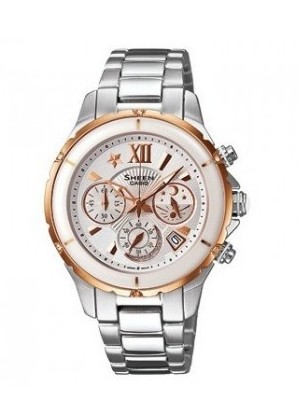
And the ladies are not to left out either as Casio have always had a range of ladies watches – some smaller versions of gents models such as the “Baby-G” which replicate all the features of the standard G-Shock series, and also some non digitalal display models such as the “Sheen” series, pictured below. In fact that ladies Sheen model shown here is a very smart watch with really decent high tech features, ceramic bezel, sapphire crystal and a Sun and Moon indicator, date window and so on – not a poor relation by any means.
Ladies “Sheen” model – Sun & Moon with ceramics bezel
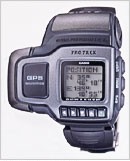
In June 1999 things really started to move with the introduction of the SATELLITE NAVI, in the Protrek series. This had almost unheard of advanced features, the main one being to easily determine directions and distances in relation to your location or destination. This was now becoming a real asset for those involved in outdoor activities such as climbing or fishing, where lightweight compact devices come into their own in comparison with more cumbersome equipment.
I show the first and second generation of these in the following images.
Satellite Navi – first generation GPS2nd generation GPS Satellite Nav
Radio controlled watches soon followed and in 2001 the WVA-300 was the world’s first radio-controlled watch that indicated accurate time by receiving standard time radio signals, and also powered by a solar cell.
The watch took the watch industry by surprise as it was believed that it simply wasn’t possible to build an advanced-function watch using solar cells.
It featured a very low power consumption and miniaturization using very advanced developments such as an energy-saving CPU based on a SOI (silicon on insulator) format, and a super-miniature detection IC. An advance perhaps gleaned from their camera technology, which of course was going on apace at another division within the Casio empire. Not surprising it’s said if you buy a watch or a camera today, then it’s probably out of date by the end of the week! Such is the pace of modern micro-electronics.
So we’re just about up to date with this highly innovative Company, Casio and I attach a few images of some other models that are around. I would certainly give them a look maybe in more depth than many do, as they have an awful lot of variety out there. One thing I am certain of however is that once you’ve seen a Casio – I assure you, you have NOT seen them all!
An interesting watch Manufacturer Movado and with some styles from the past that have always interested me, this one I recently obtained is such a model – that I couldn’t resist.
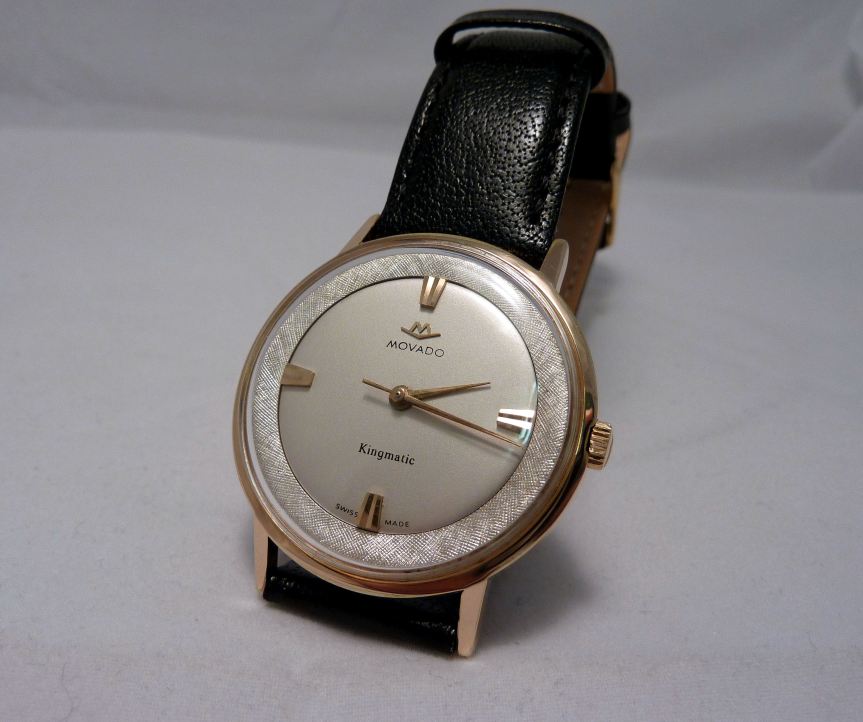
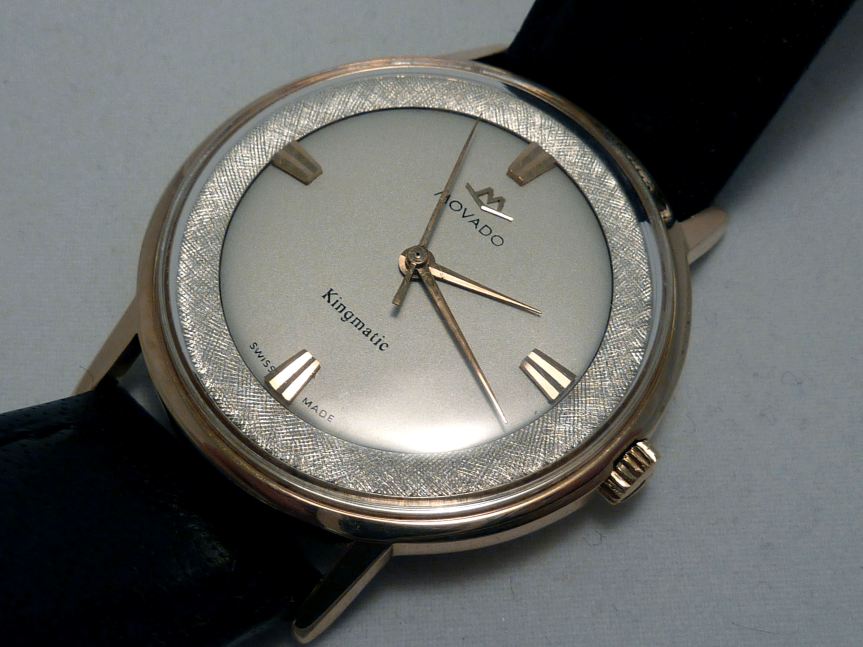
1960’s Movado S Kingmatic Auto Sub Sea model
Without doubt the best dial gents Movado I’ve yet seen, this was a must purchase. 1960’s vintage with a Movado Cal 395 – C Automatic movement. This is their famous Kingmatic Sub Sea model with 28 jewels and running as sweet as it did when new this sort of mechanical marvel never fails to impress me. Over 50 years and still perfect it has a neat 34mm diameter gold micron plated case, centre sweep seconds and applied gold numeral markers on 12, 3, 6 and 9.
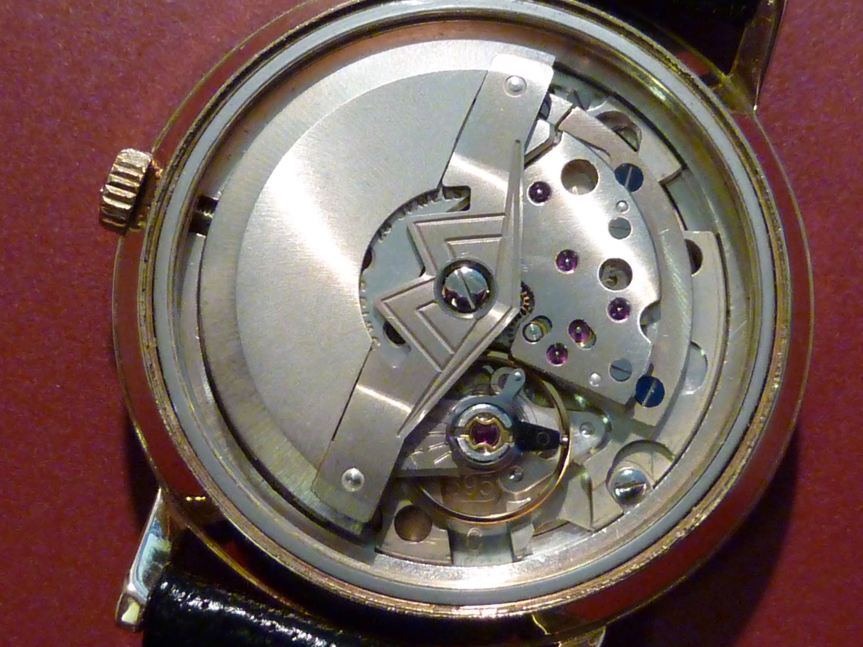
Movado Cal. 395-C movement (this is a stock image) – I will update later.
As you see the above image shows an immaculate Cal 395-C movement with the classic Movado rotor assembly, Incabloc shock protection in a very neat layout. The Calibre number can be seen clearly at the foot of this image and note the Movado “Top Hat” plate atop the rotor. Obscured by the rotor it also states Movado Factories, Swiss and 28 jewels. Lovely action too this rotor and quite silent in operation – this is a class item indeed.
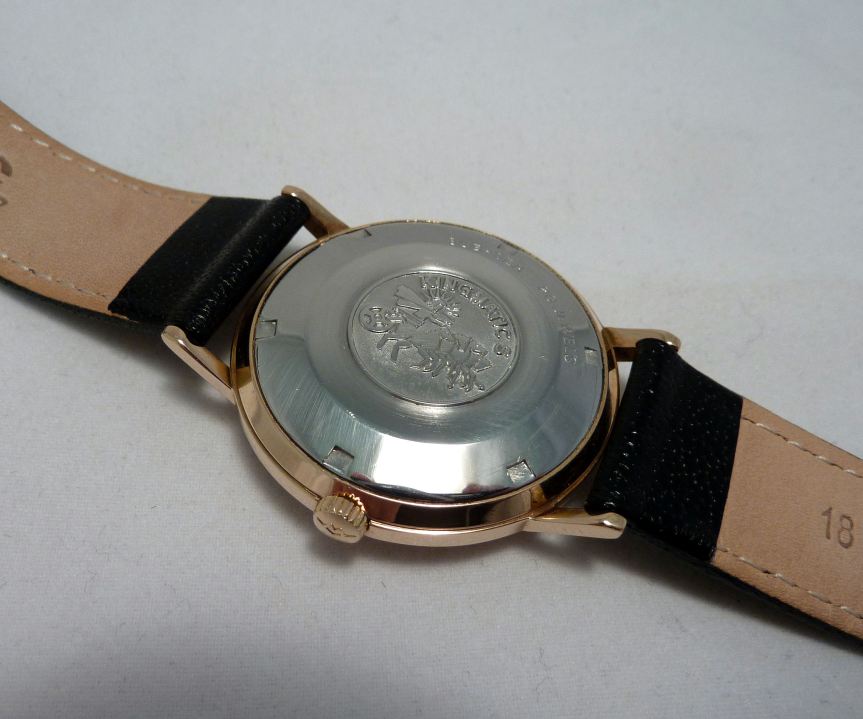
Full stainless screw back with Movado logo set.
The stainless steel screw back has a full Movado medallion logo set with Kingmatic S and the 4 horse chariot design in the centre. Sub Sea and 28 jewels are the other markings on the back. The crown is the original Movado logo and the lugs are set to fit an 18mm strap, which in this case is a nice quality though non-original Condor stitched leather variety with gold colored buckle which sits it very well.
Classic dress Movado Kingmatic
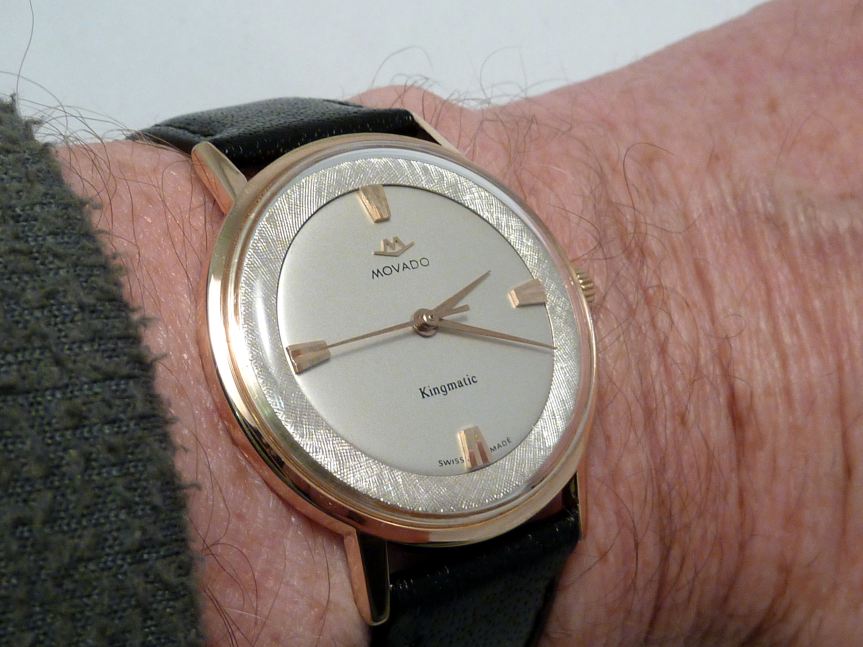
This model like so many of that time is that nice size so favored by many of the classic watch makers @ 34mm which allows it to fit most wrists easily and neatly. For me every thing about this watch is just right – beautiful face, great look, slim, elegant, perfect size, lovely automatic action and a joy to wear.
Looking good at any age.
The Kingmatic automatic model (and the Tempomatic before it) took the watch world by storm when it first came out in around 1962 and the Kingmatic was made probably till around 1967. The Company started off life way back in 1881, the name “Movado” meaning “always in motion” in Esperanto the Company has over 100 patents and over 200 awards and still operating today.
This is now my third Movado and my second mechanical model – I have also a Quartz and all have impressed me very much. The quartz one also has a highly individual dial face and a certain neat quality – and I can now see where the heritage comes from. This Sub Sea model especially with it’s rather unique face, it’s sleek movement and beautiful condition is my first purchase of 2013 and will certainly be on my wrist on many, many occasions I’m sure – and that surely is as good a testament you can have for any watch.
Regular followers of my blog will know that I have thing for comfort regarding watches. So often watches come with less than perfect straps and bracelets that whilst perhaps, and even this is debatable, are made to “look” good and compliment the model in question, but unfortunately simply do not fit the wrist properly. Or more accurately – they don’t fit or suit my or perhaps your wrist!
This is especially true of the “utility” watches I own and I quite often replace the supplied fittings. Perhaps they are very thick or stiff leather, or heavy wavelike rubber more suited for wearing over neoprene wet suits or sometimes a plastic or textile poor quality affair that either becomes brittle or unravels. So I tend to replace these with a silicon rubber deployment strap. These are fairly low cost, easily available and generally made to a similar standard and once fitted are very easy to use and extremely comfortable. I tend to prefer a twin button release version with a safety overlap clasp as shown here.
The strap basically is made of silicon rubber and slightly tapers down from the lug ends to the deployment clasp. There are around 14 slot holes across the strap that accept the spring bar and can be cut to fit the length required. Note on the ends are supplied new spring bars protruding out from the lug fixing ends as you see above.
Deployment and fold-over safety clasp
Now fitting these is by no means “rocket science” and is quite simple.
Note twin button release
The straps come with two spring bars, obviously the right length, as you will have first checked the distance between the lugs (the strap width) and ordered for example, a 20mm deployment strap. They are generally available as 18mm, 20mm, 22mm and 24mm, though it may be possible to get others outside this range, this tends to be the usual.
As you can see the strap fits to the deployment mechanism also with small spring bars and there are usually 3 alternative positions on the deployment fitting which allows you to adjust the strap for a more perfect fit once you’ve cut the strap to the approximate size required.
I usually remove the old strap and fit both the free ends of the new deployment to the watch using either the new spring bars or the old ones, whichever fits best – note sometimes the original watch fittings may be either too thin or too thick, so I prefer myself to use the new ones. Once you’ve fitted the strap it will of course, unless you have Neanderthal wrists, be far too big and loose. Simply wrap your other hand around it and squeeze it to your wrist to see how it should look. This will give you an idea how much to cut from both sides and to make sure the positioning of the flat metal work is against the centre of the inside of the wrist. You then use your scissors and cut down the edge of the slotted holes in one side of the strap (take care not to run too close to the edge of the groove – you may cut into the hole itself).
If this is the first time you’ve attempted this, take less off than you think at first, because you can cut more off as you go along, trying it out on your wrist as you go.
Once you’ve cut one side check the other and cut it to size as required. I’ll repeat that you should try to make sure that the deployment clasp is positioned more or less against the centre part of your wrist and not off to one side – this would not be comfortable at all.
Where to scissor cut the strap.Cut points – select a point to suit you on each side of the watch.
It is important however to get the right end of the strap to the correct lugs on the watch. Looking at the watch from the front with the 12 at the top, the top lugs should be fitted to the end of the strap which has the deployment swivel and button release mechanism – AS IMAGE ABOVE.
This can be seen in all the watches in the next image.
Look for the 12 o’clock position of each model shown here and note how the deployment swivel end fitting is attached to that lug side (note – these are shown for a left wrist watch wearer).
Examples of deployment fitted watches
So as said, no rocket science here, but care should still be taken. Always cut the strap, if this is the first time you’ve done this, a bit at a time. Once youv’e done both ends, try it – if it’s still too big, decide which side is the one to cut a little more from and try again. You can always shorten a little more as you go – too much and you’ll end up buying another strap! But if you’ve never tried a silicon rubber deployment strap, why not try it. They’re available on Ebay for example and don’t break the bank. Also with so many of what I call “utility” black faced, sports, divers style and military watches around, these suit them very well – but importantly once fitted these will also now be really comfortable to wear. Note they are available in different colors, though black is the most common. They also come in various textures, though for me I always seem to end up with the same one – with the parallel lines.
A simple post this time and perhaps a little bit simplistic for many, but you would be surprised at how many watch wearers have sold off watches as not suitable, when it was actually the strap and not the watch.
So if you’re lucky enough to get a new watch for Christmas and you discover that the strap or bracelet just isn’t right – don’t despair – maybe a change of strap might just solve the problem. Anyway good luck. . . .!
Note – Not all watches can take standard replacement straps – some are special fittings or integral to the particular watch. Check that a standard spring bar lug and strap fitting is possible before trying the above.
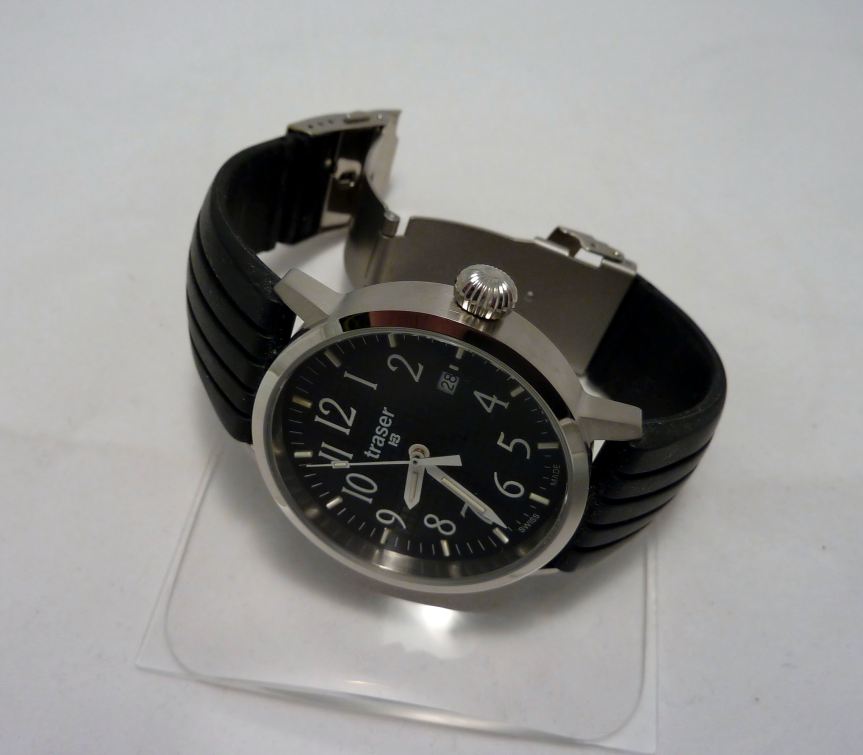
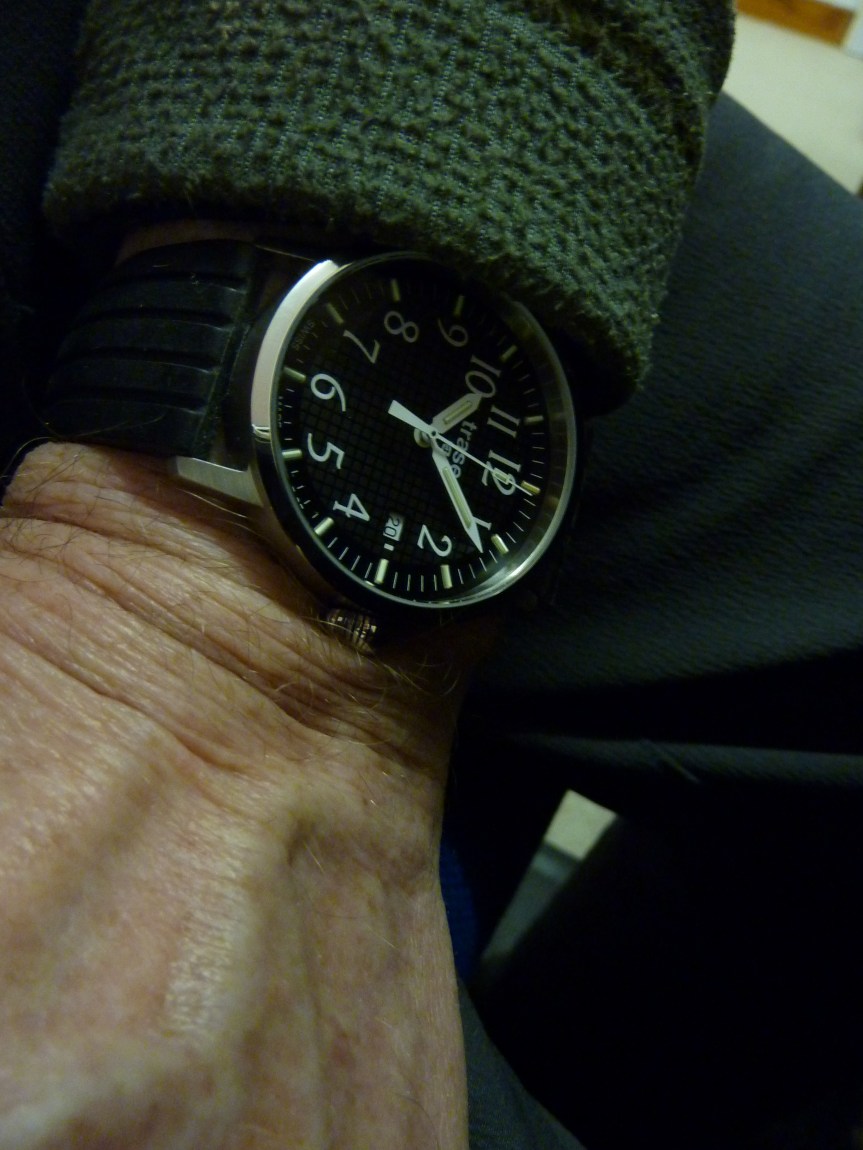
Whilst I referred to this watch in my Tritium comparison post recently I didn’t actually feature a proper review. This I will remedy now. The Traser “Classic Basic Black” watch as it is known or model T4102.240.A2.01 is a mid priced Tritium light source date watch from Swiss manufacturer Traser. More accurately this is mb traser® H3 and is the company-owned watch brand of mb-microtec ag. Thanks to its research, the Swiss company mb-microtec ag has succeeded in manufacturing a self-activated light source (GTLS = gaseous tritium light sources) that is 100 times brighter than any previously available. This is the technology it features in it’s range of watches.
Classic Basic Black from Traser (shown here with replacement deployment strap)
First off – the specification –
Model T4102.240.A2.01 – 2011
Case stainless steel case.
40mm diameter and 10mm depth.
22mm steel expandable bracelet (leather strap version available).
Ronda 715 Quartz movement.
78g weight.
mb-microtec Illuminated dial features – 1-11 green tubes & 12 – orange tube.
h/m/s hands green tubed.
50m Water Resistance.
The case is clean and solid looking with slight brushed satin look apart from the thin top bezel which is polished and being thin it allows the dial to dominate the watch look. It is in fact 35mm diameter and with the black dial background, large white numerals and white hands it is very clear to read. In fact one of the most legible I’ve seen. The date window is @3 and is set in a contrasting white background. A centre seconds hand completes the internal features and all under a flat mineral crystal that is very clear.
High visibility dial of the Basic Black
So in the dial department I have nothing but praise for this model. It is very legible in all lights, daylight, low light and as fitting for an mb-microtec tritium lit watch – it is especially excellent in total darkness. The Tritium tubes glow bright with the individual hour markers in green, the 12 marker in orange and the hands in green all easily visible. The seconds hand is just as bright and can easily be seen as it tracks around the dial in total darkness. In my opinion it is probably the best by far of any luminous system. Mb-microtec guarantee the light source for 10 years though I have the feeling that these will last considerably more than that before any degradation of light intensity. My oldest mb-microtec illuminated watch is just 6 years old now and it is still as good today as when purchased.
So no complaints at all regarding the dial features, legibility and night use – this watch excels in all these departments. Exterior wise it looks OK, clean steel lines, a slightly angular but not unattractive case shape with the good sized onion crown and with the deceptively large dial it is an easy watch to wear and own, no doubt of that.
Poor quality expandable bracelet
However when we come to the steel elastic bracelet, this is another matter entirely. This is a very poor affair, badly finished and very uncomfortable on the wrist – and certainly on mine. As can be seen in the image here neither the finish nor the fit of this bracelet is the quality of the watch. And this a real disappointment and so much so I replaced it with (as shown) a spare silicon deployment strap, which not only suits the watch much better, but is now comfortable to wear. In fact the shape of the case back and the general size of the watch, coupled with my replaced strap, makes this one of the most comfortable watches I now own.
Onion crown, stainless case – clean lines
Quality wise regarding the steel finish, whilst it’s definitely not as good as the Traser Big Date, it is certainly OK. I also note that it’s much lighter than the Big Date model at 76g (with my strap) against the rather heavy Big Date at 146g, though that’s good I think as you hardly know you are wearing it. As for the elastic steel strap – I have to view that as a mistake. I recommend the strap version.
Flat screw back in stainless
Sorry I did not manage to get a picture of the dial in the dark – my skills with my little camera don’t seem up to the job. Suffice to say that there are images on the mb-microtec, H3 Traser and other web sites which show that far more clearly than I can.
So overall I have to recommend this as a very good all round daily beater utility watch. Superb clarity in day and night conditions, easy to wear, good size for small to large wrists and well priced too. I would disregard the so called “elastic steel bracelet” as an aberration from Traser and purchase the leather version if possible.
Note – Personally I find the easily sourced silicon deployment straps I use on many of my watches are always a good replacement, though usually for replacing the more outlandish rubber diver’s straps favoured by some Makers. In this case however, it was an absolute essential and saved the day as far as the Traser Basic Black was concerned.
It would be nice if Traser take note of customer feedback in this instance and ditch the “elastic” bracelet – let’s hope so.
March 2025 – update
Now 12 years of age and the Tritium light source has faded badly. Barely visible in total darkness and I estimate within a year this faint light will have gone. And in fairness I’m not disappointed really – I could see the writing on the wall as it were and this model was the last Tritium light sourced watch I bought. Super-luminova and similar have overtaken it these days and is as about as good as you can get – and I have a good few.
So, goodbye tritium – it was good while it lasted.
Yet another model I’ve seen that I find attractive is the German producer Dievas (pronounced “D-Ah-Vas”) who have an interesting and very affordable range of quite decent quality timepieces. Modern diver or utilitarian style I suppose you could call them and the one I feature here is under their “tactical” series – the Voyageur GMT.
The Voyageur GMT Dievas
And whilst this has a larger case than I usually go for at 45mm, that is offset a little as it measures only 11mm depth, which means it’s not too bulky at all for my smallish wrist. It’s a 3 piece case made from Grade A 316L stainless steel. It is also hand finished which is rare these days in watches of this price range and has undergone the Dievas 6Steel treatment, known as Dievas 6Steel™ and as a consequence is very resilient to scratches and knocks.
You will note the large clear dial face clearly visible under a thick sapphire crystal with anti-reflective coating inside and clear Arabic numerals on the hours. White coated hour & minutes hands, plus a center sweep second, also in bright white and an almost forgotten date window @3, which I would have preferred much larger, seeing as everything else is so clear. The hands are treated with Super-LumiNova for great low light clarity, which for me is a plus. The 3rd hand which is GMT (or second time zone if preferred) is a sort of “floating” one, with only the tip being noticed initially. It is there of course but is colored black as the dial background but the tip is a bright red edged arrow with a Super-lumiNova centre. The pointer points very precisely to the outer 24hr perimeter track which is excellent, though the large red GMT lettering, whilst eye catching, for me perhaps is just a bit OTT.
“floating” GMT pointer with red Super-LumiNova arrow tip.
This model features the ETA 2893-2 automatic movement, which additionally has Côtes de Genève on the rotor and plates, incabloc shock protection and a 42 hours power reserve. A large 7mm crown means easy adjustments and finally it comes fitted with a rather solid 24mm red stitched leather strap and steel buckle. Personally, having a small to medium wrist, I’m not a great fan of heavy leather straps, so I might fit a silicon deployment replacement strap, but this is a personal thing.
As said this model caters for night time use, unlike so many others out there, which is to my mind, considering the utilitarian/divers style market, should be an essential requirement. And it does so rather well as shown in the last image courtesy of the Dievas web site which shows a typical night/low light image.
Voyager low light view – note the GMT arrow.
So pretty good on legibility at night, though with GMT arrow pointer clearly but the outer track not being lumed, you have to remember to x2 the visible numerals – in other words, this one is reading just after 9 hours. I particularly like the second hand clarity as shown and hope it’s really that good in reality.
In conclusion a nice watch and a worthy contender for my collection and definitely a wearing watch, not just for the cabinet.
Good points? – The watch dimensions, the case finish and the dial clarity – can’t really fault it – excellent.
Bad points? – Well perhaps the date indicator could be larger especially as the Dievas philosophy is legibility and since the rest has excelled in that department. And for me the strap is too heavy, but here I’m being very picky.
Overall – it is a fine watch at the end of the day – and this one is affordable and I’m sorely tempted! Again! 😉















 Watch space
You must be logged in to post a comment.