There’s class and elegance but there are few watch models that manage to combine both these words in the same breath. However for me there is certainly one that stands out from the crowd which is in my opinion often overlooked. Why it’s passed over almost without even seeing it, is perhaps as the name is so synonymous with quality it’s taken for granted that it’s beyond the reach of your average guy. But you are mistaken indeed – try looking next time and you might just be surprised. This one is the Automatic, but they also offer a quartz version, though you would be pushed to actually see much difference in looks.
Cartier Tank Solo W5200027 – says it all.
One of my absolute and all time favorites is the Cartier Tank Solo. Classic, timeless, stylish and elegance all rolled into one deceptively simple and iconic design masterpiece that once on your wrist is virtually part of you and you a part of it. Whatever magic is there and there is a magic, it becomes you and in turn you become relaxed, calm and every-things alright with the world – an attitude of mind of course, but you feel – great!
The Tank Solo model W5200027 for Gentlemen, Date watch is about as classic as it’s possible to get. So much so that everything else is compared to it, but the design is so iconic that anything other is simply not on the same page. I particularly like this model as they have revised the case slightly (I always hoped they would but didn’t believe it) to a similar case shape as their quartz version. The profile of the case has been flattened on the top as opposed to the roll shape of the original Tank design, making the overall look that much sleeker.
This extra large mens Automatic features the Cartier Swiss calibre 049, with rectangular Tank case in Stainless Steel at 40.85 mm x 31 mm and only 7.65 mm thickness. The silver dial has numerals enhanced by a Sapphire Crystal glass, a Date window @6 and the Cartier signature blue steel hands compliment the synthetic cabochon set crown. Black alligator strap with deployment buckle and Water Resistant to 30 metres.
Indeed it is so simple in it’s design brilliance that you would be forgiven in thinking this was way above your means – it’s a Cartier after all – but you would be wrong. It can be yours for under £2500, which is high for some I admit, but in this quality market actually represents good value and the quartz version which shares the same looks, can be had for considerably less, though personally I’d pick the Automatic. However I have seen this Automatic model for sale pre-owned around the quartz price and at that, it’s a great entry into the world of Cartier for actually very little.
A friend asked me the other day what I thought of the Gulfmaster Ocean G Shock series of models from Casio, which appear to be the culmination of the “pack it all in” concept with both digital and analog (motorised) display and taken to it’s limits?
Casio Gulfmaster
If you check out the many videos that are around, this is a watch absolutely stuffed with functions, is the latest thing and I should like it. BUT when considered against the Casio Rangeman for exampleI’m of the opinion that maybe it’s just too much. With the addition of analog function it’s almost overloaded and more importantly it’s twice the price. Now don’t get me wrong here, I’m all in favour of more functions and I like the Gulfmaster but would I buy it? and the answer I’m afraid, is no I wouldn’t. There is also a point when you start adding analog and digital functionality where you have to be careful of over-complication and despite how clever Casio have been, I’m not sure if they’ve carried it off.
Compass mode – Hands become True North pointer. The digital display indicates angle in degrees between the 12 o’clock and the True North pointer. Declination can be set in menu.
Take the Tissot Solar Expert Pro for example – now that’s a feat of display engineering if ever there was – utterly simplistic analog appearance and yet with enormous ABC functionality. Done with the most clever fusion of touchscreen, digital and analog micro-motor technology, it easily surpasses Casio in the complication v clarity stakes.
Casio Rangeman GW-9400CMJ-3ER (tougher than old boots!)
The Casio Rangeman on the other hand I like why? Well first off I like owning it. I like it because it manages the same functions (which are ideal for me) as my Protek ABC 270B, but in the G Shock classic tradition. I like it because it’s all digital with no analog provision and looks actually quite plain, or unobtrusive perhaps is a better description. Just another G Shock you may think, but it’s actually very much a wolf in sheep’s clothing. The function (QW3410) set is actually very similar to the Gulfmaster, but with the omission of any analog clutter, is without Tidal information, but has the added bonus of a Sunrise/sunset function and a snooze Alarm (don’t know why that got missed on the Gulf). The Rangeman is also in practice, smaller on the wrist, which is an important consideration when dealing with these multi-function models.
Both models use the “Smart Access crown, rather than separate pushers as my Casio Pro Trek PRG270B-3, which is an improvement and as I say feature wise are very similar. And with such large functionality it is pretty obvious all these models are going to be big (though that said, the advance in miniature technology is nothing short of amazing) – indeed they are all similar, but shape and band/case fit tends to dictate which wears smaller on the wrist and the Rangeman, surprisingly for a multi-function G Shock, though large is neater than expected.
None of the models are heavy though with the use of resin case technology. One of my dreams however would be if Casio could reduce the sizes of these watches to around 45 mm x 45 mm and under 15 mm case depth, but I’m very doubtful that will ever happen as there is this compulsion to pack more in with every model . . . .
However function wise the Rangeman is very comprehensive and with basically 3 versions – the GW-9400CMJ-3ER shown here with Green case and Positive display – the GW-9400-1ER with Black case and Positive display and the GW-9400-3ER with Green case and Negative display. I should say that my personal view is most Casio Negative displays are not in the same league as Positive ones.
The technical data for this Limited model is as follows –
Casio G-Shock Rangeman Men in Camouflage Wave Multiband 6 Watch GW-9400CMJ-3, GW9400CMJ
This latest addition to the Master of G Series designed has the camouflage pattern on the resin band. Based on the previous RANGEMAN plus a carbon fiber insert on the band and with the Triple Sensor Version 3 (altitude, bearing, barometric pressure). Part of the new New Master of G Series of models from Casio.
Specifications
Mineral Glass
Shock Resistant
200-meter water resistance
Case / bezel material: Resin
Carbon fiber insert Resin Band
LED backlight (Super Illuminator)
Great illumination for dark use.
Full auto LED light, selectable illumination duration, afterglow
Solar powered
Time calibration signal reception
Auto receive up to six* times a day (remaining auto receives canceled as soon as one is successful)
*5 times a day for the Chinese calibration signal
Manual receive
The latest signal reception results
Time Calibration Signals
Digital compass
Measures and displays direction as one of 16 points
Measuring range: 0 to 359°
Measuring unit: 1°
60 seconds continuous measurement
Graphic direction pointer
Bidirectional calibration
Magnetic declination correction
Bearing memory
Altimeter
Measuring range: –700 to 10,000 m (–2,300 to 32,800 ft.)
Measuring unit: 1 m (5 ft.)
Altitude Memory Function:
Auto Save Data: High altitude, low altitude, cumulative ascent, cumulative descent (1 value each)
Others: Relative altitude readings (–3,000 to 3,000 m)
Selectable measurement interval: 5 seconds or 2 minutes
*1 second for first 3 minutes only
*Changeover between meters (m) and feet (ft)
Barometer
Display range: 260 to 1,100 hPa (7.65 to 32.45 inHg)
Display unit: 1 hPa (0.05 inHg)
Atmospheric pressure tendency graph (past 42 hours of readings)
Atmospheric pressure differential graphic
Barometric pressure tendency information alarm (beep and arrow indicate significant changes in pressure)
*Changeover between hPa and inHg
Thermometer
Display range: –10 to 60°C (14 to 140°F)
Display unit: 0.1°C (0.2°F)
*Changeover between Celsius (°C) and Fahrenheit (°F)
Manual data recording of up to 40 records (altitude, barometric pressure / temperature, bearing, time (Time Stamp))
World time
31 time zones (48 cities + coordinated universal time), city name display, daylight saving on/off
Sunrise, sunset time display
Sunrise time and sunset time for specific date, daylight pointers
1/100-second stopwatch
Measuring capacity: 999:59’59.9”
Measuring modes: Elapsed time, split time, 1st-2nd place times
Countdown timer
Measuring unit: 1 second
Countdown range: 24 hours
Countdown start time setting range: 1 minute to 24 hours (1-minute increments and 1-hour increments)
5 daily alarms (with 1 snooze alarm)
Hourly time signal
Battery level indicator
Power Saving (display goes blank to save power when the watch is left in the dark)
Full auto-calendar (to year 2099)
12/24-hour format
Button operation tone on/off
Regular timekeeping: Hour, minute, second, pm, month, date, day
Accuracy: ±15 seconds per month (with no signal calibration)
Approx battery operating time:
8 months on rechargeable battery (operation period with normal use without exposure to light after charge)
23 months on rechargeable battery (operation period when stored in total darkness with the power save function on after full charge)
Size of case: 55.2 × 53.5 × 18.2 mm
Total weight: 93 g
LED:White
Not many downsides for this model, though I would liked to have seen a sort of 2nd Time Zone/Home Time SWAP feature, but I’m nit picking – changing to another World Time is easy enough so hardly an issue.
So in answer to my friend’s question – Yes I like the Gulfmaster but it’s not perhaps as tough as it could be with that unprotected glass, the analog hands feature whilst very good I don’t really need, the prominent text bezel seems over-large for purpose, Tidal and Moon stuff I don’t need and I just prefer the rugged tough look of the Rangeman, which is as well specified anyway. Now that said, there is no doubt it is a superb watch and might well suit everyone so much that I’m the odd guy out, but it’s a personal thing and remember this was a question posed to me just the other day. I have NOT seen the Gulfmaster in the flesh, so it’s a sort of remote opinion (which I never like doing) and who knows if I had it in my hand or on my wrist, my opinion might change and I might love it, though as I say fortunately I haven’t seen one close up – 😉
The Casio Rangeman GW-9400CMJ-3ER shown in conclusion is what I call a set and forget watch, looks like any other G Shock, which it isn’t and is probably the toughest watch produced, so I’ll stick with it until I see better. Which could be a considerably long time . . . . What can I say . . . .
Note – this post not intended as a comparison between the two models shown, rather I was asked for my personal opinion which I gave “in Post” as it were. . . and as I was about to Post on the Rangeman, it seemed the ideal opportunity.
Known to many watch enthusiasts, though not perhaps mainstream is the Locman series of watch models from Italy. Since 1977 this Company has produced really interesting design models not often spotted outside Italy and very rarely encountered in the UK, though that said I’ve alway checked them out every so often. Here are two models I like – one for the Gents and one for the Ladies.
The Locman Stealth Chronograph 020200 series.
First up is the Locman Stealth Chronograph (020200CBFYL1GOY) in Stainless Steel with a Titanium bezel. Sapphire crystal with black carbon dial, center seconds layout with chronograph and a magnified Date feature @3. Very neat at just 8 mm depth x 43 mm diameter fitted to a smart yellow rubber buckle strap, which color co-ordinated with the dial and hand markings which are luminous and yellow highlighted. 50 m Water Resistance and a 2 year Guarantee. Note the model has Swiss quartz movement.
The Locman Ladies Tuttotondo (Frank Muller design) MOP dial and Date watch.
The Ladies Locman Tuttotondo 034000 series model is a solid Stainless Steel round case model with Sapphire crystal and a neat Mother of Pearl dial, with a Frank Muller designed numerals layout, center seconds hand, Date window @3 and a really striking red color leather buckle strap. Neat at just 5 mm depth and 38 mm diameter this is a striking and perfect size model for the modern woman. Weighing just 60 g and with 50 m Water Resistance, 2 year Guarantee, Swiss Quartz movement.
Note the color co-ordination of strap and dial in both models, which is often a feature of Locman which gives an added attractiveness to their range.
The price of both models is around the £230 mark, so are very well priced for what are well constructed and interesting models. They will certainly give rise to conversation and comments as they are both so different, very stylish and rather uncommon.
Niche models are what I call watches not in the mainstream and quite often offer specialist pieces for a specific market.
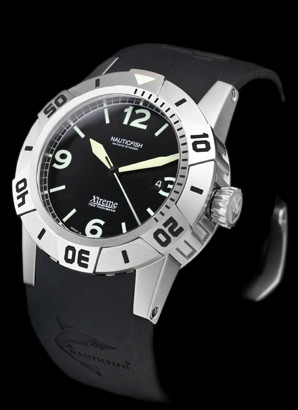
NauticFish Xtreme 2000m does what it says on the tin!
This one from Germany is typical – the NauticFish Xtreme 2000, which as you can guess is prett useful if Diving is your thing, as it has a whopping 2000m depth rating, which gives it some gravitas. Movement wise it features a Sellita SW20A which is the alternative to the ETA 2823-2 series of Automatic Date movements and well regarded in it’s own right.
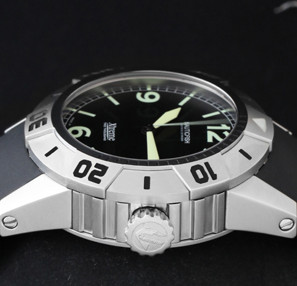
Solidly built with a Stainless Steel case some 45 mm diameter x 16mm thickness it’s liable to withstand most situations. Screw down crown of course. It weighs 120 gms, has a Sapphire crystal and here shown with a rubber buckle strap.
Solid build from Germany with a Sellita SW20A Automatic movement.
White Superluminova luminous index and broad hands with a centre seconds hand against a black dial background ensures decent clarity, with a small Date window @3.
Nothing fancy here, just a great solid built for purpose model that’s maybe not so well known, but very good for all that.
Comes with a 2 year Guarantee and a Manual – so what else do you need?
Note – This is the first of a series featuring a few non mainstream models that caught my attention of the past year, which sadly don’t seem to get the air time perhaps they deserve. Usually Independent producers or bespoke enthusiast models assembled and produced to fill a perceived gap in the market.
Some are very good indeed and others perhaps not so, though I try to pick ones that seem to me to be interesting and perhaps offer something different – but whatever, it does illustrate the wonderful diversity available today.
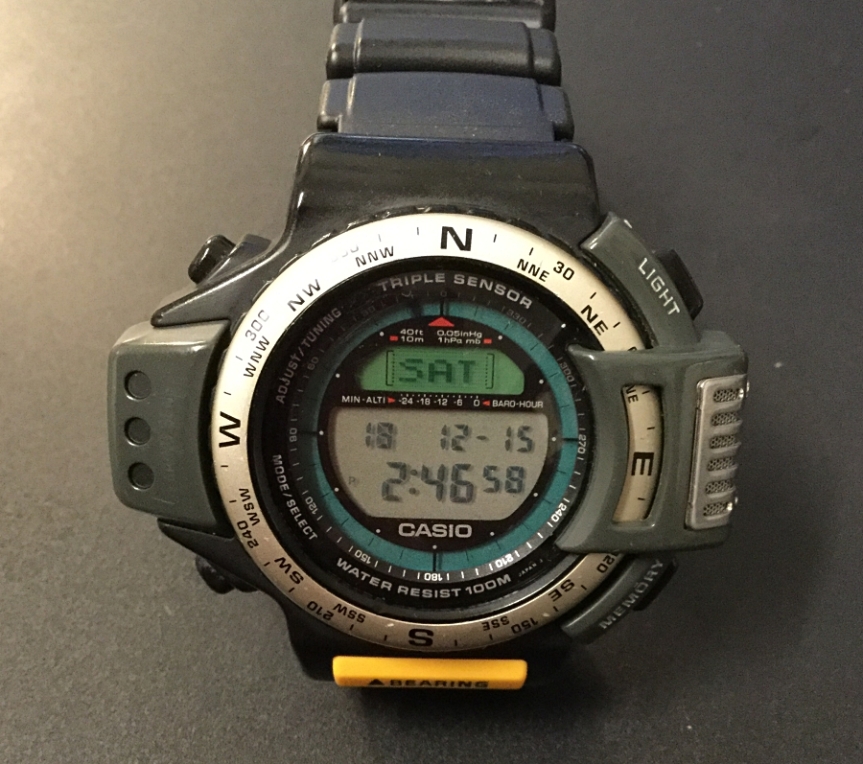
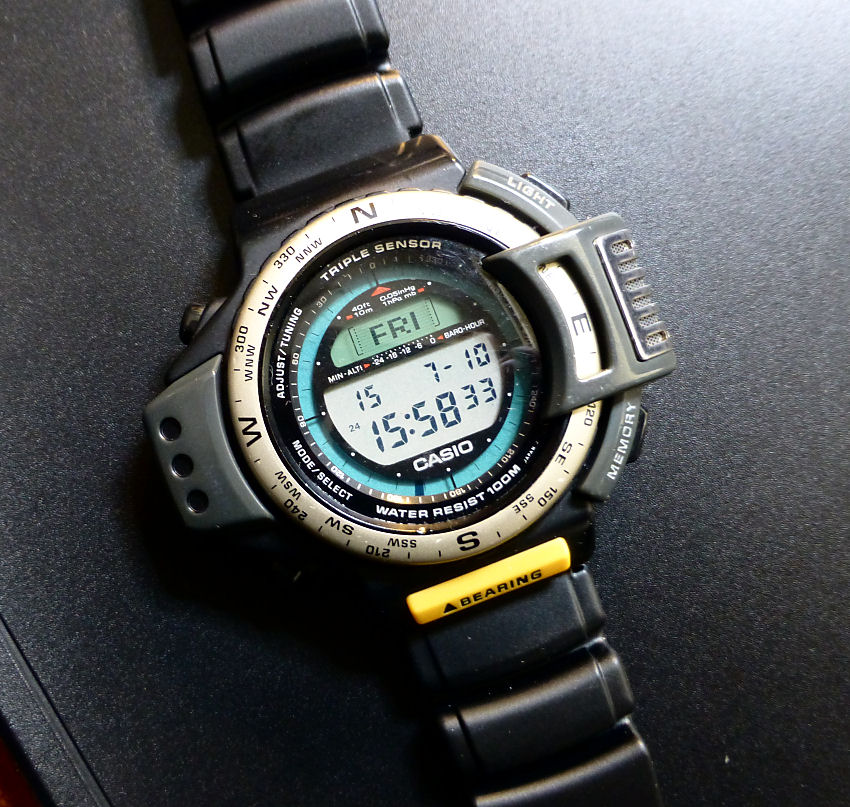
A classic from Casio – the ATC-1200 Altimeter, Barometer and Compass model with the QW1170 movement Module introduced in 1989, might be a little old, but still looks good and very high tech, but more importantly it’s still going strong today. As with many older models such as this it’s wise to check the automatic calendar function, to ensure it remains correct today – this model is OK until 2029, so will probably see me out! (Month/Day cycle ratio pattern is repeated every 28 years – so could be corrected).
Casio 1170 ATC-1200 Triple Sensor model 1989/90 – a rare classic.
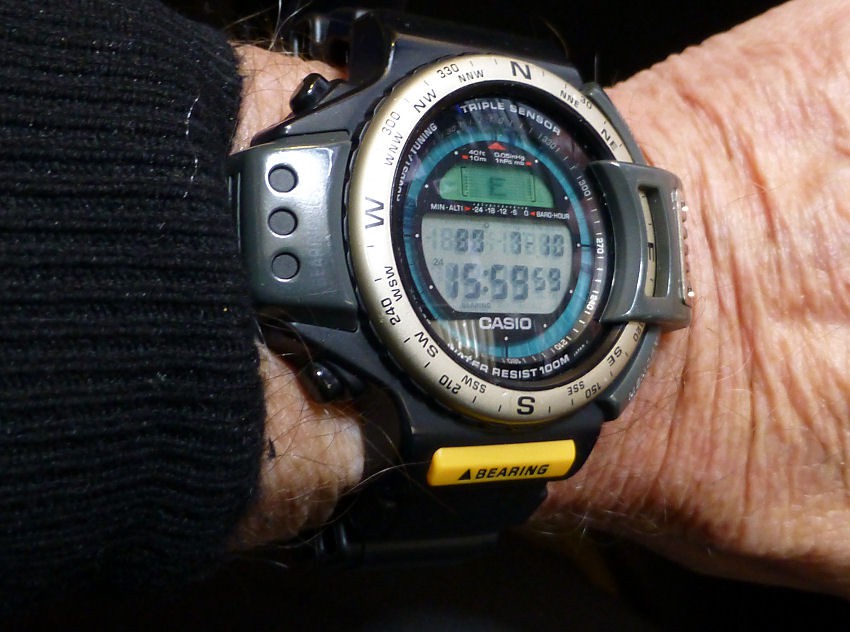
This however is one serious bit of Casio kit, incredibly well put together and beautifully fitted out with the almost science fiction style sensor housings and a very neat dial set up that manages to look just right. Dimensions are good too at just 50 mm lug to lug, so fits smaller wrists, though the case (with the sensors) width is larger at about 56 mm – however, this lies along the wrist so not really an issue. The watch case depth is the success though at under 15.5 mm, so the watch doesn’t feel big at all and in fact wears well on my average to small wrist.
ATC1200 on an average wrist – a decent fit for a full blown Triple Sensor model.
The watch has a Casio flexible resin rubber buckle strap which fits with standard spring-bar fixings (I like) and measures maybe 19/20 mm, so easy to change to any kind of alternative strap should you so wish.
The standard view on the display shows on the top line – the Day of the week. The main display lower part shows the Time (12hr or 24hr) Year, Month, Date and Seconds plus a mobile seconds track around the perimeter of the dial with black segment markers against a green background which looks rather good and very clear.
In addition to the digital compass (with 5 memory settings available), this model has Altimeter, Barometer and Thermometer sensors, 5 independent Alarms and Stopwatch with split times and 2 finish times settings. It has a warning indicator for low battery and a magnetic fields abnormality indication plus a Sensor malfunction indicator. Not at all bad for 1989/90’s.
Great Casio Triple Sensor ATC1200 – a watch well before it’s time!
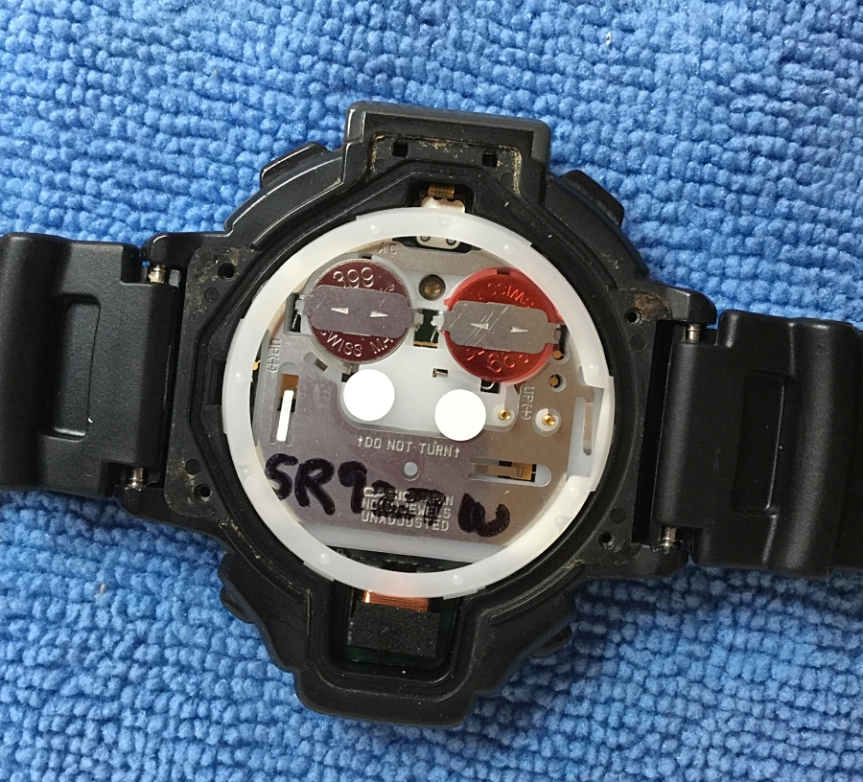
2 batteries are used in this model which are the SR927W series and these have an approximate life of up to 18 months to 2 years depending on function use. Note after replacing the batteries the display may remain blank, so it’s important to do a reset. This will empty old memory/counter settings and this is quite simple to manage – touch the AC contact and the battery (+) side OR short out the two copper “spots” on the circuit board just below and the the left of the AC mark, with metallic tweezers or similar for around 2 seconds. The display should then fire up.
I attach images to illustrate –
Casio 1170 – back removed with module exposed showing 2 x SR927W batteries.White plastic location shroud lifted away to show the AC mark on the top left of module frame. See just above it and down on the circuit board, 2 x copper connector points.Finally – Use metal tweezers for a couple of seconds to short out the copper terminations (or to case) – to reset module display.
Note – An odd but useful tip with some of these older models is after a battery change when nothing seems to happen – push the “light” button and the display will often activate ON. But note on these complication Casio models be aware that unless reset, the display whilst it’ll look right, odd results are very likely as the memories have not been cleared.
Water Resistance is 100m – assisted by the rubber seal (you can just make out it’s recess around the case body) under the flat metal plate which is held with 4 x screws.
In amongst the many functions of this watch is the neat facility to get back to the main page – whatever screen you’re in – simply press C button (lower left) for 2 or 3 seconds and the display will revert to the main Time screen.
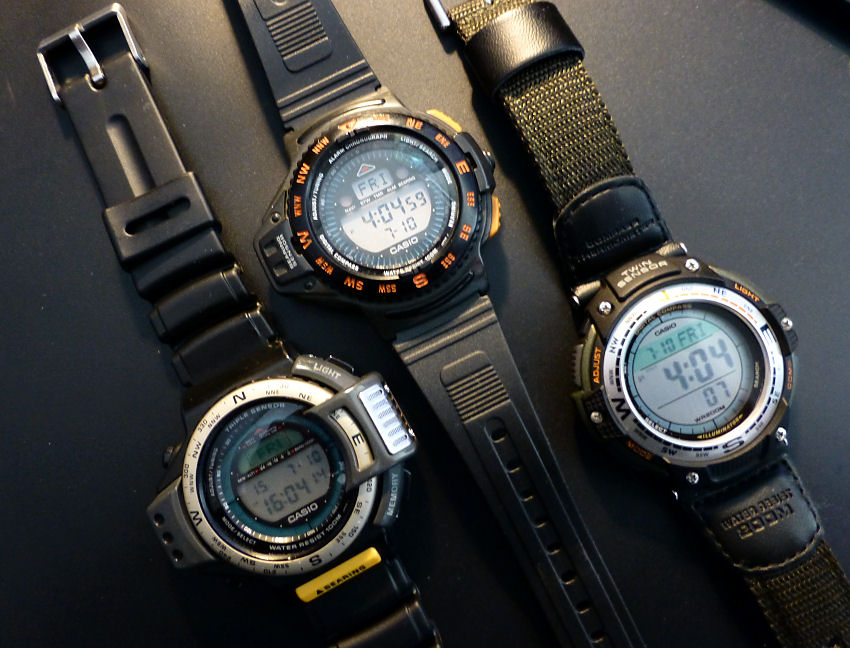
A trio of Casio Sensor watches. Wow!
The late 1980’s and early 2000’s was a great time for Casio innovation and there are in fact many “odd” function style models from this time. Not only are they often well before their time and the pre-cursors for much of the technology you see today, but are viewed as quite rare collectors pieces. And this is not so much due to their age, but owing to when they were produced, as at that time it was an amazing period of technological and miniaturization experimentation, the likes of which you will probably never see again.
Another function I like is the alternate calibration of the Compass. So often these require fiddling around with rotations and button pressing at the same time, known as bi-directional calibration. You can do this on this model if you like, but I prefer the Northerly calibration, which is simpler.
Set the watch on a level surface and face the watch bezel N towards your known NORTH (check this beforehand, at home with a real compass). Hold down ‘A’ to clear the display to show –1–, then press ‘C’ ready to start. N will appear in the upper display and then press ‘D’ to start calibrating. After a short time OK appears and that’s it.
I love it and they don’t make ’em like this anymore – which is a real pity. Awesome design and fun to wear.
Another Casio from the early 1990 period when they started production of a series of multi-function Digital Compass models. This is the Japan made model CPW 220 which features their module QW1286.
Old Casio CPW 220 Digital Compass
The operational procedures for this are exactly the same as for the module QW1030, though with transmission of the visual data modified somewhat for the highly unusual digital display.
Look carefully (lower image) and you will note the outer track is marked oddly with descending graduations from 36 (x10) to 0, which obviously is in degrees. However I’ve never seen a degrees scale running clockwise from 360 to 0 as opposed to 0 to 360 in a digital compass watch and OK maybe it’s just me, but I haven’t quite worked it out yet.
Compass bearing for 12 position (NNW) and note North & cardinal points indicator.
Note this model was produced when the “glass” was possibly a rather soft acetate compound which was easily scratched (this has a few scratches), but it is still easily read and all functions are working perfectly – a testament to Casio’s early electronics and displays.
The case resins were also not quite the quality we take for granted today and the lettering has all but disappeared color wise, but the embossed figures are still quite readable. The current seconds runs around the degree track and all segments are perfect and when using other functions the seconds markers don’t display, instead are changed for Compass, Navigation, Stopwatch, Timer and Alarms etc.
As usual with most Casio models the back light operates via the top right push button. This is a dial side light however and just about adequate I’d say though is surprisingly bright. It stays illuminated as long as the button is pushed.
Like most early digital compass models there is no facility for compass declination settings, so magnetic North it has to be and in that regard it’s still pretty accurate, if kept away from metallic influences of course. The bezels in these older models always stiff even sometimes immovable as the case screws are invariably very tight and the clearances have long since dried up. If you need to use the bezel care has to be taken in any disassembly. The problem with these old softer resin cases are the screw holes – very easy to damage them and if you do cross thread them, well just let’s say re-dieing the thread is a bit of a pain!
Great fun though, these old Casio technical watches as at that time they were really stretching the boundaries of what they could put in a wrist watch. An amazing array of different mobile displays and always a pleasure to see close up and always a discussion point if spotted on your wrist. And I always wear them! at some time.
Next up is the 1996 Triple Sensor ATC1200 – another gem from Casio that really looks the business!
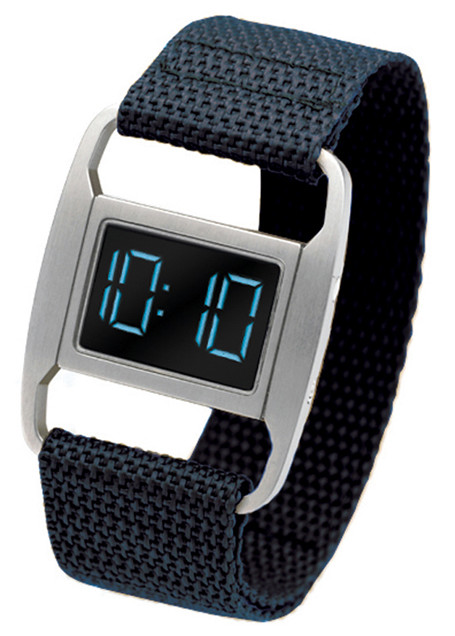
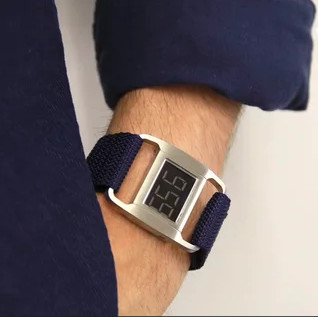
British industrial designer Michael Young has relaunched the PXR-5 which if I recall correctly first appeared back in 2010. (update info – possibly 2004) I particularly like this model as whilst it cleverly espouses a fresh and modern ultra minimalist look, it manages to do so without that bland and featureless Scandinavian style, that always turns me off.
Michael Young BXR-5 BR/NY – stainless/blue
The PXR-5 in contrast is a wonderfully understated design classic with a simple digital face and adjustable nylon Velcro strap. It’s both today and casual fashion look rolled into one. Basically and according to Michael Young himself he simply wanted it to tell the time, no more no less and also have the easy facility to change colour to suit the occasion. This very successfully manages by the use of a super simple Velcro strap. There are a couple or three little pushbuttons, the right side ones for changing the Time and the left side one for activating a back light. The case, and there are optional finishes, is Water Resistant to 30 metres, so showers are no problem.
Designer simple – yet so neat and effective
The version shown here is of the PXR-5 BR/NY with a silver brushed stainless steel face and navy blue strap.
Like all good designs, this is simple and yet incredibly effective and will suit the wearer in virtually any situation. And why has it appeared again. Well again according to Michael, the phone has never stopped ringing from folks wanting to know where they can get one – simple as that!
Case shown in this version is 316 stainless steel, with a polyester and Velcro Strap. The digital LCD display has a Blue/Green EL. The Case length is 45 mm lug to lug, 36 mm wide and just 8 mm depth. The battery is a 1.55v V391 or equivalent and it comes with a Manufacturer’s warranty of 24 months.
Silver and grey version
I understand it should be available and around £80 (UK pricing).
There are in fact 4 versions – the two shown here plus a gold coloured model with brown Velcro strap and a Black model with black strap. Prices are the same for any model and if interested, experience tells me the shelves will be cleared pretty quickly . . . . so . . . .
For those of us that don’t actually require the full ABC sensor set up there is the lesser option of a Twin Sensor model. Some folks don’t really need to know the Barometric Pressure or the Altitude or the Temperature, though the latter seems to come regardless for some obscure reason. You could of course, if money an issue, get yourself a cheap “does everything” ABC model such as the LAD Weather watch, but at £40 against the Casio Twin Sensor model at £50, once you factor in known quality and reliability issues, plus wild variations of good to bad reviews of the LAD, then I’d have to go with the Twin Sensor from Casio. (incidentally the LAD Weather watch with such conflicting reviews says to me that Quality Control is left to the buyer and that I don’t like).
So all that said and back to topic, the best value Twin Sensor model I’ve yet found with Compass and Thermometer is the Casio SGW-100B-3V and it’s not just best value, as not being G Shock and with fewer sensors, it is a much smaller and neater affair altogether. It is also very, very easy to use. I should also note this model is battery, not Solar as the triple sensor PRG270 I reviewed last week, but with 3+ years battery life, it’s hardly relevant.
Let’s say you’ve been wearing the watch for a month or so and you decide to use the Compass – the scenario being, you might have just popped up to street level from the subway/Tube in London for example and no clue what direction you’re facing – Well you’re in luck as this model is as easy as it gets, it’s also super clear to read the dial (unlike so may digital models) and one push of a button shows North and you’re on your way.
Neat to the wrist and great quality construction
Physically the watch is just 47.8 mm diameter and only 13 mm case depth and importantly just 49.7 mm lug to lug, which means this model sits great on small wrists. And weighing a mere 57 gms, it’s a wear and forget watch and a real contender for Daily Beater status. And although it has just two sensors, it still has a good feature set, with a 24 hr Stopwatch, 59 min, 59.99 seconds Countdown Timer, a 29 zone 48 Cities World Time function, 5 Alarms and is Water Resistant to 200m. The pushbuttons are not overly protected and neither do they need to be as they are sleek to the case, easily operated and located within the centre of the case edge, so don’t suffer from inadvertent operation either.
In short this watch is a gem and with it’s high contrast digital display, it is simply better than any other brand, bar none in the clarity stakes. It also has a night light in the form of an upgraded EL (electro-luminescent) panel that highlights the digits in a glow for a second or two.
The digital compass aspect (why I have it) is good and simple to use. I have also found it surprisingly accurate and against my Silva trekking compass it reads the same. Pushbutton D (lower right) and the compass mode starts – sweeping a revolution graphic around the circumference of the dial and then indicating with an arrow – North. The heading of the 12 o’clock position is indicated in degrees and Cardinals. Nice to note that in compass mode, the time is still visible on the upper dial zone. Compass Declination is catered for and can be easily set and also easily switched OFF if not required.
Neat Twin Sensor or ABC – note both are textile straps – so small wrists welcome!
It is also nice to see that Casio compass sensors are pretty accurate today. For example if I activate my Triple Sensor ABC Casio PRG270B-3, my Tissot Solar Expert and this model together with my Silva Compass, they all point in the same direction. I remember well when digital compass models first came out, different brands pointed in different directions and rarely stayed calibrated for long.
The Module in this model is the 3157 and it has a industry standard CR2025 battery, so is both efficient and practical. Water Resistance is a good 200M or 660 feet, so if you swim, no problem. This model has the textile strap which is my preference and it’s of decent quality and much better than their older generation, with melt edged buckle holes and a steel buckle and as I’ve said before, the textile strap fits the smaller wrist much better (see images) as the strap can sit perpendicularly to the case.
Casio precision case and dial quality – difficult to beat
The strap is approximately 24 mm at the case fixing and tapers to 18mm at the buckle. A hybrid springbar fitting is used and a standard strap/band could be fitted with a bit of fiddling if preferred. (Note I’ve never had issues with Casio textile straps despite adverse comments from users – What on earth do these folks do to destroy both straps, bracelets, cases, crystals and goodness knows what else? I have to wonder what their car or home looks like?
Finally this model is a testament to Casio high quality watch production today, very well made, great resin technology case construction (I’ve not seen better) and in short, this model in my opinion is pretty special and with no negatives to report. And at around £50 in the UK it also has to be a bargain.
If you don’t have one now, then I suggest you find one sooner rather than later, as these, certainly in the strap version, are becoming scarce.
So my picks for ABC and Twin Sensor are – the Casio SGW100B-3v Twin Sensor and the Casio PRG270B-3 ABC Triple Sensorand I think it doubtful either model will be bettered for some considerable time – if at all!
Note – Whilst Solar is fine for the Triple Sensor PRG270 being an ABC multi-function model, the lack of Solar on the Twin Sensor SGW100 is fine for me as the battery life is in excess of 3 years anyway.
Been having a look at my old digital compass watch models and rather impressed at the fact they still work pretty well. In fact accuracy wise they are still holding their own against more modern offerings and they have the advantage of being within a much neater footprint, despite later sensor size reductions.
Take the CPW-100 for example which features an early 1031 module set. This model appeared back in 1993 and one of the first Casio’s to feature a compass sensor. The circular digital display is still rather novel, but it shows what you need to see very well.
Casio CPW-100 digital compass 1993
I like this model for all sorts of reasons in addition to the neat dimensions as just 40mm case diameter, though if you include the sensor it’s 50mm across. But as the entire model is just 12 mm thick and the lug to lug is very small by today’s standards, so easily fits the smaller wrist.
Note the inner display normally shows running seconds. The compass works as a direct read push button and after a second indicates magnetic North/south with the digital arrow pointer in the centre circular window. The Direction is also indicated at the top of the dial as NW, ENE, etc. (here shown as WSW) in place of the Day of the week.
Compass indication – note the digital arrow pointer – to North – and the Direction of 12 position (WSW) in place of the Date.
It is an instant reading which does not change even if you move the watch, so doesn’t, like modern counterparts, take a reading every second. It does however have a “navigation”mode which allows you to store up to 5 sets of measurement data in memory, along with the date and time of the measurement. These can be recalled later to trace your progress on a map for example. To aid navigation the outer bezel can be rotated (N mark to line up with indicated N for example).
Note – the CPW-100 has 2 x batteries – Renata 399 (LR927) held in individual holders. Operating manual – Casio CPW-100
Another model of the same period is the CPW200 which features module 1030.
Casio CPW100 and 200 Digital Compass models. Circa 1993
The dial layout is more familiar to modern Casios, plus it has a running seconds digital track around the circumference of the dial. The module difference is only in regards to the digital display as in this instance the compass indication shows not just the North/south line, but also the other E & W cardinal points, around the seconds track. In fact both models use their respective running Seconds track as the compass indication.
In all other respects function wise the two models are the same – Both have Compass and Navigation modes, 24 hr Stopwatch with split/finish times, Countdown Alarm from 1 m to 24 hours with selectable auto-repeat. Also there is a a daily Alarm mode and Time signal function etc.
In comparison to the more modern Casio Compass watches these both perform really well, though neither have Compass Declination adjustments possible, so very much Magnetic North has to be used in any orienteering. That said as the Declination where I live is just 1.3ºW and would be just 1ºW if entered into a modern Casio, so for general directional compass work, walking etc. both these models perform well enough for me. They are also both water resistant to 50 m and 100 m respectively, though with any of these 20+ year old resin/metal back models, this should be taken lightly. The seals are often dried and shrunken and replacement is tricky, and whilst not impossible – I don’t go out of my way to drown them – or me these days!
In truth the fact these work at all is a bonus and both are in pretty good condition overall. Module wise both are perfect and function as new and they both “wear” well on the wrist and can often attract comment (if noticed as they are both very neat), though at my age folks seem to take it for granted that I’ll have old things!
This from my young grand-daughter just the other day! 🙂
Note – Another Compass model from the same period is the CPW220 ( planned for a later Post) features Module qw1286, which has the exact same functionality as Module qw1030. This is not surprising as within this “novelty”period, Casio whilst introducing individuality in their digital range, inevitably featured similar if not identical modules, to fit the various dial designs.
Been looking for something to replace the Casio PRW3000 I had stolen from luggage that went missing on a trip last year in darkest Africa. On the bag’s reappearance my Casio was missing along with other stuff, but the watch was the one thing I missed most of all.
When I returned to the UK, I got myself a Tissot Solar Expert (my first true Swiss ABC model) which I’d always wanted anyway and to this day it’s been my alternative compass watch for my Casio. With its touch screen concept ana/digi system the Tissot is very unlike Casio and whilst really clever operationally, somehow I still miss the dare I say, “older and more conventional” familiarity of the Casio digital set up.
Casio Protrek PRG270B-3 with Textile buckle strap.
So that said I decided at long last to perhaps consider another Casio and whilst the 3000 series is still ongoing, I’ve instead picked another model with the same and now upgraded sensor set, but at a more affordable price. And not tempted by the Titanium, this time went for the Casio Pro Trek PRG270B-3, in the green and black resin G shock style case. Note that this version has the textile band as opposed to the resin band. The reason for my choice here is important to me because of my wrist size.
Note the textile band close fit to the wrist.
The resin band versions effectively adds to the lug to lug size just enough to cause fitting issues when worn on my average size wrist. Whereas this textile band version reduces this dimension to under 50 mm and it can swing freely 90º from the case and so fits much more snuggly. Being G shock style of course it’s tough enough to withstand almost anything, which I suppose is a definite plus when considering the places I tend to end up in.
Great look in green/black with textile strap. Bright display in any light conditions.
I also selected this Casio model because it’s a middle of the road example of both the genre and price point. It appears to offer decent value and considering my PRW3000 cost twice as much (a Japan domestic model at the time). It also has the internal module 3415, successor to the 3414 of my 3000 model which was already very good. I should also say that the clarity of the green (almost gold) background digital display is really excellent and one of the best I’ve seen from any Casio to date.
Note strap allows small wrist fitting (has no extenders from case)
The 3415 module set means ease of use, logical controls and function switching. Feature wise it’s Solar Powered, World Time, Triple Sensor, (Alti, Baro & Compass), excellent full display back light. Also the overall color scheme is definitely my favorite and looks great. 10Bar Water resistance plus Chrono, Timers, Chime etc. as usual with the Casio set up and all very easy and familiar to set up. Note too the extreme light weight of just 62 gms including strap means this is a very practical wear and forget watch.
Good wrist fit with v3 sensor
The green and black textile strap is a cut above for Casio, being very well made, approximately 23 mm wide with contrasting full stitching and with a black vinyl stitched backing and keeper. Note the keeper stays where it’s put, which is a plus. The buckle holes are fully metal ring edged so will not fray and a delight to wear. The strap fixing to the case is approximately 17 mm and overall the strap appears water resistant.
The ABC feature set is as good as these get at the moment and the ease of use commendable. Compass declination can be set in a matter of a second or two and it can just a quickly be switched off. The compass takes just a second to operate via the direct button @2 and graphically shows magnetic North direction plus the other three cardinals, the heading @12 (where the 12 of the watch face is pointing) as N, NW, S etc. and the bearing indication or direction angle in degrees of the 12 also. It takes reading virtually continuously each second (for 60 seconds) and directional movement of the watch will be shown immediately on the display. It also has bearing retention memory and pretty comprehensive it is too and lining the watch face up with a map (setting the map) is easy, surprisingly clear and effective.
Setting the map with the Casio PRG270B-03
The Barometric function is also very comprehensive as is the Altitude mode, with plenty of Trekking and Climbing features within the programs to suit most folks I would have thought.
Other features are – a 999 hour Stopwatch, 24 hour Timer, 5 Daily Alarms, one with snooze, an Hour Time Signal (2 beeps), Auto Light function when wrist turned 40º towards wearer with OFF/ON darkness sensor, adjustable illumination time – either 1.5 or 3 seconds. I also like the optional main display pattern.
My preferred display, showing Day, Date, Time and running Seconds.
You can have the Calendar display in Normal Time mode indicate the Day and Date OR Month and Date OR instead the Barometric Pressure Trend Graph – this in addition to the Time and running Seconds. I prefer it set to Day and Date.
In fact there is a whole pile of stuff in this module and the instruction booklet or online version is well worth reading – and fortunately the system in use, is as about as intuitive as you can get, making this watch a pleasure to wear and use. And finally I set the time via a Radio Controlled source a week or so ago and it’s still within a second, so accuracy is virtually set and forget in practical terms, the Solar Power means no battery issues ever and it looks as if I’ve found my new Daily Beater.
I’m very pleased!
Note – Whilst I said I wanted to get back to the familiarity of the Casio digital display system, I’m not suggesting the Tissot Touch Expert is in some way inferior. Quite the opposite – but it is however quite different and in Compass mode actually works like a “proper” compass. The hands aligning as one to point North and the digital display indicating degrees of the 12 position to North, including the Heading setting ie. N, W, SSE, etc. It also takes continuous readings every second for 60 seconds. It also has an instant Azimuth “beep” system when the watch is aligned with the heading you wish to take – very useful as a trekker and if used to map & compass, then the Tissot is highly practical.
Co-incidentally I checked the Barometer sensors on both watches today and they both read the same, exactly – and that’s a definite improvement over the old days when different models and certainly brands – meant different readings – I’m impressed!
So which ABC do I prefer? Well that’s a difficult one to answer as my practical side says Tissot, yet absolute feature wise I might say Casio . . . . Which is why I love them both!
But best value for money? This Casio without question!









 Watch space

You must be logged in to post a comment.