My “everyday” chalk & cheese?

For the last 21 years, since 1999 my “everyday watch” has been my old Quartz Titanium Breitling Aerospace, basically as it has the features I use most.  Very easy to read, owing to it’s overhung minute hand and dial layout, plus it’s remarkable luminous quality (especially with narrow hands), a very clear digital Day and Date display, extreme comfort, good water resistance and excellent time keeping with Auto calendar function.  It’s neat size is another bonus (unlike current models) and just 9mm thick.  So what’s not to like?  Plus it has other hidden functions, which I really never use and I’m very happy with it.  Battery life around 5 or 6 years.
Breitling Aerospace 1999 Great “Daily Beater”.

But I thought just for fun, I’d have a look again at what constitutes a true everyday watch , this time with a bias towards the ubiquitous “recreational”  or “diver like” models, because these mostly provide features I’d consider what an everyday watch should have, often as standard.

Most are tough built, easy to read and with a decent water resistance to a bit more than a few splashes from the kitchen sink.  Plus you can see the time at night – so good luminosity is a definite.  A model you can confidently strap on your wrist, whatever you’re doing and don’t look out of place even at dinner and know it will be just fine, whatever is thrown at it – and still look good.  A jack of all trades, if you will!

Now, from a personal viewpoint, I’m avoiding those larger and sometimes over-macho models, as I have a small to medium wrist and if it’s too big, then it can look silly, which makes me look the same.  Some of the recreational styles can be over-sized in the misconception that more features is good.  And for everyday wear, it really isn’t.  Think more of what you actually need and be honest.

Looking through my own collection of over 140 watches now, I didn’t have to look far as my “other” everyday model is one of my favourites – the very affordable Apeks 200m Diver Pro (at UNDER £100).  This was and still is offered by the Apeks Diving Company, known for their diving breathing apparatus mostly, but as a watch choice, have got it just about right.
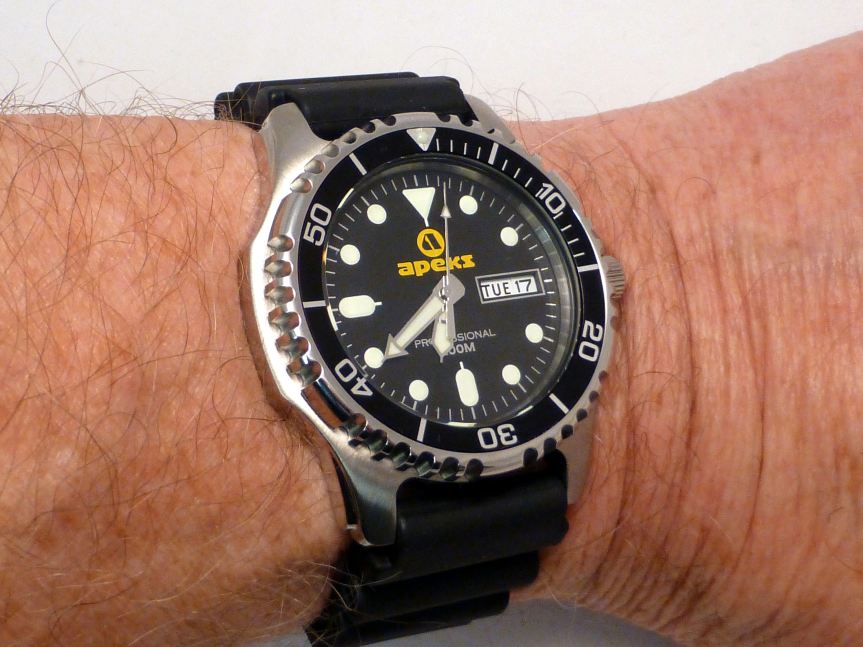
On the wrist in standard strap – best fit I have and great “Daily” watch.

This is a Quartz model.  It is also very easy to read and the dial diameter and layout is good – giving the right separation of luminous markers on a matt background, which makes night reading really good, coupled with excellent luminous features.  It also has a Date AND Day, which is a useful everyday feature.  The watch is a neat size too, only 10.5mm thick, smooth stainless case, 44mm diameter incl’ crown, screw down protected crown and a superb polyurethane strap – flat on the inside against the wrist, so it VERY comfortable.  The watch back is also very flat. The uni-directional bezel has good knurl definition, so very easy to use.
In fact this is one of the few watches I’ve ever come across, that for me has no faults at all – nothing!

I found another “diver” style watch, an old favourite at the time – the very neat Citizen BN0000.04 Eco-Drive Promaster 300m Divers’ Watch, which I have owned for more years than I care to mention.  It differs from the Apeks, as it’s Eco-Drive, 300m Water Resistance, but it’s not in the same league for clarity – in that the solar sensor face is glossy, the hands and markers slightly too close for quick glance reading, especially at night (even though luminosity is good).  The Date window is a little small, the bezel ( an aluminium insert) is not as knurled as I would like and slopes away from the dial, so is not that easy to use (possibly gloves may give a better grip).
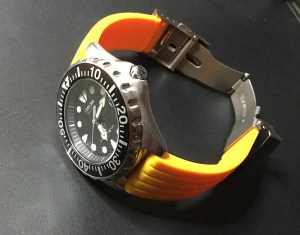
Citizen 300m Diver – decent “Daily Beater” too?

And, of course it’s Eco-Drive, so relies on solar energy (and why it resides near the window), which for me, to some extent is a drawback.  After all – I live in Scotland, where sun is in short supply and it’s always cold, which means the watch is almost exclusively UNDER my sleeve.  Now whilst Citizen say that once fully charged the watch should perform for 6 months, I’ve never chanced it.  But and I kid you not, it’s easy to forget how long it has NOT been in good light under normal wear, bearing in mind mostly under my sleeve.  But Hey!  It’s still a good everyday watch, though I’m sure there are better today. 

So I’ve come to the conclusion, for me, that battery Quartz (3 to 6 years), is OK as long as you accept if the battery dies, it’s bound to do it when you least expect it! But my personal preference, has to be the tried and tested mechanical Self-Winding Automatic, as it’s always ready and if worn, keeps going as long as you do!   😉

NEWS FLASH – I found in another display box, hidden under another etc. etc. a very smart blue Citizen Pro-Master NY0040-17E which does actually sport a mechanical Automatic movement and I intend to feature it very soon.  I thought? I had one of these, but unable to find it before this Post, was written . . . . So, more later . . . . .

Now I know someone will mention “kinetic”, but suffice to say, these are just not for me. (another story).

But, back to my quest.  Let’s look at what else is around today in that “recreational or Diver Style” that might fit as my everyday watch.

The first one I like the look of, for no other reason, that it has a very clean look, is the Szanto HLI Dive Watch.  A model I confess to never having heard of before.
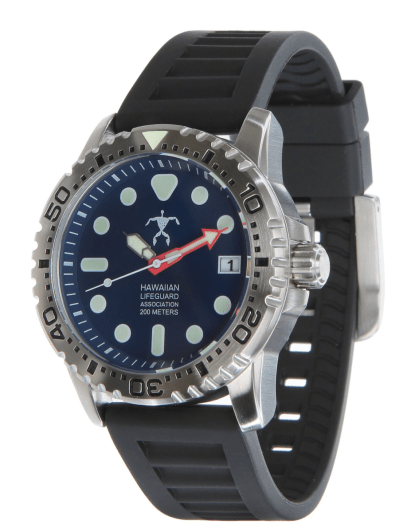
Szanto HLI Dive Watch. Clear easy read 43mm Diameter.

Like the Apeks, it’s Quartz, also 200m Water Resistance, Date only (personally I prefer day and date), but a nice readable size.  Slightly larger case 43mm diameter (crown extra) and I believe a little thicker, so I’d really have to see one in the flesh as it were, as for me, size is very important (yes, I know, I’ve heard the jokes!!!)  It also has a uni-directional bezel, with K1 hardened Mineral Crystal and a tough stainless case.

But I like the look of it’s uncluttered face, should mean it’s an easy reader with it’s large markers.  I like the second hand lume DOT, which is always a nice touch.  The strap looks substantial without any over macho look.

However, in comparison with the Apeks it’s over double the price at around the £195 mark.

The next I’ve seen is the Orient FAA02003B9, again described as a Diver, though to me recreational is more acceptable and it is also 200m described.  This is the black version with a 22mm deployment bracelet.  The stainless steel case of 43mm diameter (ex crown) by 13mm thickness, so quite chunky.
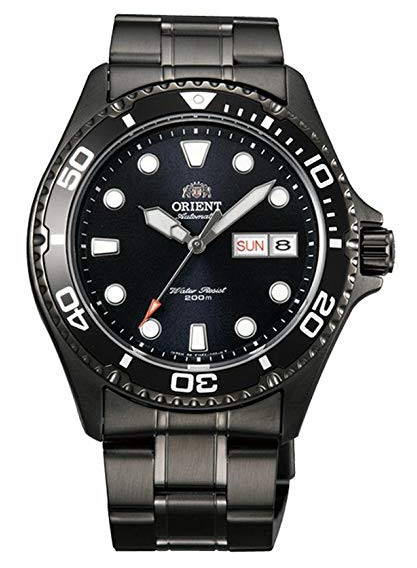
Orient FAA0200 series 5D9 black 200m Diver

This watch, however is not quartz, but a self wind mechanical Automatic Japan F699 22 jewel movement and for me this is quite a good thing and perhaps even a plus.  It’s always ready for action (no battery requirement) and as long as you wear it, it runs.

I have heard reports that whilst it can be manually wound, some say it’s as good as it should be, but without first hand knowledge I can’t comment.  All I can say is that I have many automatic models with manual winding if required and I’ve never had any issues, ever.

It also has Day and Date, which I like, the window big enough to make reading easy and the dial is uncluttered too, again a good feature.  Big luminous hands and markers, so easy read.  Whether a bracelet is your thing or not, being a standard fit, an alternative strap or a Nato job is easy to source and fit.

I also note that, as with a number of Orient watches, whilst the movement is Japan made, the case is Chinese.  This seems to be an issue for some, though I’m perfectly fine with that and Orient themselves are quite open about it.  But let’s not get into the Chinese made component argument – find the completed product without an Asian reference is a tall order indeed, today.  (I even have an expensive vintage IWC watch and it’s case was made in Hungary!)
Anyway, the Orient is a nice watch and it can be purchased for around £180 on the Web and it just about fits the everyday watch requirement pretty well.

So, just two or three recreational Diver style models available at reasonable prices – that might meet the everyday description and there are plenty more.

The trick is to get one that’s not too big, it’s easy to read, day or night, has no gimmicky functions, can be used for the odd swim, tells you the time at a glance and for me, the date AND the Day is very useful and looks good (when you’re retired you never remember what darned day it is).  😉

Personally I like the Apeks, as it provides me personally with all I need and at a really good price.  It also has original replacement straps available, should I ever need one, but it’s nice to see.

What does seem amazing to me though, is that the two watches I wear most, may indeed be “chalk & Cheese”, but both provide my everyday requirements fully and yet are poles apart, price-wise!  But as always, it’s rarely price that determines your wrist companion, but whether it meets your personal requirement – and in this case, both manage exactly that function.
Differently, yes, but perfectly too.

I also reckon I’m pretty fortunate to have my old 1999 Aerospace, as today Breitling models are too big, too brash, and too expensive.  And the Apeks is it’s perfect companion and that suits me.  I don’t think that how much I trawl current offerings, I’ll not be changing any time soon!
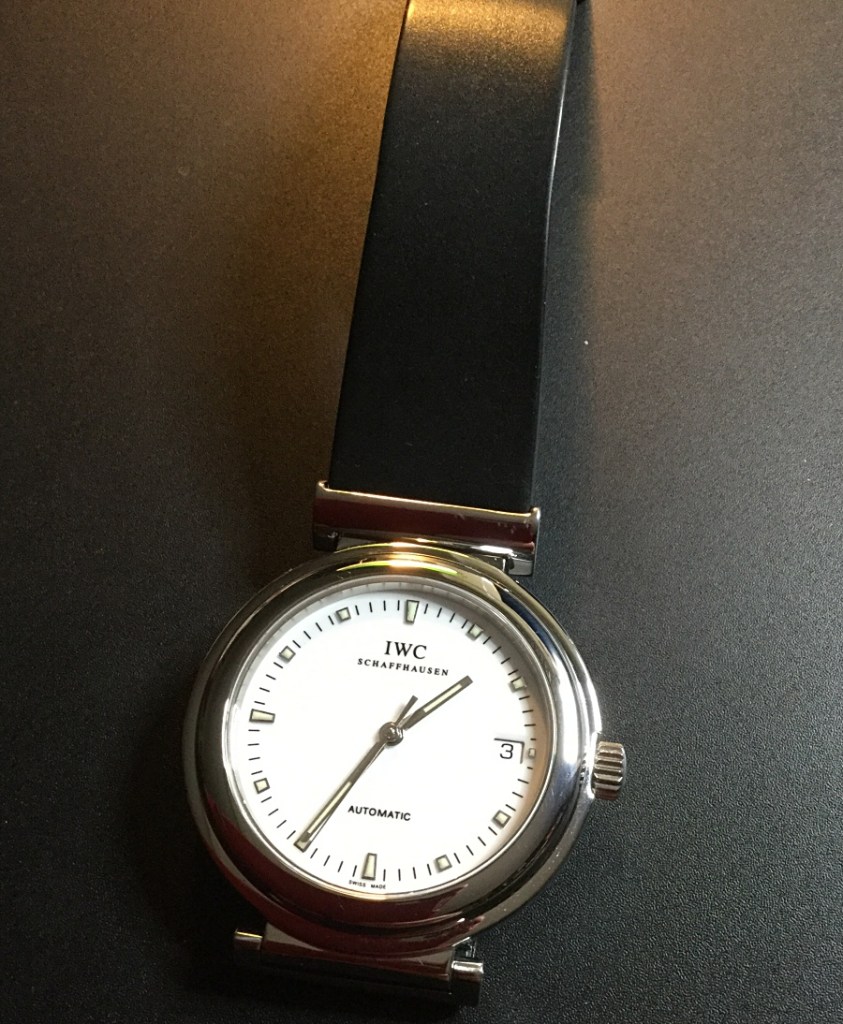
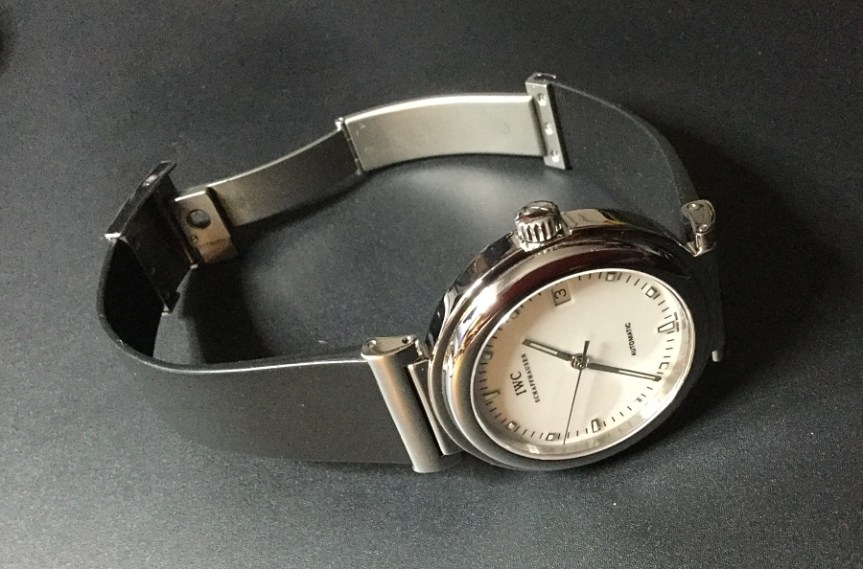
IWC Da Vinci SL

My first Post of 2020 features a neat IWC Da Vinci SL model.

IWC Da Vinci SL Automatic

Calibre 37524 based on the ETA 2892.A2 is a 21 jewel, high quality Automatic rotor mechanical movement.  Specifically adjusted for IWC to an accuracy of 0/+7 seconds per day.  It runs at 28,800 A/h and has a 42 hour reserve, with Sapphire crystal, stainless Steel case and back and a central sweep seconds hand and date window @3.
The crown is a screw down type and WR is 50m.  The case is classic sized at approximately 37 mm in diameter and features articulated bar lugs, so is ideal for the smaller wrist and the strap (deployment) is a fine rubber material. (newer models have conventional 4 lug styles, but I prefer the neater bar arrangement).

IWC Da Vinci with signed deployment & articulated bar lug arrangement – year 2000

The silver dial features numerals and luminous makers and the hour and minute hands are also infilled with luminous material. Not as bright perhaps as a Divers watch, but fine for the odd time you may have to use it. This particular model was produced from 1988 to 2002 and this one is from around 2000, so already over 20 years old and in perfect, as new, pristine condition.

The strap is an IWC original rubberised material with a stainless deployment action and signed buckle.

This is one of my more recent acquisitions, when I was visiting Lucerne in Switzerland.  A great place for watches of course, but also not so well known is the fact it is also a great source of high quality pre-owned models, complete with full servicing and guarantees.  Unlike auctions, where buyer beware is still the watchword.

One of the neatest of the high end automatic models I have and for a pre-owned one, it is in remarkable condition. Whilst I have a good number of high-ends, the look and the price sold me on it. It will also tend to hold value which is good.

My Camaro 7743

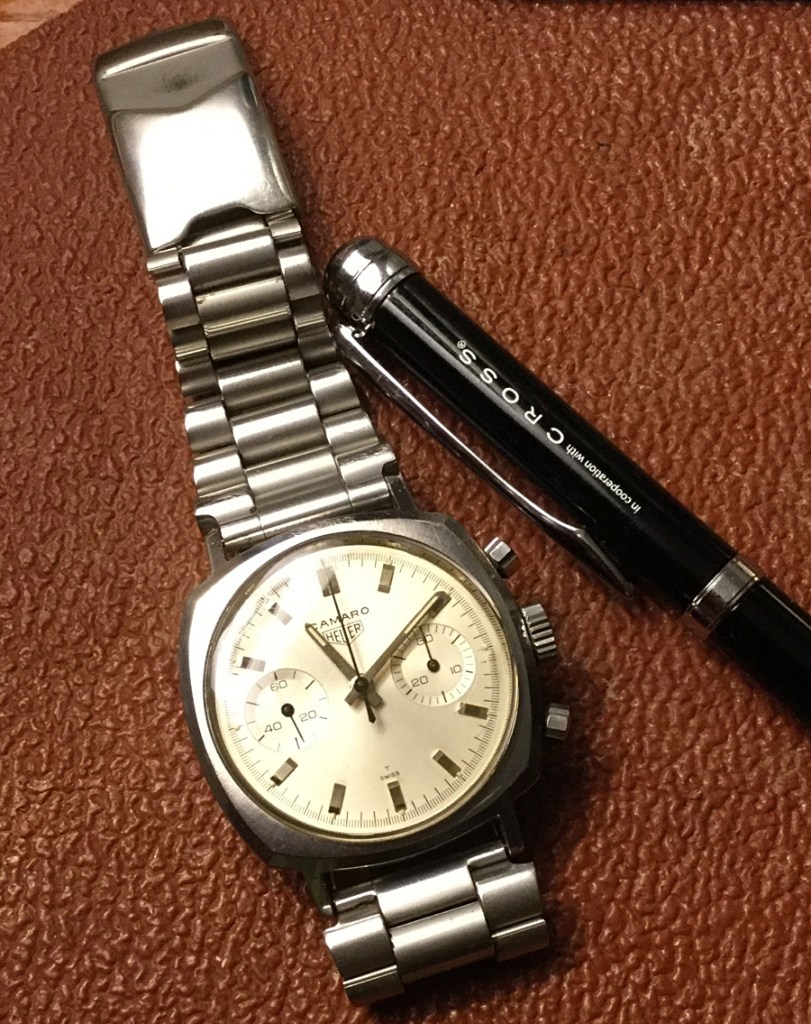
Thought I’d show off my old Heuer Camaro 7743, a 1960’s classic if there ever was. Totally as bought, with it’s original and completely unscratched and un-stretched stainless bracelet fitting to the odd sized 19 mm lugs.  Pleased about that, as so often these bracelets scratch up badly – this one however, is pristine.

Classic of the Sixties, Cushion cased Stainless Heuer Camaro 7743.

In fact the entire watch, which is the Camaro 30, 2 register chronometer version, with running seconds and 30 minute sub-dials is in pretty decent condition.  The stainless 37 mm diameter cushion case shows off it’s sunburst upper surface, which is still well detailed.  It is of course a manual wind model with the Cal Valjoux 7733 movement (one of the nicer movements out there even today) and a Plexiglass crystal.  The applied index markers with luminous batons are in perfect condition, as are the main luminescent infill hour and minute hands.  A nicely configured black seconds chrono hand completes the dial assembly.  The sub-dials are especially neat as they incorporate a circular background pattern. In short, this is a real classic watch dial set up and looks rather better balanced that many watches today.

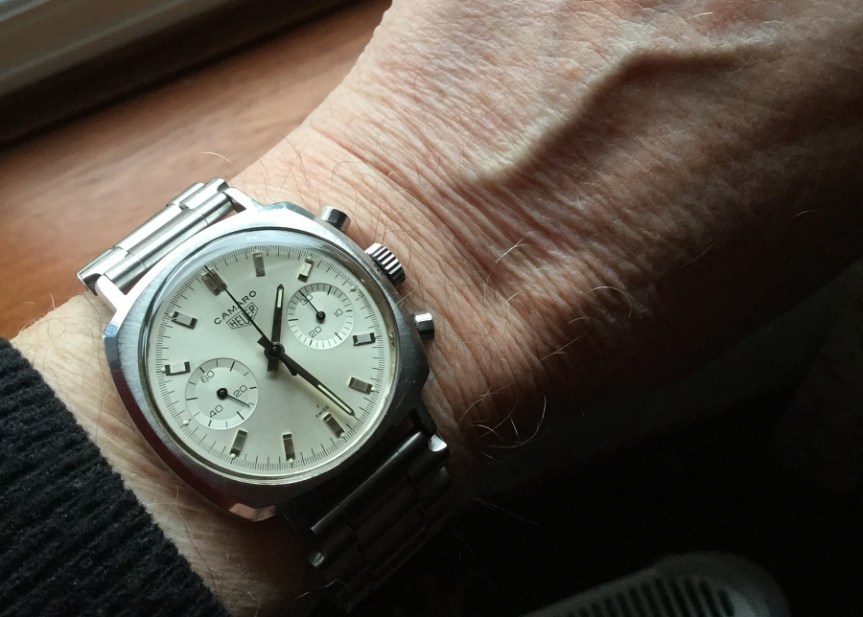
Heuer Camaro 30 7743 classic timepiece from the sixties. Great on the wrist!

The pushers are the castellated version, so slightly later in production, which only lasted 4 years. The centre crown winder manages on full wind around 45 hours power reserve, which is very impressive.  The stainless steel screw back is plain with no markings, the model number being engraved on the case side between the lugs.

The solid cushion case, even at 37mm, which is perhaps considered small today, looks great on any wrist and sits so well, it is a delight to wear.

I have never removed the back, so the water resistance is unlikely to have been compromised and unless the watch has a movement problem, I’ll probably never break in to it, but I show here a stock image of a typical 7733 movement, though I fancy my one might look even better.

Valjoux 7733 Chrono movement – 
Image from Chrono24

It is a fact that there are really not many of this model around in really good condition, which surprises me, though with Plexiglass crystal, it’s a material that’s easily scratched.  Mine has not completely escaped either, as there are two shallow scratches on the glass, but fortunately neither detract from the beauty of this watch.

I love it when a 50 year old watch gets my attention once again and springs to life from my display cabinet. This one is I think destined for my wrist for the rest of the year and long overdue.  It’s great to wear, great to look at and it functions today as well as it did all those years ago.  It is also extremely accurate and it’s proved a decent investment too – not always the case when it comes to watches.

It is also the ONLY Heuer I own (a bit like my Rolex collection – one from 1960, and one from 1920’s).

OK, I admit it – I’m picky!

Digital delights

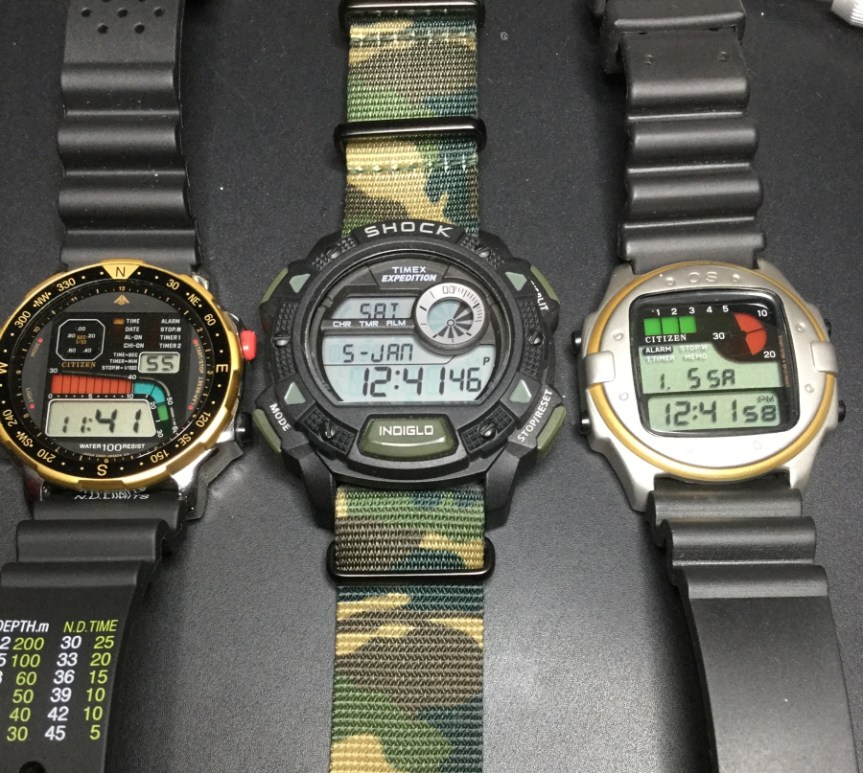
There’s something about early digital watches that really attracts me, mostly because they can look so interesting.  Often full of complications and with amazing dial designs, which for me is possibly the most important aspect of these creations.  How to display the most relevant information or data to the user, without causing confusion – and still make the function of it, or the “user interface” as they say today, both easy to read, understand and also intuitive to use.

Not an easy task.

Here are a few that for me manage that task pretty well.

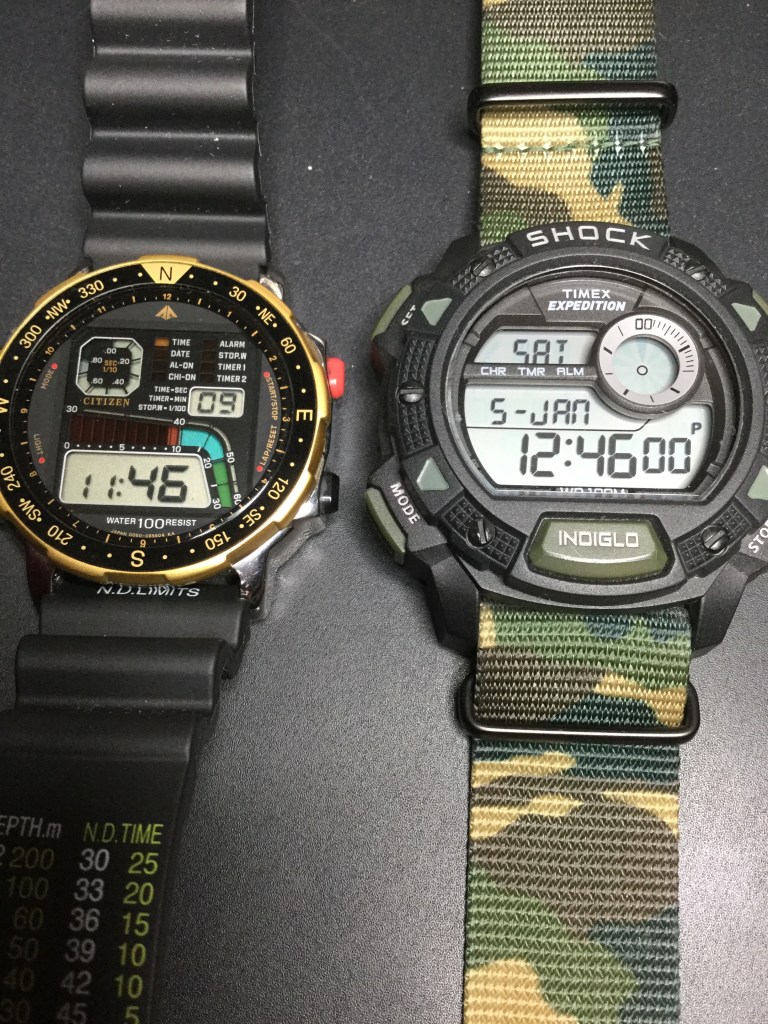
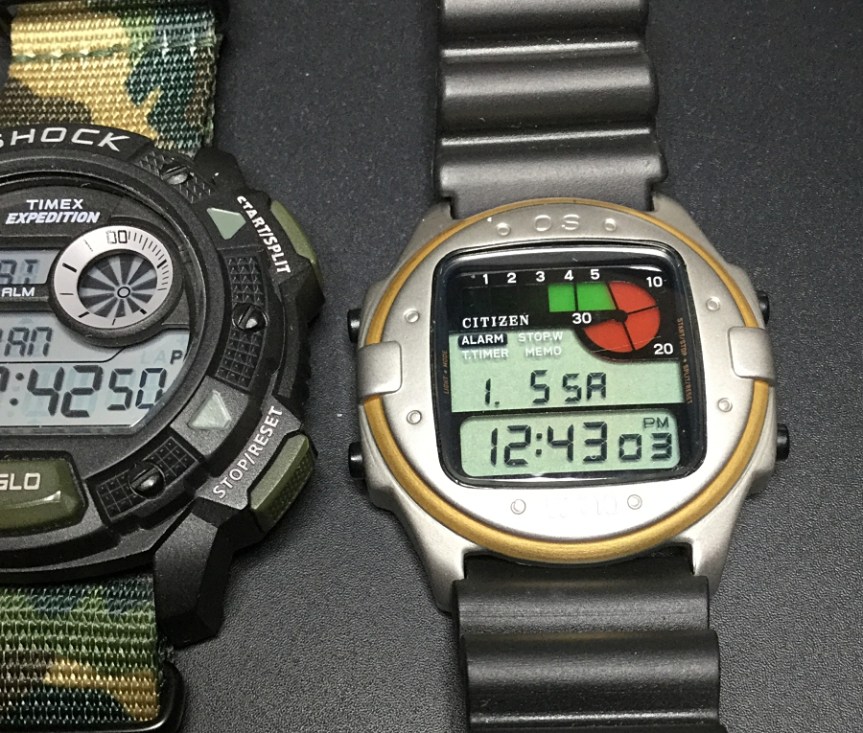
Early Citizen D060 Windsurfer, Timex (later) T49976 Expedition, Early Citizen D100 Promaster Windsurfer

And yes they are all quartz, battery powered and every so often you have to change the battery – it can be daunting, though once you get the hang of the user logic, these ones are actually easy to manage.  Sometimes there are printed highlight notes on the module reminding you to short out this or that, or push all buttons prior to setting up and so on, though that’s basically to clear memory and rarely affects the basic time function.
Any time a battery needs changing – it’s – clear the desk workspace – take care and concentrate.  But seeing the display come to life again and then scrolling through the various functions and reminding yourself just what these modules can do, is always a pleasure.

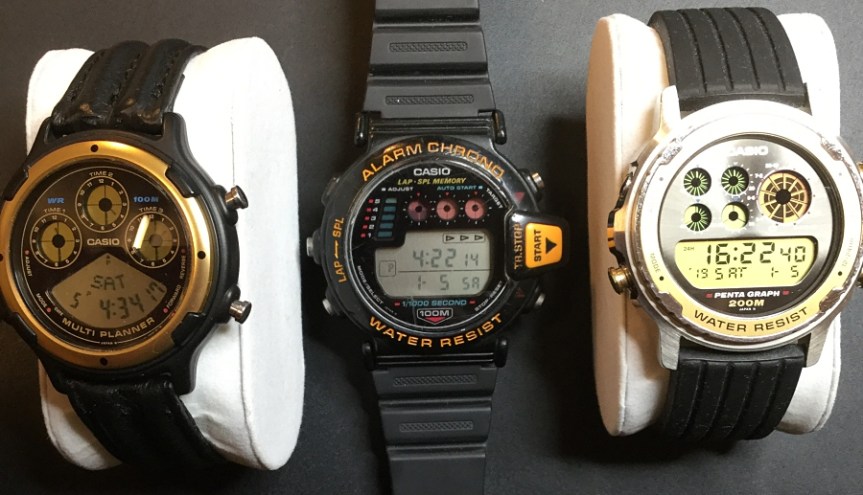
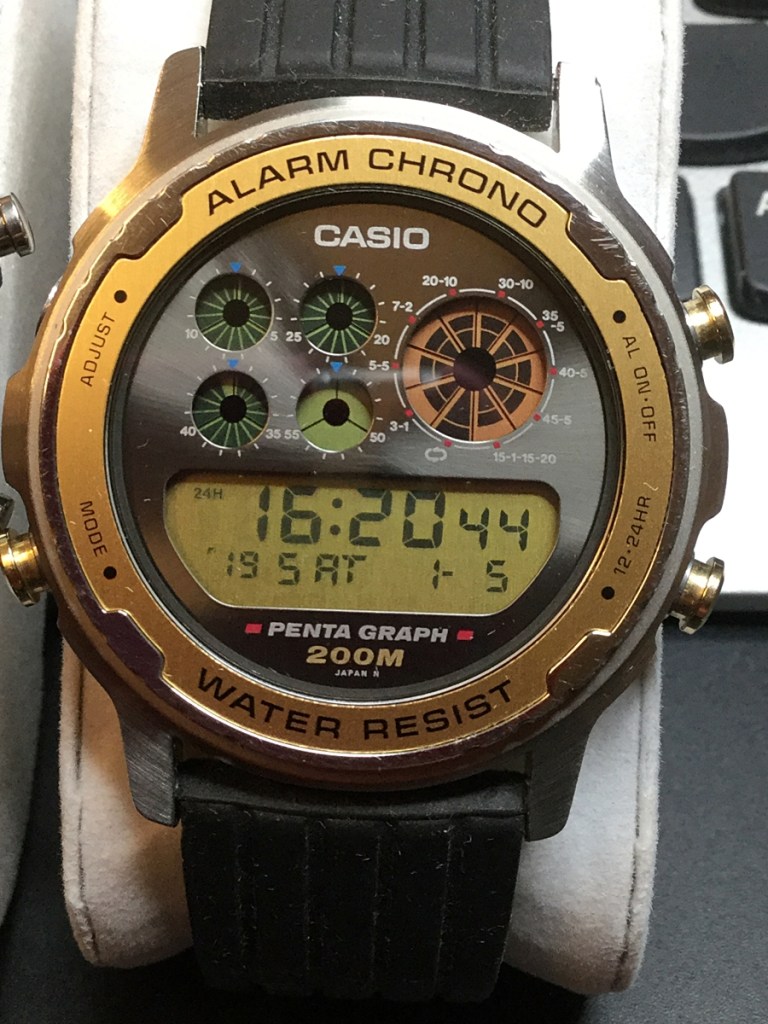
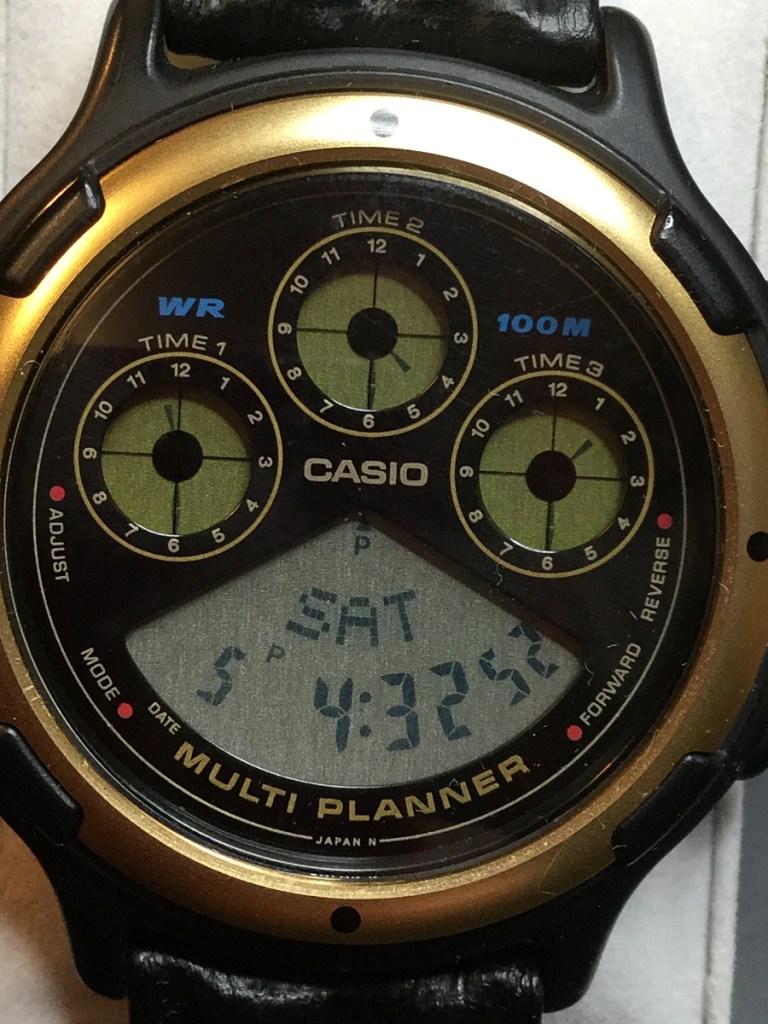
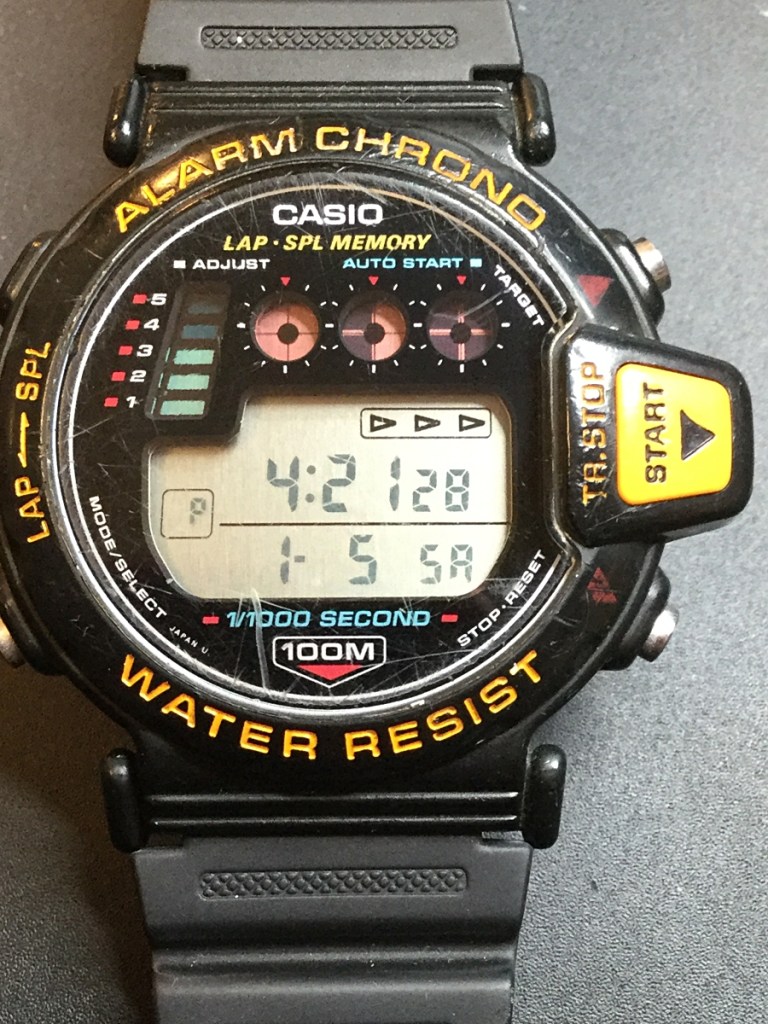
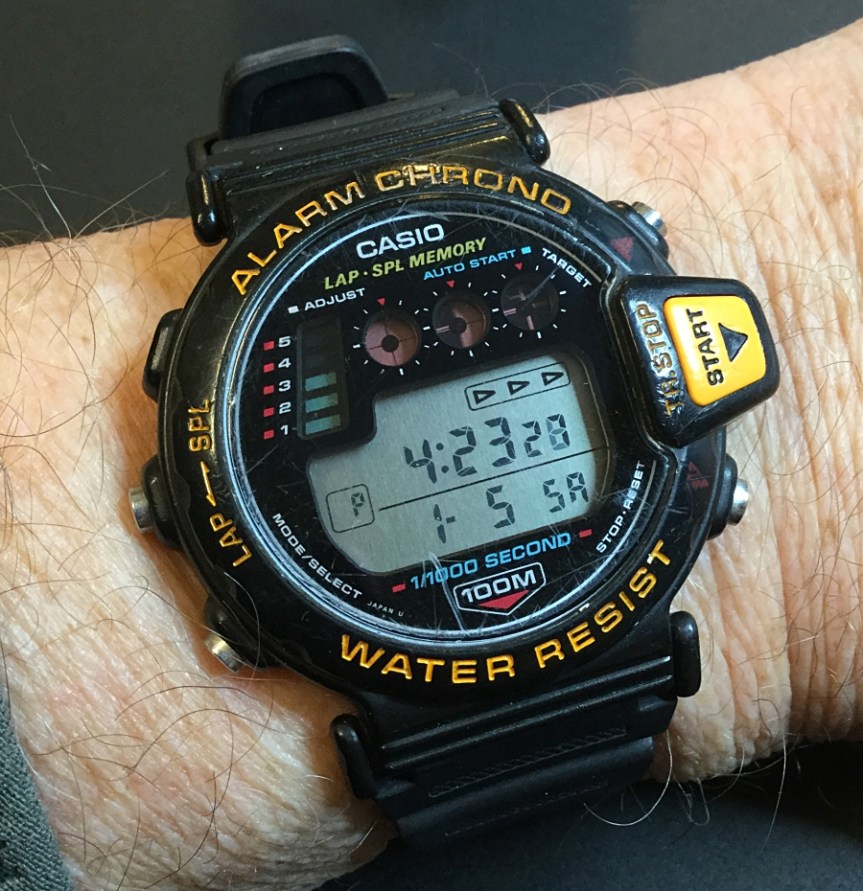
Casio 931 – BGP-20 Multi-Planner,
Casio 928 DW-7200 Pentagraph Referee Timer

Casio vintage Alarm Chrono, had tough times but still good!

With a reasonable collection of digitals from the late 1970’s onwards, you can see the dial contrast improvements and the creation of more intuitive commands, to manage this or that function, though I’m still bowled over by some of the early ones and realize just how good they are.

I’m not going to go through the functions and so on, but rather just show here a small photo gallery of some of the ones I’ve collected over the years.  The dials say it all really and there are many more, many covering all sorts of sports and pastimes, but increasingly difficult to find these in really good condition.  They are not expensive and as a result tend to get worn “hard”, often not surviving.  Often as not, if the module goes, so does the watch – into the trash, which is a pity as they are a testament to the ingenuity of the first Quartz sports watch pioneers.

Many are Japan made and although there are many, many lookalike digitals around from China, none of them have the pedigree of these or indeed the quality of the Japanese modules and displays, which in their day, were truly science fiction, and particularly in the actual design.

Rare watches today as they represent a time of change and great innovation and ridiculously accurate for their time too, which is a real bonus.  Usually wherever I go when wearing one of these, people comment and mostly they are rather impressed.  Not bad after some 40+ years of plastic/resin moulding, early display technology and large battery styles – I take my hat off to them – great!

Note – I have probably featured these somewhere in the web site at some time as a Post. For more information, just use search.

Is it just me?

I often trawl through the weird and wonderful watches that appear from time to time, where the old analog idea of hour and minute hand is sort of forgotten about.
And we have the sometimes preposterous methods for showing, telling or indicating the passage of time, which at first glance (and you’ll need a few glances I can tell you), it is nigh impossible to read the time.
You also get some rather ingenious ways too, but mostly the common denominator is the fact – it’s haystack time! and you’ve got to find the needle!  The needle being the time!

To the young it may be fashionable and I’m sure a topic of conversation (do the young actually converse face to face any more?), a talking point, as all your friends gather round to see if they can make out what time it is.  However to my old peepers, I would be better squinting at a kaleidoscope via an illegal substance overdose!

Now what time is it?

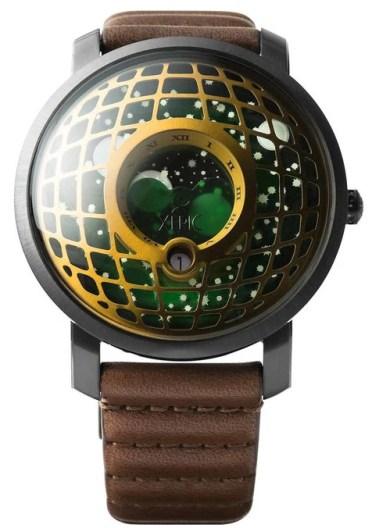
Xeric Trappist Monk Moonphase – and tells the time I think.

(1) Apparently the Trappist Monk here tells you the time with the window @6 showing the Hours and the planets or stars somehow showing the Minutes.  I haven’t managed to see it myself yet, but I’m sure if I had time, I might figure it out.  Love the colors and the sky design and all that – but . . . .
Seems ironic for me that the watch dial is really large and OK it looks intriguing, but the time telling bits are so small in comparison, it ends up with such a small set of indicators, you certainly can’t just glance at this to get the time.  If you can get it at all!

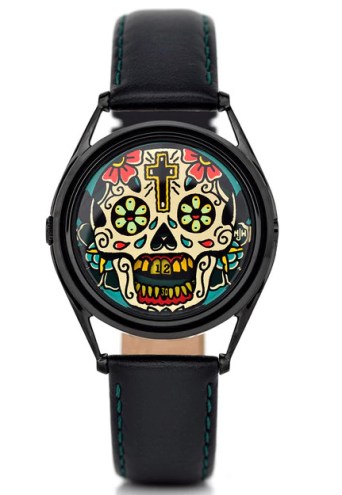
(2) The next guy is the Last Laugh Tattoo by Mr Jones,

LastLaughTattoo
Mr Jones – Last Laugh Tattoo

which though colorful and has lots of symbolism tattoo stuff, to me seems to be an exercise in how to hide, not show, the time.

Once you have your glasses on you can just make out the Hours on the top set of teeth and the Minutes on the lower set.
But again we have the repeating theme of a large dial area with only a tiny fraction used as the time indicator, so really good eyesight required for this one.

Always remember here, before designers get carried away, that the prerequisite for a watch is first and foremost – to tell the time.  So to my mind these first two have not really managed to meet the brief.

Now I’m all for trying to indicate time in a different way, just for a change if nothing else, but making the time indicators either too small or hidden in some way doesn’t seem the right way to go about it.

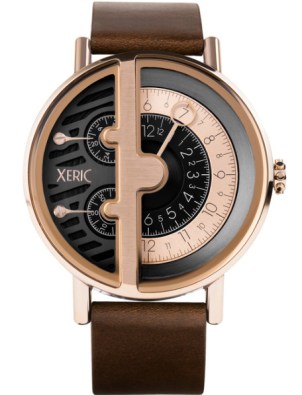
(3) Next is the Xeric Soloscope, which is a tricky one and it also requires very good eyesight indeed to read.  On this model and on the face of it, the Hours should be relatively easy to spot, being circled by that single hand BUT it’s only actually effective when directly over the Hour numeral as shown here (7).  When it’s between Hours, say 15 minutes past the hour – Ah, then it’s very tricky indeed!  Because the circle itself partly obscures the very thin index you’re trying to see and there’s no numeral to see.  Each line of the index denotes 5 minutes by the way.

Soloscope – a tricky read indeed.

So basically this is an overly fancy single hand watch – and I’ve had them before, bought for the novelty, but which unfortunately I’ve always found in practice soon wears off – and I’ve sold every one of them on to some other novelty seeker.
I suppose if you’re OK with a vague approximation of the time, when someone asks – you’re answer is “Oh it’s after 7 sometime” – which maybe sounds OK, but if the inquirer is catching a plane – not so clever.

(4) Now this one is a little different.  Not easy to see at first, but none of them are, but this one has purpose, as it caters for the visually impaired, so seeing it, is somewhat irrelevant.

Bradleys Classic Black Mesh

This is the Eone Bradley Classic Black Mesh with it’s inside, outside “silver balls” that you can feel with your fingers.  The outer one on the edge of the case, indicates the Hour and the inner one, the Minutes (assuming a 12 hour clock dial).  The dial is matte black and has raised markers and an strongly embossed diamond at 12, so it has a Braille touch style, which really does assist those with impaired vision.  Obviously there is no glass/crystal here as the fingers can feel the raised numeral markers and the ball on the dial.

So this is a model that has genuine purpose in reading time in a different and very useful manner.

(5) OK this is the last one is probably the best one for me, because it’s relatively readable and is an older idea seen on quite a few vintage watches.

This is the
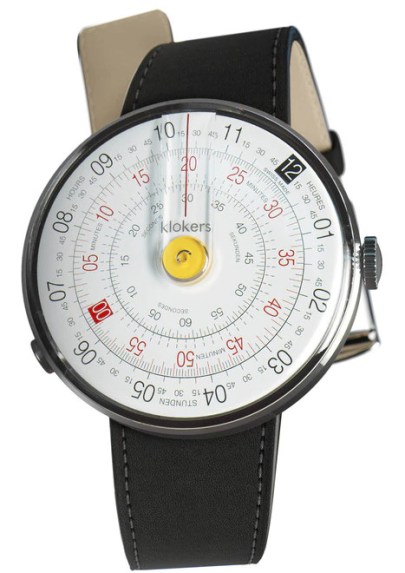
Klokers Klok 01-D1 Yellow Matte Black Leather – which is an update of the old disc watch, where Hour, Minute and Seconds discs move round a large dial and pass underneath a vertical fixed pointer which highlights the time.

Just read down vertically from the top – this one looks to me to be about 10.20 and almost 30 seconds, so can give quite an accurate time.  Mind you to pick out the seconds it really has to be read.  Personally I’d prefer the numbers to be in a heavier font with more contrast – but that might just be me.

A quick glance, however, should give you the 10:20 bit, which is probably accurate enough for most of us.

Also this watch is a “mobile” – which is evident as the discs rotate, but unlike hands, these rotate anti-clockwise, which is a bit odd when first seen.  Also each disc rotates at a different speed!

So, OK, I accept it can be a little tricky at first to get your head round these odd movements, but once on board you suddenly get the picture.  It’s also a decent full dial size at 44 mm diameter, which helps.

Personally this one has an attraction for me.  And maybe I like it because it shows time actually passing, which can be quite fascinating.  And this is because, as I said, the disks constantly revolve and at different speeds – as I say – fascinating.

Disc watches truly involve you in the process of time itself, and if you like mobiles it’s very much cheaper than a Tourbillon!

The only downside I’ve found with the odd disc watch I’ve owned is their timekeeping. The discs have to revolve smoothly and without touching an adjacent disk and depending on the quality of manufacture, play is sometimes unavoidable, so accuracy can suffer a little.
But if it’s a quartz model it has at least a good basis to start with, the mechanics are minimal and should still be accurate enough for most of us – just check it every fortnight, if the mechanics are not quite to the same standard.

So there we are, just a selection of unconventional watch dials, guaranteed to confuse the elderly   😉

Of course I jest.  These are unusual watches and inject a bit of interest and sometimes humor into what can be a tedious procession of clocks and watches that can be quite boring at times.

And as I haven’t had a disc watch for many years, I could be tempted by the Klok – just for fun.

And it’s also sobering that if you can see time actually moving – you’re still here!


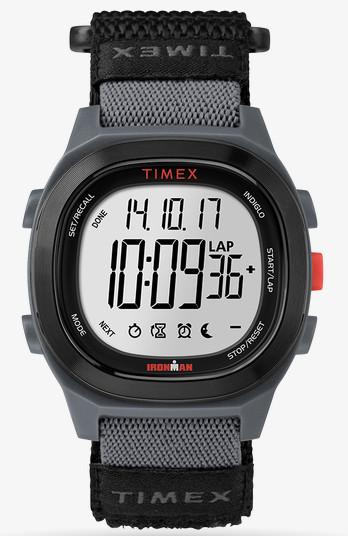
Timex Ironman Transit

Odd name for a watch I know and not being in the know these days, unfathomable to me, but those folks at Timex marketing have come up with it and it sounds good. . . . For me it differentiates it a little from the Expedition series, one of which I already own.  And as my Expedition is one of my very favorite watches, from anybody, I thought that a look at this one in this “Transit” guise would be worth a look.

The Timex Ironman Transit

Here they’ve removed the tough looking macho “shock” exterior and replaced it with the running, fitness orientated modern man look that seems to be the thing today (the only thing I run now is a bath and this website!).  I have to admit I like it’s clean looks and easy to read dial with large digits on a very clear display, something that I feel Timex leads the way over all others.  The contrast is good and the displayed information gives the Day, the Date and the Year, plus the time – what more do you need on a quick glance.

And that’s something you can do with this watch – a quick glance is all you need and bingo – no squinting at it, trying to make out poor digits against a poor background.  This is for me the way to go in digital displays.  And once the daylight fades you can use the Timex patented Indiglo dial lighting system, which I have to admit is brilliant on their digital watches (not so good on their analog ones though – see my views at the foot of this Post).

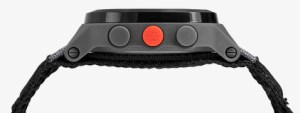
I also like the operation of this Indiglo function.  If in a dark place during the day for example, a press of the center colored button and the dial lights up for 3 seconds.  But later in the day you can activate the system fully by pressing the center Indiglo button for 4 seconds and what this means is that pressing any button on the watch will light the dial.  So no fumbling around looking for that one button – any of ’em will do – the dial light again will illuminate for 3 seconds at a time.  The Indiglo system will stay activated (as a system) for the next 8 hours or until you switch it off (4 seconds press of the center button again).

I quite like this degree of control, which my old Expedition one lacks (or I haven’t noticed it!)  😦

Functions on the watch are useful, such as a Countdown Timer and a Stopwatch (sports) with a 10 lap memory, a few Alarms and the watch also has a 100 m Water Resistance which is pretty good.  Not a diving watch, but it’s OK to shower with it or swim in the local pool or even on the beach.  If beach swimming just remember the salt water doesn’t do anything much good (apart from aching feet), so a rinse in fresh water is a good idea afterwards.

A little chunky perhaps (added to by the under body fast wrap strap), but at 40mm very comfortable.

The watch dimensions are just 40 mm diameter which is a little neater than some of the older models and it comes with one of those very useful “Fast Wrap” straps.  When I first saw these I didn’t know whether I’d like them, but I do.  They are quick and comfortable and usually better than a strap and buckle arrangement, unless they fray, which has been known.

So this is a practical watch from Timex and it’s easy to wear, very easy to see, day or night.  Has enough useful features and functions on it, a decent Water Resistance and at a price of under £50 has to be a really good daily beater in any language.

Note –

I mentioned the Indiglo system of dial illumination and I said it was great on this model and most other Timex digital dial watches.  But as I said I’ve always found it to be a great disappointment on any of the non-digital analog models. 

The reason is that the standard analog watch tends to have hour and minute hands, either colored steel , skeletal or a combination of both PLUS a luminous looking tip or pointer.  The numerals and markers are similar and if it is a Date watch with Date window – forget trying to read the Date at night.

Indiglo lights up the background dial surface in a sort of fluorescent green and shows everything on the dial as black silhouette and I have to say, not that easy to see. The hands, numerals and markers are simply not at a decent enough contrast to this greenish background (makes my eyes go funny) and forget about any so called luminous tips to the hands – these are also dark.
And the date is virtually black and unreadable.

On this watch, which is digital, it is brilliant, as is my Expedition, which is a joy to use at night.  So a case of technology where it’s needed basically and my maxim is simple – for Digital display Indiglo is OK, but for analog display, good luminous coating or Tritium is the best.

Just my opinion and you take it or leave it, but one thing I can’t abide – is not being able to read the time day or night – and I’ve had a few models over the years that manage that feat.  I don’t have them now!

But as to the Ironman Transit – it has to be great value and you don’t look as it you’re in the Army . . . . You’ve just joined the fitness people!

Nightspeed by Swatch

Each year I tend to have a look around the offerings by the Swatch Group, but concentrating not on their high end portfolio, but rather on the Swatch in-house Brand .  This is the one started life back in 1989 with the introduction of 12 new models.  The start of a range of watches from Switzerland, produced to counter the mass influx of cheap quartz watches from Asia.  Termed Swatch to infer “second watch” at a low competitive price point, a Swiss movement and a true “Made in Switzerland” logo.  It was a successful ploy and they have produced millions of successfully selling watches ever since.

IMG_1606
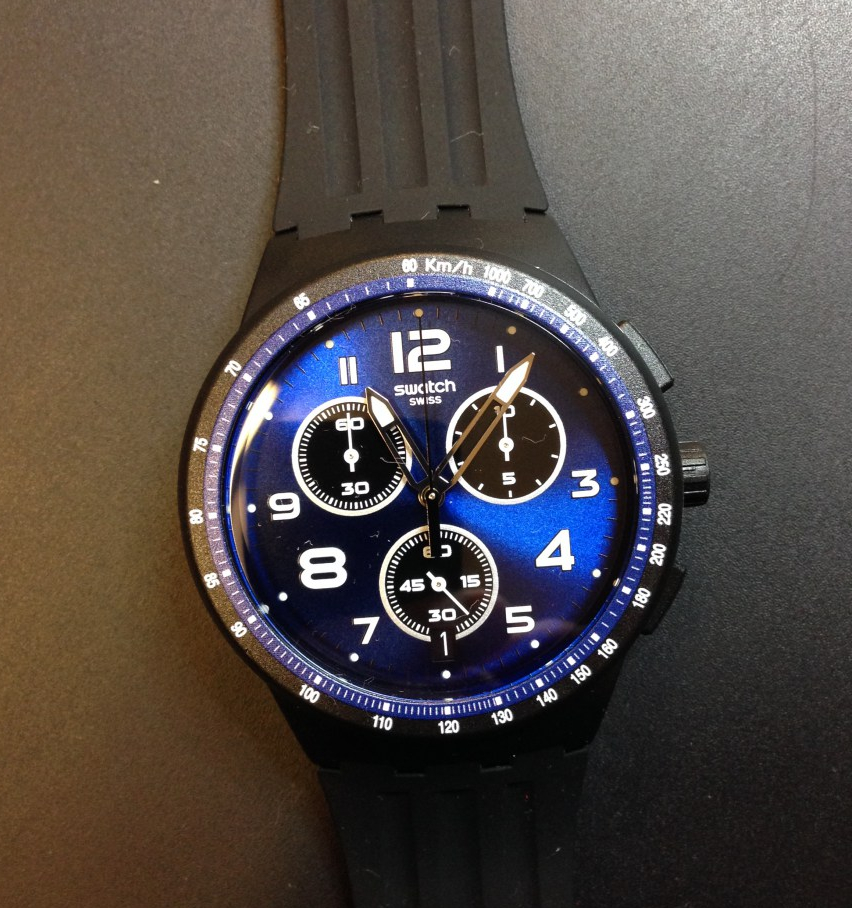
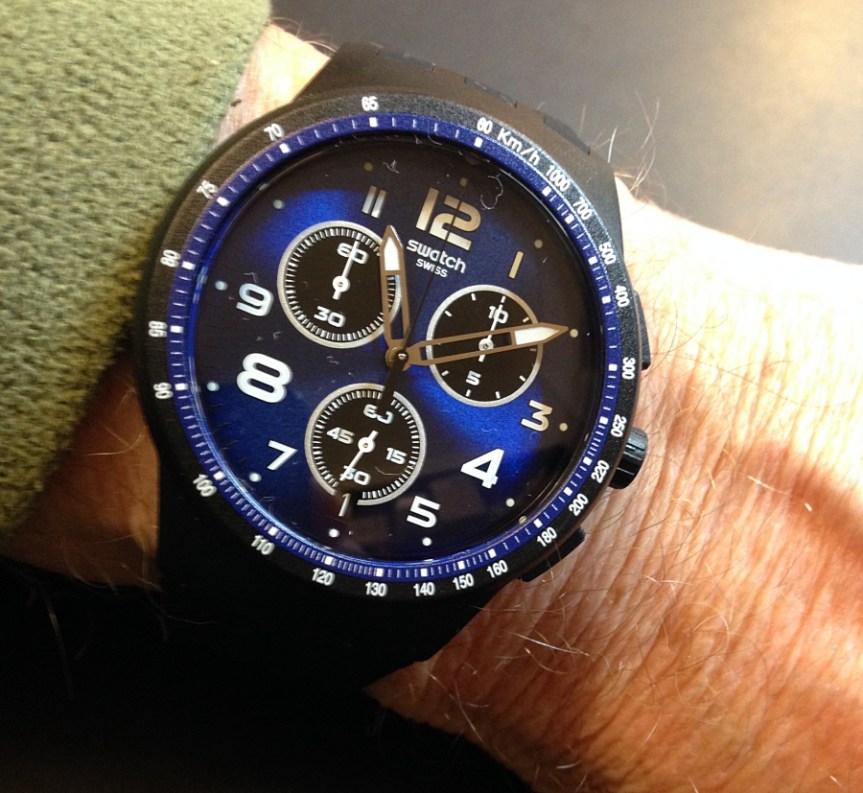
The Swatch Nightspeed blue black

Swatch introduce new models often and you can usually guarantee good quality, a good movement and an affordable price.  So this year I looked to see what would take my fancy and be my model for this year (it might not be a 2018 build, but one I maybe missed in the past).

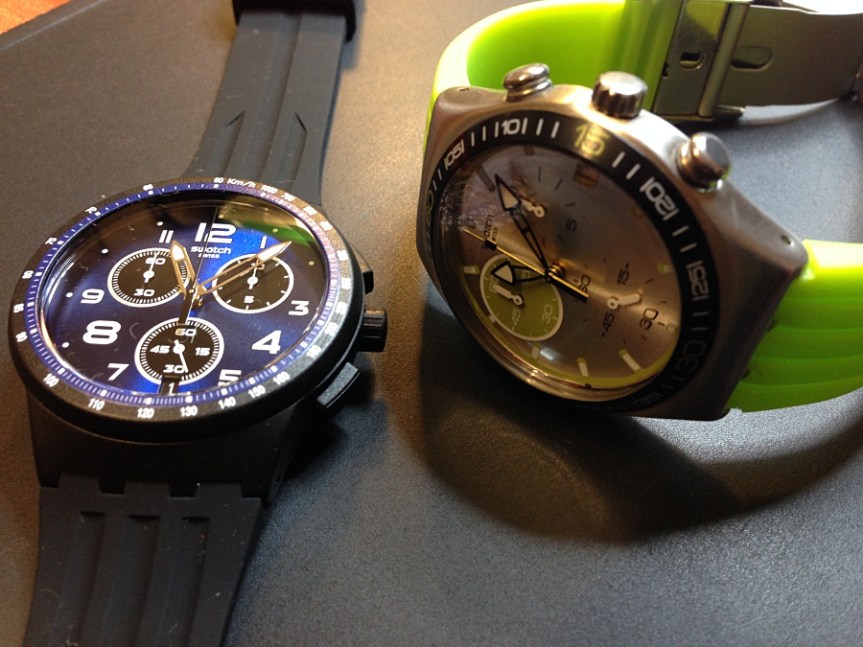
This time I’ve gone for a black plastic cased, quartz powered model, called the Nightspeed.  I find it to be a very attractive dark toned blue dial within a black case with a black silicon buckle strap.  I particularly like this strap as it’s very, very flexible, has a nice mat black finish and the Swatch (through) buckle fitting.

IMG_1609
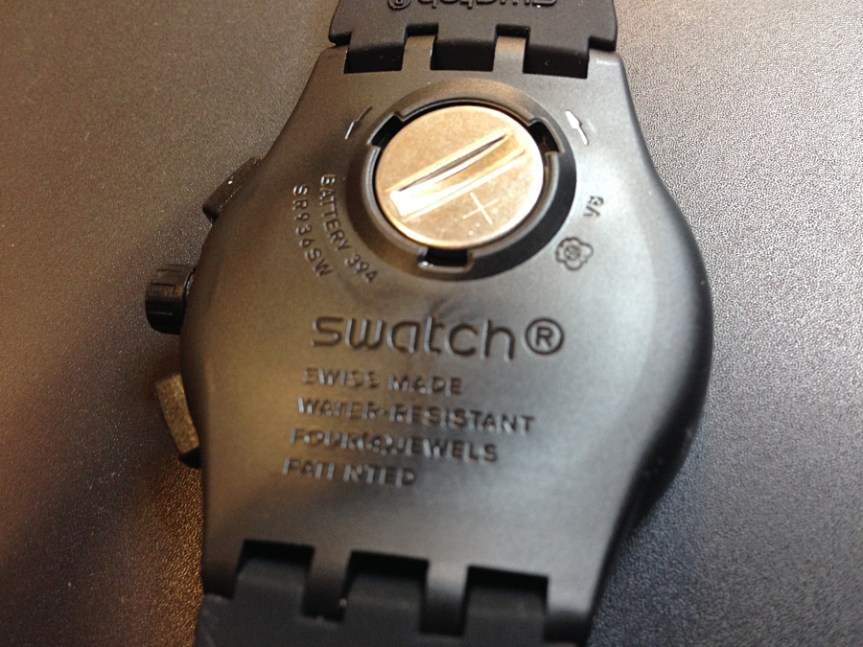
Quick change battery hatch – with battery type inscribed on back.

The dial numerals are in white with two different font sizes, the 12, 4 and 8 being larger. There are three sub-dials with running seconds at 6, and the two at 2 and 10 function as stop-watch counters.  There is also a date window at 6 with white against black and most of the dial features are luminous.  There is a black stop-watch seconds centre sweep hand and the semi skeleton hour and minute hands have white tipped pointers.
There is a finely marked dial bezel featuring a Km/h marker ring and there are two black pushers on the right, either side of the centre crown for timing functions and setting the watch.

IMG_1610
Light weight plastic body – easy on the wrist.  Note the date window @6.

Whilst the colour scheme is predominantly black and blue, the white features within the dial make this an easy watch to read.  Overall it is both understated and yet very attractive.

The dimensions are 42 mm diameter and just over 13 mm depth including the slightly domed crystal, so a nicely sized watch and being plastic cased is very light on the wrist.
According to the data on the Seller’s website, the Water Resistance is quoted as 30m, though with the Swatch quick change battery “hatch” as opposed to a full screw back, I’d be cautious it testing how good that may be!

One neat point to note is the battery type (394) is inscribed along-side the hatch, which is very useful.

The Swatch 4 jewel Quartz movements, I’ve found and certainly the ones I own are both accurate and reliable . . . . which when put together with the general attributes of this particular model, I am certain will be a great model to own and at around £80 represents a good buy.
IMG_1607

Just a note – if you are looking for a watch to match colours with clothing, it is a fact that generally the Swatch range give you a great choice, as they do offer an extraordinary number of models in all sorts of colour options.  Just a thought for Christmas. . . .

MeisterSinger Neo Q

After my European travels a month or so ago, I have got myself another one of those wonderful ONE Handed watches for which I seem to have a love/hate relationship. I say this as I had a similar model to this some years ago, but got rid of it for the same reason I bought it – that One handed design.  So what’s changed?

This is the MeisterSinger model Neo Q,

MeisterSinger Neo Q One Handed model

which again is One handed but this one is quartz powered, so low maintenance (stick it on the wrist and forget). However the main difference from my old mechanical Perigraph model is that it is NOT Perigraph.
And because of this fact the dial is much simplified and for me that is the whole point of single hand.  It IS easier to read.  And to assist in this aspect it has new typography too with much clearer lettering and now sports a round Date window @6 which suits the overall look.

Note the undercut case – allows perfect strap fitting.
Neat, stainless steel, undercut case, suede leather strap.

This model is stainless steel cased and is a neat 36 mm diameter, which being honest is a perfect size for the average wrist.  It is beautifully finished, sleek and smooth with a suede leather buckle strap. My model here is the black dial with white hands and numerals – it was a toss up between the normal white with black notifications, but I chose this version.

It IS however a delight to read.  It is very easy to so do and very clear.  Each hour is divided into quarter, half and three quarters and in between these into 5 minute segments – and it is surprisingly accurate to read.  Not having a second hand means that unlike most quartz models there is no jerky ticking of the second hand – instead the Hour hand (no minute hand either) very slowly and majestically sweeps around the hours with a rather stylish grace that I find very agreeable.

Note on the image the case top is a larger diameter than the underside.  This is because the case profile is undercut, allowing perfect fitting of the straight cut strap.  Also the strap features a quick release fitting spring-bar.

This model is not luminous which is an omission in my opinion, but basically this is a dress watch, hence the lowly 3 Bar water resistance, but certainly adequate for the intended purpose.

Overall a very nice watch to own – I like it.

On the wrist – just about perfect.

Swatches

Every so often I like to trawl the swatch world, just to see what low price models take my fancy.  I like Swatch as the quality is invariably at a decent level as to ensure a good and reliable timepiece. Their quartz models in my opinion are almost always good value and more often that not, great fun to wear.  Slightly funky colour-ways mean that if you are even a tiny bit dress conscious , then these can make a rather neat and subtle statement that you ain’t finished yet!

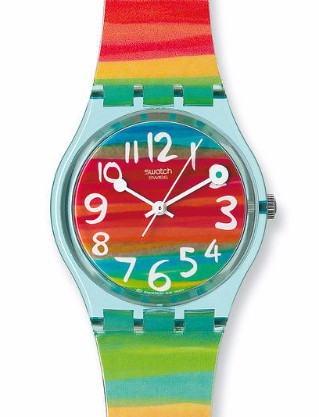
Unisex Colour the Sky Swatch model Quartz.

This is the GS124 or the Swatch Unisex “Colour my Sky” quartz model – available for anywhere between £30 and £40 and OK is a basic 3 hand model without Day or Date, but has got lots of colour, both dial and strap. Dimensions just 34 mm x 8.75 mm depth, this is a very neat watch and will fit anyone. (and don’t be thinking this is too small – some of the best Patek’s are 34 mm!).

It is what it is and that of course defines the ever so quirky Swatch range.  The back has the usual coin screw battery access and the case is sort of see-through plastic and the dial layout works pretty well with the slight odd hands set up. In fact this one has a touch of the old “railway” clock look about it and is pretty easy to read.

I like it.

My next Swatch pick is the oddly named “Lonely Desert” (Day & Date) model (SUOB721) which is I suppose more gents that Unisex, though that said, is not a large watch either at 41 mm diameter by 9.85 mm depth, so still a neat wearing model.  Price wise not a lot more than the first watch featured, but has the advantage of the Day and Date window.

Swatch Gents “Lonely Desert” Quartz.

I like this one as it features a leather strap in a really neat shade of “leather brown” that works well with the dark case. The dial is silvered and the Day and Date window stands out really well with white letters against a black background.  This is a slightly more serious watch model than the colour sky idea and looks really good either in casual or in a formal setting.

The usual coin battery access at the back –

Typical Swatch coin battery access.

Here’s a pic of the typical Swatch battery hatch system.

So just a couple of models from the huge Swatch range that caught my eye, both very affordable, Quartz powered and yet quite different.

I have to admit to a liking for quite a few of the Swatch Day and Date watches as they really do represent great value for money, especially when coupled to a quality standard that seems to stand up proudly on it’s own merit.

I have a few friends who collect Swatches (sad I know . . .) and I reckon most of us know someone who probably has more than one and I suppose it must be gratifying to Swatch themselves as the “S” or second “Watch” idea (Swatch) has turned out to be such a success story.

I’ll probably feature a few more of the ones that I like – and you never know, you might like the odd one too.


Vintage Vulcain

Vintage watches are still my passion and perhaps more so today than ever, simply because many are from an age where “style” and “elegance” were as important as the watch function itself.  And I have to admit I like that.

Neat but good sized Ladies 1920’s 18K Vulcain manual wind in original condition

This example is a 1920’s Ladies 18ct Gold Vulcain which has survived in very good condition and is being worn today, keeping good time and looking as elegant as when it was made.  I guess it was produced just after WW1 when Vulcain moved to their new factory, so possibly around 1923 or so, once the new premises was fully up and running.

This model is a bit of a rarity with this case shape, though checking through the Vulcain “Book” I found this very similar model from around 1930.  Note the early Vulcain logo in a simple font without underlining etc.

1930’s Vulcain with diamond decoration – from the Vulcain “book”.

Another reference I found is from the  Watch Book – “Wristwatches – A Handbook and Price Guide” 6th Edition of Gisbert L. Brunner & Christian Pfeiffer-Belli, printed by Schiffer, which although listed as anonymous, could indeed be a Vulcain such is the similarity.

Similar cased & dial look of the 1920’s

My Vulcain 18K Gold cased is also complimented by the expandable bracelet (marked DV, which denotes a Vulcain parts or accessory) which suits it perfectly with no degradation to the spring action or the fastening clip and safety chain.  (note the Trademark DV with the V on top shown is prior to the rectangular form, which appeared in 1934).

Original Vulcain accessories (DV) 18k Gold expandable bracelet

The case back is numbered and hinged with a snap closure and the movement is in very good condition considering this watch is not water resistant.

Vulcain of course is a very old established Watch Company formed back in 1858 and still producing high quality watches today.  Famous amongst other things for producing the 1st practical mechanical Alarm watch, the Cricket” – which could be heard over 30 metres away and operated without disturbing the time keeping of the watch, both features thought impossible. After many years of research it finally was introduced commercially in 1947.

So all in all very pleased with this purchase as once again it is relatively rare, both in shape and style and is in excellent running condition.  What’s more it appears that the original bracelet is attached and the watch has obviously been kept for special occasions as it has worn exceptionally well over the best part of the last 100 years.

The last image shows a Gents Vulcain from around the same vintage, again with the original Vulcain logo on the dial and very similar font applications on the dial.  Note too the hands and dial colour are virtually identical, which were obviously the parts of choice at this period.

I’ll keep a look out for this particular Gents model and if it comes up at any time – I’ll be very interested in adding it to my collection.  You never know!

Gents 18ct Gold 1925 model (Illustration – from the Vulcain “Book”)