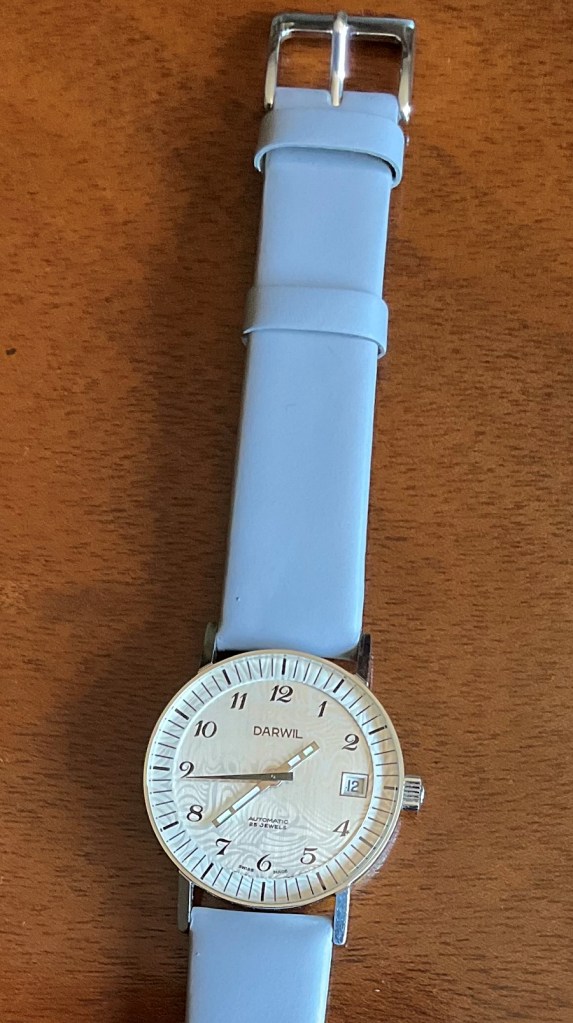
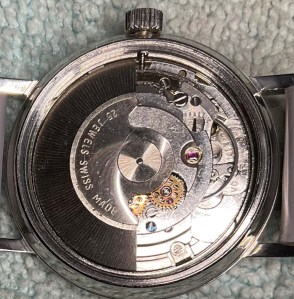
This quite unusual pattern dial model is powered by the automatic Swiss ETA 2472, 25 jewel movement from around 1960’s. In it’s day, the calibre 2472 was pretty much state of the art and this one’ date is positioned @3 and is what you’d call a ‘semi-quick’ date setting function.
Darwil 1960’s Automatic Date watch
To set the date you move the time back & forth from 20.30 – 24.00 and the date is an instant change at 24.00hrs. It is 18,000 a/h beat with 2 x Incabloc protection and a 2 way self winding rotor. It has a 42hrs reserve. And so far it’s proved surprisingly accurate – one of the reasons I love automatics.
I particularly like the sweep seconds hand being more prominent than most and the perimeter track is nicely detailed. The hour and minute hands are luminous filled.
ETA 2472 Automatic calibre – circa 1960
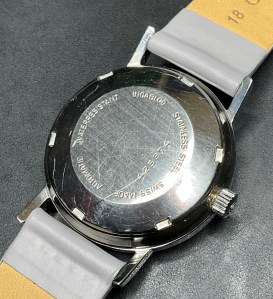
The case is stainless steel, screw back with seal and marked as water resistant. Unsure of the rating for this one but Darwil was known in the 1970’s for their 100ATM divers model, so I certainly expect it to be absolutely fine for every day use.
Stainless screw back with sealing ring.
Whilst there are quite a considerable number of pre-owned Darwil models around, it is rare to find one is such good condition.
Darwil started life in 1910. The founder was Darko Wilfan who in association with the Tanis Watch Company produced watches in the Grenchen Valley in Switzerland. They were later also located in Trieste in Italy and from the Darwil Palace store, sold an amazing 2 million watches at that period.
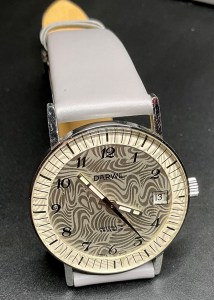
The patterned dial can be seen in certain light – certainly different!
I mentioned a patterned dial at the beginning on the Post and it tends to be seen in certain light. My last image shows it up quite well, but it doesn’t detract from the legibility or clarity of the dial when worn at all.
I liked the fact that the dial pattern ideas of Swatch and others today were beaten to it, with this 1960’s ’70’s period piece – quite modern for it’s day.
After Posting my 1986 (38 years old) dual display 7 jewel quartz Tissot Two Timer (D377) I Post here another one I have. And this is also an original first edition model, before the advent of the altered case lugs and bespoke strap configuration and four screw back plate, but with a similar but different dial layout.
As said in my first Post on the Tissot Two Timer – this model was introduced as a higher quality Swiss alternative to the often variable quality analogue/digital watches coming from Asia.
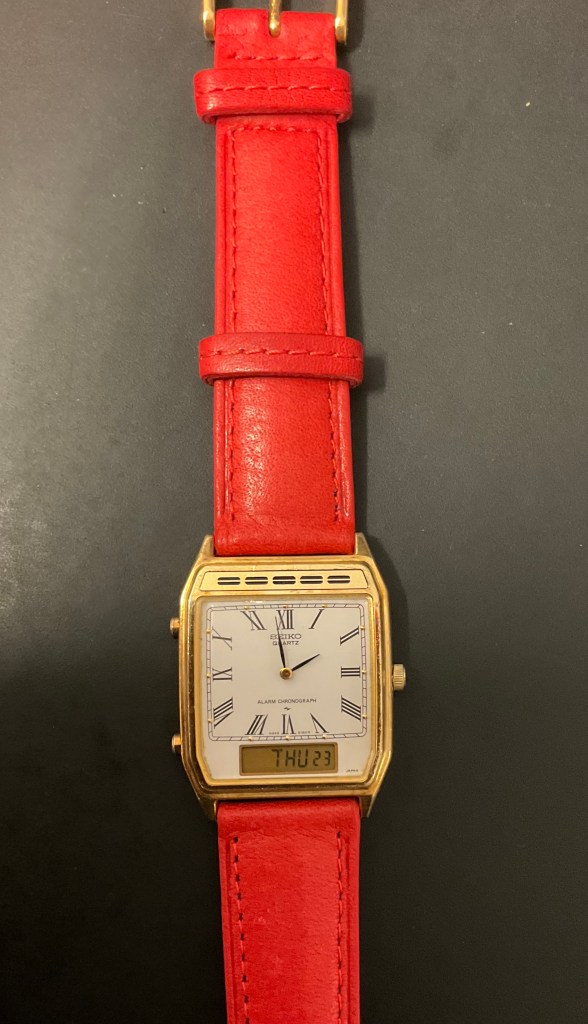
Seiko H249-5130 – analogue/digital 1981
And as Seiko were one of the major producers of this concept (plus Citizen, Casio and a few lesser brands) I thought I’d manage a quick and brief comparison between my Swiss Tissot and my Seiko H249-5130 model of the same era. Both have very similar functions and date of manufacture just 5 years apart. The Seiko 1981 and the Tissot 1986.
Both models are pleasing to the eye and both have an analogue handed dial plus a single line digital display.
The Tissot Two Timer is a high quality cased model in fine, smooth stainless steel. Sleek dimensions at just 8.5mm depth with a curved top plate and Sapphire crystal and a case width of 27mm and lug to lug of 37mm, with a high quality 22mm wide Tissot leather & stainless buckle strap. As a neat dress watch it is pretty much perfect. (note the plain strap means it’s easily swapped, unlike its later version). The case quality of this particular watch is as new, no scratches, perfect. There are also no buttons or pushers on this model, as it employs a good sized stainless steel crown for all adjustments.
The Seiko case is of an ‘SGP’ or Seiko Gold Plate base metal, un-curved with a flat crystal. It is very thin at just 6.7mm, around 27mm case width and lug to lug of 37mm. On this model the ‘thin’ Gold plating is just holding on with just noticeable (close up) wear showing, but is still pretty good for it’s age of 44 years. The case back is stainless steel. The SGP case finish, whilst it can look good when new, does tend to wear and flake over time. And this one is showing it’s age now (Gilt has a max lifespan of 30 years?) but can’t compare to an un-plated stainless steel case of the Tissot.
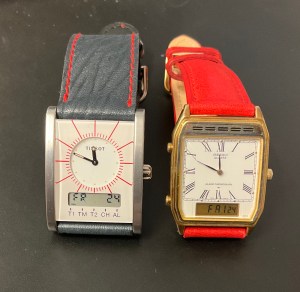
Tissot & Seiko compared – note digit separation
The Two Timer features a battery hatch (eventually introduced to Swatch) and is as good now as it was when new. A bonus too that its rubber seal is intact, so it should still be Water Resistant to 3ATM or 30m (slightly better than splash proof, but not full immersion). Certainly good enough for a dress watch. (however, if you buy any pre-owned watch with a battery hatch – check it has the seal before getting it wet!). And note this stainless steel case back does not open.
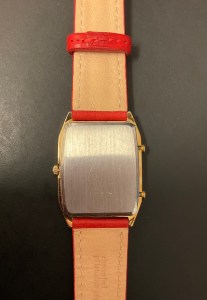
The Seiko has a stainless steel back, but is a ‘snap’ fit – so I wouldn’t class it as Water Resistant, but will probably manage the odd splash – maybe.
The Tissot employs the single crown system, controlling time settings and all functions both digital and analogue. It is also very smooth and precise. This Tissot single crown system is about as good as it gets and whilst there are no push buttons, the crown does have a push function.
The Seiko has a rather small centre crown on the right and 2 push buttons on the left of the case. They are also in gold tone and both pushers have a slight issue of weakened springs, which was and always has been an issue with early ‘pushers’, though so far both work, albeit a little slowly and sometimes require a few attempts.
The analogue dial displays of both watches are clear to read, though the Tissot has more contrast and digit separation is better and the Tissot dial area and display are slightly larger overall. The Seiko gives up some of the space for the Alarm speaker, though in practice the Tissot has the louder Alarm.
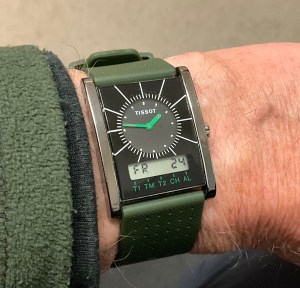
Yet another Two Timer – alternative colour set – with blackened stainless case
There’s no doubt that the Two Timer model has a sleek wrist hugging design and produced with so many face designs, it seems to have a wonderfully fresh look every time I see one. And not many models can boast that versatility apart from maybe Swatch today, which is unsurprising as Tissot was a founder member of Swatch back in the day (and still a member today).
As to design – the Seiko, whilst the latest thing back then with a dial and display combination, somehow looks a little dated now, whereas the Tissot is very much of today. In fact it is difficult to realise the Tissot is 38 years old, basically owing to the overall design, build quality, materials and look plus comfort and functionality are quite a step up from this particular Seiko.
Seiko H249-5130 stainless ‘snap’ fit case back
And the Tissot Two Timer is maybe a bit of an oddity – produced to fill a gap, yet shows it’s superb Swiss heritage so well. The overall design and build quality a testament to Swiss design and watch construction. Also Tissot’s LCD digital display is clearly superior to the Seiko of this period and I know that Seiko, Citizen, Casio, Zeon and other analogue and digital Asian models in those days were not without issues.
However, considering the period, both watches have a raft of functions – such as – Home time, 2nd time or zone, Quartz movement/module, analogue hands and digital displays either linked or viewed separately, indications of Day, Date, Month, running Seconds, a Chronometer, Alarm, AM & PM indication, 12/24 hour selection. Very similar in fact. And in the case of the Tissot, functions are controlled by a single crown, which was quite an advance on what was an Asian digital watch revolution at the time.
My opinion, for what it’s worth, is the Tissot Two Timer is and has always been a bit of an ‘under-the-radar’ model. In fact, I’d say an understated classic, as it stands up so well even today. And I have not come across another Ana/Digi watch of that period with a better timeless look to it.
However, as said at the start, this comparison is perhaps a little skewed, as the Seiko was made in 1981, the Tissot in 1986. And 5 years is a long time in watch development, but regardless of the advancements, the Swiss Tissot Two Timer stands above any comparable Asian models of that time in both design and function.
And of course, model wise there are later Seiko, Casio and Citizen models around that likely better this particular Seiko H249 series, but my conclusion remains.
Just a word on the single crown control –
Ever since the Crown of a watch was introduced back in the early 1880’s, it was a revolution. John Arnold an English watchmaker first thought of some sort of knob to replace key wound watches of the day. Then Breguet took the concept further, allowing the Crown to manage more functions. So, the concept of looking at new ways to expand the Crown’s capability is not new, but with the Tissot Two Timer, the Crown reached new levels yet again. Especially in regards digital function, which is a complication all of it’s own making.
Anyway, whilst it all seems rather complicated – and of course, it is (a bit like an inkjet printer – it prints – but boy! it IS complicated). The trick however, is to manage the “user interface” to make it useable.
But for the watch Crown user, once done a few times – it really isn’t and there is a logic to it.
Generally – with most multifunction digital models, it is a case of selecting the function, either pulling out the crown or pushing a button will cause the digits to flash. Then either using pushers or crown, alter them to suit, then shove the crown or pushers back to the neutral position.
But as with all of them, unless you wear the watch frequently, it’s easy to forget what to do. And in fact, there are many modern digitals today that can get you frustrated.
On this Tissot there is a first and basic procedure that starts it all. And this is whether you’ve got one that’s displaying wrong or you’ve just changed the battery.
First thing to do – is synchronise the analogue and the digital displays.
And if you remember this first bit, then usually you start to remember what you’re doing (basically get things flashing, adjust and so on as above).
So, to synchronise –
And in this order – we first want a blank digital display by simply turning the Crown any way. Once the display is blank (off), pull OUT the Crown – this switches ON the time display. Then turn the Crown (this moves the hands – so you move them to match the digital time). Once the hands and the digits show the same time, simply push IN the Crown again. You are now synchronised!
Now you can set the correct time – With the Crown IN as you’ve just done, turn the Crown again until T1 on the display has a small cursor line below it and a digital time indicates. Pull out the Crown and the hours and minutes flash – and turn it – this time the hands and the digits will move together. (moving the crown slowly moves it minute by minute and FAST motors the hands quickly – like in hour jumps!). Set the correct time approximately, OR if you need to set it to the second, the seconds display will flash for another minute to give you time to set it exactly to the second. Then push in the Crown again.
And that’s the very basic bit , or what I usually remember bit, done!
Personally I don’t set it ‘to the second’ – let’s face it I’m retired! who needs seconds! Roughly to around the minute is fine for me.
And for the rest of the adjustments like Day, Date, Month, blah blah blah – get the instructions out! Then forget it all for the next 4 years or so until the battery pegs out! Then hopefully you might remember the basic bit – (blank display, pull out the Crown and move ”em all at once – yes?) the basic bit! above – then for the rest of it, you might have to findthe instructions!
And finally – the best Tissot Two timer instructions I’ve found are here.
This is an update from a Post I did in 2015, brought about today by my re-organising and relocating my watch storage ideas – and as I saw it, thought I’d check it over. Always worth checking for any errors or incorrect info made at the time, and update on it’s condition and any other images I have, I can add.
Occasionally I visit Antique Fairs, mostly as an accompaniment to my Wife who’s into Art Deco, so I take the opportunity to seek out any Watch sellers that happen to be there.
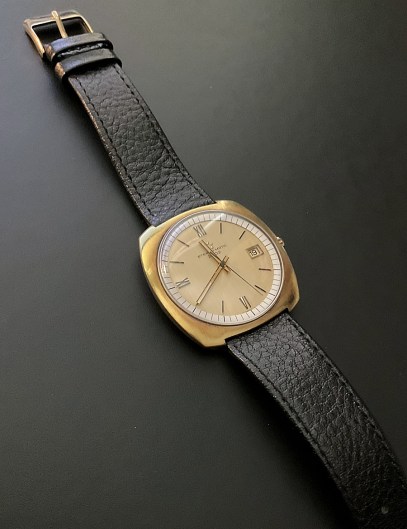
Eterna·Matic 2002 from 1973
Anyway, trawling around the Fair and in amongst the “house clearance” stuff and quite a few watches that obviously lived their lives in boxes full of old nails, I did come across a guy who actually had some decent stuff. His prices were the sort of prices I understand – he’s a watch guy – say no more! and we got on.
Quite a few decent models there too, from Jaeger LeCoultre to Omega to Rolex and so on, but the one that caught my eye was this lovely super condition Eterna·Matic 2002 from 1973. It simply stood out as one of those very good but understated Brands and this one as good today as the day it was produced. The case is that lovely cushion/tonneau shaped ’70s style and in really good condition with no corrosion or plating loss.
Original dial – as good as it gets.
The excellent mechanical movement is the Calibre 12824 or (ETA 2824) automatic date, which beats along at a very smooth 28,800 a/h frequency. The description “sweep” seconds hand really does apply here.
The serial number is scribed on the movement, as is the Eterna·Matic name, Brevet Swiss (Swiss patented). The movement condition is also excellent, the rotor sweet and smooth and the watch dial is something to be very pleased about. The watch back is screwed stainless steel with an intact near perfect condition rubber gasket seal and engraved case number.
Approximately 38 mm wide (39 mm including the semi-recessed Crown) by 37 mm lug to lug and the wrist shot is self evident – pretty much perfect. The Crown is part shrouded by the neat underside chamfered shaping of the case and a slight indent on the top/side of the case.
The dial is really good – the gold hands and baton markers crisp and clear, the dial’s vertical brushed Gold texture background and wonderfully light contrasting outer index a total delight and all original. Note the Crown – is topped with the 5 protruding balls logo and matches the dial logo. The strap is a 19 mm wide non-original (the old one was done) Condor in a soft flexible Buffalo Calf which matches up very nicely.
Watch dimensions – just about ideal for me or indeed anybody today despite the penchant for large watches, this just fits perfectly.
As good as it gets on the wrist! Makes some modern watches look bland! (2015
The watch functions smoothly, the date change crisp and the date wheel is in perfect condition and it is one very accurate movement, as was intended.
The Eterna·Matic Automatic Cal 12824 – 28,000 beats (2015)
Interesting model this as it started off life in 1972 (Eterna have been around sine 1856) and it was with this Eterna·Matic named model that the Company re-introduced itself to the world.
It was a bit of a revelation in the Watch Industry as it was the first watch to wind itself automatically by means of ball bearings – self polishing too, which reduced friction losses considerably and as a result produced a remarkably accurate movement. They even offered a Ladies model with the same set up – and that was something really new.
Eterna·Matic 1973 automatic – (image 2024)
And so here it is in 2024 after 51 years and looking great! – now that has to be quality. And as to value? Well let’s just say that I was VERY pleased at the time I bought it. . . .
This is not the first Eterna·Matic in my collection – and it won’t be the last, I’m sure.
Screw down back & semi-recessed crown (image 2024)
Note –As a brand Eterna today is often forgotten about by the mainstream, which is an oversight in my opinion as their range of models are both technically interesting and varied.
Models such as the Adventic which features the Eterna in-house Calibre 3843 with their Eterna Spherodrive mechanism (ball bearing mounted barrel) or the hand wound Madison big date (one of my favourites), which features an 8 day Calibre 3510 with a serially coupled pair of spring barrels working in tandem to deliver 192 hours of power thanks to that Spherodrive system. This is a hand wound model that only requires to be wound 3 times a month!
So plenty of innovation from Eterna and certainly should always be a consideration if looking for a more individual watch today. I hope to run a Post at some point on the range of models currently available
Note– The original Post is still on the main Posts section, but as I’ve now updated it, I’ll delete it from there. There is a copy of the Post in the Vintage gents section and I’ll update that one with this update as I go along.
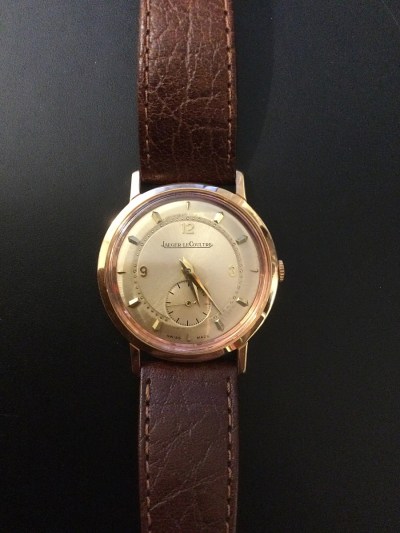
Had a mental block today and couldn’t remember what movement my 18ct gold Jaeger Lecoultre dress watch had. (my memory not as good as it was!). So, had no choice but to unsnap the back off to have a look.
18ct Gold Jaeger LeCoultre gents manual wind – circa 1950
Of course it shows the movement as the cal. 480 CW (how could I forget?) and the serial number dates it I think to around to early 1951 (or maybe late 1950?). I should have known as I’m relocating my collection from boxes to drawers over the next week or so and it was in my box marked 1945 – 1955, so what can I say?
I remember I did that as the watch was sold as 1949 and I gave it some leeway, though I was pretty sure it was early fifties. Anyway, at the time I told myself to check, but apparently never did. Probably as I discovered at the time JL were and still are, touchy about publicising serial numbers/dates. Back then they charged a fee that for me I thought was a bit steep (just checked and it’s now up around £250!) – so I’ll happily go with the dates I’ve decided after checking some JLs for sale, where the dates were given – and checked my serial No. against these – and I’m close enough.
Jaeger LeCoultre Cal. 480 CW manual wind
In my photo I’ve blanked out the serial number, but I can say it was 6 digits starting 82, so maybe that’ll help others with a rough guide.
I did wonder in passing as to what it’s value would be in comparison to when bought, not that I have any intention of selling but it’s always nice to know.
Certainly when I look at todays pre-owned watch auction prices for what are relatively ordinary watches, it appears most have have trebled, though I’m very sceptical as to their true worth.
However, Jaeger LeCoultre is a “name” and renowned for their high quality. My one here is in superb condition and is 18ct solid gold, so I’m pretty sure based on the general increase, it should easily mange a threefold increase. So that’s nice!
This is something I never really thought about when I first started collecting, as I bought models that I liked, regardless of brand or for any investment reason. I bought what I liked and within what for me, I thought “affordable”, however subjective that is and I wanted simply to wear them.
However, with the inflated prices being asked today for some pretty mundane everyday models, maybe in retrospect I should have considered it.
But it is what it is and if it does manage to value at 3 x times my outlay, then great – but I’m not considering selling.
So, this Post – just an update to add a couple of images taken this week (March 2014) of this iconic brand and my elegant Cal. 480 which is a bit of a classic.
This LeCoultre is one of a select number I used to wear at functions and dressy holidays (not so many these days!) as it’s just such a delight to wear – and what’s always surprised me, are the number of people who actually notice it and comment. It seems there are folks around who actually make a point of looking at what watch you have (maybe they want to get out more !).
To illustrate – in Berlin, Germany a few years back I actually got an offer for it, quite out of the blue when in a meeting – but I declined the offer.
Then a few weeks later in Budapest, an ‘older than she looked’ lady stopped me and asked me for the time AND made me an offer. But I was old enough to realise this offer was for something else entirely – and before you jump to conclusions – I declined! 😉
My wife, who was just across the street looking at a shop window, came over to re-join me and asked if I knew this woman –
I said, “No, she was just asking for the time!” and said no more.
I’m stopping this Post now, before things get out of hand . . . . .
One of the nicest watches to wear is this 1948 9ct gold TREBEX, with it’s superb overhung centre sweep second hand and one of the most unique pointer styles I can remember seeing on a watch. I have heard this particular model was referred to as an excellent “Doctor’s” watch In Japan, no less! Perhaps not officially, but as the seconds index is fully blocked in, coupled with the wonderful seconds hand made pulse timing very, very easy. It IS however VERY rare indeed to find it.
There is some confusion about the origins of this brand, though the horological trade mark index (the Mikrolisk data web site) does have it listed as a sub brand of the Milex Watch Company. They were registered in Switzerland in 1938 along with Elem under their trade mark appropriation data.
Swiss Trebex 9ct Gold Gents watch 1948 vintage.
The watch case is 34.5mm diameter which is quite large for the period and had what was termed as “fluted” or “fancy lugs”.
The hand wound mechanical movement is an A S Schild 17 jewel calibre 1351 and runs perfectly and in fact a very good time keeper.
I fitted it to a green lizard strap which seemed to suit it complete with a rounded vintage gold buckle and it is a delight to wear and often to be seen on my wrist of an evening.
No idea of the value of this watch at all, but it is what it is and so far I’ve not come across another with this particular dial. I have found only one with what appears to be a very similar case including the “fluted” lugs, but not with the same seconds/minute closed index OR that amazing seconds pointer hand.
So, to me it’s worth having basically for it’s apparent rarity and the fact, I like it very much and often wear it. And that surely is what it’s all about.
February 2025 –
On reflection I wonder if the dial has been redone at some time. And the hands maybe retro-fitted and not for this dial size. I suppose when you look closer, the minute and seconds hand overhang the printed dial index considerably.
Just a thought – but whatever – I just love watching the seconds hand move smoothly round the dial – quite fascinating.
The main reason I collect vintage watches is simply because of their look. And yes, generally they are smaller than today, but not to be confused with ladies models, which when these were produced were very much smaller. But that doesn’t mean they look feminine on a gent’s wrist, not at all, but it does mean that they are amazingly comfortable and to my mind, look great.
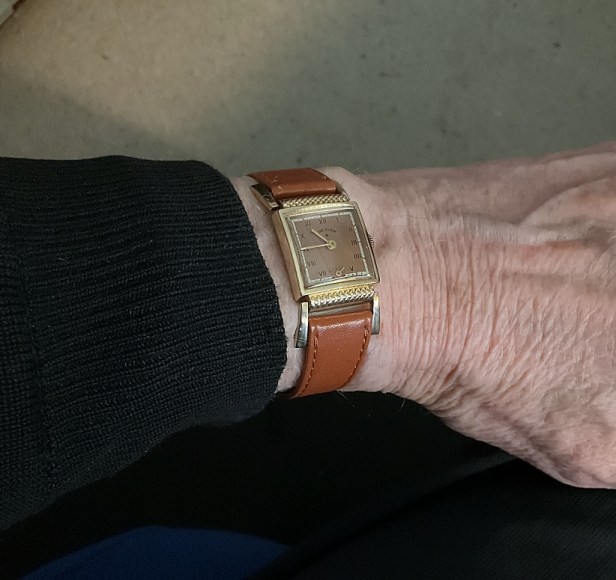
Take this 1947 Lord Elgin, which is not quite as old as I am, but at 76 years old it is still working perfectly, keeps reasonable time and has a power reserve that lasts easily from day to day.
Lord Elgin vintage model from 1947.
This model has the 21 jewel Cal. 670 manual wind movement, adjusted to 3 positions.
It has a lovely copper dial with gold hour and minute hands, plus a sub-seconds dial @6 also with a gold seconds pointer. A minute index is nicely configured around the dial and the detail is really very good indeed.
This model also has wonderful fully articulated “fancy” lugs (a cute and correct quaint term of the day) with nice engraved work at the case ends. The watch is in a Wandsworth Gold Filled case and the entire look is excellent, as is the condition.
Note the “adjusted in 3 positions” – this means that when produced, it actually had an accuracy goal right from the start.
Many watches are not adjusted at all for accuracy, but for these vintage watches it was a good thing. Different levels of accuracies could be graded, such as 2 positions or 5 positions and this means simply that the watch was tested (duh!) in different positions, such as crown down, crown up and so on. Because wearing on a wrist, the watch ends up in many different positions, so it shows an attempt has been made right from the start, to minimise inaccuracy from a positional point of view at least.
There are actually two other main factors affecting accuracy, such as temperature and then the mainspring effect, or “isochronism”, which is caused by the spring unwinding as it runs. For example it might be 2 or 3 seconds fast in the morning, but later in the day maybe 3 or 4 times that. So to try and regulate that “rate” is another way of improving accuracy.
But this watch at least has had some positional adjustments carried out, which is a good indicator of decent quality movement wise.
However, the main point of this Post is much more basic.
I simply wanted to show how good a true vintage sized watch can look on a gents wrist (the gent being me!) 😉 and I think it looks great and it wears great, which was and is still the main reason for my vintage watch collecting.
Note – The dimensions of the watch are 21mm across (add 1mm for the crown) x 45mm total lug to lug including articulation (the case is actually 27mm lug to lug) and the curved case is approximately 7mm thickness including the high domed crystal, which is a feature on many vintage watches of this period.
I’m going to do a few more of the vintage watch Posts, since I re-organised my watch storage ideas recently. I have a pile of leather strapped models waiting to be re-located in new cabinets and I’m cataloguing them too, so they are to hand.
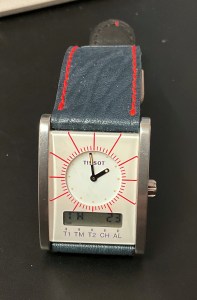
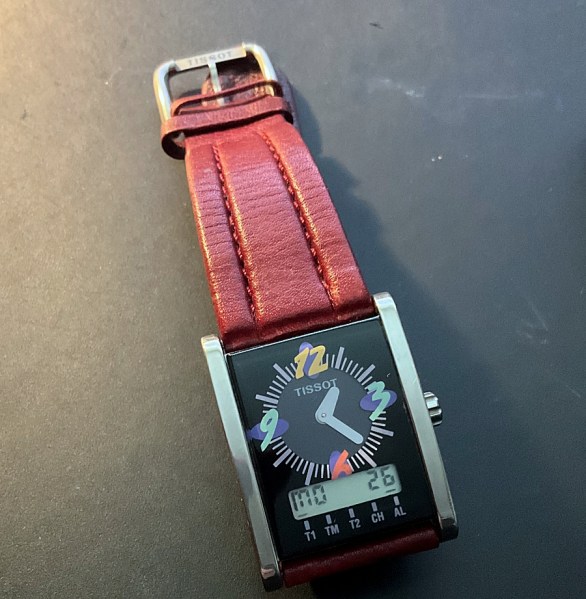
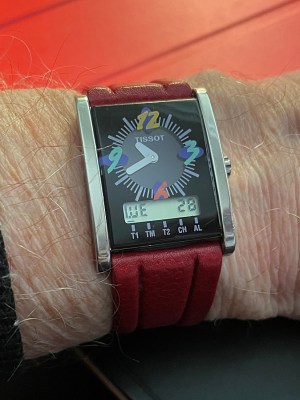
Interesting watch, the Tissot Two Timer (D.377) introduced by Tissot in 1986 and this one dated around that date. By the number of different configurations, this Tissot model interestingly reflects both the Swatch ideals (Tissot joined Swatch as a founding member in 1983) and a competitor to the new Asian digital reality of the time, but in Swiss style. In my small collection of these, I Post this one first as it’s quite a rare one, purely owing to it’s funky overlay dial. The TTT (as I call them) models were relatively new tech for the time, as they were Ana-Digi models with an unusual feature of using just a single multi-functional crown. The control module sets and adjusts the analogue time and the digital functions, which indicate in the single line digital display and by analogue hands.
Tissot Two Timer 1980’s Analogue/Digital Alarm/chrono (note – Alarm is shown as set)
The (adjustable) digital functions featured are; Digital Time, Seconds & Date, Weekday & Date (auto-calendar), Timer, 2nd Time Zone, Chronograph and, Alarm. Each is selected and adjusted by the single crown, which is still today a bit of a rarity. Analogue and digital can be synchronised too and the digital display can also be switched OFF.
I have just a few models that utilise single crown multifunctionality apart from the Two Timers. One that immediately comes to mind is my 1999 Breitling Aerospace, which may well use the same or very similar module. So, this very affordable 40 year old vintage watch, is in very good company.
As said this module uses a single crown adjustment system which although effective, is tricky to manage and if you’ve just bought the watch. You will need the instructions, believe me!
Basically there are 3 crown positions. Press the crown IN once (position A1 – spring action) it selects the main function changes and can also switch the Alarm on or off. Crown position A (normal) rotates either way and moves the line marker under the digits to select the required function.
Position B – (one click OUT) is used to alter the digits on the function selected – then again rotate the crown in either direction. Note that a fast crown rotation moves hours and months & slow rotation alters minutes and days.
So, quite tricky to get the hang of. I found that slow is just that – a nice steady turn and fast is – fast! I would say instructions should be to hand and perseverance is required – but the system does work, believe me. The trouble is that next time you have to adjust it after replacing the battery, you will likely have forgotten what to do – so don’t lose the instructions!
Anyway, on this Two Timer, all functions operate flawlessly and the digital display is as good as it gets with no bleeding or fading, which is a real bonus on any vintage watch with a digital display (a weakness of early digitals).
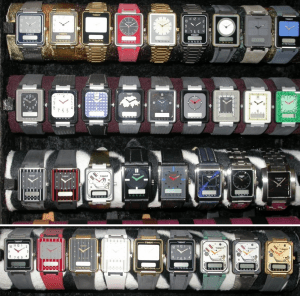
Image shows a Tissot Two Timers collection for sale in 2007
However, the main reason for my interest in this particular 1980’s – 1990’s Tissot Two Timer model is because of it’s rarity.
And this is totally owing to it’s colourful and rather funky overlay dial layout as it is VERY unusual. A fact that’s very obvious by it’s absence in this great picture of a fabulous Tissot Two Timer collection offered for sale some years ago. Do I see this dial? No.
Whilst I’ve also seen many variations on the theme with around 20 different 1st generation Two Timers up to maybe 1995, plus more variations with the 2nd generation models – I’ve only seen this particular one oncebefore and as these pre-owned models change ownership every so often – who knows, maybe this is the one?
Update– I have actually seen one with this dial for sale in Singapore since I Posted this.
For anyone interested in Tissot Two Timer models, especially the 1st generation ones, there are a few (and just a few) of pre-owned ones around, mostly the more common dial layouts, such as the vertical striped face or skeleton. Though these tend to be the 2nd generation models which seem popular. However, fully working 1st gen’s pre-owned ones are much more scarce.
Note the small battery hatch – similar to Swatch – a 20 pence coin fits the slot.
As said, this particular model is a rather colourful and quirky dial layout with thick white coloured (I call loony) hands plus an overlay of quite jazzy numerals and markers – I love its different look from the many others I’ve seen. So I’m very pleased to have it. Plus, it has the original stitched leather strap as well and whilst obviously worn, it’s still OK to wear. However, I do have another strap I obtained recently if and when this one gives up. I note later versions have moved from leather to rubber options – which doesn’t do it for me I’m afraid
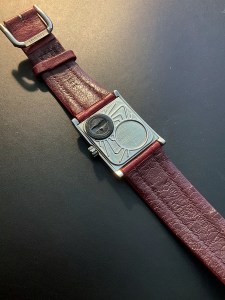
The watch is quartz powered (7 jewels) and the battery (SR920SW) is accessible via a battery hatch (note – 3ATM with the correct seal) on the rear (see image). And the all important crown is well knurled which makes it easier to turn for adjustments. Note the battery cover is often a plastic one and the slot is quite wide – I find here in the UK a 20 pence coin (7 sided) is perfect and prevents damage to the plastic. (don’t be tempted to get one without the battery cover – as these are very difficult to source).
Watch dimension are really good at around 28mm width (add crown just under 30mm) and the case thickness is very neat at around 7mm. The case is also curved with a flat back, so looks very neat on the wrist.
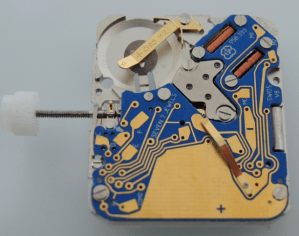
ETA 958-333 7 jewel module (available), but unknown if it would be a direct replacement.My funky Two Timer on the wrist
So, as often the case, I find many vintage models preferable for all sorts of reasons – and fortunately, as said, they can still be found (but not always) at reasonable prices. Beware Two Timers for big prices – they shouldn’t be).
A little unsure as to the movement module used in this Two Timer, but it appears to be a variation of or similar to, the ETA 988.332 module in my Breitling Aerospace. Perhaps the ETA 958.300 series with a single digital window.
The module is part of the Swiss ETA Flatline series and information can be found online. However, little information appears available after 2009 and although I have seen complete 958-333 modules, I would not assume these can be used as a replacement for this particular model.
A few other watch brands have utilised the ETA Flatline series of modules in addition to Breitling, such as Bell & Ross, Rado, Victorinox, Chrono and Butler, so obviously quite well regarded.
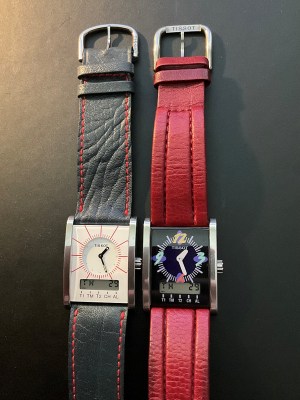
2 x Two Timers, same model, different year. Strap, buckle and dial cosmetic change.
The Tissot Two Timer was never an expensive model, but it was in my view an important one as it not only competed, but matched Asian competition at that time. Along with the introduction of the new Swatch Brand (Tissot being a founder member) this offered a proper well established quality Swiss Brand to customers at a crisis time in the European (Swiss watch) Industry.
So, to Tissot – Founded in 1853 in Le Locle in Switzerland, then allied to Omega – becoming the Omega Tissot Brand from around 1929. They further expanded with the amalgamation in 1983 of what was known as the SSIH-ASUAG & SMH (the Swiss names are too long winded for me to spell out) and finally SMH became a new Group known as the Swatch Group. Today, of course a huge player in the watch industry, with a membership of many major and still independent Swiss Brands, such as Tissot themselves of course.
Anyway, that’s my funky Tissot Two Timer and I love it, both for it’s 1980’s modernist design and to my mind, under-stated place in the watch world and the fact that on the wrist, it just looks great! And I do prefer it to their previous ana/digi models which were not to the same standard.
I also show here in this image, another of my Tissot Two Timer models. This is another 1st gen D.377 model, not quite the same year, with another dial layout, strap and buckle and a different look. Note – Later generation of the D. series have an altered case and lug design which necessitates a non-standard strap, often rubber. Also the battery hatch is no longer used, so the back is more conventional and uses screws to access the battery (maybe a better idea as often battery covers go missing).
Note 2 – Two Timer modules feature an auto-calendar, though this year (2024) being a leap year, with 29 days in February, I manually changed the date accordingly.
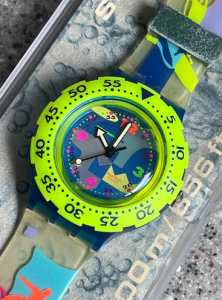
I suppose Swatch watches are known more for their very affordable, reliable and good quality Swiss Quartz models, which started off life back in 1983 as a result of the Quartz revolution, basically from Asia and the inherent danger to the Swiss mechanical models at that time. A response was required and hence the Swatch appeared – sometimes referred to, or maybe popularly called, the Second Watch or SWatch. A model that was colourful, very affordable and also very reliable and with great Swiss Quartz timekeeping too.
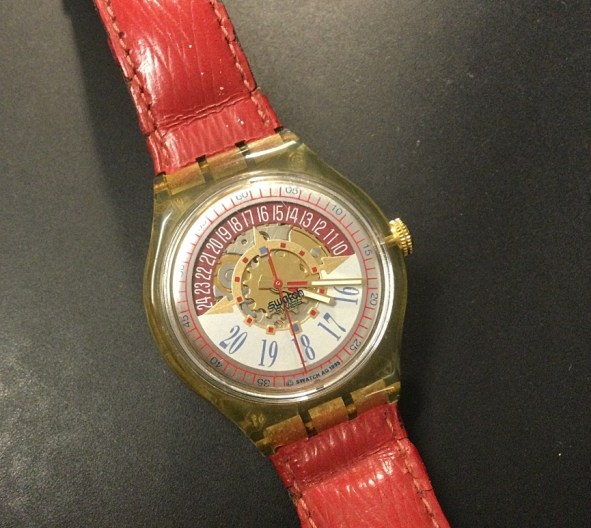
Swatch Terra Cotta Automatic, 1995.
However, back in the early days Swiss watches really were famous for mechanical movements, not Quartz, so a few years after the Swatch revolution, for that’s what it was, they also produced Swatch watches with mechanical movements, manual and automatic and always of a dependable high quality.
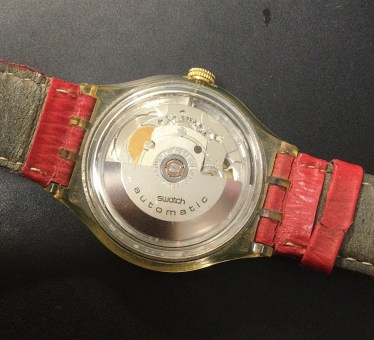
The Terra Cotta (SAK402) is part of Swatch’s “Original Automatic” family, a legacy watch if you will, which appeared in 1996, and this one completely original – with a very decent 23 jewel automatic Swiss movement. This is visible through the full “exhibition” clear back. The plastic case is 36.7mm diameter which is a rarity in itself and not a case size currently available.
On the dial, there’s a neat viewable Date indicator, via a wheel and pointer arrangement, that just sets it apart from the mainstream. And yes, a simple change to the more common date window, but rather nice, as viewing it, you can sort of confirm your place in the month.
The red coloured centre seconds hand, defines it’s movement heritage, as it doesn’t tick each second as a quartz movement does, but rather has a smoother “sweeping” motion, with a smooth rapid tick.
Terra Cotta – 23 jewel Swiss Auto movement.
The original strap on this model is of red leather (not plastic), which rather compliments the dial colour and although a bit frayed now, is still OK to wear. I like that as it shows this watch was wrist worn and loved – and to me, this means it was a “daily beater” for the owner and that’s a big plus in my book.
This one may well have been a “home buddy” as it came by way of Zurich in Switzerland and now it’s on the travel trail with me. Though later this year it’ll be back in it’s old stomping ground, as I tend to visit the middle countries of Europe every year. There are no better places for good watch hunting, new or pre-owned.
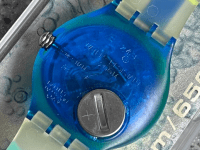
These were and still are produced in amazing colours and styles and most were Water Resistant, even the Quartz models with their small “hatch” fit battery.
The cases were made of light weight plastic, so almost unnoticeable on the wrist, were it not for the bright colourways they use in an almost infinite range of patterns and dials. Today they often use “Bio materials”, allegedly more kind to the planet, but the philosophy remains the same. And movement wise, so confident are they these days, some movements are completely case sealed – no repairs possible – and in the rare event it stops, throw it away and get another one.
While I’m on about Swatch, I checked out another model that came to my notice, though tempted, have not bought (yet?)
SwatchOverTheWaves – odd title, but that’s Swatch Quartz for you.
This is the SwatchOverTheWaves, a diver style Quartz powered model – with an amazing 200m Water Resistance. I just love the colour combinations, which seem to work very well.
It will certainly be seen as a statement piece either in or out of the water!
Typical Swatch Quartz battery hatch. Note water resistance of 200M
So, whatever the reason Swatch are still managing to produce affordable models, both quartz and mechanical, in amazing colours and styles and most, believe it or not, are indeed Water Resistant, which I find surprising with that small “hatch” rear fit battery.
A success story no doubt and when you might assume a high price for a Swiss watch, these are very, very affordable. They’ve not only managed to compete but some would say surpassed that original fear in the early 1980’s that they would be over-run, by this new cheap technology.
Not so – and in my opinion, Swiss watches still reign supreme. In fact it’s a delight to browse through the current and vintage ranges available today as there’s always something new – and something you can afford!
Note – If you need to change a Swatch strap, make sure you get the correct size and remember they are not held in by “spring bars”. Swatch straps are sometimes measured (but not always) from the outside edge of the outer strap loops or between the outer edge of the case lugs.
However, it is fact that straps can also be measured simply at the widest part, where it meets the case – so be very careful which method is used by the retailer.
To remove the strap, you need a small pointer, such as the small round end of a watch strap removal tool (or Swatch’s own tool) – make sure it’s a slightly smaller diameter than the “straight pin” which will slide through the case lug, the centre case lugs and the strap’s three loops – then gently, from one end, push out the pin. Either use pliers or the Swatch tool to grab the other end and finally pull it out. Note, I said ‘gently’ – It is important especially if a vintage Swatch watch as if it has a plastic case, it may be brittle, so could easily crack, so don’t force it, but gently does it. Once the pin is out, put the new strap in position, then ‘gently’ push in the pin again. You may have to wiggle the strap slightly as you push it into place, through the first plastic case lug, then the two guides covering the centre of the strap – all in a line, then into the last case lug. Make sure the pin is not protruding and that should be it.
BUT – word of warning – When it comes to an old vintage Swatch model (such as the Terra Cotta) , the original strap fitting with the trademark 3 x loops lug fitting may be similar – it could be smaller.
And the issue here is, that newer strap loops are larger and wider and may NOT line up or fit in with the original case/lug separations. They are also much thicker at the lug end, than vintage ones, so even if you managed to cut/modify the new strap to fit, so you could refit the retaining lug pin – it could look oversize and clumsy.
In the case of my Terra Cotta here – I’m fortunate the original strap has still got a bit of life in it, so I will not be trying to change it any time soon. (another option of course is to find a true vintage Swatch for a cheap price and if it has a decent strap – consider swapping the strap) Anyway, if it does fall apart – I’ll look at my options then and not before.
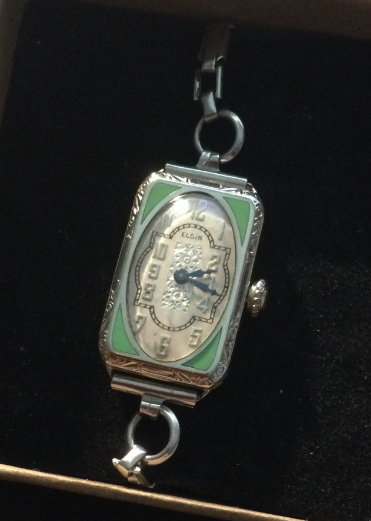
Another Ladies vintage watch in my collection is this nice 1928 Elgin Art Deco model in 14k Gold with a the original 15 jewel movement. The fact that this is working perfectly after nearly 100 years, is a testament to Swiss watch movements of the day.
Elgin enamel dial ladies watch.
I particularly like this model owing to the enamel decoration of the dial bezel/top face, which nicely highlights the figured Elgin marked dial. Not water resistant of course as this was a hinged snap back case and the crown arbor design was via a quite large case entry. The crown is also very easy to use, being quite large.
As was usual at this time, especially in Ladies more fashionable designs, the case has engraving all around the top and side of the case and the case back is perfectly plain.
Very similar to the Elgin ‘Parisienne’ range of models, in regards the use of enamel decoration, though in the case of this particular model, not sponsored by any particular fashion designer of the day. The Parisienne models of course were closely coupled to the famous French Fashion Houses of that period and I have the pleasure of owing quite a few, or my Wife does . . . .
I like the enamel designs, simply as they lift the usual engraved features to another level often by adding colour and texture. Some feature quite inspired cloisonné decoration on the face design, which for me adds even more interest and appeal.
Elgin produced great watches from 1864 and ceased trading in 1968, so over 100 years and this particular model is 94 years old today and, as I said at the start of this Post, an absolute testament to the inherent quality of mechanical watches – and I don’t see this one stopping any time soon!
However, this model is NOT the more popular and later Rendez-vous, which has a rotating bezel with a dot marker – a tricky marketing feature, where the Lady moves the bezel around the dial, denoting the number of hours to the “Rendez-vous”.
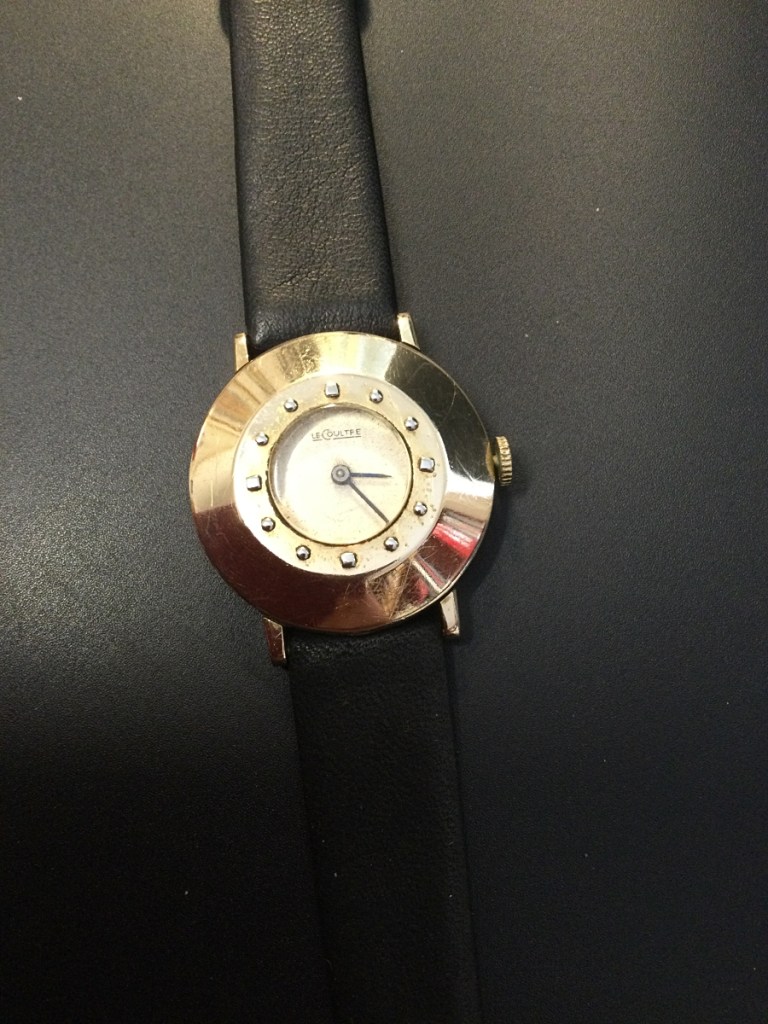
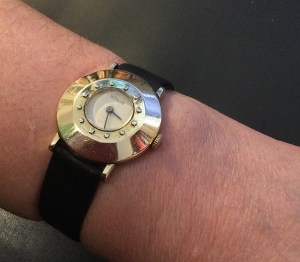
This is the earlier fixed fancy wide bezel version of around 1954 and without jewels, in 14 carat gold vintage cased LeCoultre in original untouched condition. Inside is a manual LeCoultre signed movement, a silver dial, though now with aged patina and I’ve fitted a newer leather strap, as the old one fell to pieces. It would appear that the previous Lady owner wore this pretty constantly.
Why I purchased this model was simply that you don’t often find an older LeCoultre ladies watch in such truly original condition, which for me, makes this rather special. Date wise this is from around 1954 and this particular model (different strap) is listed in the Thirty-Eighth edition Complete Guide Watches, Gilbert, Engle & Planes.
The unique button markers are an integral part of the case and are situated surround the small original acrylic crystal covered dial. I also noted the winder is original – so often these are replacements with watches of this age. The watch also runs perfectly and keeps very good time and according to my Wife, is neat to wear and a nice size.
I may end up managing a sympathetic clean and polish, but don’t really want to spoil the look of age and obviously a well loved watch, so the final decision has to be my Wife’s – and I think she likes it just as it is.
As with many auctions, this one was bought at a hammer price well below the US estimate, so I’m happy with it – plus the fact – where do you get another one and doesn’t it look good on the wrist.






 Watch space
You must be logged in to post a comment.