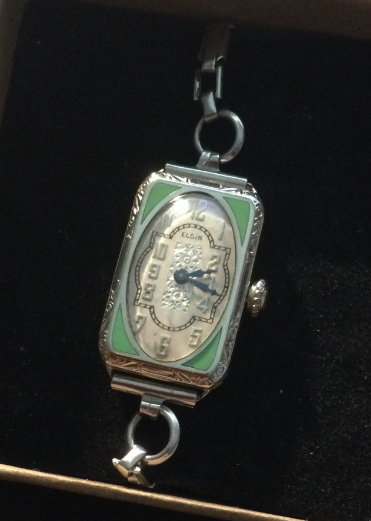
Another Ladies vintage watch in my collection is this nice 1928 Elgin Art Deco model in 14k Gold with a the original 15 jewel movement. The fact that this is working perfectly after nearly 100 years, is a testament to Swiss watch movements of the day.
Elgin enamel dial ladies watch.
I particularly like this model owing to the enamel decoration of the dial bezel/top face, which nicely highlights the figured Elgin marked dial. Not water resistant of course as this was a hinged snap back case and the crown arbor design was via a quite large case entry. The crown is also very easy to use, being quite large.
As was usual at this time, especially in Ladies more fashionable designs, the case has engraving all around the top and side of the case and the case back is perfectly plain.
Very similar to the Elgin ‘Parisienne’ range of models, in regards the use of enamel decoration, though in the case of this particular model, not sponsored by any particular fashion designer of the day. The Parisienne models of course were closely coupled to the famous French Fashion Houses of that period and I have the pleasure of owing quite a few, or my Wife does . . . .
I like the enamel designs, simply as they lift the usual engraved features to another level often by adding colour and texture. Some feature quite inspired cloisonné decoration on the face design, which for me adds even more interest and appeal.
Elgin produced great watches from 1864 and ceased trading in 1968, so over 100 years and this particular model is 94 years old today and, as I said at the start of this Post, an absolute testament to the inherent quality of mechanical watches – and I don’t see this one stopping any time soon!
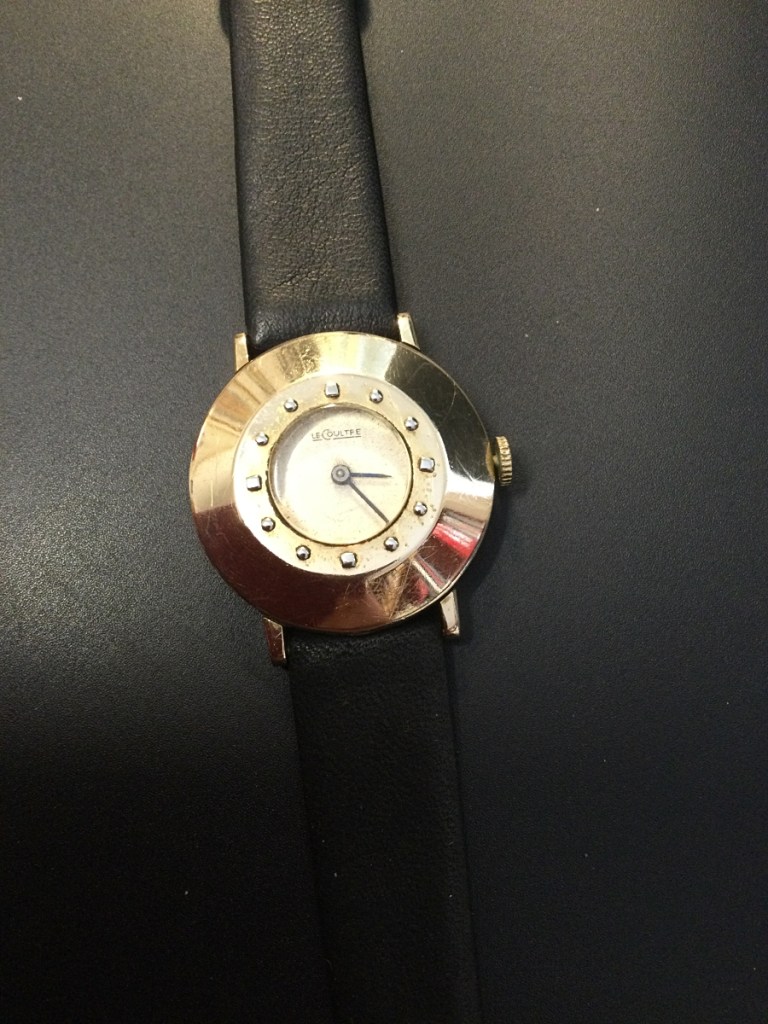
However, this model is NOT the more popular and later Rendez-vous, which has a rotating bezel with a dot marker – a tricky marketing feature, where the Lady moves the bezel around the dial, denoting the number of hours to the “Rendez-vous”.
This is the earlier fixed fancy wide bezel version of around 1954 and without jewels, in 14 carat gold vintage cased LeCoultre in original untouched condition. Inside is a manual LeCoultre signed movement, a silver dial, though now with aged patina and I’ve fitted a newer leather strap, as the old one fell to pieces. It would appear that the previous Lady owner wore this pretty constantly.
Why I purchased this model was simply that you don’t often find an older LeCoultre ladies watch in such truly original condition, which for me, makes this rather special. Date wise this is from around 1954 and this particular model (different strap) is listed in the Thirty-Eighth edition Complete Guide Watches, Gilbert, Engle & Planes.
The unique button markers are an integral part of the case and are situated surround the small original acrylic crystal covered dial. I also noted the winder is original – so often these are replacements with watches of this age. The watch also runs perfectly and keeps very good time and according to my Wife, is neat to wear and a nice size.
I may end up managing a sympathetic clean and polish, but don’t really want to spoil the look of age and obviously a well loved watch, so the final decision has to be my Wife’s – and I think she likes it just as it is.
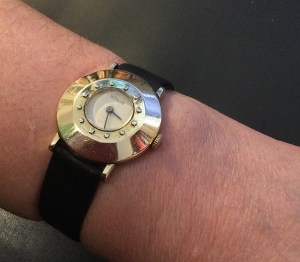
As with many auctions, this one was bought at a hammer price well below the US estimate, so I’m happy with it – plus the fact – where do you get another one and doesn’t it look good on the wrist.
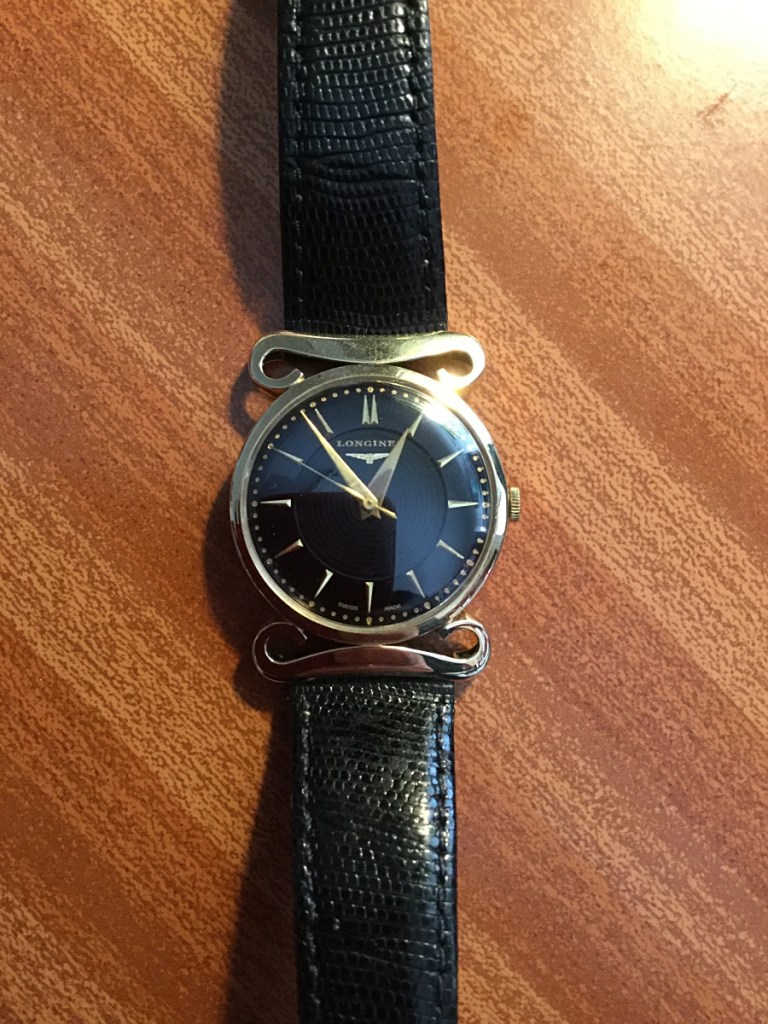
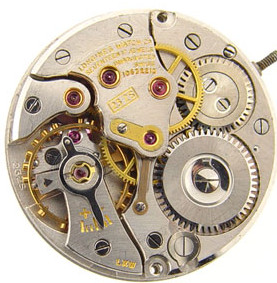
This midsize 30mm diameter, manual wind 23ZS 17 jewel movement model with it’s amazing fancy lugs is one of my favourites. The lugs are much more substantial than many of this type, being very solid. The D&A watch case is nicely polished in 14K filled Gold, and the dial has a black face with an inset machined inner, the hour, minute and centre seconds hands in matching gold, as are the applied arrowhead markers. A Gold filled snap back cover and a size 18 black lizard leather strap completes the item.
Longines Calibre 23ZS centre seconds sweep.
Quite an expensive watch of it’s day and the 23ZS movement one of their great calibres, with 18000 a/h and a Power Reserve of 44 hours, this model is ticking away, keeping very good time after 65 years. A darned sight more efficiently than I am!
I note this model has a snap back/base which when removed still holds the movement within it. To remove the movement it entails further and careful prying apart from the case base. I have not removed the movement here as I don’t wish to disturb it, but I show a image from a web source.
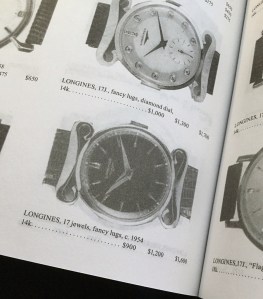
Model entry in Shugarts Complete Price Guide Edition 38.
Note – This model was one of a series and this version is featured on page 918 of the “2018 Complete Price Guide to Watches” Edition 38 by Gilbert, Planes, Engle, Gilbert & Shugart. The other model shown is the sub-seconds version, with diamond markers.
The watch is in very good condition, possibly refurbished to some extent over the period and the movement shows some tarnishing, but not enough to cause any issues. It keeps pretty decent time showing perhaps a minute slow near the end of it’s power reserve of 44 hours. The crown is a little stiff, but other than that, a very nice addition to my vintage Longines collection.
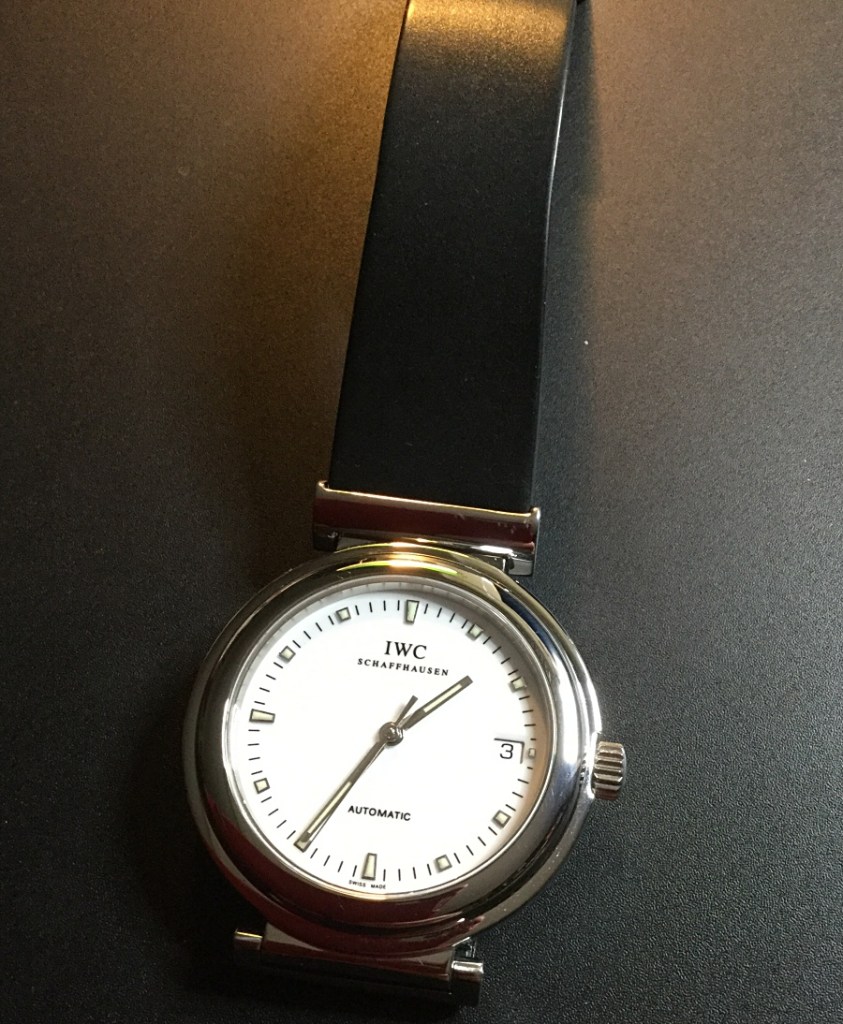
My first Post of 2020 features a neat IWC Da Vinci SL model.
IWC Da Vinci SL Automatic
Calibre 37524 based on the ETA 2892.A2 is a 21 jewel, high quality Automatic rotor mechanical movement. Specifically adjusted for IWC to an accuracy of 0/+7 seconds per day. It runs at 28,800 A/h and has a 42 hour reserve, with Sapphire crystal, stainless Steel case and back and a central sweep seconds hand and date window @3.
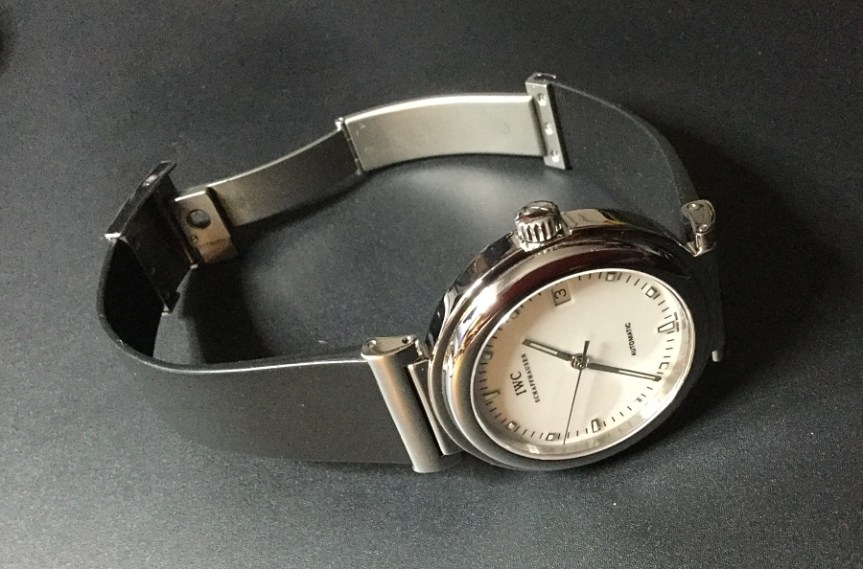
The crown is a screw down type and WR is 50m. The case is classic sized at approximately 37 mm in diameter and features articulated bar lugs, so is ideal for the smaller wrist and the strap (deployment) is a fine rubber material. (newer models have conventional 4 lug styles, but I prefer the neater bar arrangement).
IWC Da Vinci with signed deployment & articulated bar lug arrangement – year 2000
The silver dial features numerals and luminous makers and the hour and minute hands are also infilled with luminous material. Not as bright perhaps as a Divers watch, but fine for the odd time you may have to use it. This particular model was produced from 1988 to 2002 and this one is from around 2000, so already over 20 years old and in perfect, as new, pristine condition.
The strap is an IWC original rubberised material with a stainless deployment action and signed buckle.
This is one of my more recent acquisitions, when I was visiting Lucerne in Switzerland. A great place for watches of course, but also not so well known is the fact it is also a great source of high quality pre-owned models, complete with full servicing and guarantees. Unlike auctions, where buyer beware is still the watchword.
One of the neatest of the high end automatic models I have and for a pre-owned one, it is in remarkable condition. Whilst I have a good number of high-ends, the look and the price sold me on it. It will also tend to hold value which is good.
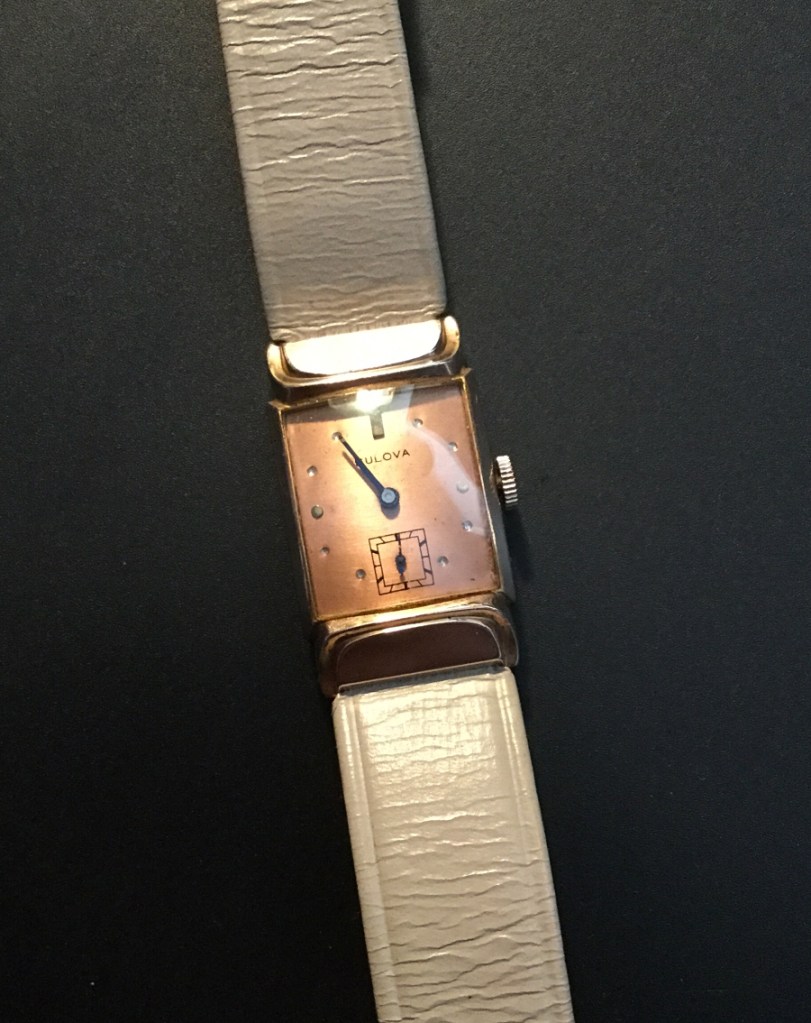
I’ve always liked copper dials and this vintage 1940’s Bulova “Squadron” is no exception. 14ct Rolled Gold case with factory copper tone dial and a signed manual wind Bulova Calibre 8AE Bulova movement, which is relatively uncommon, with semi-hooded lugs, is a very neat watch by any standards. The leather beige Laco strap is a nice quality replacement, which suits the overall colour of this ensemble and has just perfect and acceptable wear, looks great on the wrist and is very comfortable to wear.
Bulova vintage copper tone dial
Nice to see an original copper tone dial in such good condition. Note the markers are a combination of raised silver tone markers and indents. The watch overall is in decent condition with very few scratches on the case and the back is a tight “snap” fit which is always nice. The case is solid 14ct and appears to be Rolled Rose Gold and the movement winds and runs smoothly, keeping excellent time.
I bought this at auction at a very keen hammer price of just £70.00, which has to be a bargain. It begs the question why anyone would buy a watch at retail today. Use common sense and there is no doubt you can still pick up great watches, with some great style (sadly lacking today) at sensible and realistic prices.
This watch is by no means modern, but the movement is working as good as it was when made. It’s mechanical, so never needs a battery, it’s easy to reset the time for Summer time and so on, the date change is also easy at the half crown position for some of the months – in short it is very easy to live with.
In the same auction I also found a very nice 20 year old quartz mid size in absolute mint condition, at a fraction of it’s new price, though my Wife has snaffled it for herself. I don’t blame her as it is one very smart looking watch.
So happy auction days recently, which I have to say is really unusual, especially as over this last year I have been banging on about how poor and how expensive auctions are becoming today. And in general they are unfortunately and I’m sure will come back to bite those selling agents, with fewer successful sales.
But regardless of all that doom and gloom, for me this was a shot in the arm, though caution is the key word. Today, I am VERY careful at auctions and I never get carried away, especially with the high auction costs, which increase every time you blink!
And whilst Buyer beware has never been a more true statement, this week proves that you can still manage to purchase a bargain as I’ve recently seen one very similar for nearly £300!
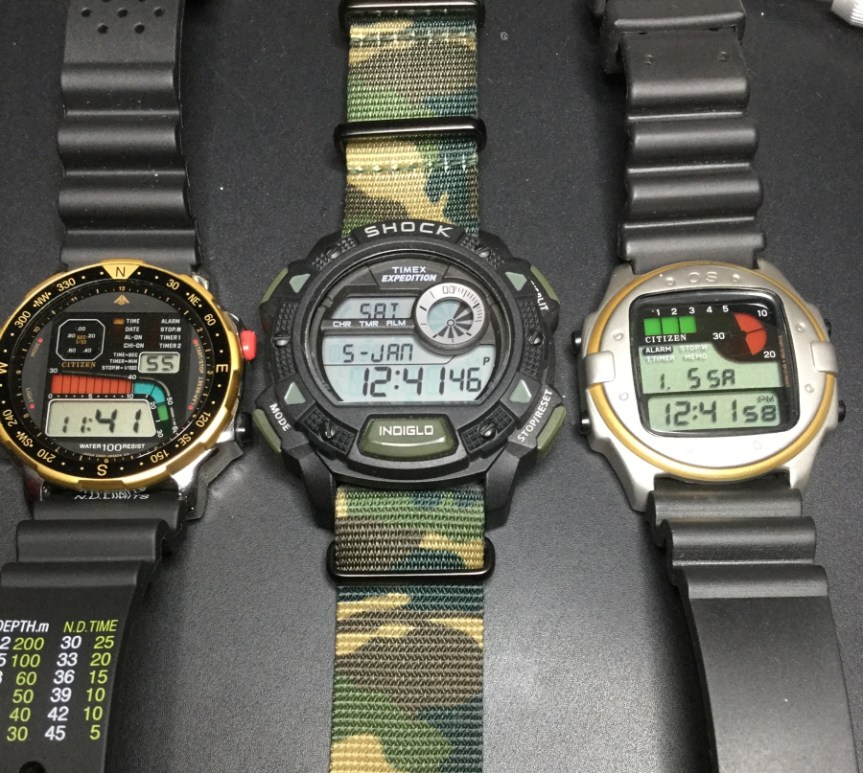
There’s something about early digital watches that really attracts me, mostly because they can look so interesting. Often full of complications and with amazing dial designs, which for me is possibly the most important aspect of these creations. How to display the most relevant information or data to the user, without causing confusion – and still make the function of it, or the “user interface” as they say today, both easy to read, understand and also intuitive to use.
Not an easy task.
Here are a few that for me manage that task pretty well.
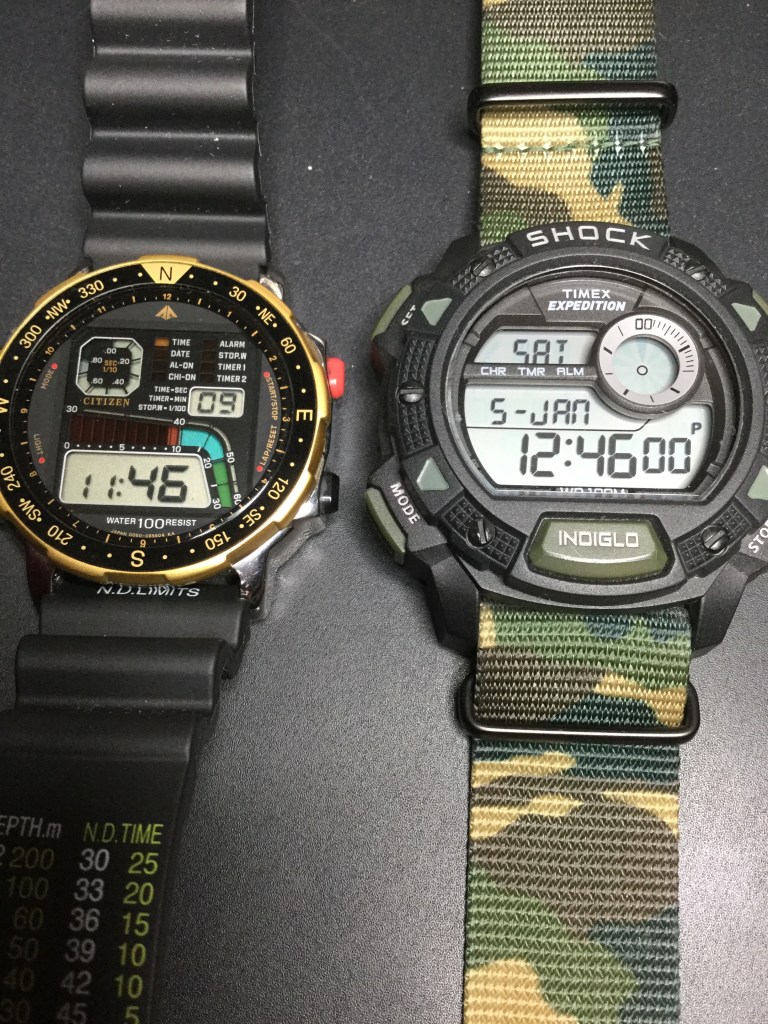
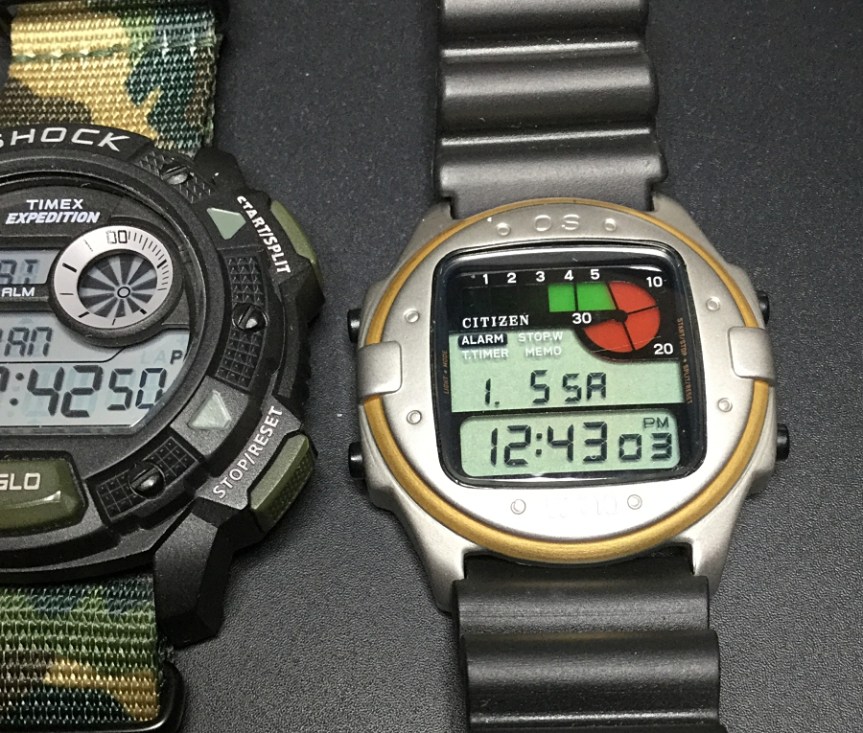
Early Citizen D060 Windsurfer, Timex (later) T49976 Expedition, Early Citizen D100 Promaster Windsurfer
And yes they are all quartz, battery powered and every so often you have to change the battery – it can be daunting, though once you get the hang of the user logic, these ones are actually easy to manage. Sometimes there are printed highlight notes on the module reminding you to short out this or that, or push all buttons prior to setting up and so on, though that’s basically to clear memory and rarely affects the basic time function.
Any time a battery needs changing – it’s – clear the desk workspace – take care and concentrate. But seeing the display come to life again and then scrolling through the various functions and reminding yourself just what these modules can do, is always a pleasure.
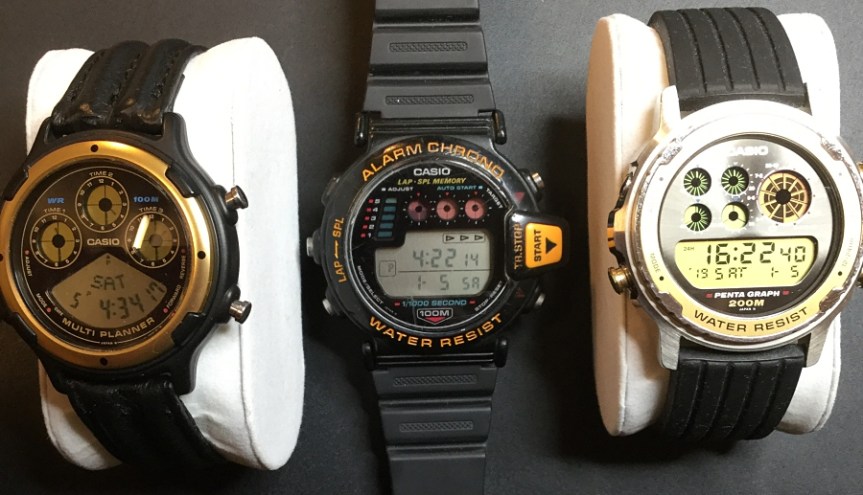
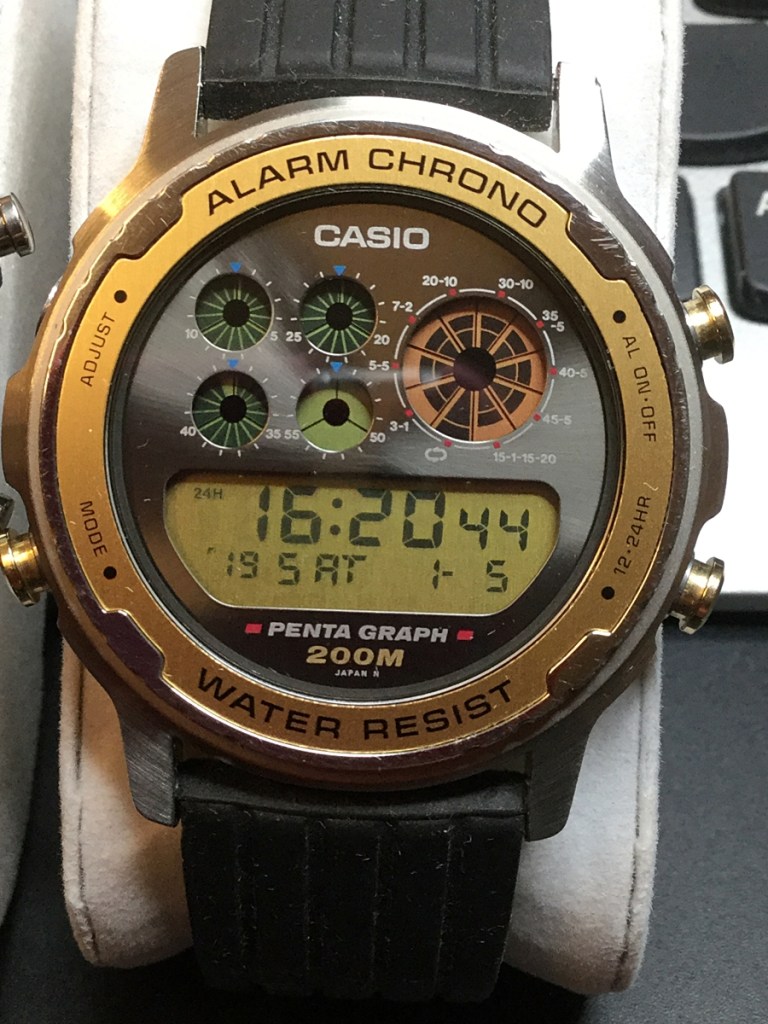
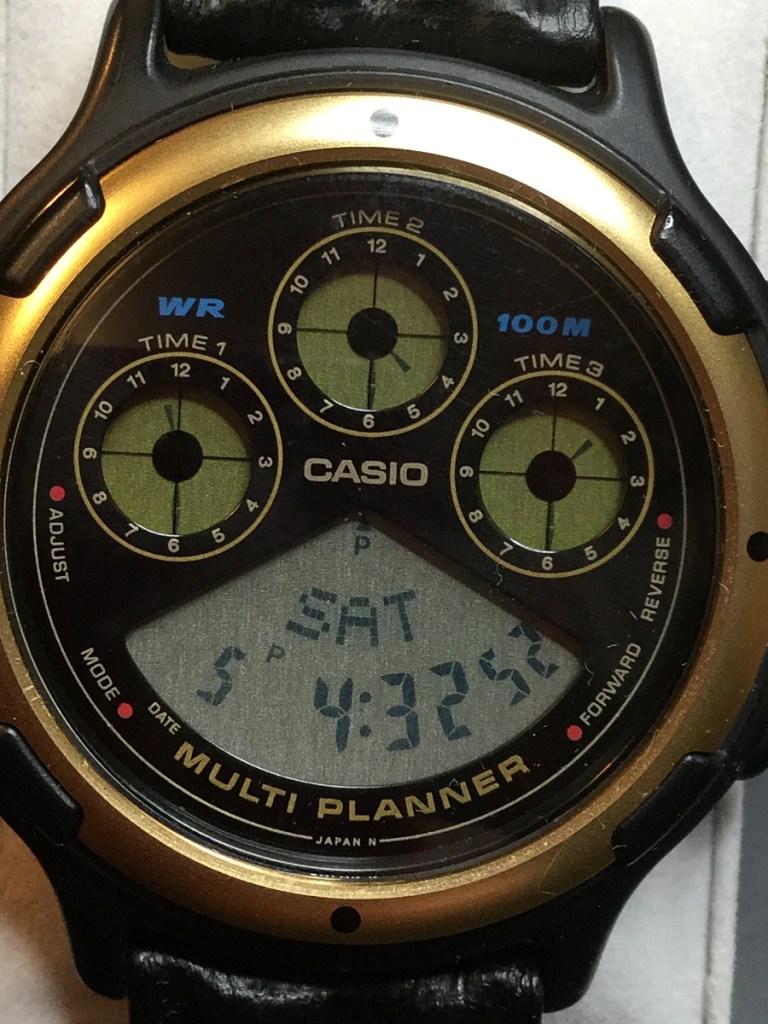
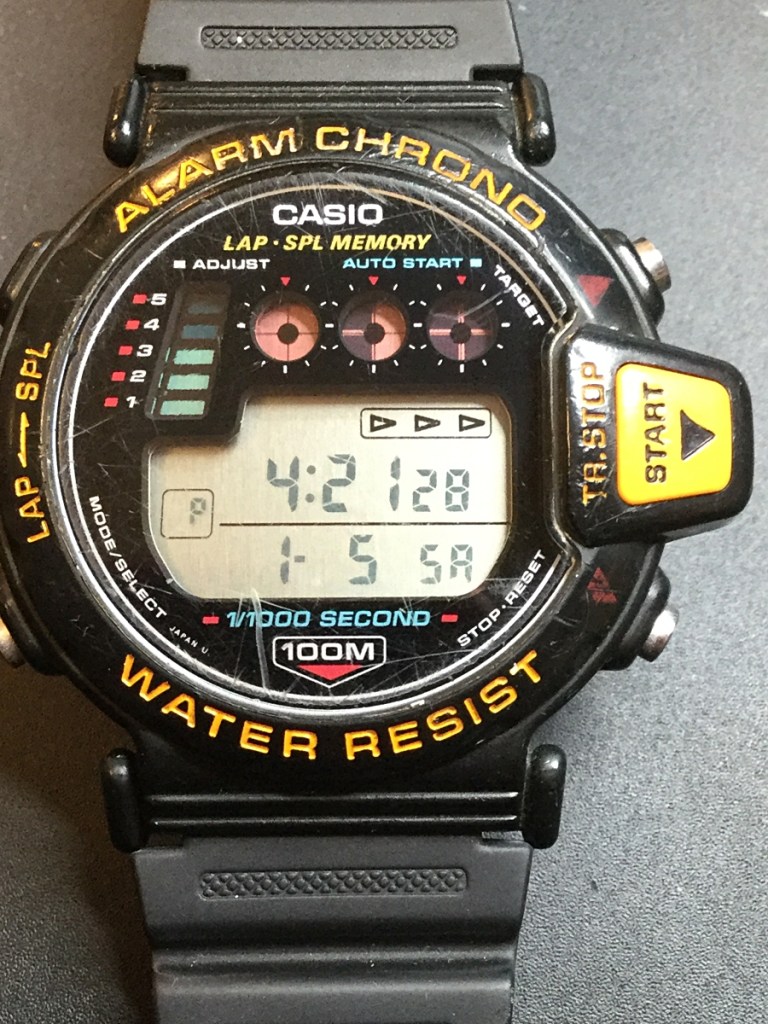
Casio vintage Alarm Chrono, had tough times but still good!
With a reasonable collection of digitals from the late 1970’s onwards, you can see the dial contrast improvements and the creation of more intuitive commands, to manage this or that function, though I’m still bowled over by some of the early ones and realize just how good they are.
I’m not going to go through the functions and so on, but rather just show here a small photo gallery of some of the ones I’ve collected over the years. The dials say it all really and there are many more, many covering all sorts of sports and pastimes, but increasingly difficult to find these in really good condition. They are not expensive and as a result tend to get worn “hard”, often not surviving. Often as not, if the module goes, so does the watch – into the trash, which is a pity as they are a testament to the ingenuity of the first Quartz sports watch pioneers.
Many are Japan made and although there are many, many lookalike digitals around from China, none of them have the pedigree of these or indeed the quality of the Japanese modules and displays, which in their day, were truly science fiction, and particularly in the actual design.
Rare watches today as they represent a time of change and great innovation and ridiculously accurate for their time too, which is a real bonus. Usually wherever I go when wearing one of these, people comment and mostly they are rather impressed. Not bad after some 40+ years of plastic/resin moulding, early display technology and large battery styles – I take my hat off to them – great!
Note – I have probably featured these somewhere in the web site at some time as a Post. For more information, just use search.
Vintage watches are still my passion and perhaps more so today than ever, simply because many are from an age where “style” and “elegance” were as important as the watch function itself. And I have to admit I like that.
Neat but good sized Ladies 1920’s 18K Vulcain manual wind in original condition
This example is a 1920’s Ladies 18ct Gold Vulcain which has survived in very good condition and is being worn today, keeping good time and looking as elegant as when it was made. I guess it was produced just after WW1 when Vulcain moved to their new factory, so possibly around 1923 or so, once the new premises was fully up and running.
This model is a bit of a rarity with this case shape, though checking through the Vulcain “Book” I found this very similar model from around 1930. Note the early Vulcain logo in a simple font without underlining etc.
1930’s Vulcain with diamond decoration – from the Vulcain “book”.
Another reference I found is from the Watch Book – “Wristwatches – A Handbook and Price Guide” 6th Edition of Gisbert L. Brunner & Christian Pfeiffer-Belli, printed by Schiffer, which although listed as anonymous, could indeed be a Vulcain such is the similarity.
Similar cased & dial look of the 1920’s
My Vulcain 18K Gold cased is also complimented by the expandable bracelet (marked DV, which denotes a Vulcain parts or accessory) which suits it perfectly with no degradation to the spring action or the fastening clip and safety chain. (note the Trademark DV with the V on top shown is prior to the rectangular form, which appeared in 1934).
Original Vulcain accessories (DV) 18k Gold expandable bracelet
The case back is numbered and hinged with a snap closure and the movement is in very good condition considering this watch is not water resistant.
Vulcain of course is a very old established Watch Company formed back in 1858 and still producing high quality watches today. Famous amongst other things for producing the 1st practical mechanical Alarm watch, the Cricket” – which could be heard over 30 metres away and operated without disturbing the time keeping of the watch, both features thought impossible. After many years of research it finally was introduced commercially in 1947.
So all in all very pleased with this purchase as once again it is relatively rare, both in shape and style and is in excellent running condition. What’s more it appears that the original bracelet is attached and the watch has obviously been kept for special occasions as it has worn exceptionally well over the best part of the last 100 years.
The last image shows a Gents Vulcain from around the same vintage, again with the original Vulcain logo on the dial and very similar font applications on the dial. Note too the hands and dial colour are virtually identical, which were obviously the parts of choice at this period.
I’ll keep a look out for this particular Gents model and if it comes up at any time – I’ll be very interested in adding it to my collection. You never know!
Gents 18ct Gold 1925 model (Illustration – from the Vulcain “Book”)
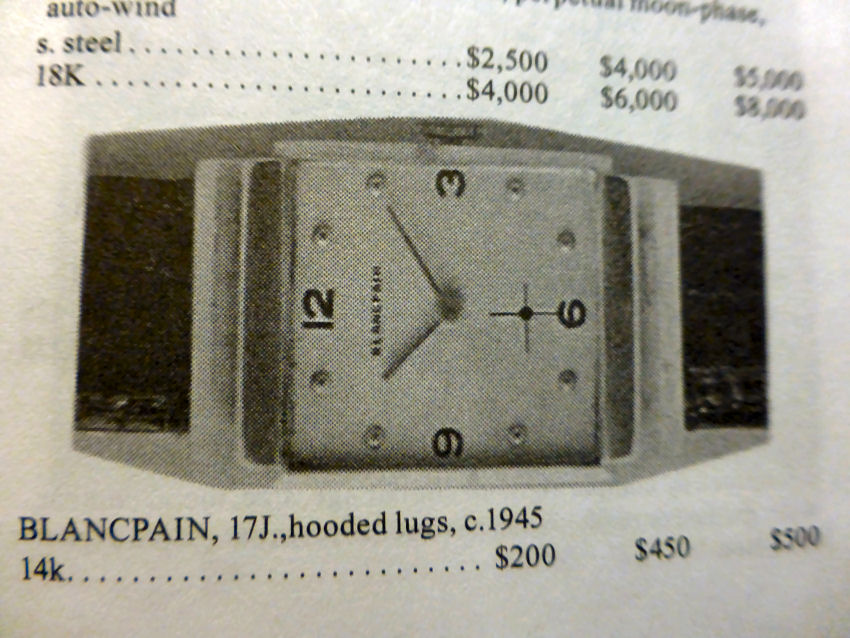
Yes here was I thinking that Blancpain produced only round case watches. I checked around however and with some difficulty it has to be said I did find an image example in my old No 30 Edition Gilbert, Engle & Schugart “Complete Price Guide to Watches” on page 677 right at the foot of the page, an image of almost the very same model. It too has hooded lugs, though shown complete rather than the part hooded ones of my version.
Gilbert, Engle 2010 Watch Catalogue – illustration of vintage Blancpain model
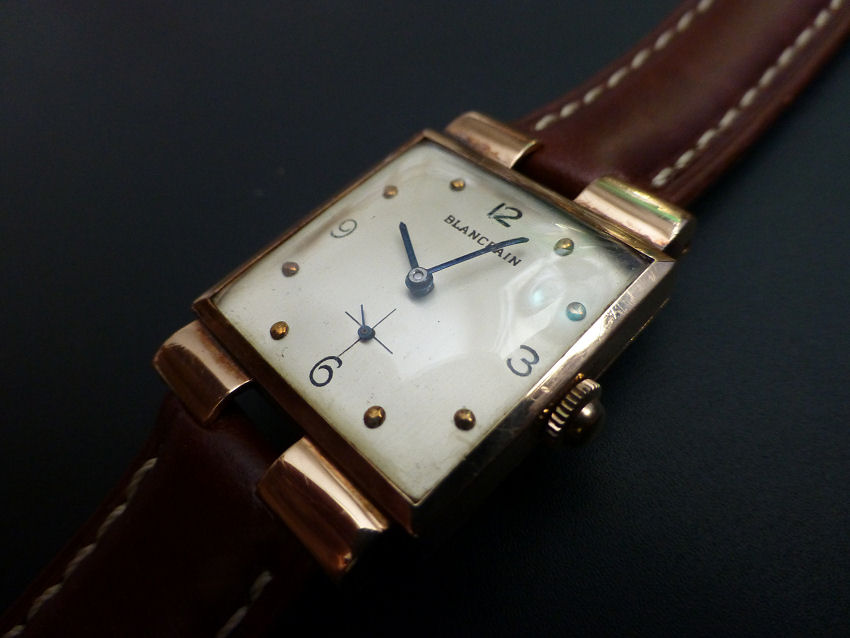
However the dial is exactly the same, stick hands dot markers and the tiny sub-dial seconds, plus the 4 cardinal numerals. The glass is unscratched and domed and the solid 14k Gold case is in great condition. A degree of re-finish is evident and why not as this watch is from around the 1940-45 era. The strap is not a Blancpain but a modern Italian leather Rosario 18 mm that looks just fine. As always with any watch I collect – it has to be worn on the wrist regularly and Rosario straps are always comfortable.
Blancpain vintage rectangular c 1945
The movement which is in superb condition is signed Blancpain 17 jewel unadjusted with the Rayville SA import mark clearly shown (KXO). I’m not sure if Blancpain even made their own movements in this period and the movement looks very similar to an A. Schild. It does look as if it could be related to the AS 970 for example, though I’m no expert on these and there were so many AS movement variations, I can’t definitely put a number to it, but they were of very decent quality for the period.
1940s Blancpain signed 17 jewel – perhaps Anton Schild.
The case has been cleaned up at some point in the past, but the Case Maker marks show up clearly to be Katz & Ogush Inc of New York, who were registered in 17th January 1921, and denotes the 14k Gold motif. K&O had two different motifs – the other was simply plain text with their initials, so this is a nice bonus for me as I have a thing about Watch Case Maker marks.
Katz & Ogush Case Maker for Blancpain c 1945
When I first saw the images on Auction I thought perhaps this was a Ladies model, but the watch overall size at 26 mm x 35 mm lug to lug, is definitely for a Gent.
It was also produced at the time when the “formed” watch style was coming in to fashion, as they moved away from the traditional round pocket watch style of earlier times. Of all the shapes around at the time and into the fifties, the square and rectangular became the most popular and are still with us today.
So to say I was pleased in an understatement – I am delighted with my vintage find this month.
It’s not often you find a rectangular Blancpain and movement wise it is in great condition, the case is clearly marked with a known Case Maker and it’s in good condition – it also keeps excellent time which is another bonus.
The question of absolute original condition and refinished condition always comes up when collecting vintage watches. It is a fact that to find watches in “perfect” condition of this age is becoming almost impossible now. More often than not the watch is in various stages of poor condition, corroded movements, spotted dials, mechanical damage, scratches and dents and certainly not looking at all as it was when made. The question you have to ask is – Do I want it looking like that? And in my case – Do I want to wear it?
Personally as a “wearing” watch collector, I prefer the watch to look more or less as it was. And I don’t mean completely refinished in such a way as to look false, but rather cleaned up sympathetically, basically to show the attributes of the original watch.
I also don’t mean to replace everything on it, but where possible to refurbish the existing elements to best advantage.
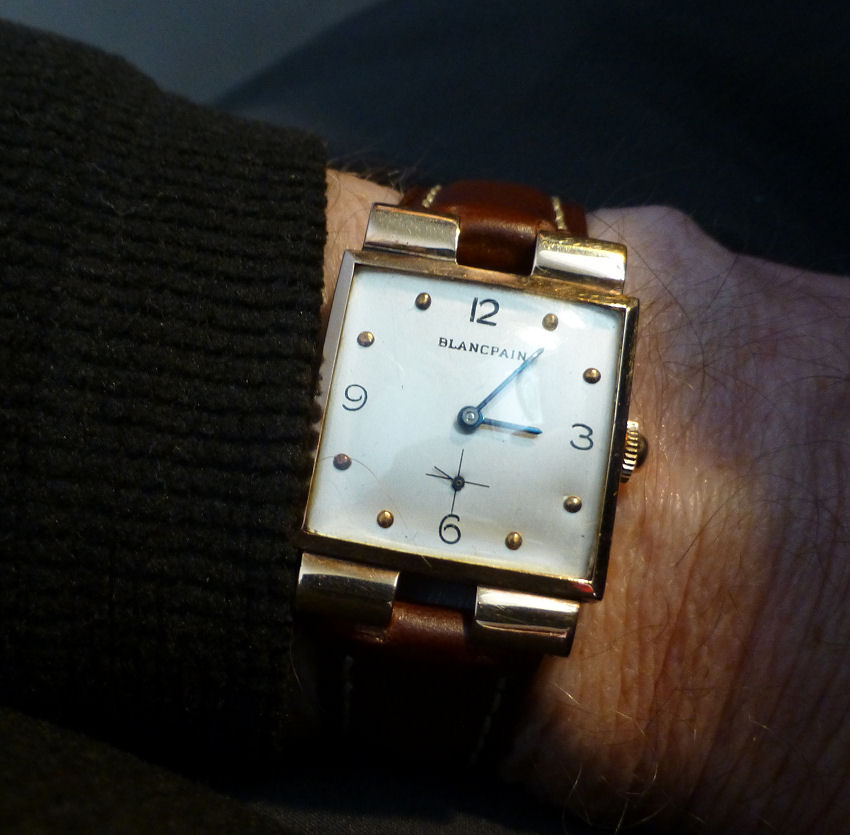
Rectangular 14k Gold Blancpain c1945
The only time I would tend to accept the absolute original, would be for very much older pieces, such as a few pre -1900 models. I have some and these 1800’s models are about as original as you can get and “as found” and are the only watches I own that I don’t wear.
They are (unfortunately) for display purposes only. I suppose I got these when I first started collecting and had this exciting “purist” idea, but I soon found that firstly it was a VERY expensive and perhaps over-optimistic collecting idea. Secondly I realized that wearing watches was my real passion so had to revise my strategy and not look too far back – and of course it’s cheaper!
But for me, more fun . . . . .
Note – One of the problems with vintage watches is the degree of uncertainty when checking them out. You have to be a bit of a detective and maybe a skeptic too, which is a pity. It would be so nice to accept things at face value, but that would be unrealistic. There are some things on this model that could make you wonder, one of which is evidence of machine holes/marks on the rear of the dial. Are they related to the fitted movement and dial? Well yes they are in this case and are actually the reverse of the dot marker positions on the dial. If you look closely at the markers they are not just “applied” markers, but are in fact punched “through” the dial itself. And that’s about as permanent as you can get.
So maybe after all this is me being too Sherlock Holmesy, but this sort of thing does makes you question – But as I say happily every aspect of this case and dial was perfectly consistent with the watch. Though had they not been you have to remember it was the middle/end period of the 2nd World war, watch cases and parts may not have been easy to get and to assemble a complete watch might well involve a certain degree of “mix and match”.
I might have to go along with the fact it may – and I say may – have had a very light and sympathetic dial refurbishment and that is absolutely fine by me – in fact I love it.
So after close examination I think I’ve got myself a really nice and genuine example of a rather rare watch – AND I can wear it – so I’m happy.
One of the nice things I like about Longines, is their trick of producing high quality watches at affordable prices. And that’s what we’ve got here with this vintage Auction find for under a £100. I say value for money as I spotted a pre-owned one, co-incidentally just the other day from a Retailer, for £450 and this one is in far better condition.
Very neat Longines Conquest quartz Date watch – c 1992?
This is the Longines 1992-4 Conquest Date model in stainless steel, with the Longines L1.161.4, 6 jewel ETA quartz movement. Slipped into a sleek well finished stainless case that’s only at around 5.32 mm thick is what I call neat. In fact the entire watch is neat at just around 34 mm (excl. crown)in diameter. This version has the original Longines French made leather strap, with the proprietary deployment clasp with twin button release. Note this is a bespoke strap as it has to fit the lug case design with the centre cut out. I also noted when searching this model on Google it’s actually rare indeed to find a strapped version, as almost every one I’ve seen comes fitted to a Longines bracelet.
Neat Longines Conquest with 5.32mm thick stainless case & original deployment fitting.
Anyway this watch is in pretty much perfect condition with no marks or scratches at all (I hasten to add that the images shown are as I bought it, uncleaned), the Sapphire crystal is perfect and there are no intrusion marks on the back, which is also pristine. The fact there are no intervention marks is a real bonus, as so often ex Auction pieces have had a few over zealous buyers poking around them with their penknives! (Yes! it happens – I’ve seen it! and that really annoys me!).
The deployment strap is not actually damaged but is very oily/dirty with accumulated crud from obviously been worn 24/7 by the previous owner, so do I try and clean it or not?
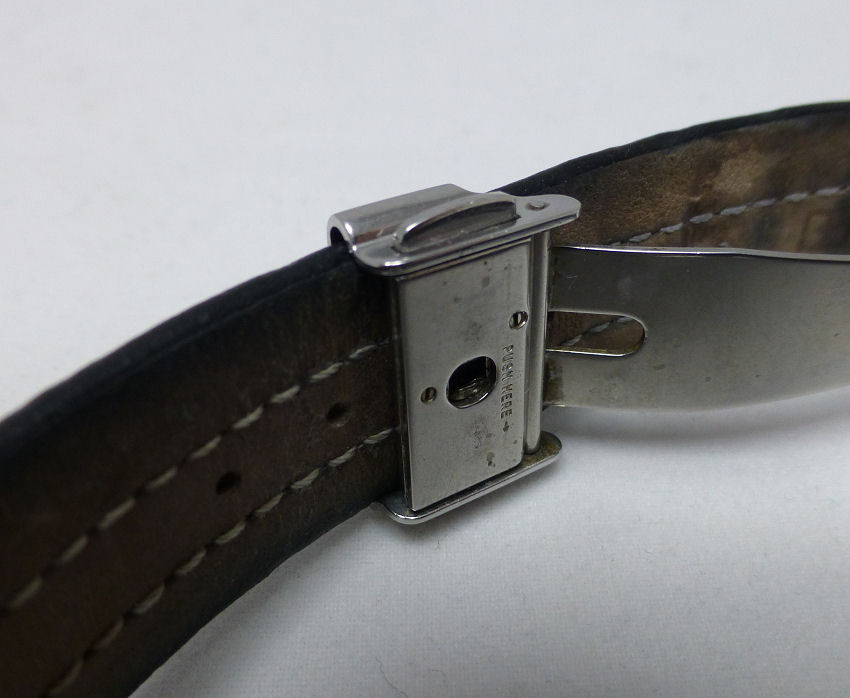
Original Longines deployment fit – with quick release adjuster.
The Longines branded deployment clasp itself is actually very good and I note it doesn’t have your typical friction fit clamp adjustment. It is more subtle than that. To alter the fit length you have to push in one of the pushers (it’s marked with a little arrow) which allows the small push-button assembly to lift out. Once out, re-position the deployment over the strap hole you want, then pop it back in – job done.
Now whilst I am a great believer in deployment clasps for certain styles of watch and even with this one being rather good, on this very slim model it tends to defeat the purpose. I find that deployments can hold the strap away from the wrist by virtue of the fitting itself and in this case, as it’s such a neat, super thin and almost delicate watch So, I decided to fit a standard Longines leather strap and buckle instead.
And I was lucky enough to have a superb original leather one salvaged from another Longines with the correct end fit profile sitting in my spares drawer which will be ideal. Note – shown fitted with photograph at Post end.
Uncleaned as yet, but showing no scratches or marks – perfect!
So an excellent Auction buy, quartz it may be but it is a very high quality one and great value.
Longines watches are still and always have been undervalued in my opinion, which fortunately makes them a good choice when looking for a pre-owned watch. And I mean this for both quartz and mechanical models. Part of the reason is that they are not sold at inflated prices and even new they represent good value as the quality is really, really good and the closer you get to one, the better they look.
Looks good on the wrist at just 34 mm diameter.
This particular model is from the early 1990s and as good today as when it was made and I have to say there is a certain “comfortable quality” about it. What I mean is just everything about the watch feels right. The smoothness of the silky satin finished stainless steel case case, the rounded edges, the elegantly designed dial, subtle luminous markers and hands, it really is a sweet little watch for men or women.
So this purchase was both a surprise and a delight. A surprise as it was so cheap to actually get and a delight, in that once seen, in your hand, then worn on the wrist, the realisation that this watch is a keeper, no question.
Longines stainless buckle alternative to deployment.
Note– it is important when checking the serial number of this model, it is NOT the the obvious one on the case back, which yes, it does have between 5 and 8 numerals. Though conversely the movement calibre IS on the back.
To date the watch, you need the number On the movement module itself, so you need to snap off the back and check it on the movement module.
I like this neat and rather rare 1949/50’s Ladies Movado Day and pointer Date calendar complication model I picked up in Auction recently.
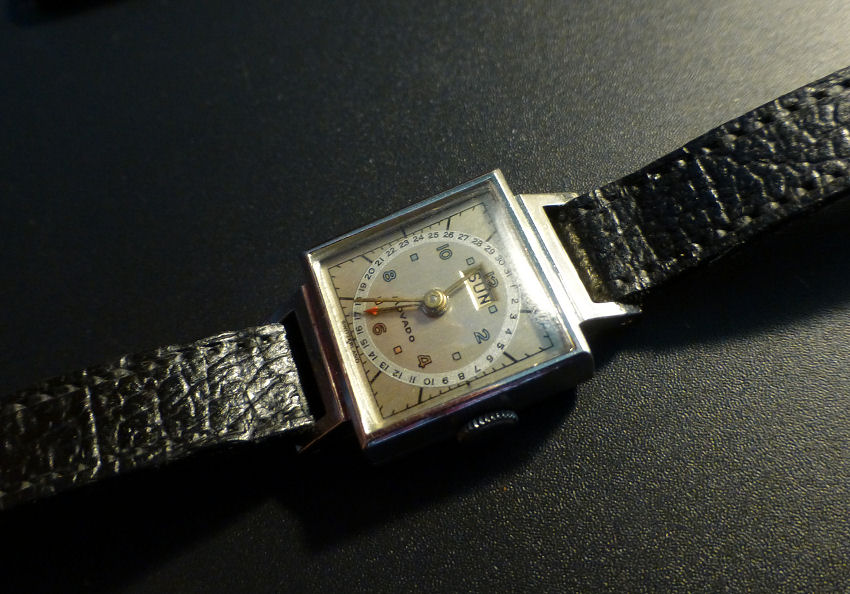
Movado 3 letter Day & Date pointer Calendar index model – 15 Jewel – Ladies
Dated around 1950 maybe it has a 15 jewel manual wind Movado signed movement and a very neat layout dial with a three letter Day window @12, a red tipped Date Pointer with calendar perimeter index, with direct pin side calendar adjusters in addition to the main crown. The very solid looking square case is stainless steel and measures just 12 mm wide with a slightly domed crystal. The case is stainless steel and the back is a tight snap fit. The black leather strap is a standard 8mm fit, so easily interchangeable if needed, though this one is virtually new and recently fitted.
Movado Case data
This watch is in decent condition with few signs of wear at all except for one tiny ding on the back, which actually is of no consequence. The important thing for me about buying any of these small complication watches is the mechanics. Do they work? In this case there is a 3 letter Day wheel and a Date Pointer, both of which require setting – and on this model they do.
Movado direct adjust Day and Date apertures.
The problem with Auctions is that anybody and his dog have access to fiddle with the items (I’ve seen people open watches, get screwdrivers out and start poking inside – I kid you not!) and whilst the Auction House may indicate in their Condition Report that it winds and appears to run, that’s usually about it.
It is very definitely up to you to ensure it and for this model, that the complications work.
This Movado is a manual wind and has two tiny little pin adjusting holes on the left side, positioned at about 7 and 10 on the outside of the case. These adjust the Day and the Date independently of the Crown which simply alters the hour and minute hands (the time).
As said fortunately they work on my one, though once I’d had a close look inside I found one of the adjusters was bent out of position. If left in that condition it could mean that inserting a pin could easily slide past the adjuster and stab the movement in it’s vitals! Not good at all . . .
The adjuster levers in this model are side sprung, to enable them to move and line up with the internal case apertures and the pin holes. So I re-centered them and set them into the correct position. Now if you insert a pin to adjust, it will hit the adjuster dead centre and operate the mechanism as it should.
Movado 15 jewel Day & Date pointer Calendar movement
So a word of warning when you meet a model with pin hole adjusters. Have a real careful look to see and/or feel the adjuster, before stabbing it harder and harder! Get it wrong and you can easily damage the movement.
NOTE – if you check out the image of the movement above you might just make out the adjusters at the bottom of the image (in the shadow – sorry) – on the underside of the M of Movado and the C of Factories. There are 2 levers which move side to side, sprung – but straighten these and they fit nicely into the case apertures and pin holes.
These ones both work as they should, so adjusting the time, Day and Date is easy. In fact easier than many modern complication efforts – and amazingly it’s all contained in a very small movement within a small 17mm x 12mm case.
Movado Ladies Day & Date Calendar index model. Circa 1950
Yet to get hold of my Wife to get a wrist shot, but when I do, I’ll add it here at the end . . . . after this shot of it lying on my office desk.
Note – Oh as usual – if you don’t know, if you click on any image you should get an enlargement . . . . .











You must be logged in to post a comment.