J&T Windmills – update

My collection has grown somewhat since getting this particular watch, which I see is still being produced today. This is the J&T Windmills Threadneedle model 10004/01 with hand wound 17 jewel adjusted movement.  I understand the movement is the Swiss Sellita SW200, in their own hallmarked Sterling Silver case.

I understand the Dreyfuss Group, owned by China Haidian, are the owners of the Brand name now, though I’m not sure if that was the case when I bought this one back in 2009.
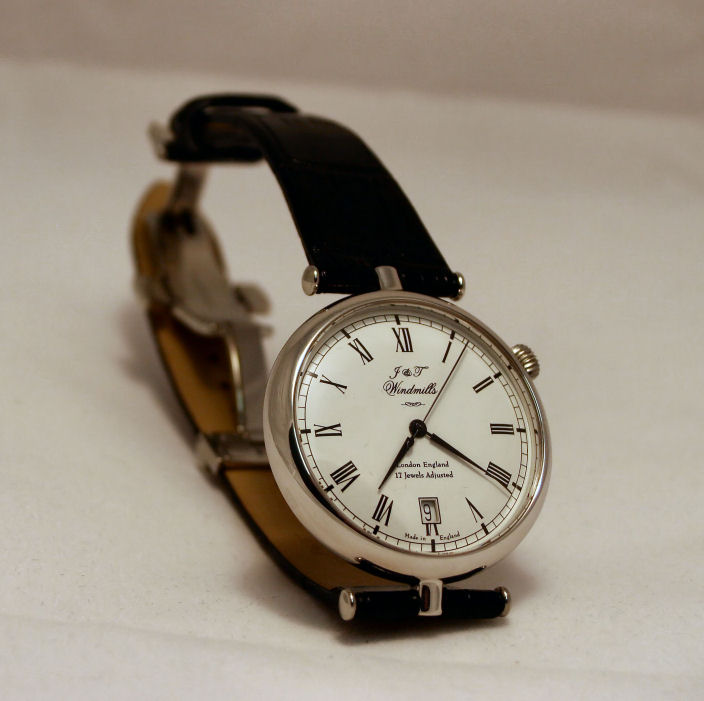
The Windmills "Threadneedle"
The Windmills “Threadneedle” manual wind, sterling silver cased.

It is in fact a rather stylish watch, harking back to the days of the original J&T Windmills of London pocket watches, reflecting the dial styles of the originals.  The dial states “made in England” as opposed to “assembled in England”, though it seems barely relevant these days as so many components have varied and tortuous sources.  Suffice to say it’s a Swiss movement and the whole watch is assembled in the UK.

Certainly the J&T Windmills watch looks pretty decent, especially with the nicely rounded gleam of a Sterling Silver case and those singular articulated lugs and offset ‘onion’ crown @ 2. (my personal preference would be straight spring bars).
17 jewels adjusted, hand wound.

The shape of the case itself is both sophisticated and elegantly slim (7mm) with beautifully rounded and polished sides. The description “sophisticated”  is evidenced by the fully decorated back, taken from the original Windmills engravings of old. Quite striking actually and subtle in that it’s hidden from sight to all but the wearer.
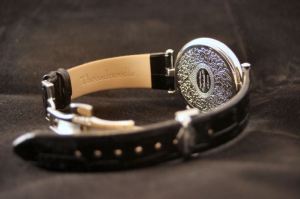
Decorated back with individual watch number
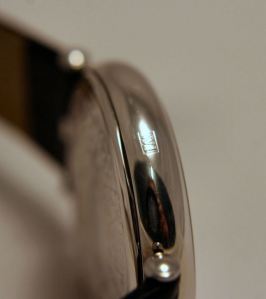
The original WI "Windmills" Sterling silver hallmark.
The original WI “Windmills” Sterling silver hallmark.

The dial is classic pocketwatch or clock style, so reflecting the origins of the Company it is honouring.

I like the overall look of the dial face with long and dark fine shaped hour and minute hands and a I do like a fine overhung centre sweep seconds hand.
Both minute and second hands align and meet the first inner curve of the numeral markers perfectly. The hour hand meets perfectly the inner edge of the roman numerals, thus making a precise reading of the time assured.  This, I really do like – and such a simple feature that many manufacturers could and should take the trouble to emulate.
Slightly elongated Roman numerals in black and a neat date aperture @6, which is large enough to give clarity without compromising the elegance of the whole, complete the frontage of this very stylish watch.  I note in the current model, the date window is @3.

Back to the Made in England reference.

To have the nomenclature “made in” or “X made” is basically a matter of where, what and how. And importantly how much of the where, what and how is in the Country so defined.
Here in the UK the Trades Description Act requires certain parameters to have been met – namely “… goods shall be deemed to have been manufactured or produced in the country in which they last underwent a treatment or process resulting in a substantial change”.

And in this case a judication was actually made a year or so ago and these are some of the facts disclosed.

Quote –
The J&T here is designed in the United Kingdom – in London. Prototypes are developed in China and subsequent samples are refined in their Essex, England facility.

The movement is sourced from Switzerland movement – this is a “raw” movement set where a complete set of the components of a watch of which all or part of the components are not assembled or partly assembled (marketed in this form). In the case of this particular mechanical display movement the dial and hands are not included.
The watches are assembled and quality controlled by specialist watchmakers at the UK assembly facility.  J&T watchmakers decorate the movement with bespoke Windmills “plates”, which is a manually intensive task, seat the dial on the movement and fix and set the watch hands in a careful and time consuming process.
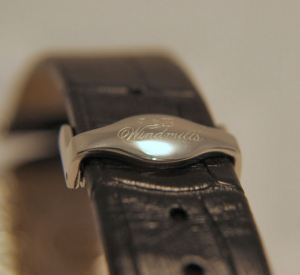
Deployment engraved "Windmills"
Double deployment engraved “Windmills”

After testing the full “casing up” (assembly) process is undertaken where watchmakers insert the movement into the case, fit the crown to the stem and wind the watch fully, and after a further 48-hour testing process they approve the watch for packaging and despatch.

So, as the value of components sourced abroad is only 34% of the ex-works price, value-wise the watch can genuinely be described as “Made in England” and as said, there are a few Swiss Mades that might be in a similar position if challenged.
It is true that the British Horological Federation (BHF) confirmed that the use of foreign movements was common practice in the watch and clock trade, and that labour and parts would provide substantial added value to the final product.

So a British watch promoting British heritage, re-launched if you will and named in honour of the revered watch and Clock making family J&T Windmills of the 19th century.  A tried and tested trend used by a few others – and not a bad result.

Perfect addition to my collection.
Nice addition to my collection.

The watch included a fine patent leather and a deployment fitting. The strap was not overlong as too many are today and with watch dimensions of just 38mm diameter and an approximate 7.5mm depth (the sapphire crystal is slightly domed).  It is slim and neat to wear and will easily slide under a sleeve.

On the wrist - perfect!
On the wrist – perfect!

Accuracy is commensurate with Swiss quartz, so no surprises there.

My only real issue is with the deployment buckle, which though in keeping with the watch style, signed and so on, is a double deployment fitting, which I personally find very fiddly. A single deployment for me would have been so much more practical.  The deployment advantage? – it’s said that it protects the strap from premature wear and that maybe true, but for me a simple pin buckle strap will with wear, mould itself to your wrist and I much prefer that any day.  Anyway, this one is quite comfortable (once you get it on, that is . . .).

However – 

I remember not long after getting the watch, as I was winding it, the crown and stem simply fell off into my hand! Disaster! Not what I expected at all.

Made me doubt both the assembly procedure and their Quality Control and I was very disappointed.  So, after emailing them, I sent it back under guarantee and rather than a repair, I was sent a replacement (different number).  Very commendable I hear you say, but why did it take them 11 weeks before replacing it, which with my pessimistic nature, to me smacked of lead times from – perhaps China? OR – optimistically, perhaps just a very busy newish Brand company, who knows?

However, this replacement watch has performed exactly as it should, no issues at all and overall I’m pleased with it.

But that double deployment, though very nice and shiny as it is, is still a real pain to get the watch on your wrist. So, as the strap is actually a fine leather one, I have modified it to take a simple pin buckle. I removed the deployment, notched the short watch head end which allowed me to fit a polished stainless 14mm buckle with it’s spring bar and it is now perfect. It feels so much better, the watch/strap lies flatter on the wrist – in short – to my mind they would be better not bothering with that particular deployment.  The watch to my mind has suddenly showed a proper classic style that wasn’t quite right before, but is now.

It will now be on my short rotation wrist wear plan (I have some 200 watches in my collection and I rotate wearing them), instead of just now and again, as at last it feels right.

So, overall I like the watch now with the quality strap is, for me, used as it should be. The watch functions as it should, it’s very nice to wear and regardless of where it’s made, assembled or whatever – I like it and its proved (after a slight hitch) itself to be a decent buy.
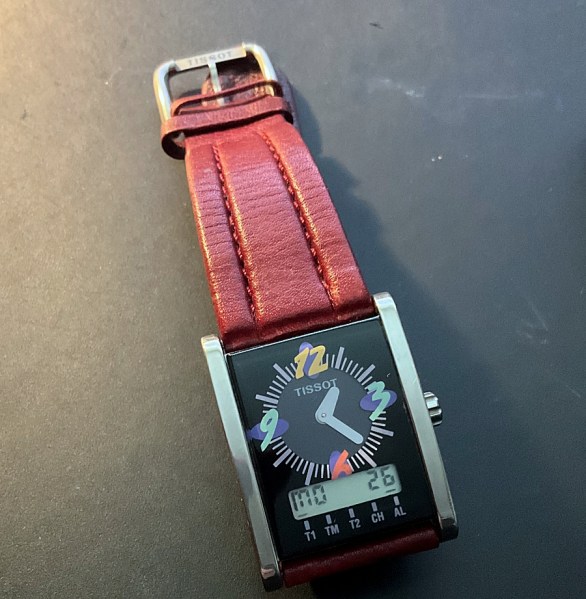
My Tissot Two Timer

Interesting watch, the Tissot Two Timer (D.377) introduced by Tissot in 1986 and this one dated around that date.  By the number of different configurations, this Tissot model interestingly reflects both the Swatch ideals (Tissot joined Swatch as a founding member in 1983) and a competitor to the new Asian digital reality of the time, but in Swiss style.  In my small collection of these, I Post this one first as it’s quite a rare one, purely owing to it’s funky overlay dial.  The TTT (as I call them) models were relatively new tech for the time, as they were Ana-Digi models with an unusual feature of using just a single multi-functional crown.  The control module sets and adjusts the analogue time and the digital functions, which indicate in the single line digital display and by analogue hands.

Tissot Two Timer 1980’s Analogue/Digital Alarm/chrono (note – Alarm is shown as set)

The (adjustable) digital functions featured are; Digital Time, Seconds & Date, Weekday & Date (auto-calendar), Timer, 2nd Time Zone, Chronograph and, Alarm.  Each is selected and adjusted by the single crown, which is still today a bit of a rarity.  Analogue and digital can be synchronised too and the digital display can also be switched OFF.
I have just a few models that utilise single crown multifunctionality apart from the Two Timers.  One that immediately comes to mind is my 1999 Breitling Aerospace, which may well use the same or very similar module.  So, this very affordable 40 year old vintage watch, is in very good company.

As said this module uses a single crown adjustment system which although effective, is tricky to manage and if you’ve just bought the watch. You will need the instructions, believe me!

Basically there are 3 crown positions. Press the crown IN once (position A1 – spring action) it selects the main function changes and can also switch the Alarm on or off.  Crown position A (normal) rotates either way and moves the line marker under the digits to select the required function.
Position B – (one click OUT) is used to alter the digits on the function selected – then again rotate the crown in either direction. Note that a fast crown rotation moves hours and months & slow rotation alters minutes and days.

So, quite tricky to get the hang of. I found that slow is just that – a nice steady turn and fast is – fast!  I would say instructions should be to hand and perseverance is required – but the system does work, believe me.  The trouble is that next time you have to adjust it after replacing the battery, you will likely have forgotten what to do – so don’t lose the instructions!


Anyway, on this Two Timer, all functions operate flawlessly and the digital display is as good as it gets with no bleeding or fading, which is a real bonus on any vintage watch with a digital display (a weakness of early digitals).

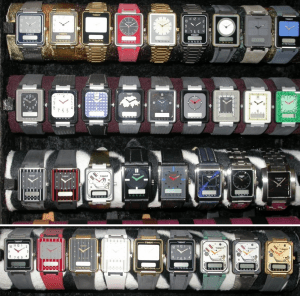
Image shows a Tissot Two Timers collection for sale in 2007

However, the main reason for my interest in this particular 1980’s – 1990’s Tissot Two Timer model is because of it’s rarity.

And this is totally owing to it’s colourful and rather funky overlay dial layout as it is VERY unusual.  A fact that’s very obvious by it’s absence in this great picture of a fabulous Tissot Two Timer collection offered for sale some years ago. Do I see this dial?  No.

Whilst I’ve also seen many variations on the theme with around 20 different 1st generation Two Timers up to maybe 1995, plus more variations with the 2nd generation models – I’ve only seen this particular one once before and as these pre-owned models change ownership every so often – who knows, maybe this is the one?

Update – I have actually seen one with this dial for sale in Singapore since I Posted this.

For anyone interested in Tissot Two Timer models, especially the 1st generation ones, there are a few (and just a few) of pre-owned ones around, mostly the more common dial layouts, such as the vertical striped face or skeleton. Though these tend to be the 2nd generation models which seem popular.  However, fully working 1st gen’s pre-owned ones are much more scarce.

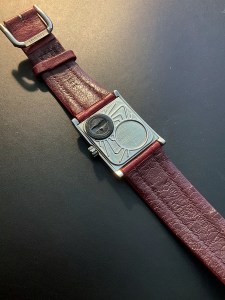
Note the small battery hatch – similar to Swatch – a 20 pence coin fits the slot.

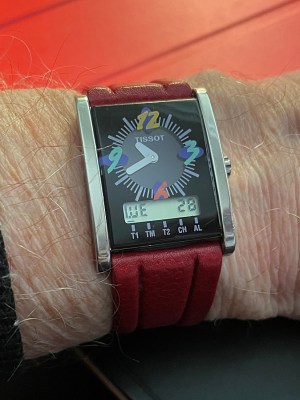
As said, this particular model is a rather colourful and quirky dial layout with thick white coloured (I call loony) hands plus an overlay of quite jazzy numerals and markers – I love its different look from the many others I’ve seen.  So I’m very pleased to have it. Plus, it has the original stitched leather strap as well and whilst obviously worn, it’s still OK to wear.  However, I do have another strap I obtained recently if and when this one gives up.  I note later versions have moved from leather to rubber options – which doesn’t do it for me I’m afraid

The watch is quartz powered (7 jewels) and the battery (SR920SW) is accessible via a battery hatch (note – 3ATM with the correct seal) on the rear (see image). And the all important crown is well knurled which makes it easier to turn for adjustments. Note the battery cover is often a plastic one and the slot is quite wide – I find here in the UK a 20 pence coin (7 sided) is perfect and prevents damage to the plastic. (don’t be tempted to get one without the battery cover – as these are very difficult to source).

Watch dimension are really good at around 28mm width (add crown just under 30mm) and the case thickness is very neat at around 7mm. The case is also curved with a flat back, so looks very neat on the wrist.

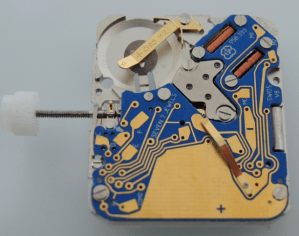
ETA 958-333 7 jewel module (available), but unknown if it would be a direct replacement.
My funky Two Timer on the wrist

So, as often the case, I find many vintage models preferable for all sorts of reasons – and fortunately, as said, they can still be found (but not always) at reasonable prices. Beware Two Timers for big prices – they shouldn’t be).

A little unsure as to the movement module used in this Two Timer, but it appears to be a variation of or similar to, the ETA 988.332 module in my Breitling Aerospace. Perhaps the ETA 958.300 series with a single digital window.

The module is part of the Swiss ETA Flatline series and information can be found online.  However, little information appears available after 2009 and although I have seen complete 958-333 modules, I would not assume these can be used as a replacement for this particular model.

A few other watch brands have utilised the ETA Flatline series of modules in addition to Breitling, such as Bell & Ross, Rado, Victorinox, Chrono and Butler, so obviously quite well regarded.

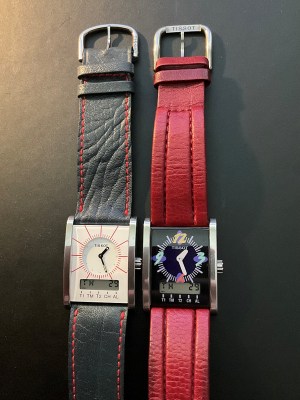
2 x Two Timers, same model, different year.
Strap, buckle and dial cosmetic change.

The Tissot Two Timer was never an expensive model, but it was in my view an important one as it not only competed, but matched Asian competition at that time.  Along with the introduction of the new Swatch Brand (Tissot being a founder member) this offered a proper well established quality Swiss Brand to customers at a crisis time in the European (Swiss watch) Industry.

So, to Tissot – Founded in 1853 in Le Locle in Switzerland, then allied to Omega – becoming the Omega Tissot Brand from around 1929. They further expanded with the amalgamation in 1983 of what was known as the SSIH-ASUAG & SMH (the Swiss names are too long winded for me to spell out) and finally SMH became a new Group known as the Swatch Group.  Today, of course a huge player in the watch industry, with a membership of many major and still independent Swiss Brands, such as Tissot themselves of course.

Anyway, that’s my funky Tissot Two Timer and I love it, both for it’s 1980’s modernist design and to my mind, under-stated place in the watch world and the fact that on the wrist, it just looks great! And I do prefer it to their previous ana/digi models which were not to the same standard.

I also show here in this image, another of my Tissot Two Timer models. This is another 1st gen D.377 model, not quite the same year, with another dial layout, strap and buckle and a different look.  Note – Later generation of the D. series have an altered case and lug design which necessitates a non-standard strap, often rubber. Also the battery hatch is no longer used, so the back is more conventional and uses screws to access the battery (maybe a better idea as often battery covers go missing).

Note 1 – Instructions are available here – https://www.manualslib.com/download/863198/Tissot-Twotimer.
And Here – which has a full set of instructions in .pdf format

Note 2 – Two Timer modules feature an auto-calendar, though this year (2024) being a leap year, with 29 days in February, I manually changed the date accordingly.

UPDATED – this Post was updated January 12th 2025

Back in the day

A revisited Post I did many moons ago, which was itself a revised Post from much earlier times, of an auction many years ago, when my watch collecting was still something new.  And I’m Posting it here just as a reminder of the fun auction and watch collecting can be, even if you’re not mega rich, but you do have hopefully within your position in life, some modest goals and dreams.

Well, it was one of those days where you manage to do what you said you’d never do – and that’s impulse bidding at an auction.  I mean there you are zeroing in on that little vintage model you’ve been after for ages, the estimate is just about do-able and you’ve got the cash in your pocket and Bam!  Just your luck!

The bids are all of a sudden thick and fast, jumping between 5 or 6 damned phone lines and the floor bidders have suddenly woken up, to say the least – through the roof in fact and so far above your budget (stratospheric actually!) that you feel really quite inadequate – and completely out of your league.  And before you know it, your day, so full of expectations is no more.   Gone in a flash of someone else’s money and your item well out of reach – and just a silly, naive dream, as if . . . .

And then, just as you were about to go off for a shell-shocked sulk and a cup of coffee, the next item’s up – it’s been added to the auction – and, Hello? one that you’d never even noticed, such was your tunnel vision towards the previous one – and suddenly there’s this absolute gem – it’s there – right in front of you. . . . .Gerald02xc

Wow! – I’ve been looking for any one of HIS – for ages!  And the estimate is what?  That’s not too bad you know – just maybe I could wing it and swing it!  Then you think – oh oh, what’s wrong with it?  Maybe it’s a “come and buy me” estimate to lead you on . . But no time to check it out . .  . damn . . . . just typical!

Nothing much said in the description and that estimate seems awfully low, so big decision – do I take the chance?

And looking around I don’t see that anybody else has spotted it either, after the excitement of the one I missed.  Half of them are still talking about the last one – so maybe. just maybe they haven’t seen it. After all, it was sandwiched between a series of big names, and that’s what most of the Dealers here were obviously snapping up – to resell at inflated big City prices.
You know the usual Omegas and Rolex’s (are they really that good?) and then Tag and the Muller – you get my drift.  The inflated name game. But this one is just, well, sitting there, an addition to the published catalogue and almost hidden by the weight of the buzz names – so maybe . . . just maybe . . . .

Sod it! – I’ll have a go – what’s to lose?  And this is a true collector’s illness – well I didn’t get the lot I came for, so I’ve saved money, haven’t I?  So as I say, what’s to lose?

Well the first bid is just plain silly, derisory really and after that, it just creeps up.  This, of course, in itself can be deceiving as it could suddenly take off, but sometimes, just sometimes it bombs and maybe without a reserve somebody gets themselves a real bargain.  And that’s my hope here.  So, wary of that possibility I quickly jump in don’t I – I mean it’s the obvious thing to do – because – you never know . . . and then after just a few bids and before you know it – it’s all over and the auctioneer is looking at the buyer, saying SOLD to . . . . . and I’m looking around like an idiot – SOLD to – as I catch his eye – Yes! it is – That’s MY number! – as I fumble with my auction “paddle” which was stuck in my jacket, ripping the pocket as I struggled to get hold of it and hold it up!

Wow!  This is just so brilliant.  I’ve just paid – HOW MUCH? (I can still hear the echo from my Wife’s shriek!) for something NOT on the menu and the auction is carrying on as if it never happened.  Is this a dream or what?  And was that my bank manager at the back of the auction house?  Smirking as he turned away? I’m sure it was . . . . I never knew he even went to auctions . . .!

Anyway – it was no dream and you might just wonder what on earth I bought after all this excitement.  Well here’s a clue or two . . . .

The watch was designed and signed by a guy who was perhaps one the best designers of watches – ever. In 1966 he designed the Universal Geneve Golden shadow range of watches, then in 1972 designed the Audemars Piquet Royal Oak and in 1976 the Patek Philippe’s Nautilus, then cases and dials of the Omega’s Constellations and
Seamasters.  So quite a pedigree!  He also contributed to the designs for the Ingéneur, The Pasha Cartier and the 222 Vacheron Constantin, Piaget, Chopard, and so on and on . . . .

He had his own Watch Company from 1969 till 1998 and another from 2001 under a different name.   All his watch models are quirky, unique and novel, very technical and high specification and often quite expensive.  Octagonal cases he particularly liked and played around with, even producing a Mickey Mouse model or two just for fun.

My model is from circa 1995, so bang in the middle of his best production period – and it’s actually quite rare!  There’s only a handful been sold at auctions in the last 10 years and this one changed hands twice before it got to me.  I love it as it shows off his unique style and is a perfect introduction into the Genta world.

OK, the watch goes as soon as it’s touched – always a good sign.  The quick date pusher works perfectly – OK.   I also noted that I couldn’t figure out how to set the Alarm time tried the upper crown but without success.  However managed to get instructions online and it was simple simple, so all OK.  Read on further to find out how.

The case is in very good condition – a tiny dint in the sapphire glass – OK,  a screw missing from the stainless steel back (should be six only 5) – OK and the original leather strap (with tolerable wear) and deployment is for a large wrist – OK.  So, it all looks fixable . . . . . .Phew!    Note – the missing screw has since been fitted.

So after all that – here are a few images of my impulse buy.

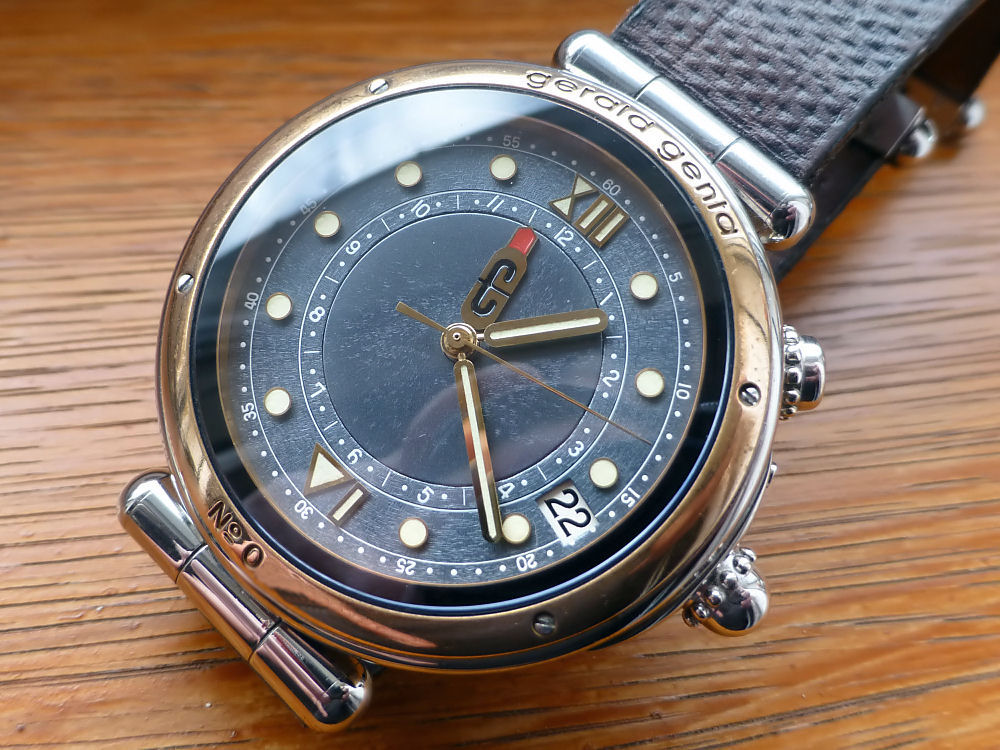
Gerald Genta Bartolomeo Stainless Automatic Alarm Calendar.
Gerald Genta Bartolomeo
Stainless Automatic Alarm Calendar.
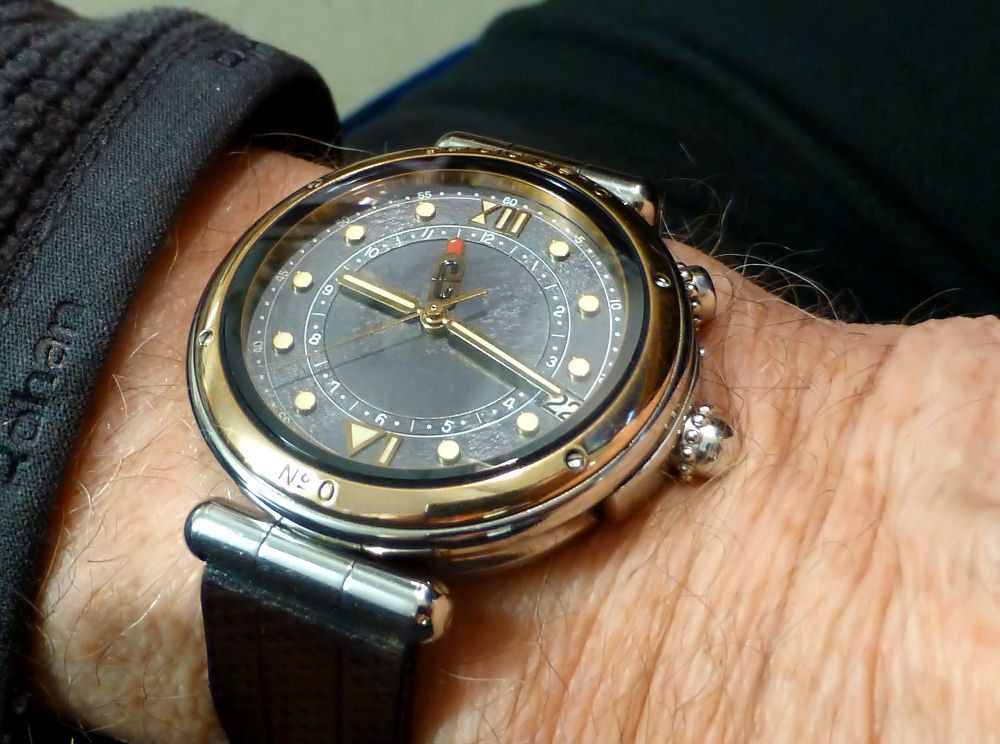
Bartolomeo 40mm diameter Alarm on the wrist

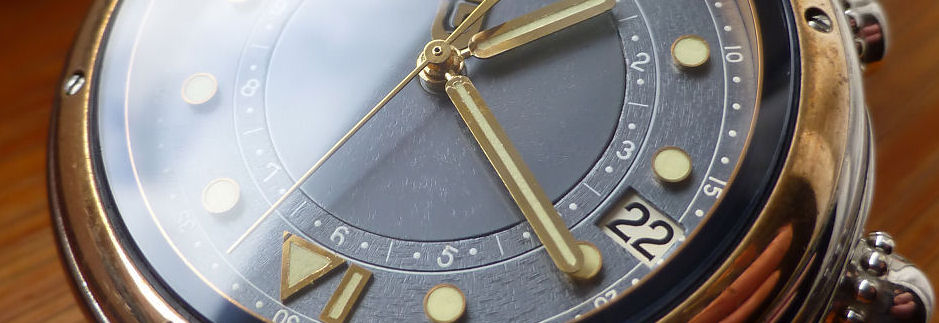
So, this is a Gerald Genta Bartolomeo Alarm Calendar watch with slate dial, gold filled numerals and markers, gold hour, minute and seconds hands plus a GG logo in gold on the red tipped Alarm pointer, which is on a central disc.

The Alarm function is by a central rotating disk and operated  and set by the secondary capped 3 position Crown at between 1 & 2 o’clock.

The watch has an automatic Omega Cal. 980 19 jewel movement, so no winding required.

The time is set by the main/centre crown @3.

The mechanical Alarm is activated by upper crown(between 1 & 2) when pulled out one click.  With the upper crown pulled out two clicks, it disengages the main crown from the hour and minute hands, which allows the main crown to set/move the Alarm pointer hand (disc) – in either direction. Pushing in the upper crown, re-engages the main crown to the hour and minute hands, as normal.
The alarm is as I said, mechanical and the sound is produced by a small hammer striking a gong attached to the movement. It is what I would call (and Omega said this too) a discrete sound and rather nice in comparison to the modern digital ones.

The watch (although automatic) can also be manually wound using the main crown.

Also of note is the fact this Alarm does not require winding – this is done automatically with the normal auto movement (one winding barrel suffices) and is operational again within an hour in normal wearing.

This is almost the same as the Omega Memomatic which shares the same 980 movement. The difference being the Memomatic has a second disc on the dial which indicates minutes, which allows it uniquely to be set precisely to the minute.

The clearly defined dial layout features a large Date aperture between 3 & 4 o’clock and there is a small quick set date adjuster, just below the 2 o’clock position on a small raised case mount, in the form of a small pusher.

The two piece slate dial has applied gilt luminous dot markers, with white minute markers plus gilt baton luminous filled hands.  The bronze coloured bezel is secured with 4 screws.  The crystal is Sapphire and slightly domed.  The watch case is stainless steel, as is the back with said securing screws with the serial number & model details inscribed plus brand logo.  The Gerard Genta logo is also featured on the red tipped Alarm pointer, which form part of the central slate disc on the dial.

The Gerald Genta original T bar leather strap has the original signed stainless steel double deployment clasp.  Case diameter is 40mm ex. crowns. and 13mm thickness.

The very few previous auction sales I’ve seen for this model have been considerably higher, though metal specification obviously a factor.   But I’m very happy I’ve got a bit of a bargain for what is a relatively rare model, so I’m really pleased with my impulse buy!

Gerald Genta watches are seen as an iconic brand and to actually have one is an unexpected surprise and a pleasure – and my Wife has forgiven me since she set eyes on it – she now likes it as much as I do.

Anyway, I suppose it’s all relevant – and whilst maybe a bargain, it was still quite expensive for me at the time.

But as my better half says, “Well you’re a watch collector dear. And we don’t want any old rubbish, do we?”

Update – The watch is still going strong and it never fails to make me smile when I pick it up after a dormant period (I don’t have winders) and it smoothly continues it’s seconds sweep, as if it was never idle. You don’t even have to waggle it a bit – nope – it just starts as you pick it up – what could be better?

Latest (April 2024) – I recently had the watch fully serviced – with a 2 year guarantee no less, no issues found and as good as it was when made – I am very pleased.

Old favourites

A selection of some old favourites – not picked in regards price or value – but rather models I just like to wear.

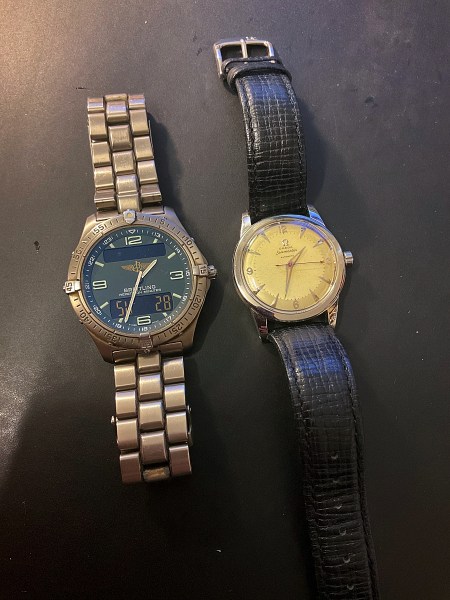
Breitling Aerospace 1999 quartz, with the Omega Seamaster 2577-6 Automatic

For whatever reason, they just feel right. It’s also true to say that for what they are, they are very, very good watches and seem to work and work, smooth and silent and never let you down.

The Breitling Aerospace 1999 model, which is probably my overall daily beater and worn mostly since I bought it new. Why do I like it?

Well, firstly it looks good and it’s one of the most successful ana-digi models I’ve ever come across. I say this as the digital display is electro-luminescent, which is quite rare today, which you can read in any kind of daylight circumstance.
The analogue hands though very slim, are highly luminous (as are the minute markers) and are what I call “all nighters” as they are readable for many, many hours of darkness. The minute hand overlapping the centre spindle is also very clever, in that it gives an immediate visual separation between the hands.

The watch also has a comprehensive digital set of functions, which though quite unobtrusive are available with the simple selection of the single control – the crown.

This particular case and bracelet are made from Titanium, which I’ve always liked, as it ages so smoothly it is a delight on the wrist.

And when this model appeared, they obviously had divers in mind as the bracelet features a built in extender, so can be worn over a wet suit.

Then there is the 1950 Omega Seamaster 2577-6, Cal 351 17J Automatic with it’s odd 300º bumper rotor. which is a bit of a classic if there ever was. Such an understated design and so neat to wear as it only measures maybe 36mm across. This in stainless steel with screw down crown and screw back.

Age patination on the dial now, but it seems to make it even more desirable and the smoothest movements you can imagine – moving the hands manually, it is smooth as silk. And the tiny red pointer on the sweep seconds hand – a nice touch.

As I say, a classic!

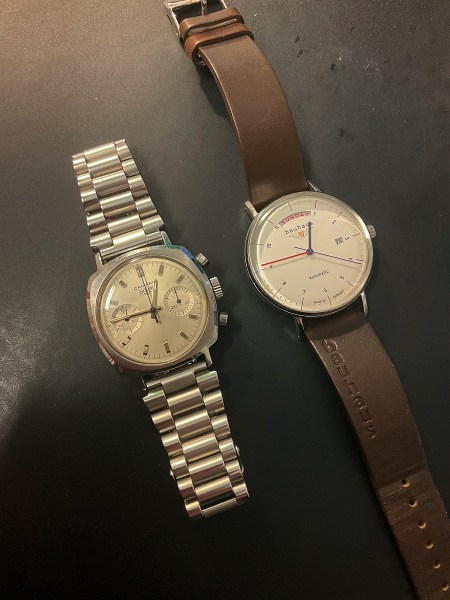
Heuer Camaro 7743 manual, Bauhaus Classic 2162-1 Automatic.

Next, is the absolute classic from 1960, the Heuer Camaro 7743 model, with it’s Camaro 30 chrono Calibre Valjoux 733 movement in that wonderfully designed 37mm stainless steel cushion case, which you really don’t see these days. A great shape for all wrists, but rare today.

This is another watch that is so good to wear – it sets so well on the wrist and it’s a very good looking design with the brushed steel topside, it looks and is very solid and substantial and is without doubt one of my very favourite watches. Again it’s one of those models that just works so well and worth a quite a bit these days, as they are quite rare to find in really good condition.

Next to it a more modern models that eschews the past – this is the German Brand, the Bauhaus Classic 2162-1 Automatic Day, Date. Called the classic – it should be a classic.

This watch shows off the intriguing Bauhaus minimalist + functionality concept perfectly.  Note the asymmetric hour and minute hand hand widths, the sweep centre seconds, a Date view @3 and the full Day window @12, make this a very practical and efficient way to read the time at a glance. It has a lovely domed crystal and the case design allows a large dial surface

It uses the Automatic movement – the Citizen 21J Miyota 8285, which is a very smooth performer. It also has a high quality brown leather strap in keeping with the watch overall. Again this is a great watch to wear and invariably gets comments when I do wear it.

Last but not least of the six presented here –

Two different models now – they look different but both are practical and function so well.

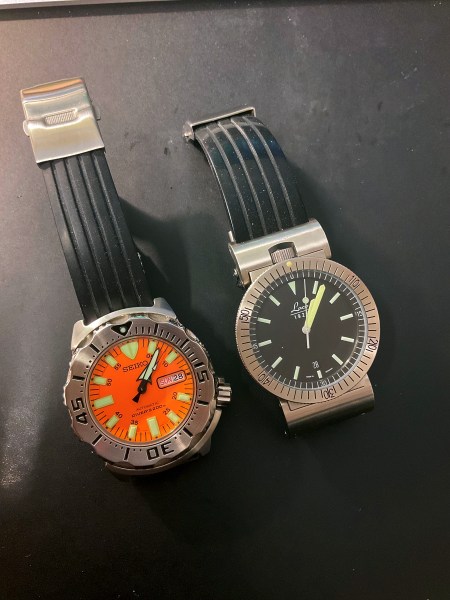
Seiko Orange Monster Auto and the Laco “Squad” quartz

First is the rather amazing Seiko classic – the Orange Monster SKZ781K3 a Divers design model, which features a really solid and distinct stainless case, built like a battleship, 200m Water Resistance, a curved outwards unidirectional bezel and superlative luminous dial features and very clear to read.

This also uses the Seiko Classic, reliable and so well designed 7S26 Automatic movement (which I still prefer to later versions) with Day and Date combined window@3. This is a model that people either love (as I do) or for some unaccountable reason, don’t (your loss!).  All I can say is, this particular model was very popular!

Last but not least, is the lesser (in the UK) but well respected German Brand – the Laco 1925 “Squad” watch, 40mm diameter, bull winder @12 Quartz ETA FO6.111 movement, with it’s highly unusual curved double articulated lugs design which hold it neat to the wrist. It’s another great Water Resistant model rated at 20ATM.

The wide dial has a really black matte finish background, that contrasts so well with the large and clearly defined luminous analogue hands, plus centre sweep seconds hand with dot marker. A date window @6 and a very nicely defined and operating click unidirectional rotating bezel, completes the look.

Has that distinctive look and the model from their range I prefer (quartz) as it’s just 40mm diameter (the mechanical version when I bought this was 46mm – too big for me).

So that’s just 6 of my likes from watches I have, picked just because I like ’em and they came first to hand.  Value wise and in no order, from very affordable to mid range affordable.  Every so often I’ll pick some more from the stuff I have, maybe affordable or maybe not, who knows what will turn up. It’s also fun to do as it brings back the memory of acquiring them and gets me fired up to maybe look at more watches that attract me.

That for me is what collecting watches is all about. It also makes me realise what an eclectic collection I have – love it!


Casio – and why I like them.

Casio as a brand seem to have been in existence for almost as long as I have – well almost!  -)

And it makes you wonder why?

They started in 1946 in Japan and still producing today and providing the world with more innovative products.  With many tech milestones back from the early days of Calculators, Musical Keyboards, E Dictionaries, to what I’m interested in right now – watches. From G-Shock (1983), RC controlled models, to GPS to whatever . . . . the range is amazing and ongoing.

Proof of how good they are can be seen in their present line up of mechanical and Digital watches – because, so many of them don’t seem to have changed, since they were first produced – There’s no doubt they were and are well designed and do the job they are meant to do, right from the start.

Casio at it’s best. Affordable, Quartz accuracy and lots of functions.

And their pricing for a decent watch that will last and last, is amazingly cheap in comparison to so many competitors.

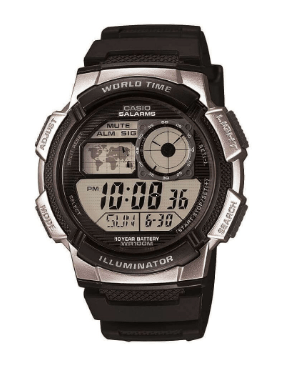
This is the ubiquitous Casio AE-1000W-1A2VEF – some title I know, but this model has been around for many years and is still a remarkable best seller.

Very affordable and for reliability and features, it’s as good as they get. It’s also very clear to read and at a glance shows the time with running seconds, am or pm, the Day, Month and Year, even your time zone.

The controls are obvious on the top of the watch bezel – Adjust, Mode, Search and Light. It also has a 10 year battery life, which rather makes these so called “smart” watches a bit of a joke, in my opinion.

The functions and features list is comprehensive –

Accuracy is +/- 30 seconds a month,  An Alarm Function with 5 Daily Alarms: Each will sound every day at the time you set, an Hourly time signal: The watch beeps every hour on the hour (selectable on/off).
It also has an Auto Calendar – Once set, the automatic calendar always displays the correct date. It also has a Countdown Timer, from 24 hours, measuring 1/10 second. A Stopwatch function, which can measure 24 hours with different modes – Elapsed time, 1st-2nd place times and all to 1/100th second.

Plus, if that wasn’t enough, it features a World Time – giving you 4 Time Zones (quite enough) and these Local Times can be called up quickly and easily, which is so much better than some over-complicated World Time models.

As said, the dial displays current Day, Week and Year, so a quick glance is all you need on a daily basis and this is all contained in a very tough resin case measuring just 43.7mm diameter and 13.7mm depth. The strap is resin, which has never been my favourite, as they tend to go brittle, but this can be changed quite easily.

The dial can also be illuminated with LED and an afterglow function. There is a Mute Function which switches OFF any tone sounds, whilst all pre-set Alarms or Timer functions stay active.

The glass is also break resistant and the control pushers are shrouded, just enough to prevent accidental operation – Note– the dial light button is top right and very easy to operate. The watch is also Water Resistant to 100m, so as a “daily” why take it off at all?

At around £40 in the UK and changed little since first introduced, there’s a reason – it’s simply because they got this one just right, first time. So, if in the market for an easy to use, easy to see, easy to live with digital quartz – and when you consider the two similar models noted on the links below, I’d say they pretty much got them right!

And that’s why I like Casio (and Timex digital if I’m honest)

Two other models I also own are virtually the same – check them out!
The first – is the Casio AE1200WH-1AV – which I Posted here – https://watchspace.co.uk/2013/11/18/holiday-watch/
Probably the same module, without the “Shock” name, but just as tough – again this is a favourite holiday or travel watch. Note when I bought this, it was under £20!

The Second – a different brand – this is my Timex Expedition T49976 which is very similar, even the dial layout, but without the World Time. This is another favourite travel watch.  And for Time Zones – it’s no real problem, as changing time on the Timex is a case of pushing 2 buttons – and it’s done.
This was one of three Posts on this model – https://watchspace.co.uk/2014/08/27/my-camouflage-choice/

My Bruno Söhnle Pesaro IV

My usual daily watch always tends to feature a similar specification. It has to be luminous (properly so), easy to see and read, I like a Date indication, even a Day would be nice and it has to be the right size. Whilst I probably prefer an Automatic (mechanical) movement, Quartz is OK with me too.

In a dress watch, however, I’m not quite so fussy. It doesn’t have to be luminous, it has to be stylish on the wrist, an OK size and a Date is always acceptable and a Day is a bonus.

Which brings me to a watch Brand I’m very comfortable with – Bruno Söhnle. This is a German maker and I already have three models, all bought when in Europe at different times. But as I was over there earlier this year and as I felt like having a new dress watch, I looked them up.

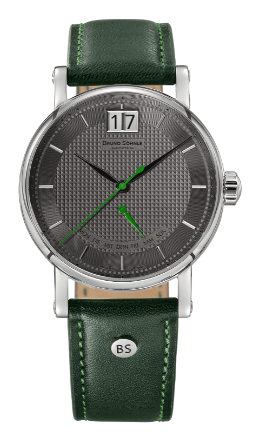
The Pesaro IV Big Day Date dress watch was just what I was looking for. It come in two versions and this is the grey model (the other is a more standard plain) and it met my expectations perfectly. The dial incorporates two different split textures and it features a very obvious Big Date @12, plus the green centre Seconds hand and retrograde Day pointer.  This is also a Quartz powered model, based on the Ronda 7003.L, but highly refined by BS in-house, to create a very stylish dress watch. The crown winder is nice and large with decent knurling, which I like.

The 316L stainless steel case is 41.5mm diameter, which is about as big as I can take and is 13.65mm thickness. It has a Water Resistance rating of 10bar (so if I fall in the swimming pool, it should be OK – not sure about me!)

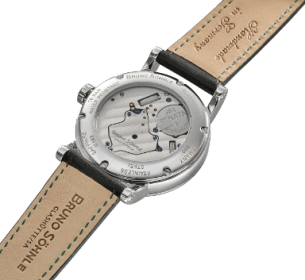
The crystal is Sapphire Glass with an Anti-reflection coating inside and it has a glass back, so the movement and battery type (Renata 381) is visible. All set off by a nice quality dark green coloured fine and smooth calf leather strap, 22mm width with a folding clasp.
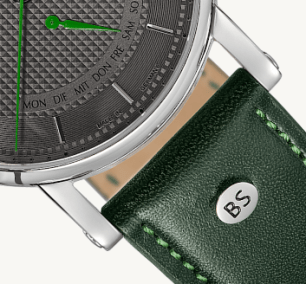
All in all this is a very stylish watch, which looks that little bit different and the colourway seems to work well overall.  I have always liked the retrograde days of the week idea indicator and it’s not the first watch I’ve had with this feature. Though the green pointer is certainly different.
I also like the fact that the Brand name is subdued on the dial and does not interfere with the visual appeal of the dial, as it’s not obviously as clear to read as the more conventional coloured version.  Black analogue hands are admittedly, for me, not my normal choice, but I’ll go with it in what I consider a dress watch.

I refer to two models I already have Posts for here –
https://watchspace.co.uk/2009/07/03/bruno-sohnle/
https://watchspace.co.uk/2015/03/12/german-schonheit/

The Terra Cotta (Swatch)

I suppose Swatch watches are known more for their very affordable, reliable and good quality Swiss Quartz models, which started off life back in 1983 as a result of the Quartz revolution, basically from Asia and the inherent danger to the Swiss mechanical models at that time.  A response was required and hence the Swatch appeared – sometimes referred to, or maybe popularly called, the Second Watch or SWatch.  A model that was colourful, very affordable and also very reliable and with great Swiss Quartz timekeeping too.

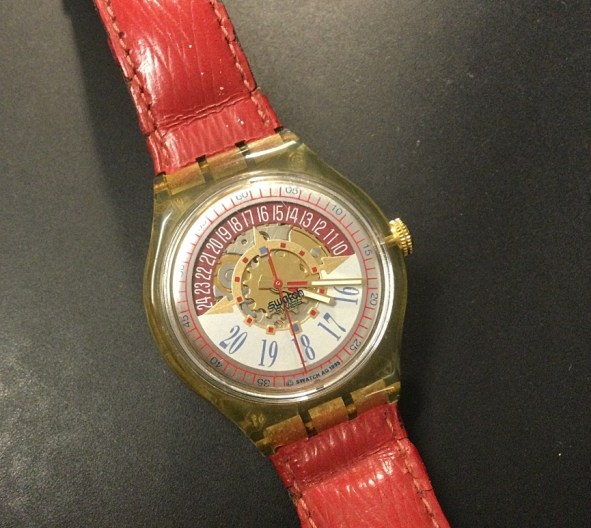
Swatch Terra Cotta Automatic, 1995.

However, back in the early days Swiss watches really were famous for mechanical movements, not Quartz, so a few years after the Swatch revolution, for that’s what it was, they also produced Swatch watches with mechanical movements, manual and automatic and always of a dependable high quality.

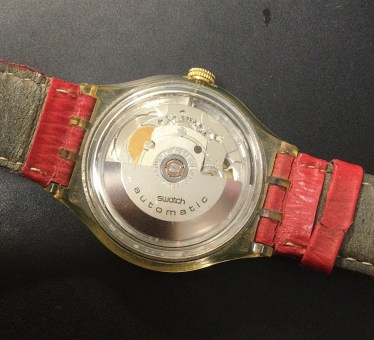
The Terra Cotta (SAK402) is part of Swatch’s “Original Automatic” family, a legacy watch if you will, which appeared in 1996, and this one completely original – with a very decent 23 jewel automatic Swiss movement. This is visible through the full “exhibition” clear back. The plastic case is 36.7mm diameter which is a rarity in itself and not a case size currently available.

On the dial, there’s a neat viewable Date indicator, via a wheel and pointer arrangement, that just sets it apart from the mainstream.  And yes, a simple change to the more common date window, but rather nice, as viewing it, you can sort of confirm your place in the month.

The red coloured centre seconds hand, defines it’s movement heritage, as it doesn’t tick each second as a quartz movement does, but rather has a smoother “sweeping” motion, with a smooth rapid tick.

Terra Cotta – 23 jewel Swiss Auto movement.

The original strap on this model is of red leather (not plastic), which rather compliments the dial colour and although a bit frayed now, is still OK to wear. I like that as it shows this watch was wrist worn and loved – and to me, this means it was a “daily beater” for the owner and that’s a big plus in my book.

This one may well have been a “home buddy” as it came by way of Zurich in Switzerland and now it’s on the travel trail with me. Though later this year it’ll be back in it’s old stomping ground, as I tend to visit the middle countries of Europe every year. There are no better places for good watch hunting, new or pre-owned.

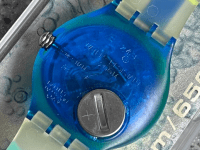
These were and still are produced in amazing colours and styles and most were Water Resistant, even the Quartz models with their small “hatch” fit battery.

The cases were made of light weight plastic, so almost unnoticeable on the wrist, were it not for the bright colourways they use in an almost infinite range of patterns and dials. Today they often use “Bio materials”, allegedly more kind to the planet, but the philosophy remains the same.  And movement wise, so confident are they these days, some movements are completely case sealed – no repairs possible – and in the rare event it stops, throw it away and get another one.

While I’m on about Swatch, I checked out another model that came to my notice, though tempted, have not bought (yet?)

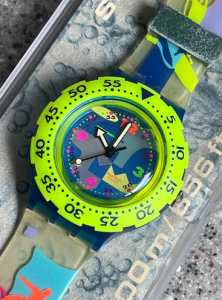
SwatchOverTheWaves – odd title, but that’s Swatch Quartz for you.

This is the SwatchOverTheWaves,  a diver style Quartz powered model – with an amazing 200m Water Resistance. I just love the colour combinations, which seem to work very well.

It will certainly be seen as a statement piece either in or out of the water!

Typical Swatch Quartz battery hatch. Note water resistance of 200M

So, whatever the reason Swatch are still managing to produce affordable models, both quartz and mechanical, in amazing colours and styles and most, believe it or not, are indeed Water Resistant, which I find surprising with that small “hatch” rear fit battery.

A success story no doubt and when you might assume a high price for a Swiss watch, these are very, very affordable. They’ve not only managed to compete but some would say surpassed that original fear in the early 1980’s that they would be over-run, by this new cheap technology.

Not so – and in my opinion, Swiss watches still reign supreme. In fact it’s a delight to browse through the current and vintage ranges available today as there’s always something new – and something you can afford!

Note – If you need to change a Swatch strap, make sure you get the correct size and remember they are not held in by “spring bars”. Swatch straps are sometimes measured (but not always) from the outside edge of the outer strap loops or between the outer edge of the case lugs.
However, it is fact that straps can also be measured simply at the widest part, where it meets the case – so be very careful which method is used by the retailer.

To remove the strap, you need a small pointer, such as the small round end of a watch strap removal tool (or Swatch’s own tool) – make sure it’s a slightly smaller diameter than the “straight pin” which will slide through the case lug, the centre case lugs and the strap’s three loops – then gently, from one end, push out the pin. Either use pliers or the Swatch tool to grab the other end and finally pull it out.
Note, I said ‘gently’ –  It is important especially if a vintage Swatch watch as if it has a plastic case, it may be brittle, so could easily crack, so don’t force it, but gently does it. Once the pin is out, put the new strap in position, then ‘gently’ push in the pin again. You may have to wiggle the strap slightly as you push it into place, through the first plastic case lug, then the two guides covering the centre of the strap – all in a line, then into the last case lug.  Make sure the pin is not protruding and that should be it.

You can also see how to manage this on many U tube videos – such as this one – https://www.youtube.com/watch?v=n6wj95R9BXE

BUT – word of warning –
When it comes to an old vintage Swatch model (such as the Terra Cotta) , the original strap fitting with the trademark 3 x loops lug fitting may be similar – it could be smaller.
And the issue here is, that newer strap loops are larger and wider and may NOT line up or fit in with the original case/lug separations.  They are also much thicker at the lug end, than vintage ones, so even if you managed to cut/modify the new strap to fit, so you could refit the retaining lug pin – it could look oversize and clumsy.
In the case of my Terra Cotta here – I’m fortunate the original strap has still got a bit of life in it, so I will not be trying to change it any time soon.
(another option of course is to find a true vintage Swatch for a cheap price and if it has a decent strap – consider swapping the strap)
Anyway, if it does fall apart – I’ll look at my options then and not before.

Kienzle update (and disappointing)

(Original Post link)  – www.watchspace.co.uk/2021/06/14/double-date/

Update – December 2023

The battery has died, which should have been easy to replace – BUT – on trying to remove what appears to be a screw down back – it simply will not move.
One issue is that the slots around the edge of the back plate are VERY badly defined and too shallow for any of my three different tools, after many attempts, to grip properly. I thought for one moment that perhaps these were false slots and the back was a snap type, though the watch is inscribed with 100m Water Resistance, so I thought not.  However, I  tried the tools I have for snap back – but not possible.

Finally after deciding, that damage or no damage to the back, I was going to get this thing off.  So, clamped in the vice (NOT a watch makers one, but a fully fledged industrial one) a decent weight hammer and an effective chisel blade that manage to get wedged in one of these shallow slots, I belted it many, many times!

But . . . .  you’ve guessed it – not an iota of difference – no movement whatsoever!

So, as my blood pressure was moving faster than the stupid watch back, I decided enough was enough – I have therefore “thrown” this Kienzle into my junk bin.  The rubbish collection people are due later this week – and I am VERY tempted to let it go with them. And that is the very first time since I started watch collecting (many years ago now) that such a thing has happened, but these days, at my age I simply do not have the TIME to mess about.

Mystery Fiction

A few years ago I came across the Fugue Fiction One watch.  Fugue was a French start up brand looking for crowd founding, who had initially prototyped a couple of models that looked rather good.  And being prototypes, the prices quoted were VERY low indeed, especially considering the high quality of the models being projected.

To remain afloat, this start up got involved in crowd funding, which in my view always seems a dodgy concept.  If no-one’s interested, then investors can be few and far between.  And if that is the case you tend to sink, not float.  And so it was – even after 2 crowd funding attempts they were unable to meet the finance they looked for.

And now one of the quite rare prototypes is now on my wrist – and I am very pleased about that.
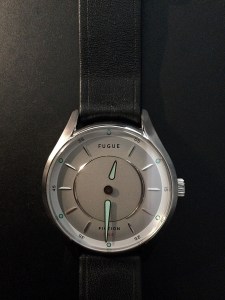
This was their second model – a great watch and for all sorts of reasons.  I mean, basically, what’s not to like?  Especially now that it is one of a very few around. They made two different coloured dials – this is the lighter less contrasting one.

To start with it’s a Mystery dial watch (tricky to do well, I may add), then there’s a good automatic movement.  It’s also very well made and a nice sensible size with excellent quality materials used throughout – plus a very decent flexible black calf leather strap – and very comfortable to wear.

The thing about “mystery dials” is the fact that they make you wonder how the hands are connected. Vintage watches from various makers sometimes used this feature.  The most obvious were the models that showed the minute hand attached to the central spindle, with the “mystery” hour hand in the background painted or applied to a disc, so giving the illusion of not being connected to anything.  Some were overly elaborate, using discs for both hour and minute hands but often difficult to read.

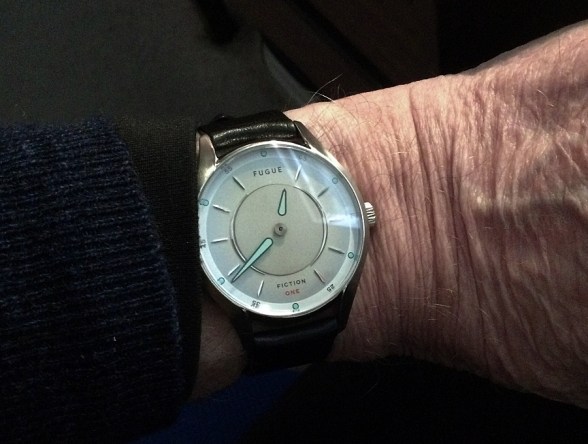
The Fiction One however is both simple and clever and beautifully designed.  It also uses discs, but one is fully transparent and really does give the illusion that both minute and hour hands are “floating”.
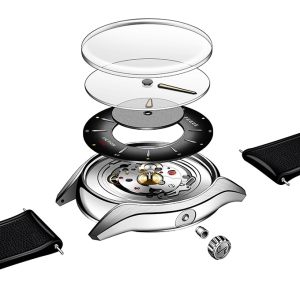
It is VERY easy to read.  The transparent disc, which has the minute hand inscribed, plus a third clear thicker disk allows a subtle depth separation between the hour hand on it’s opaque disc – thus giving it that “mystery” floating effect.
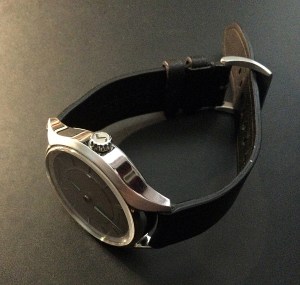
The images taken today show how clear this watch is to read the time.

Note the omission of any seconds hand, which makes it slightly tricky to set the time exactly – (basically use another watch/internet or iPad/iPhone whatever and push in the crown on the hour is easiest) in fact you have to look at it carefully to see if it’s actually working.  Mind you it’s odds on it will be, as the movement is the Sellita SW200-1 elabore, a model I have on some other watches and it is a VERY reliable automatic, being based on the ETA2824-2 (minus the date configuration). It beats at 28,000 beats per hour and has a reserve of around 38hrs.

The dial has a real quality finish to it, from the luminous applied markers to the perfectly integrated transparent discs. Complimented by the wonderfully sculpted hands with Super-luminova – it’s a quality watch.

The case is stainless steel, lightly brushed on the top surfaces and highly polished on the sides. It is also obvious that the case has been hand finished and it has a flow to it, from case body to lugs, which is a homage, if you will, to their first watch model – the Chronostase, which featured a modular case with a removable inner case (on ball bearings), which I don’t have, but would not be averse to having, if one came up for sale.
The fugue Fiction 1 Water Resistance (tested) is 5ATM, but the crown is not a screw down variety.
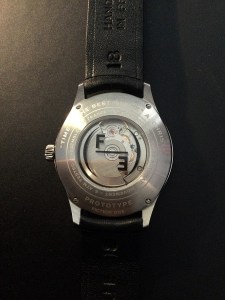
The clear crystal is Sapphire, as is the clear back window, which shows the movement in more detail.  The watch dimensions are 38mm diameter x 46mm lug to lug and just 11.1mm thickness according to my micrometre, with the strap measuring 18mm width.

So, all in all, this is a really great watch so wear.
It has an amazingly comfortable strap, which seems “run in”, as they say and is both flexible and soft on the wrist.  It is a model that is the perfect size, it’s unobtrusive, yet with the cleverly designed take on the “Mystery dial” being done so well, it’s just about as perfect an example of the concept you could get.

Alas, it seems that the Fugue Fiction 1 is now a rarity and no longer, which is a mystery (the Agatha Christie inspiration for the watch) – as it really is a classic in it’s own right – and I’m so glad to be the proud owner of one.


And yet again – Swatch

Forgot to Post this one the other day – purely as I like the look of it. Very modern, colourful and OK for size.

Swatch Rouge and Noir Quartz

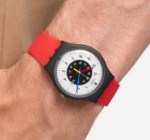
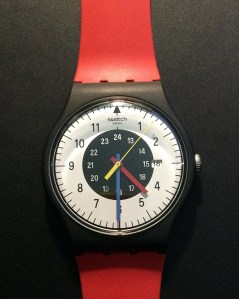
This is the Rouge and Noir (red and black) Bio-ceramic Quartz model SO32B401-STD.  Black case with a Matte red strap, loop and buckle in ceramic bio etc, so nice and light.
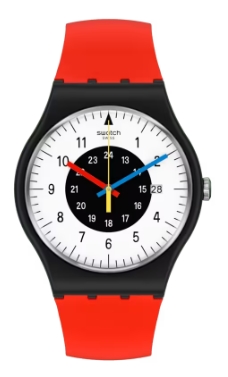
It has a vibrant dial/face in white with black print and rather sudden multi-coloured hands. I like the overhang style of the bright yellow centre seconds , short enough not to confuse when reading the time, but very noticeable as a mobile seconds reference.

You certainly know the watch is working!

Swatch Rouge and Noir quartz on the wrist

The Water resistance is as usual fairly minimal standard at 3Bar, so splashes are OK, but don’t jump in the shower with it and the dimensions are perfect for most folks at 41mm, 9.85 depth and lug/lug at 47mm. You don’t need extra size to see this watch!

I really like the overall look of this model – the colours work great – no neon though (they have these too) which I personally find overpowering, but great to look at on the wrist.

The strap fitting is the Swatch format, so not that easy to change unless you go to Swatch for a replacement. However, it can be done with a simple silicon strap IF you’re prepared to fiddle and cut an bit – I’ve done it in the past (I have a Post on it somewhere) and I was very successful with my efforts.

Anyway, I digress – this model very OK priced at £82.00 – and includes free postage (UK) and I have to say I’m rather tempted.
I find it a bit surreal that this model is part of what they call the 1984 reloaded collection – so even though Swatch started in 1983 or whenever, this is a retro model!     Maybe I’m just getting old!   😉

Update – Here are some images of the actual watch, taken today 18th

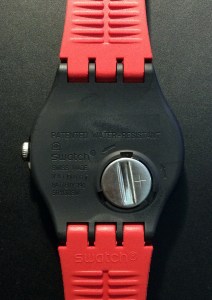
Note the back of the watch and the proprietary Swatch battery hatch and the text quoting the battery type, which is always useful, so you can order one before taking the old one out, which is sensible. However, a silicon strap for me, might have been preferable to the bio stuff, which feels a bit plasticky, though it is flexible.

All in all, though – a nice little colourful watch though I’d caution that care has to to taken with bio material – feel is important and tricky to get right.