Came across this the other day – liked the look of it and it’s now in my “other watches” display box in my collection. A watch company that perhaps many here in the UK are not aware of but in India they are the largest watch manufacturer with over 7 million units sold every year! Exports to over 40 countries and the 6th largest watch producer in the world.
Quality time from India
Many of their range are Quartz models often with Citizen or other movements but they also produce their own in-house movements and mechanical models too.
This model first introduced in 1998 is called the “FasTrack” and features a French Quartz movement which surprised me and it also surprised me with the overall quality of build.
As can be seen this is a nice sized watch at 36mm diameter and just 7mm depth it sits neatly on the wrist. Nice contrasting white hour, minute and centre seconds hand (with that super red tip) read easily against the black and dark gray face.
Date window @4
A red edged circular date window @4 with black numbers against a white background is large enough to be seen easily. Odd sort of minute and second chapter numerals with the outer ring showing 5, 10 to 60 @12 and the inner ring showing 10, 20 to 120 @12 seems a bit odd, but doesn’t detract from telling the time, so is of little consequence.
The case is a nice dark finish stainless steel, good knurled definition crown and stainless solid back look good. The watch also features a 50m Water Resistance indicated on the case back.
All in all a very clear watch to read which is always a bonus in a watch as neatly proportioned as this one.
The strap is a reasonably good black stitched leather one and for my smallish 170mm wrist is just about the perfect length, though may be a little short for some larger folk. It is 8 inches long and wide enough for comfort at 18mm width.
Solid performer, solid crown
This model came from “overstock.com” and comes with a 1 year Dealer Limited Warranty, though the Titan Guarantee is in the box and is 2 years so it looks as if they stand by their product which gives you confidence in their quality expectations.
Price-wise this watch is very affordable and you get a decent quality – albeit perhaps not a “current” range Titan model but nevertheless a good buy in my opinion.
Note– the lighting on the image opposite is a little brown looking – whilst the dial is sort of two tone it is really much darker than shown.The image above is nearer the colour.
Drawbacks? well there’s usually something – isn’t there?
In this case it is the annoying lack of luminousity – these lovely and clearly defined white hands and NO LUME!!!
This is a real shame as had it good luminous hands this watch would have been 5 star but the lack of it drops it to a 4 star – sad but true.
Perhaps a name to be considered when you’re looking for that new timepiece – IF the price is right. I say this as I’ve noticed that some of the current quartz models, certainly here in the UK are priced maybe just a bit on the high side (see the Indian prices!).
Talking of other models though – I think they have got a real winner in their “thinnest watch in the world” model, the “EDGE” – for what it is – it has to be good value even here in the UK. I mean the movement is only something like 1.5mm depth, which is amazing.
This “FasTrack” though is a nice, neat and well made product and if the “Edge” is as good or even better than this one – then it’s a winner – all the way.
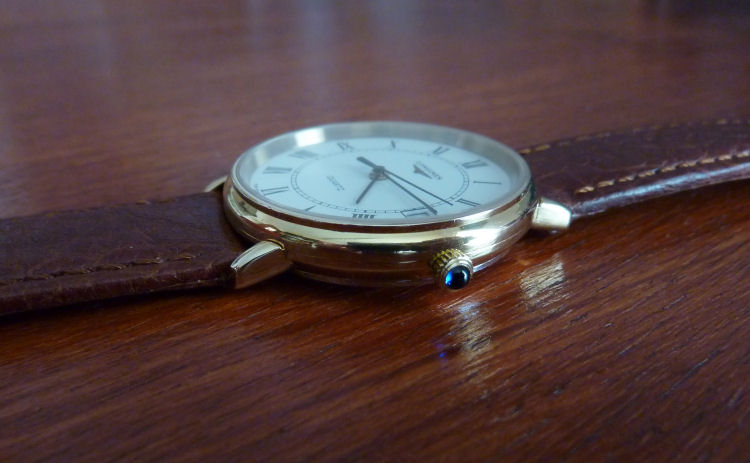
Another dress watch finds it’s way into my modern/vintage collection. This time a neat gents Longines 20 micron Gold plated Quartz model of 1983. The model has changed since and I have to admit I find this one infinitely nicer on the eye.
Longines gents Quartz Gold "Presence" model
I particularly like this version as it has the larger date window @3 whereas the more modern versions the date window is much smaller, though the case is still a lovely sleek and slim shape.
Lovely Cabouchon crown
I picked up this pre-owned watch recently and very pleased too as it has very little wear. An almost perfect unmarked white dial and a nice color contrasting blue Cabochon inset to the crown. Stainless steel back again virtually unmarked.
A great feature of many Longines watches is the movement which here is a top quality Swiss ETA/ESA 7 Jewel quartz , so it is a superb timekeeper.
It came with a black padded leather strap which I personally thought did not do the watch justice – I find so many of the older watches to my mind are better suited to a non-padded flat strap and so I fitted this rather nice high quality flat brown leather stitched strap.
On the wrist - perfect
I think it lifts the watch to another level (a bit like the painting with a decent frame – it can make all the difference).
On the wrist it looks very elegant which is a nice complimentary description to any Longines watch and is a delight.
The dimensions are almost unisex today at 34mm diameter ex crown and 37mm lug to lug so would also suit a lady (the Longines ladies watches are considerably smaller). It is also a very clear watch to “read the time” with the slim black hands and center seconds against the white dial face. The date window being quite large is also very helpful in this respect.
This watch I think confirms my personal opinion that pre-owned watches are so often a much better buy than many a “new” watch. They are usually better value more often than not and also for me they represent a “style” and elegance that seems to have been lost today. Note – I say value – as this watch cost barely a third of the new version – and – it’s more elegant – far easier to read and is virtually as new condition.
What could be better?
——————————————————————————————————————————————
Note – Have you seen the “watch of the week”? – and my new “For Sale” tab – check them out………….top of page.
This week for a change I feature a rather interesting Seiko quartz watch from the ’80’s. The Seiko AGS or Automatic Generating System Model 7M22-6A40 gents watch first appeared in 1988 and was an early automatic quartz forerunner of what’s better known now as the “Kinetic” series. It was first pioneered by Seiko in 1986 as AGM and further altered to AGS when this watch came out.
Early Seiko Automatic Generating System watch
This 1988 April version has a nice white dial with Roman numerals, black coated hour and minute hands with a central gold coloured seconds sweep. A date window – black against white @6 completes the neat easily read dial and a good “Hardlex” crystal to the front. The date features a quick set on the first click of the crown. Finished in satin gold plate with matching gold coloured bracelet it looks very neat indeed. The bracelet which is very smooth to wear can accommodate up to around a 7.75″ wrist.
Seiko AGS 1988
This particular watch shown here was a brand new Old Stock model when I got it recently and has been in storage lying dormant for over 20 years and is in absolute pristine as new condition.
So how does it work?
It works using a rotating pendulum rotor in similar fashion to the rotor in a mechanical automatic watch which is attached to a larger gear which meshes with a very small pinion. It operates on the wrist movement of the wearer and rotates via a 1/100 gearing pinion, transferring energy to a power-generator at high speed to produce an electrical current which in turn charges a capacitor (KESU) which in turn feeds the time circuits. Being one of the earliest models with a 3029110 power capacitor the full charge might last maybe 3 days or 75 hours – however, full charge takes about 800 swings of the rotor, so really has to be worn a lot to get the best capacity reserve out of it.
A feature of this early model is that the second hand operates in 2 second jumps, if the power reserve capacity drops to around 3 hours. Now, as it can take a considerable wear time and wrist movement to build up a sufficient charge, it can sometimes seem as if 2 second jumps are normal! In fact I know of a few owners who thought that was normal!
All is not lost however, as in 1990 owing to charging issues with the older capacitors, they were replaced by the newer 3023 24R capacitor (KESU) module which dramatically improved both the reliability and allowed a whopping 90 days on full charge – much better – and the 2 second warning was not in evidence.
This particular model features a 5 jewel all metal 7M22A movement, which is all metal and before plastic parts is actually better than some modern watches.
The dimension of this watch is very compact for an AGS or Kinetic watch and measures 40mm top to bottom and side to side (without crown) just 35mm. Back to front is just 9.5mm and with a 28mm diameter crystal. Quite neat and unobtrusive and quite dressy and I have to say it looks very good on the wrist.
AGS 7M22A 5 jewel movement
In this image you can see both the rotor and the capacitor, which is a Panasonic MT920 (2.4v) at the left. The watch serial number follows the Seiko numbering system with first digit 8 denoting 1998 and the 4 for April. The next 4 digits represent the model number in that month. Quite useful to see such an unusual and Seiko historic movement mechanism and note the cal. number etc. You can also hear the rotor operating though once against the wrist it’s almost inaudible.
So an unusual model and factually a milestone in Seiko watch terms. This one is in fantastic condition even after just over 20 years since it first came out.
I suppose if I was honest that capacity charging efficiency was low with this original concept. In fact the 2 second jumps can appear all too easily, especially if you take the watch off at night, or if you wear your watches in rotation and leave it in the watch display box for a month. It just takes far too long to get it up and running at full tick, as it were.
But it CAN be changed and upgraded fairly easily and I have the newer replacement capacitor ready to fit.
Anyway not withstanding the above – it’s still an intriguing and to my mind, a historically significant watch and a nice addition to my collection.
February 2015 – update – I changed the capacitor. (however, after 10 years I replaced it as it barely functioned).
So, today I have updated and edited the previous report as follows –
June 18th 2025 – I have just now replaced the power unit with a new 3023 24R which is a direct fit.
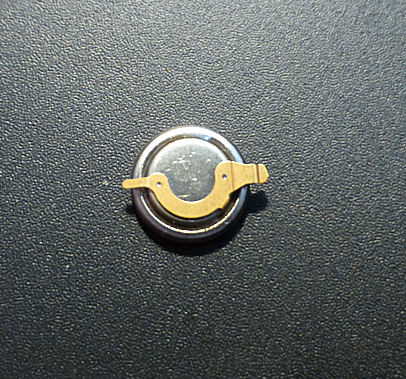
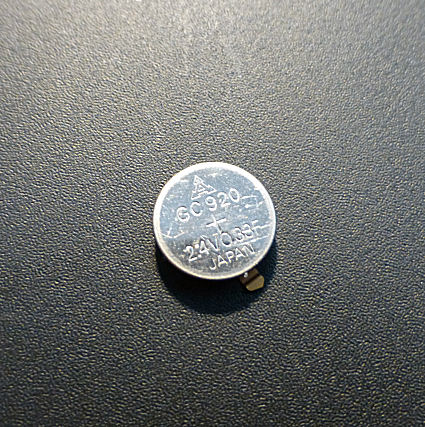
Note how the original capacitor “appears” smaller than the replacement.
Note, it’s a bit misleading when you look at the previously installed capacitor via the exhibition glass back, as the visible top part (negative) of the capacitor is of smaller diameter than the positive side (see image).
Important note – when removing the new capacitor from it’s small blister pack, do not touch it with your fingers, either use nitrile gloves or similar or plastic tweezers. Also don’t be tempted to check it with a voltmeter as this could cause issues.
Anyway, my procedure – I removed the screw case back. Once inside, you can optionally removed the rotor for easier access, or continue as I have without. I found last time it was possible and I’m always wary when re-tightening any rotor screw.
The capacitor is recessed and before you can take it out you have to remove two small screws holding the top plate surround. Using tweezers take off the top plate and underneath there is a small brown insulator gasket. Carefully lift it off from it’s tiny locating points. Take note – don’t pull it, as it is located under the spot welded yellow metal capacitor plate on the left side, but above the wider plate on the right.
However, as I always do, prior to working on it, I take close up pictures of the whole thing in situ, so I can refer to them if I get the orientation wrong.
Note – the gasket sits under the left of the yellow plate and sits on top at the right. Always take photos before to assist in re-assembly.
Fitting the new one is the reverse of the process and once all done up again, in my case, it immediately started. With full tick. Once fully charged it should get at least 30 days and perhaps 60 days as the 90 days quoted may be over optimistic.
(NOTE – if you have removed the rotor, do make sure you screw the rotor back carefully – tight enough to hold, but not too tight – if slack, the rotor is ineffective).
The original capacitor for the AGS.
AGS is called Kinetics now and the science has moved on somewhat since 1986 and whilst Seiko had a Kinetic collection, this was ended in 2020.
However, I believe kinetic might still be available in their Premier range, though I have heard that as of May this year 2025, these may also be discontinued.
It seems that Spring Drive has replaced the whole kinetic idea – check Seiko main web site for details.
You see that’s the trouble with deciding that “this” is the watch for you – or maybe “that’s” the watch…! It’s all about choices and maybe finding a watch you’d never seen before – then your fixed ideas can go right out the window!
Take this one for example –
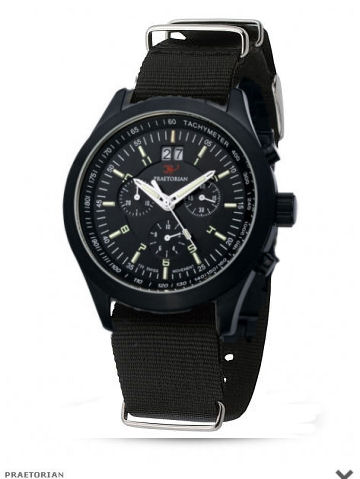
Praetorian Swiss chrono
A Praetorian “Centurian”. A 44mm diameter black PVD coated stainless cased Swiss quartz Ronda-Startech 5040B chrono movement, with screw down crown and case back and 100m water resistance. The matching double locking bracelet is also PVD coated stainless and 22mm wide.
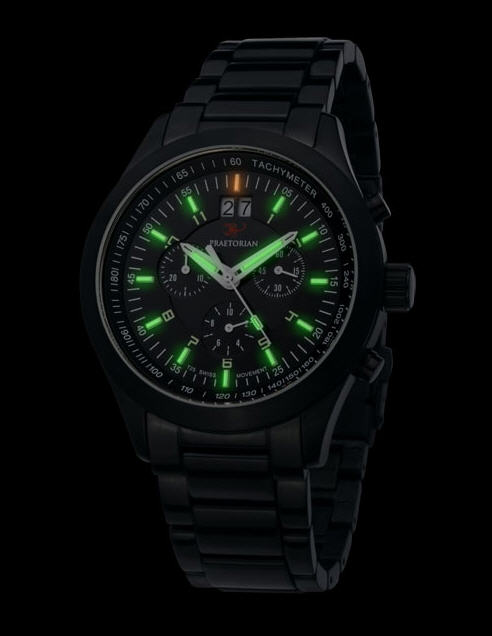
Great looking watch and with my favourite Swiss mb-mirotec Tritium illumination again giving super night vision. 12 marker is orange and the 11 others green as are the hour, minute and second hands.
Unusual too in this style of watch is the large double window date @12 making for very clear readability. And yes this is a chrono so has two extra pushers on the side and yes I know I said in my previous post that I didn’t need these – well – they seem to fit rather well on this model and are actually quite unobtrusive. What can I say?
The clear mineral glass is scratch resistant and the watch has a case diameter without crown of 44mm and only 12mm depth, which is pretty neat for a chrono such as this.
The chronograph functions are the central stop seconds hand, “3” second, “6” 1/10th second, “9” minute/hours after 30 seconds.
Tritium illuminated by Swiss Made mb-mirotecMagic of computer – Nato strap fitted
Image left –
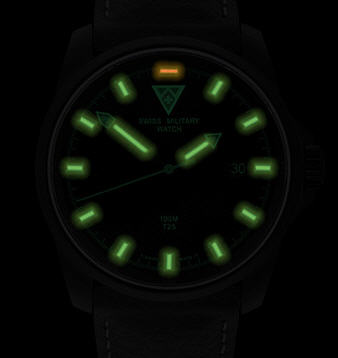
Shows the tritium light system in action in a night shot
Image right
Shows magic of computers as I fit a Nato strap in place of the bracelet just to see how it will look.
So a new find for me and a watch I have never encountered before – and I like it!
In fact I like everything about it.
The dial has a nice clear and clean look to it, especially considering the superb double date window (which is a real plus I have to say) – it’s a good gents size without being too thick and cumbersome as so many often are.
Then it has that wonderful night vision capability with the Tritium light source, which I kid you not you really have to experience in comparison with the alternative “paint coated” systems – then to cap it all is the price – it is NOT very expensive.
So yet another one to add to my consideration list – which is growing by the minute – yet again!
Whilst I have quite a number of military watches, it is as you collect over the years that you see what you really want in a watch as opposed to thinking about what you might want. There is a difference!
For military I already have the multi-bezel 12 hour and 24 hour registers, the oversize crown guards and odd coloured dials, chronos and the like. So looking for something simpler but not simplistic (I already have both Nato and Mil spec watches) is actually not as simple as it sounds.
I would prefer no bezel (or if one must it should be relatively unobtrusive) and I like a single crown. It also must be strap changeable or in other words I don’t want a rubber/textile “special” affair that only fits that watch. And I must be able to see it at night.
Here’s one that comes to mind –
Swiss military Watch "Millicurie PVD"
This is the Swiss Military Watch company’s “Millicurie ” pvd coated stainless model. Complete with my favourite H3 technology light source lume – which is simply unbeatable.
The hands and numerals are Tritium tubes – orange for the 12 and green for the numerals and the hour & minute hands.
Slightly odd this one in that the hand tips also have Super-Luminova infills – though I can’t quite see the benefit of this when the hands themselves are Tritium tubed.
Note the image taken in the dark – whilst the Tritium hands and numerals glow brightly, the tips are pretty faint in comparison. What this does show however is the superiority of the self illuminating Tritium system as opposed to the ambient light charged Luminova coating. And this is especially noticeable if like me you wear your watch under your sleeves most of the day – the luminova will never see any light – and therefore will not glow too well.
The rest of the watch features are pretty good – a Swiss Ronda Quartz movement, red centre seconds and date@3. Nice clear black face, no distracting bezels, 100m water resistance with double O ringed crown. It’s also a nice size at a medium 40mm dia and 13mm depth, so not a monster. A 22mm strap completes the ensemble which is a nice “mans’ size and looks good on the wrist.
A 2 year guarantee on the watch and a 10 year guarantee on the “unchanged optical readability” of the H3 Trigalite illumination system.
All in all not a bad offering at all and it’s not expensive at around €180 (Euros) or $240.
H3 illumination
Image 2 Shows the H3 Tritium light source lume used on this model. Note the Orange horizontal marker @12makes for excellent readability.
——————————————————————–
So any negatives?
Well the date maybe could be larger or clearer and the Luminova hand tips a bit of a waste of time, though in fairness the arrow heads are quite clear during the day against the black face so OK I’ll accept that.
But the positives outweight the negatives by a long way – so it’s definitely under consideration.
Note – Check out “Watch of the week” above in the tabbed header.
Another of my vintage watches this time – the 1949 Longines President Fillmore 11 in a solid hallmarked 14ct gold case with lovely curled and fluted lugs.
Model President Fillmore 11
It has a satin silver finish dial with the hours marked with gold coloured batons and the Arabic number 12. The subsidiary seconds recessed dial can be seen @ 6 o’clock and the lovely elegant gold hands are in superb condition.
The case is 39 mm from lug to lug and 26 mm across excluding the crown and the watch is triple signed, dial, case and movement.
The watch has the Longines cal. 23Z movement with 17 jewels set in solid gold casings runs perfectly and keeps remarkably good time.
The movement serial number dates the watch to 1949. Note that the 23Z together with the 9L are two of the most rugged and reliable movements made by Longines and used in their watches from the 1940’s until the 1950’s. This particular watch was marketed in 1950 so this 1949 stock movement was fitted early in that year.
I’m really delighted with this one and it’s complimented by a fine quality lizard leather grain strap and the watch is just great to wear for that special occasion.
A very elegant and unusual timepiece of the Art Deco period and as the watch dimensions are quite generous for the period it looks just great on the wrist. It also generates a fair bit of interest wherever I go and I just love it.
Check out Watch of the week – on the tab at the top of the page – shows another of my vintage watches.
Next up – an affordable AstroAvia chronograph – with Nato?
Isn’t it funny how some watches lend themselves to bracelets and others to straps and often you are never sure which is best until you come to own them.
Never more true than one of my favourite watches – the Junkers G38 Titanium Alarm model (6296M-5) – This is a superb looking chronograph with an excellent 4 jewel Swiss ETA G10.791 Quartz movement (which in the case of this particular model is exceptionally accurate) – (for information – this watch takes the Renata 394 battery).
Alarm function, date window, very good luminescent hands and markers and a nice flat clear mineral crystal – all in a solid Titanium case, 42mm diameter and 11mm depth and with in this instance when I bought it – a solid link Titanium matching bracelet.
Ti Junkers & matching solid link bracelet
Now whilst it is a great looking watch and it was sold with either a leather strap OR a Titanium bracelet. I thought value for money the bracelet won hands down.
BUT – actually there was another option, not offered but which in fact put the whole combo into a different league – and that was the Nato strap.
Junkers in full Nato
Wow! Absolutely looks the business! And in my opinion what a transformation. From a rather smart chronograph to a military fighting machine!
The choice of colour here for the super Nato strap was picked to compliment the wonderful grey dial of this Junkers, so much more classy than the ubiquitous black faced divers, chronos and the like. This has that “something” to set it apart from the crowd and I just love it.
Junkers in Nat
Here I decided to use my little new Lumix T7 compact camera – hand held and it shows up pretty well the quality of this watch. I liked it so much I decided to take another picture ………….
Junkers & Nato showing Alarm set button
Pleased with this one as it does show that contrary to common opinion a Titanium cased watch (in this case solid Ti) and without any protective coatings and suchlike – doesn’t have to scratch and look as if its’ been chucked in a drawer full of nails for a year, and it can look as good as it was the day I bought it a couple of years ago.
I wear it quite often too – in fact for the last 2 weeks it’s been my daily beater with the Nato strap fitted and it does get a few looks too, from all sorts of folks.
But just like a car, certain models suit a certain colour. The very same with watches – some like leather, some like bracelets – but this baby LOVES NATO – and so do I.
Just on the subject of scratches and so on. It never fails to amaze me how many watches I see second hand, pre-owned, whatever, that are in terrible scratched condition. Cases almost wrecked, the crystals a maze of scratches so bad they’re opaque sometimes and all too often there’s even a hand missing – missing! I ask you!
I do have to wonder just what these owners DO with their watches and their wrists for that matter! Makes me wonder too what their car or their house is like – LOL.
This nice little 1935 art-deco rectangular Elgin model known as the Osler doctor’s watch. A little masterpiece in a 14ct gold filled case is in fact named after Sir William Osler, M.D. (1849-1919).
The Elgin “Osler” watch 1935
Called the “Doctor’s” watch was because many watches of this period either had no seconds hand or a small sub-dial seconds hand which was pretty small to see let alone use for pulse measurements. And this was where this model scored with the medical fraternity.
Firstly, having a centre sweep seconds hand was a plus but secondly and probably of more importance, was the addition of a printed seconds graduated chapter ring making it much easier to read. Just tick off the first 15 seconds then multiply by four and pretty much still how to read your pulse today. The centre seconds hand on this model sometimes had a red marker on it just prior to the arrow head of the pointer, though this one is plain.
A nice sized 14ct Gold filled watch at 39mm x 22mm it features a neatly recessed crown and a clear slightly domed glass. Such a sensible size in comparison with some of the monster watches of today…
Inside is the hi grade 522 manual wind, 15 jewel early and fairly rare Elgin signed movement, which is ticking away as good now as it was the day it was made over 70 years ago!
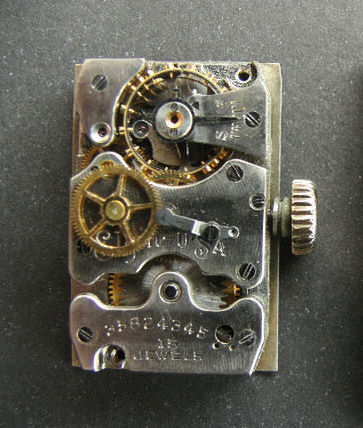
Elgin movement 15 jewel 522 hi-grade – 1935
Of course one of the benefits of these old watches is that you can quickly snap off the back and expose the movement quite easily (water resistance wasn’t much in evidence at that time) and you can easily adjust for accuracy.
To the right you can see the actual movement and the nice solid crown winder at the side. At the top the adjustment lever is easily accessible and surprisingly large compared to many more modern watches and the the serial number at the foot equates to a 1935 manufacture.
And I have to say that this particular one is amazingly accurate and certainly within around 50 seconds in 24 hours!
I also noticed that the stem/crown mechanism is actually superior to many a modern day watch in regards strength – it is superb and provides a very definite and strong winding action.
So a little departure from the watches I usually feature here, but I thought I’d share one from my “vintage” collector box as often they are so much more interesting than some of the modern offerings around.
I’m also quietly confident that these will not only still be ticking along fine many years from now, but will probably attract rather good prices.
Addendum –
Today (February 2024) it’s worth upwards of £700 – isn’t that nice?
Well after a few weeks with this latest watch I have to report that any reservations I had or indeed criticism of it are utterly unfounded!
I have not had this watch OFF my wrist since! It is working flawlessly and to my surprise is keeping VERY good time indeed – in fact much better than I initially thought would be the case with a relatively low priced Far Eastern mechanical automatic movement.
In the luminous department, whilst it is better than the whole face lighting of the last Aeromatic, it’s about average, but the contrast is better in daylight.
So all in all I am VERY pleased with this model and for the price it is difficult to see how it can be beaten!
My next review is a Quartz Eco watch which took my fancy some time ago and for the smaller wrist it is pretty good.
Another Aeromatic 1912 model but this time a model A1027 which is a “sextant” inspired aviation style from this German “maker”.
Model A1027
A little more conventional than the last model and without the all luminous dial feature. Instead here we have the traditional numerals and hand luminous painted. However the numerals are painted glossy which I don’t think does it justice. Matt is for me far better and clearer. That said the watch is still quite clear to read and the luminous hands do stand out from the dial with far better contrast than the luminous dial version. The dial face is in dark gray which gives reasonable contrast to the white markers.
The crystal on this one is very slightly domed (and very well fitted I have to say) and the crown is the more standard non-onion style. It fits well to the wrist and overall at 40mm diameter it’s a nice size. The case is a very smooth satin finish stainless and the stainless steel back has a crystal to see the innards at work, which are identical as far as I can make out to the previous model I posted.
Looks good on the wrist.
The watch keeps pretty good time and is as accurate as one should expect from the jeweled automatic Asian mechanical movement.
Finished off and complimented by a nice quality leather strap it sits very well on the wrist, and I have to say it’s actually as good if not better to wear than the previous one – but this is a marginal thing.
Suffice to say I like it as a good solid looking, neat and practical watch. It’ll manage a good downpour pretty well but like me – swimming is probably out!
Overall – Whilst it maybe has to compete with some of the “practical” Seiko and Citizen quartz watches that are out there – and as a well made mechanical non quartz watch, it’s both well priced and better value than many of them – so a good choice in my opinion. I can see it being a good companion for many years to come.
Aeromatic 1912 owned by Rainer Bettner of Frankfurt, Germany. As often the case the “manufacturer” title may be misleading and perhaps more a case of assembly with alterations of what appear to be Asian designs found in the Million Smart Enterprises; website catalog – then perhaps re-badged Aeromatic 1912 or perhaps Tauchmeister. So very much Asian in origin they use Lioning, Shanghai and SeaGull mechanical movements and various quartz ones such as, Miyota and probably Swiss Ronda too.
However such is the quality of Asian movements (the better known ones actually have quality control – the cheaper ones YOU are the quality control!), these are quite good watches and certainly for the price pretty well unmatched. So an Aeromatic mechanical watch purchase will probably not let you down and in fact may well be a very good “daily beater” in comparison with anything else out there. That has to be good – yes!
Update January 2014– Just a word on the luminosity of this particular watch. Certainly not as good as Seiko Lumibrite or SuperLuminova, it is maybe the older Luminova or some other compound used here. Consequently once light charged it does tend to fade quite rapidly and after a few hours of darkness it is maybe just visible. So OK perhaps but certainly could be better.











You must be logged in to post a comment.