The Ambassador – from Android

A surprisingly excellent model from those folks at Android USA – the Ambassador 11 Swiss complication watch (Triple Date Calendar model)

Ambassador 11 Swiss moonphase – Triple Date Calendar model

Not in the “way out” style I associate Android with at all, this is a rather elegant polished stainless steel cased Ambassador model, which features as it’s power source the excellent Swiss Ronda 5 jewel 706.B. This model has displays for – month, date, day, moon phase, in addition to the hour, minute and center seconds hands.  This particular dial also shows an index for week numbers of the year, so will appeal to businessmen as a very smart and useful dress watch.
The dial is silver/white and the hands a very good contrasting blue steel, including the seconds hand, so despite all the complications it is an easy watch to read.  The month indicator has a curve pointer at the end which is colored yellow.

Having such complications it is important as to when you change them you make sure that you manage this task at the correct time so as not to damage the mechanics of the movement.  Often the watch instructions are not as detailed as the movement instructions and I prefer to use the latter when it comes to settings.

Whilst the instructions that come with the Android are OK, a slightly more detailed set is available from Ronda on their own very good web site.
For example to change any calendar functions it should not really be done between 11.30pm and 05.30am as automatic changes are usually in progress at these times.  The initial setting of the moon phase also requires a bit of concentration and as with my other moon phase models – my advice is – Don’t lose the instructions! or better still download a copy of the Ronda ones and keep it on your computer.

Elegant clarity on the wrist

Basically moon phase functions are initially set (and done only once) by selecting the day of the last full moon, then set the date pusher to that date.  Then using the crown set your current situation and that’s it done.  For other settings the watch has some quick change pushers for the week and the date.  The pusher @2 moves the Month and Week Number and the lower pusher @5 changes the date.

The hour, minute, day and date hands and markers are infilled with luminous material and look pretty good in low light. Of course as with many of these, they will tend to fade after an hour or so, but they’re reasonable.  In daylight and for basic clarity this model excels as the dial layout is really well thought out and exceptionally clear to read.  It is certainly in my opinion a very smart looking model without being flashy – in fact a true “dress” watch that seems to fit it’s purpose very well.

At 42mm diameter and 12mm height this is a nice modern watch size (ex crown).  In fact to find such a nice watch at this size in the Android stable is quite a find, as all too often many models in their range tend (for gents) to be over-sized for me.

Now with such a busy dial face you could be forgiven if thinking that it might be cluttered and in fact nothing could be further from reality.  Everything is well spaced and lettered cleverly to be highly visible.  Note that the hour numerals are applied blue painted and stand out from the other black printed texts – quite a subtle arrangement.  I also note that the Android logo is neatly managed in a non bold typeface which says all it needs to say but is both neat and unobtrusive.

The case is a solid chunk of highly polished stainless steel and Water Resistant to 100m which is nice to see in a dress watch of this type.  The crystal is a slightly domed convex hardened mineral glass.  The complication pushers are on the right side of the case either side of the crown and virtually hidden.  The 22mm wide strap is good quality, if rather stiff, Croco embossed Italian leather fitted to quick release lug pins and with a matching polished steel Android logo buckle I have to say seems to compliment the watch very well.  However as with a few of my watches I changed the strap for a Silicon deployment style and it looks really good fitted.

Overall I’m very pleased with this addition to my Android collection (I knew the first one wouldn’t be the last!) and I can see me wearing this quite often as one of my favorite dress watches.

Any negatives?  Well. . . no actually. . . it is what it is – a very nice watch indeed. I love it!

Update January 2013 –

Well this model has lived up to my expectations big time.  It has not yet had to adjust or correct the time which shows the quality of the Ronda movement.  No issues at all as this watch has functioned perfectly since I bought it.  I’ve since been looking for another Triple Date Calendar watch and found nothing in this price bracket that even approaches at it terms of looks or quality.  It’s just a pity it’s not available now as I think Android had themselves a real winner here and maybe didn’t realize it.  Maybe I should tell them!

Movado class

A new addition to my collection is this very tidy two tone (pre-owned) Movado.  Slightly smaller than a Patek Philippe Calatrava this is a neat gents or unisex size, but it’s perfect for my 165mm wrist and as I like it so much – I’m afraid my wife will miss out on this one!  Not much data on it but dated perhaps to around 2000 though possibly earlier and model name unknown, but is signed MOVADO logo on the face and a sub reference to the ESQ range on the back.  Unusually it has a 14kt Gold filled rotating bezel (not quite sure why) atop a stainless steel polished, slim case, but this watch has real presence.

Movado 13 jewel quartz

It had a coloured leather strap when I bought it, but I decided to fit in it’s place this nice Hadley 12kt gold filled expandable bracelet with contrasting black enamel panels which cried out to meet up with this gem of a watch.  And they do seem to get on very well together.

I’ve always admired Movado watches and this is my first one and OK it’s quartz and not mechanical, but I really don’t mind, as it’s the style of this one that so attracted me.  Well defined blue steel hands against an unusual and delicate eggshell blue face with Roman numerals at 12. 3, 6 and 9, then gold applied chapter markers leading outwards to very neat and individual minute index block numerals (5 minute intervals + single minute markers in black).  I like too the red 60, 15, 30 and 45 marks – it’s really a beautifully set out dial with the MOVADO logo @ centre 12 and a discrete “Swiss Made” at the foot.  A contrasting white coloured seconds sub-dial @6 with a gold coloured hand completes the dial detail.

Stylish Movado with Hadley bracelet

Topped off with a 14kt gold filled unidirectional milled bezel marked in 12 graduations and a @12 centre datum gives the watch a nice solidity and contrasting two tone colour scheme against the rest of the very finely made stainless steel casing.  The flat sapphire crystal is virtually reflection free, though I’m not aware of an anti-reflect coating.

That solid look makes it appear in the images like a much larger watch – in fact the dimensions are neat at 32/36mm diameter and a slim 7mm depth.

The movement is a high end Swiss quartz 13 jewel with a 1.55v lithium battery as the power source and good for 3 years at least.  Stainless steel back with the ESQ logo, Water Resistant and model/serial numbers completes the details of this watch.

I did have another strap – high quality camel leather one in brown which would be an alterative (much better than the one I bought it with) which would match , but I have to confess I love the Hadley bracelet on it and whilst I’m not normally a fan of expandable ones, this one looks great and is really comfortable – once past the hairs issue ‘getting’ it on, so it might just stay as it is.

In fact I am absolutely delighted with this watch and I’m sure it will be one of the “dress” watches in my collection that I’ll never tire of wearing – and that’s surely a very good recommendation for any watch.

I also haven’t found out too much about this model at all. What model is it?  What year of production and what price would it have retailed for?

As usual, anyone out there who has definite model information – I would be very grateful to hear from you. . . .

Update –The ESQ or Esquire range was launched as a subsidiary by Movado in 1995, but unable to find much reference to the early model names.

Boccia Chrono

Sometimes you come across a watch or in this case a complete range of watches that for some reason strikes a chord.  And as I am quite a collector of Titanium watches it was of considerable interest that I chanced upon the Boccia range (pronounced Boschia).

Boccia Titanium Chronograph Cal.05.11

I don’t know about you but I have found that many of these “designer” watches often use too much chrome in their dials, with numerals and hands not being the easiest to read – too much ” bling” I suppose, a fashion I personally dislike.  In the Boccia range there are indeed some like that but fortunately not all.

For in amongst this range I spotted the B3777-02 Chronograph model which definitely bucks the trend of their other watches.

First off I like this one as it has that nicely sculpted dark Titanium colored case with matching chronograph buttons and a rather neat and clear dial arrangement.  The numeral/markers are both large and very white applied and the hands are similarly done, which contrasts well against the dark dial face.  The hour and minute hands are also well proportioned and broad which aids clarity.  The chronograph sub-dials are positioned vertically between 12 and 6 and are colored in a medium gray, which is OK and doesn’t detract – a little different from the normal white or silver.  A center seconds stopwatch hand in white, plus a contrasting date window @3 and an inner seconds chapter index completes the dial set up.

Clear hands and numerals makes for clarity

Luminous infill hands and painted numerals, large as they are I would only class adequate in the dark.

Overall however and looks wise this watch from my perspective has a lot going for it.

The crystal is a flat mineral glass and coupled with a narrow top case profile on the wide case, the watch appears larger than it actually is – though not a small watch at 47mm diameter including the protected crown (without crown is around 43mm)and is quite clear to read even without an anti-reflect coating which I usually prefer on this watch type.  The overall dial design and colorway has a great deal to do with this clarity which in this case is good design and to be recommended.  Depth of the watch is very neat at 10mm.

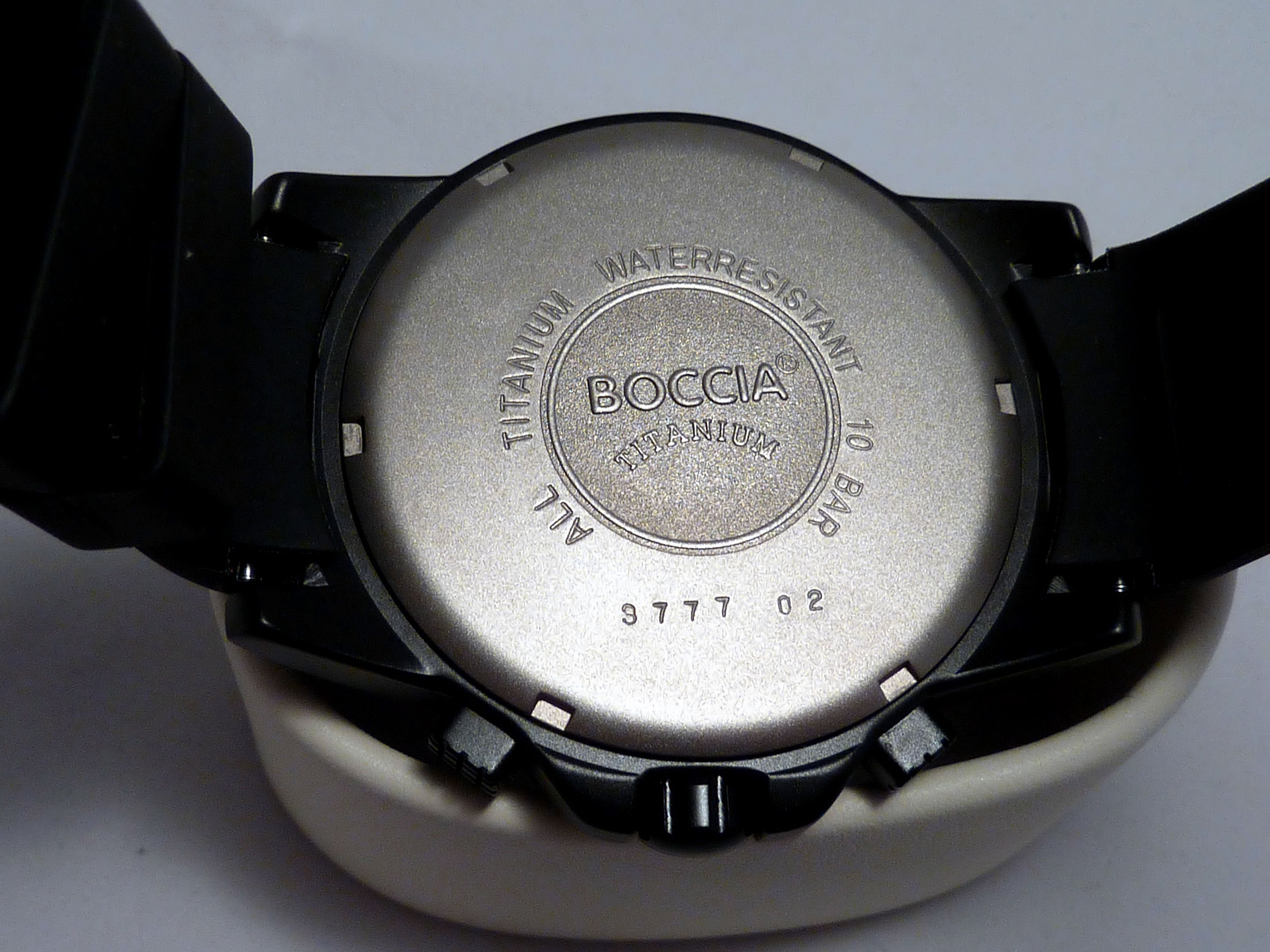
Titanium screw down back with watch data

The movement appears to be a Japanese Citizen Miyota Cal. OS 11 Quartz Chronograph (60 minutes) and it functions well and is accurate to around +/-20secs month so is quite acceptable.   There is also a chronograph reset function used if the 1/1 second hand doesn’t return to the O position after the chronograph has been reset or after a battery change.

The watch power is a Silver Oxide SR9 27W battery or equivalent.
The watch is marked on the screw down Titanium back as 10bar (100ft) water resistance.  I understand all Boccia Chronographs are 10bar.

Build quality appears excellent, the all Titanium case is well finished and the rubber strap is of good quality – Note this watch can also take a standard leather strap as an alternative as the case features standard lugs and pins.  A point I’ve made before and I’m really pleased to see it here.  In fact thinking further on this, a good Nato strap would suit this model very well if rubber is not your thing.  I’ll post an update when I fit one later this month for comparison. (see addendum below)

So what do we know about Boccia watches?

It is marketed from the United States importers Universal Watch Company (NOT to be confused with the UWC of Geneve fame) who have their headquarters in Las Vegas.  Watches are said to have either good quality Japanese or sometimes Swiss movements in their range of products and I’m assuming this one is Japanese with the Cal. OS11 description.  I’ve not unscrewed the back as I’ve no wish to compromise the water resistance – I’ll check it out when it eventually needs a battery.  With no data that I can find as to manufacture location I would surmise the watches are built and produced in the Orient somewhere and nothing wrong with that, though I note that their design team is actually European.

  • Marina Sechi from Italy
  • Minuca Casadavell from Spain
  • Michael Qvortrup from Denmark

I quote the above data from one of their outlets and I can see certainly see the European  influence in the finished designs.

So a marriage of European and Orient – and hopefully taking the best from both.  If this is an example of  East West collaboration then I’ll certainly look out for more of them and especially if this model is a precursor of things to come.  They are also reasonably priced for what appears to me to be a decent mid range quality product.

So overall a nice Chronograph in Titanium for a fair bit under £200 and complete with a 2 year International Guarantee and instruction booklet which includes a list of Wordwide Service Centers.

Not much to complain about though perhaps the luminous quality could be improved if I was being picky.

But nevertheless the Boccia Titanium’s are now on my watch list . . . . .

Addendum – I mentioned that I thought this watch might suit a Nato strap – Well I was wrong – it doesn’t.
The reason is that as this watch is quite large lug to lug the Nato strap quite doesn’t sit the watch snug against my smallish wrist (170mm).  Regarding the supplied strap which for a buckle version is really very good, I confess with rubber straps a preference to a deployment or fold-over clasp to buckle, so as an alternative I’m in the process of buying a third party 22mm silicon rubber strap with a fold-over clasp and I’ll let you know on an update feature once it arrives and I try it out.
Actually as I write I’m wearing it with the supplied buckle strap and whilst ii is comfortable it has a pronounced curve just at the lugs and if being picky it can’t quite sit against my smallish wrist perhaps as I would like, so the alternative one should be an interesting trial.

See Bocca Addendum – post dated 18th February 2011

World Perpetual Citizen

The watch featured today is the Eco-Drive A-T CB0020-09E also known as the World Perpetual A-T – a superbly made 42mm diameter, 11mm depth stainless steel Radio Controlled model from Citizen.

World Calendar Citizen AT – Eco-Drive, perpetual Calendar, Radio Controlled, instant world time analog and only 11mm depth – a masterpiece!

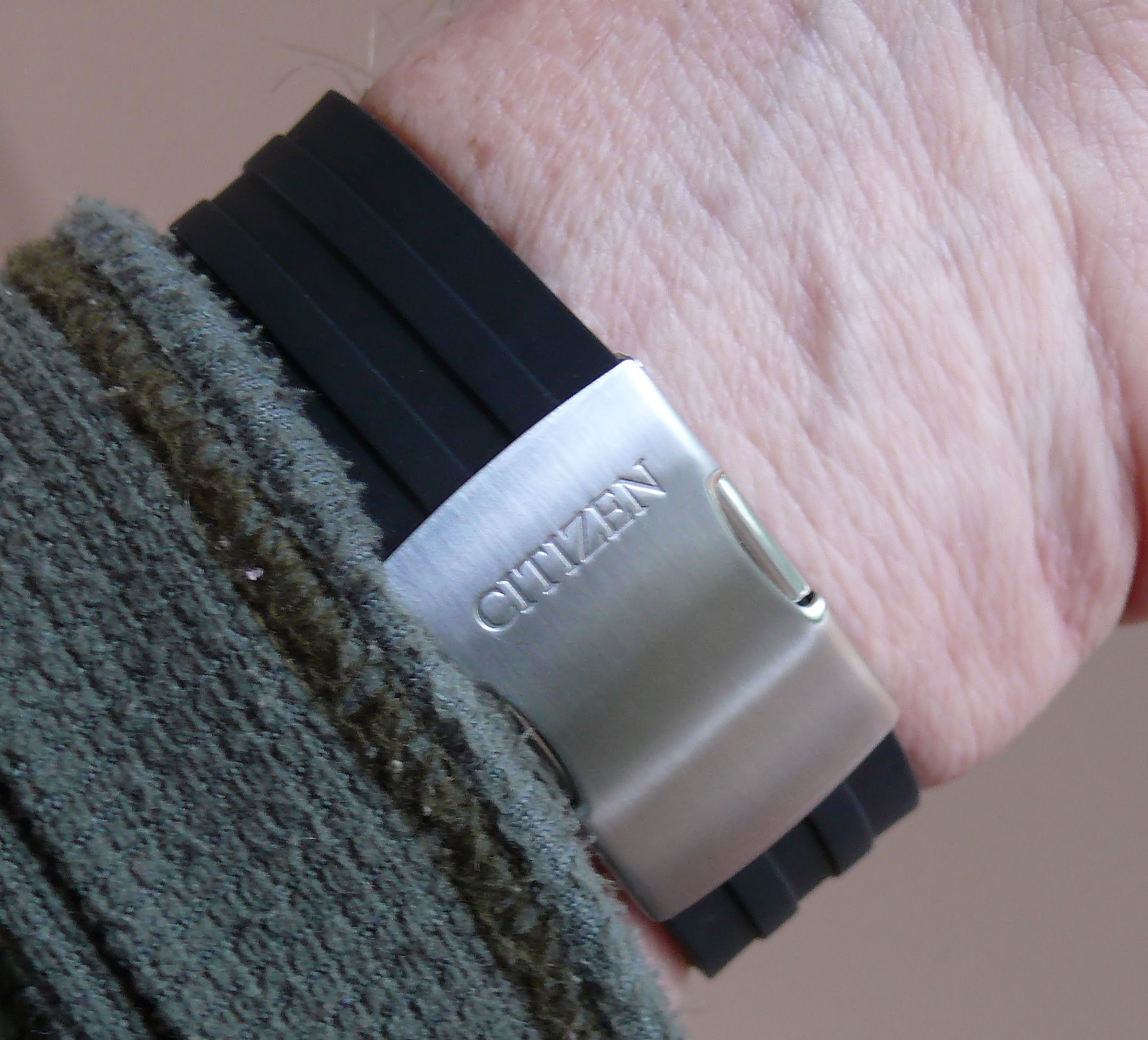
This is the rubber strapped version (a couple come with leather straps and a couple with bracelets are also available).  And an excellent quality of silicon rubber strap it is too, with a nice double push button fold-over clasp.  Like many other rubber straps however whilst it is adjustable it also tends to be a sort of final adjustment if you have small wrists as cutting is the name of the game, which is a pity.  However as alluded to in my previous post, this is not the end of the world as this watch has standard case and lug arrangements, so a replacement alternative rubber or leather strap is easily sourced and fitted.

43mm x 11mm makes for a neat watch on the wrist

As said the other versions come with alternative strap arrangements, but this is not the only difference.

Whilst this model has a button @4 which is used to set the world time for example, the leather strap version has a recessed pusher instead.  I personally prefer the button as it can easily be operated with the finger and not the end of a pen or other pointed object which may not be to hand.
Another difference is the omission of a bezel – where this model is clearly marked with the city positions – the strap versions have no bezel and the city markers are tucked under the sapphire crystal and part of the dial.  Those who are familiar with my blog will know I’m not a great fan of bezels, but  in this case not only does it look well but I find it a little easier to read.  And apart from some other minor variations the watches share the same functionality and internal mechanics.
The flat sapphire crystal is anti-reflection coated and is very effective, especially as the internal dial markers and so on are not over chromed or reflective anyway and as a result the dark dial face has good contrast and is clear and easy to read.

The movement is the H144 caliber and with radio receivers built in and Radio Controlled so assuming you can receive a signal from one of the 5 transmitting stations, then it’s pretty much the perfect time keeper – it’s stand-alone accuracy without RC is pretty much standard fare for this range of Citizens at around +/-15secs per month.
Radio Control wise, the watch automatically scans for a signal at 2am, then 3am and 4am.  If it receives successfully at either of these, then further attempts are deactivated.  You can also initiate demand reception manually rather than wait for the automatic update and this is easily done.  Simply press and hold the button @4 for around 2 seconds then release.  The seconds multi-function hand will move to the “RX” in the little window @9.  Let the watch sit in a position where it can best get the signal and note the receiver on this watch is on the 9 side of the case, so point that side roughly towards where the signal is

Stainless push button fold-over clasp

Here in the northern hemisphere I point it south as the European radio transmitter is located in Germany and it manages fine – here it takes under 5 minutes (the instruction booklet says allow up to 15 minutes as it’s dependent on signal strength).
After the update completes, the second hand returns to normal operation.  The indication of success or otherwise can be checked easily – simply press the button once and the seconds multifunction hand will move to the little window @9 and point to OK or NO.  Can’t be much clearer than that!

Interesting system means this watch is a perpetual calendar until 2100 anyway – set the time and it sets the year, month and day automatically.  But note that only the date is shown in the window@3, it doesn’t display day or month like the ana/digi Citizen Attesa models, such as the ATV53-2833 (click for my review).
Note – in case of problems the day, date, month and year can be set manually.  There is also a quick set date concealed pusher @2 – so pretty much everything is catered for.

Setting the world time in 26 cities and time zones from 0 to 12 with a couple of half zones in there, is a piece of cake – crown to position 1 and turning it moves the seconds hand (which doubles as a control pointer) to each city in turn.  The hands follow automatically to whatever zone is selected.  Daylight Savings time is indicated in the little window between the 4 and 5 o’clock position and will automatically be set when a signal is received.  It too can be set manually if needed.

Being one of Citizen’s Eco-drive models it doesn’t require battery changes.  Managing to power itself from available light, when fully charged it can run for 2 years with the power save function activated or around 6 months if not (Power Save is used if the watch is in the dark for 7 days – it stops the hands and deactivates the Radio Control receive function, but the watch continues to keep quartz time).
Note that the watch will also not try to get a signal if the power is low – indicated by the second hand moving in 2 second intervals – another neat feature of this watch.

Other features include a full reset, hand repositioning etc. and the Time and Calendar can also be set manually to allow the auto calendar function to continue after that.

So all in all a pretty comprehensive unit, beautifully made, an excellent 200m Water Resistance, a very comfortable rubber strap and with sensible operational and safety features seamlessly built in.  It can be found from around £230 in the UK, though fortunately I managed to find this one for less and coupled with the inclusive Citizen 5 year Guarantee I’m pretty pleased with this new and modern watch for my collection.

Update – May 2013

In use this model has proved to be one of the best everyday watches I have and as a World Time model it is perhaps the best I’ve ever owned.  Basically as it’s operation is so simple and fool-proof.  I have found in the past that some World Time models if not used for a while it can be tricky to remember the sequence required to set time zones or change back to local time.  Very embarrassing on the plane when the chap next to you simply moves his 1 jewel Mickey Mouse hands back one hour and you’re still trying to figure out what to do with your all “singing and dancing” World Time watch!  This model though is really, really easy – just pull out the crown, turn one click and an hour change is what you have – exactly.

Latest update – Nov 2022

After 9 years since my last update, I decided to check it out as I am wearing it as my daily wearer for the winter months – and because I am involved in travel again to various parts of the world. So, a World timer such as this is essential. I said back in 2013 that it was perhaps the best I’ve ever owned for that purpose and I can amend that to say it is without doubt, THE best world timer I own.

Basically as it is so easy to change the time to whatever zone you are in. Simply pull out the crown (first unscrew the lock-down) to position 1 and move clockwise or anticlockwise to the city/zone you desire. It will consolidate that zone once it connects to the radio control in that area.

I also have to say that this model is as good as it was the day I bought it, no marks, no scratches, perfectly working and basically indestructible. The only change I made was to replace the Citizen deployment band, not because it was faulty, but having small wrists, I found the mechanism did not sit as flat on my wrist as I liked. I simply changed the deployment to another generic silicon one, which is perfect.

So, very lucky over the years to find two watches that I wear easily and which I love, with no downsides at all.  So, with my 1999 Breitling Aerospace repetition minutes model and this Citizen – it makes me wonder why I collect other watches at all?

Strapped Santos

Recently I acquired via family sources, this nice little Quartz Cartier watch which has been through the wars a bit and I know, I know it should have a bracelet.  However the one fitted had been partly torn off in an accident, badly damaged and beyond repair.  Luckily the lugs of the watch were relatively unscathed with only minor damage and some small marks to the case.

This model is a Santos Steel & Gold W20060D6 quartz version I believe which was re-issued probably as a “homage” to the original 1904 model.  Roman numerals with blue steel sword shaped hands and with a date window @6.  The movement is a Swiss Quartz Calibre 687 and running perfectly once I fitted a new battery.  A nice neat size of watch too with a square face of 29mm x 29mm actually which suits me very well.

So what to do?  Either source a Cartier bracelet which would be very expensive or find an alternative.
The answer was easy for me as I’ve always disliked the Santos bracelet (I actually I don’t like many Cartier bracelets) – and the Santos I’d owned myself some years ago used to hurt my wrist as it was too sharp and after 12 months of  a raw wrist I sold it on.

Now to replace with an alternative bracelet is almost  impossible unless specially made as the bracelet fitting is very tricky.  The fixing pin is hard against the case body, very unusual and fits into a little recess on the very end of the bracelet.

I thought OK – if I’m going to keep the watch it has to have a strap?  Well this initially looked a little difficult owing to the fixing problem – the bracelet securing pin holes in the lugs were far, far too close to the case.  The existing pins were unusable being badly distorted owing to the damage and even if they had been OK they were too thick to use, as even bent it would not have been possible to fit a strap between them and the case body.

I solved the problem quite easily in the end by using a much thinner steel wire (a paper clip actually) than the original pins and cut them at a length to slightly protrude from the lug holes at either side.  I then bent the wire outwards from the case between the lugs enough to allow an open ended strap to slide between the wire and the case.  This bending of the pin effectively shortened the pin by pulling the pin ends inwards slightly, thus making them fit just inside the holes without protruding which was perfect.  My open ended strap then managed to fit with a bit of juggling and this is the result.  The strap is a great high quality camel grain leather one I found at Watchworx.

As said I never like the look of Cartier bracelets generally and personally think the watches look far better with a strap. Which is why I prefer more recent Cartier watches like the Santos 2007 for example as they are proper strap watches, having the strap fixing holes in the correct place.  However I have to admit a sneaking preference for this older model with it’s classic style blued steel sword hands rather than the infill hands of the newer ones.

So all in all I’m pretty pleased and now have a colorful little dress watch, albeit a bit of a “homer” if being critical and one that suits me quite nicely.  A good day all round!

Oh just a point about lugs and bracelets etc.

These days I always check the case construction of any watch I’m interested in to see if it can possibly be fitted with a standard strap.  It is noticeable that many bracelet models have the cases modified in some way and profiled for the particular bracelet or strap and often with oddly shaped lug fixings that make it impossible to change.

Their are literally hundreds of watch styles and models out there that have really quite unique straps or bracelets.  All sorts of strap or bracelet styles, maybe rubber or resin or composites of some kind and whilst they may look great and perhaps compliment the watch – what happens if they wear out or break? (rubber ones used to go brittle and break on me after about a year).  If the model is an older model it can be well nigh impossible to get an original replacement and owing to that odd case/lug arrangement it’s pretty  impossible to get any kind of replacement at all!
Couple this with the fact that many watches in the market place may have little or no after sales support, the watch ends up effectively useless as no OEM bracelet will actually be available anyway.

I don’t have any of the “sport” watches with those sort of  “built-in composite straps” as I find there is simply no way to replace the strap nor get any kind of replacement at all.  To me this is where “fashion” more often than not does away with “function” completely and is a non starter.

So I check the case/lug construction and make sure that the case has what I regard as a standard lug arrangement.  Just sometimes though you do manage to find the odd watch that manages to provide form and function.  There are quite a few around of course which co-incidentally leads me nicely to the fact that my next post  features just such a watch.
This one perhaps unusually has up to 3 different versions and offered with the choice of bracelet, rubber or leather, which seems to me to be the most wonderfully enlightened and sensible idea.

Standard lugs you see – so important.

Accutron – a well tuned watch.

Thought I’d post one of my more unusual watches.  Not that unusual I suppose but different in that it doesn’t have a hairspring or balance wheel – and it doesn’t tick.

It hums………. and this one’s been humming along since 1967.

Accutron 218D - the Tuning Fork watch.

The second sweep hand is a true sweep with no jerks at all as it just smoothly “sweeps” around the dial – other than that on the face of it, it looks a very traditional 60’s 70’s watch.  Good size at 40mm diameter, 18mm strap or bracelet with removable spring pins to fit.

The back however isn’t a “snap” fit as this model 218D is waterproof (according to the stainless steel back) and has a stainless screwed collar that secures a separate inner plate stainless steel back.  Internally there is a rubber sealing ring to ensure a watertight seal.

And here any resemblance to the “normal” watch ends – as inside looks about as different as you can get!

218 Accutron movement

See what I mean?

And no the image is NOT out of focus – you will note that the two little coil assemblies look out of focus, but in fact these are fitted to the ends of the “tuning fork” which are vibrating at 360 cycles every second (360Hertz).  In fact you are looking at the first ever “electronic” watch.

Bulova used to guarantee their Accutrons to about 1 minute per month (or 99.9977% accurate as their sales literature used to say) which was quite astonishing in those days.  So much so that it was installed as the timing device in the Telstar Satellite and used to switched off  it’s beacon transmitter on July 16th 1964.

Becoming more scarce these days and nice to have one that runs.  Could perhaps do with a bit of a clean but is in original condition, not restored at all, so I’m pretty pleased as it was not expensive when I picked it up on the net some time ago.

It plays a decent tune too – hum………….

Vintage Russian Alarm

A Russian watch from my vintage (2) collection (60’s to 90’s)

A gold plated Poljot “Signal” watch which is maybe from the early 1990’s (further inspection of movement could maybe pin it down more exactly).

Poljot "signal" Alarm watch

Manual wind 2812.1 18 jewel movement from the First Moscow Watch Factory (1MChZ, Kirova, Poljot) with alarm complication.

The hour & minute hands and winding is managed by the crown set @4 and the surprisingly loud mechanical alarm is both wound and set anti-clockwise with the upper crown.

Poljot Alarm - 18 jewels with alarm pointer

Gold plated case with stainless steel screw back with alarm off button inset into the base.   The watch is 42mm lug to lug by 37mm width including the crown and 12mm depth.  So quite a nice sized watch.

Overall condition is excellent, dial, crystal and plating are all really good and a few cosmetic scratches to the base near a small inset.  Not shown here but this little stub contacts the end of the small anvil which is struck by the alarm striker.

Alarm sound post

The sound stub (as I call it) just comes through the case-back and assists in amplifying the sound.   The alarm runs for maybe around 10-15 seconds before running down (it may manage longer but I haven’t wound it fully).

And it makes for a pretty loud alarm too  (it also vibrates somewhat) – rather like a high pitched cell phone on silent ring and VERY practical  (When I first got this watch I set it in the kitchen to try it and my wife heard it in the lounge next door!).

To set for a wake-up call – set the alarm the night before by pulling out the top crown – set the hour – wind it up then push in to set and that’s it.

I have to say it’s far better than most of the quartz alarm watches I have – as I frankly rarely hear the darned things with their little electronic beeps (maybe these are just for the young of hearing!)

I simply have to make a point about many of these older Russian watches in that they really are excellent quality movements and invariably keep very good time – as this one does and they are really not expensive.

Let’s face it – try finding a true mechanical alarm watch today at reasonable cost . . . . . . it is not easy!

The first image by the way shows it sporting a new Birkenstock leather strap which compliments it well and I think it looks pretty good.

There’s no doubt that I’ll be collecting a few more of these  Soviet made timepieces – they are classics after all and you don’t see these designs too often.  The “before the wall came down” ones are probably more collectable but all of them are certainly different.

Dugena gold

New but old Dugena

A gold plated Dugena hand wound Swiss Made model with an unusual “sunburst” heavily textured dial with Louis XV hour and minute hands.
Shown here with a Hadley USA 12K Gold Filled expanding bracelet with an alternative (last image) open ended calf leather strap..

Dugena vintage gold

Very unusual too are the numeral markings with black infills and signed Swiss Made.  All contained in a 20 micron (Geneva) stamped two tone textured gold case, which is a better gold thickness than many watches today.
The bezel holding the glass is satin finished and the rest high polished giving a different tone effect.  The back is stainless steel and also marked Swiss Made.
The case also has very small sculpted lugs which has and requires curved spring pins.

Sunburst dial & "grandfather" hands

Unable to get an image of the movement at the moment as the case back is very well fitted and my old Bergeon won’t shift it (I assume it screws there being no slots or apertures visible to suggest press back).

Above shows the Hadley bracelet which I fitted to see how it looked ( and it looks pretty awesome to me!) and the last image shows it with a classic Condor calf leather strap (open ended this one as it had to be very thin at the end to fit the tiny space left around the curved spring bar).
Virtually NOS condition and I have to say it is really perfect.  It is also a very neat watch to wear at 34mm dia and 7.5mm depth.
Timekeeping is really good at just seconds per day which is a nice surprise – so I’ll really have to see that movement sometime

I seem to be building a collection of Dugena watches and this is my oldest one to date.

This 1950/60’s model is signed as Swiss Made which is interesting to me as  in 1927 (founded 1917) they relocated their manufacturing facilities from Switzerland to Germany.  The name is in fact an acronym of (Deutsche Uhrenmacher-Genossenschaft Alpina) or German Watchmaker Association Alpina.  Also the Dugena brand when it started life was a actually branch of the Swiss Alpina Watch company, though it became a separate brand later.
In 1948 they relocated again because they were in the east side of the Berlin wall and set up in west Germany at Darmstadt.

So confusing to say the least – but one thing is not confusing or even uncertain – they are fine watches.

LATEST NEWS –
Check out  “Watch of the Week” above – you’ll be in a whirl!

Familiar name – Russian watch

A bit of an oldie here this time – another “vintage” watch for my collection and a first for me.  A USSR made watch, rebadged in the 1960’s and sold as “Sekonda” – this was a company set up in 1966 by “Chasprom” the USSR watch industry central agency who’s remit was to sell their Russian made watches to a wider audience.  And very successfully too…

USSR Sekonda

I bought this as I loved the simple elegance of the dial and the fact that it is a proper USSR marked vintage watch – ie. one that was manufactured before the “wall” came down and the old Soviet regime disappeared.

Now the first thing I should say is that I am no expert on USSR watches, but managed a little research – as one does when just having bought a new “old” watch.

This watch was advertised as 1950’s I seem to recall which maybe wasn’t quite right, as if I’m not mistaken the name “Sekonda” didn’t actually appear until much later when Sekonda was established as I said previously – in 1966 in the United Kingdom and supplied USSR made watches such as the Poljot, Raketa and others – but re-badged them as “Sekonda” to a wider world market.

Classic Sekonda (Raketa) movement

So I have to assume this watch is maybe 1966 or later ( mind you pre-1966 watch movements can be found in Sekonda named watches ).  Possibly dependent on available movement stock at the time I suppose.


However after digging around I think this is a type 2609 or a 2609.1 – 17 jewel movement and most likely produced in the Petrodworzowy Factory in Russia.  This movement and versions of it were used in Raketa, Sim, maybe Poljot and perhaps other Russian models of the period.

It is in very good almost perfect condition and numbered 70708 but no factory stamp that I can spot without dismantling it anyway.  Maybe even assembled in the Masleunikower Watch Factory where often Petro’ factory marks were omitted and sent out as “clean” models.

So far I’m unable to confirm a date.  The 2609 movement series seems to have had a long usage from the late ’50’s into the ’80’s.  But as said USSR watches have never been my forte and no doubt someone with far greater knowledge than I will kindly let me know.


What is certain however is the quality – which is not an issue here!  In the  ’50’s to late 70’s period the USSR produced watches of real high quality.  In fact there are excellent Russian watches around today that are amazing value for money.

As said I particularly like this model as it has nice thin black coloured high contrast hour & minute hands, plus a centre seconds and the dial is populated with numerals with a slight italic font, thus giving the watch a very simple and clean look.  It also has to my mind that English “Smiths” look – simple,  understated and elegant that I have to confess I particularly like in a vintage dress watch.


The case is gold plated (marked au 20 for 20 micron I assume) and is a classic and elegant style which eminently suits the period.

Neat crown/back recess

There are nice touches too that you notice after handling it for a bit – like where the round case is flattened on the edge between the lugs so that the strap fits easier to the watch and the fact that the case has a neatly sculpted projection under the crown giving both support and protection – but subtly – a neat touch.

I haven’t bought any Russian watches before though am well aware that there are very keen collectors out there and with very good reason – so maybe this is a start of something new for me   …..   We’ll see…!

Note – 1992 – End of Soviet Union, Chasprom disperses, privatisation of the Russian Watch Industry and Sekonda (UK) in 1993 abandoned Russian manufacturers and started to market all-Asian watch suppliers.

England’s finest

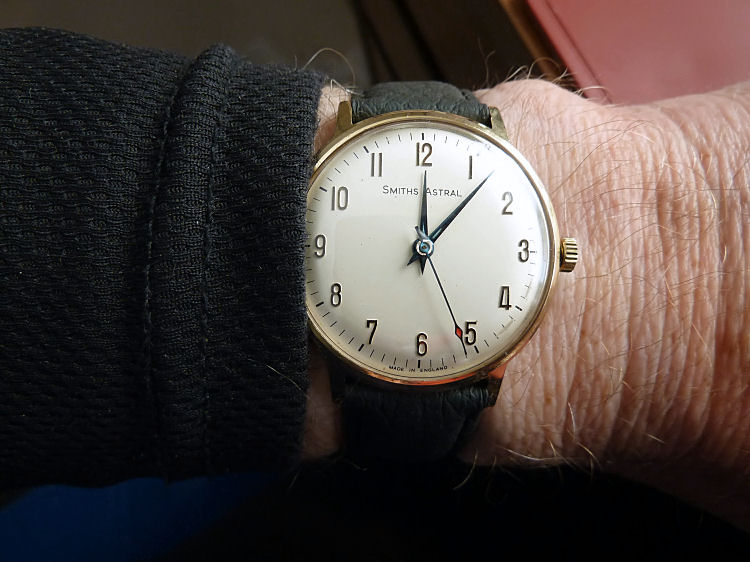
A simple and stylish English under-statement of timekeeping – a Smiths Astral gold plate Gents watch from the 1950’s.

Smiths Astral 17j

An elegant watch indeed and with “Made in England” below the 6 makes it a rarity these days.  Produced by the Smiths Watch Company in the 1950’s it shows all the best attributes of English watchmaking.
Lovely blued steel hands on a virtually unmarked clear dial plus a red filled tip centre seconds hand and with neat raised numerals – it is quite simply – a classic.

Smiths 17 jewel lever movement with centre seconds

A neat Smiths 17 jewel hack shockproof lever movement is fitted underneath an unmarked well fitting press stainless steel back keeps this watch ticking along nicely.

Sometimes mistaken for a Jaeger LeCoultre movement, whilst it has some technical similarities it has nothing to do with that Company at all.  This is a common misconception as the only link with that company was because Robert Lenoir, Smith’s Technical Director was an ex LeCoultre employee.

High quality models were manufactured at Cheltenham mostly whilst the lower market models were produced at Ystradgynlais in Wales in a joint venture with Ingersol.   Usually noted by the dial inscription “Gt Britain” or “Made in Britain” – which is quite a useful way of identifying the origins of particular watch models.

Classic dial Smiths.

So it would appear that this particular model is not a product of the Anglo-Celtic Watch Co of Wales, but from the Smiths factory at Cheltenham.
The Astral model is perhaps not top of the range or as popular as the “everest” models, but I think does represent the classic elegance of a “Made in England” watch to perfection.

This particular movement is going as strong now as when it was new.  This one is a manual wound version which feels nice and strong when wound and set.  Perhaps a little wear in the hand setting I admit but easily sorted should this be necessary.

The watch is also a good size at 34mm diameter without crown and 39mm top to bottom with a strap size of 18mm and in consequence wears very well –

At 34mm diameter – a nice size for the wrist.

So another nice purchase for my “UK” – “Made in England” vintage collectors cabinet and this one will hold quite a decent position in that box.
Not a UK built or assembled watch with a Swiss movement, but an English watch built with an English movement too – and in reality a darned good one at that – so a bit unique in my opinion.  AND as it happens this one is pretty much original and in superb condition – another plus.

I’m sure this one will receive quite a bit of wrist time which is always a good sign as my philosophy on watch collecting is simple – if I get it I must wear it – these watches are for wearing and every watch I own MUST work – that’s what they do best.

My next purchase though may be a little bit different.  A choice of two really.  One an early “electric” watch (around 1962) and the other a “direct read” watch from about the same era  – a mechanical “digital” if you will and somewhat different from their more commonly seen “mystery dial” style.

I’m I’m looking forward to posting both here – so watch this space.