They are a relatively recent company, a French manufacturer, based in Paris, with their manufacturing facility in Switzerland. They came into being in 1992, when they used the German manufacturer, Sinn (I liked their U1 1010 Diver (though big) and more recently the Sinn 105 St Sa UTC) for initial production, but in 2002 became their own man so to speak, when Bell & Ross really came into their own.
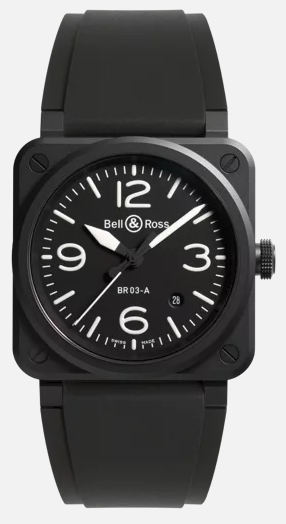
The BR 03 – not as big as it looks at just 42mm across.
Their philosophy was and is simple and according to their own literature, their watches meet four basic principles: legibility, functionality, reliability and precision. They are also known for the BR series of models which were square cased. Mostly based on aircraft instrumentation for style and legibility, they soon became favourites with pilots, divers and other action occupations and of course extreme sports lovers.
But for me I like them for one main reason (amongst others) – because they manage to make what appears to be a large watch, with great clarity and readability – appear small.
And that’s no easy feat, especially with a square case format, but for myself with an average wrist size, it means a great deal. And most of their conventional round cased watches are a sensible size too.
They also use their own excellent Swiss automatic movements, such as the latest Br323 with an astonishing 70 hours power reserve and they use ground breaking luminous features, which have to be seen (in any light).
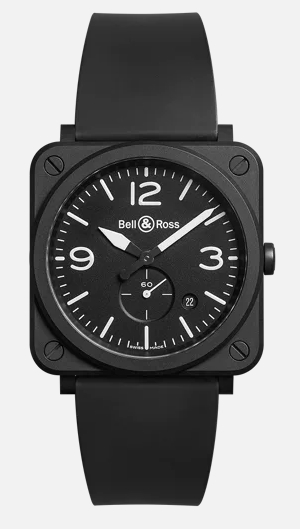
The BR S Quartz powered matte ceramic at just 39mm across.
The what I personally call their basic signature model the BR 03 (in matte black) for example is just 41mm across, though at first glance may appear larger, due in some part to the wide rubber (part synthetic fabric) strap. However, although this model ‘just’ manages to wears on a medium wrist, if you have a small wrist (mine is 165mm) I recommend the their very much neater Velcro wrap-strap which is available. It holds the watch in a much neater fashion than the standard band, so much so that I can wear my BR under a dress shirt easily.
This is a Date watch (though perhaps a little small) @between 4 & 5, great clear reading dial with excellent contrast and it’s powered by the BR-CAL.302. Automatic mechanical movement with an excellent 54-hour power reserve.
It’s also just 10.6 mm thick and made from micro-blasted ceramic and the sapphire crystal is anti-reflective. This model is rated as 100m Water Resistant.
And there are more –
In the same range they also have a Quartz version, the BR S which is only 39mm across with the BR-CAL.102 Quartz movement with an almost identical dial, but with a small seconds @6, rather than the sweep centre one. More suitable for the smaller wrist, if you don’t mind Quartz.
Perhaps for some folks, Bell & Ross may be a little expensive, but they are a high end Brand with much innovation. So what you get for your money in relative terms is certainly quality and of value. Couple that with such compact functionality and that large can be small concept, certainly a Brand to consider.
Part of the fun is to actually try one on the wrist – and once you do . . . . I warn you – you’ll probably get it.
Note – Obviously the Quartz BR S Quartz model is the most affordable compared to Automatics at around £2,200 in the UK. But I have seen the odd pre-owned model at a decent price – but do be mindful of the size.
One of the nicest watches to wear is this 1948 9ct gold TREBEX, with it’s superb overhung centre sweep second hand and one of the most unique pointer styles I can remember seeing on a watch. I have heard this particular model was referred to as an excellent “Doctor’s” watch In Japan, no less! Perhaps not officially, but as the seconds index is fully blocked in, coupled with the wonderful seconds hand made pulse timing very, very easy. It IS however VERY rare indeed to find it.
There is some confusion about the origins of this brand, though the horological trade mark index (the Mikrolisk data web site) does have it listed as a sub brand of the Milex Watch Company. They were registered in Switzerland in 1938 along with Elem under their trade mark appropriation data.
Swiss Trebex 9ct Gold Gents watch 1948 vintage.
The watch case is 34.5mm diameter which is quite large for the period and had what was termed as “fluted” or “fancy lugs”.
The hand wound mechanical movement is an A S Schild 17 jewel calibre 1351 and runs perfectly and in fact a very good time keeper.
I fitted it to a green lizard strap which seemed to suit it complete with a rounded vintage gold buckle and it is a delight to wear and often to be seen on my wrist of an evening.
No idea of the value of this watch at all, but it is what it is and so far I’ve not come across another with this particular dial. I have found only one with what appears to be a very similar case including the “fluted” lugs, but not with the same seconds/minute closed index OR that amazing seconds pointer hand.
So, to me it’s worth having basically for it’s apparent rarity and the fact, I like it very much and often wear it. And that surely is what it’s all about.
February 2025 –
On reflection I wonder if the dial has been redone at some time. And the hands maybe retro-fitted and not for this dial size. I suppose when you look closer, the minute and seconds hand overhang the printed dial index considerably.
Just a thought – but whatever – I just love watching the seconds hand move smoothly round the dial – quite fascinating.
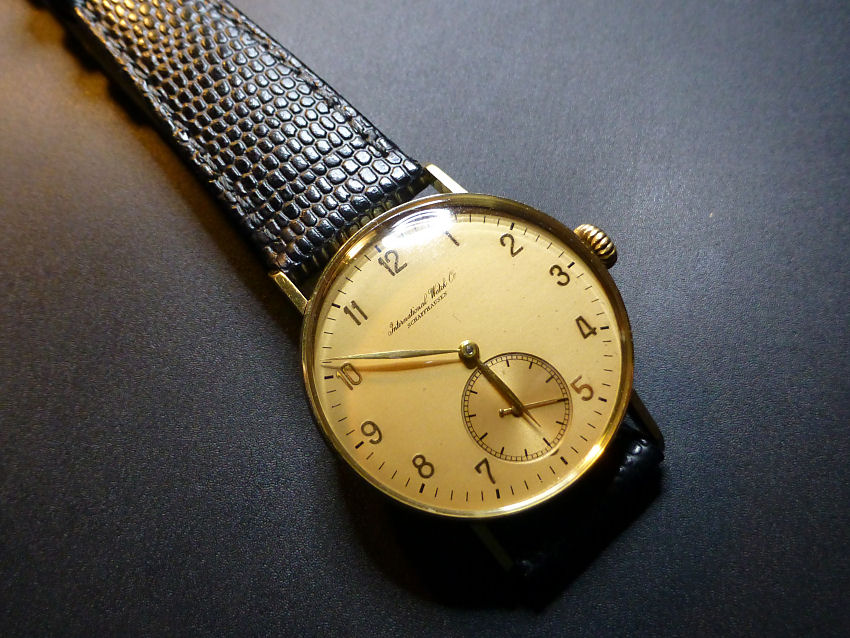
This is my interesting 1941 IWC with it’s elegant Calibre 83, 6 bridge-design movement, in a gold case. After some investigation this is in a 14kt Gold case, may have been supplied to or produced in Hungary during the war.
The watch is in excellent condition both due to it’s age and considering the time it may have been produced as WW11 raged across Europe. Still unable to confirm the Case Maker/Sponsor mark even after some years of trying.
The wonderfully elegant IWC Cal 83 was introduced/produced between 1935? and the mid 1940’s and regarded as a transitional movement between the pocket watch and the wrist watch. In fact it reflects the very best of pocket watch movements at the time and this one is in very good condition. Factually this movement is 15 jewel with wonderful Geneva stripes with angled edges, with Brequet hair spring and a wonderful symmetry. It also has a power reserve of 47hrs. It is in essence beautifully made.
I have heard it said by a few watch commentators that this movement (and I quote) “is as well executed as Patek Phillipe”, which is praise indeed.
The case is a little more unusual having straight sides and thin lugs, though it has a precedent as it’s very reminiscent of No 58 and some others in
IWC Cal 83 1941 hand wound movement
IWC’s 1941/2 Blue Catalogue.
Within this catalogue it is quite obvious, comparing the available models, that there were quite a few “mix & match” combinations of dial layouts and case designs over this period. This particular watch case could also be an IWC design imported into Hungary for separate metal assessment and subsequent matching to the movement.
as it shows the Hungarian Assay mark for 14kt Gold (580/1000) – this is a stamped left facing Wolf’s head + the number 4. This stamp is repeated on the right hand top lug exterior.
However this is still conjecture and probably will never be known.
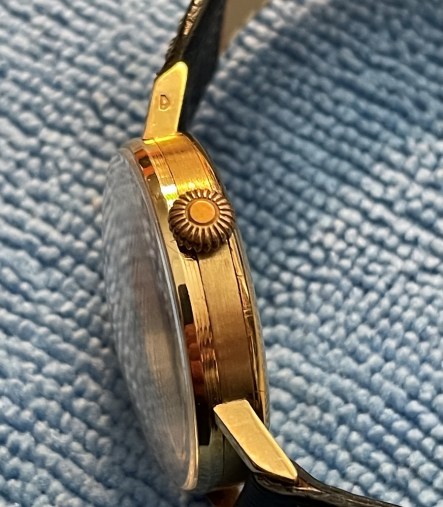
Note the Hallmarked 14k gold symbol on the top lug and the large “onion” crown. Gold hands and seconds sub-dial on what appears to be a well preserved original dial – I note there are a few small spots on the dial background but only noticeable under magnification. The case diameter is almost 33 mm without the onion Crown, so larger than many at the time and I’m very pleased that it wears “larger” and looks good on my average wrist.
The strap is a high quality water resistant Hirsch leather 18mm to fixed wire fittings between lugs which were common at the time. No spring bars here and replacements straps must be open ended types to fit.
Note the nicely decorated case back interior which has case number, case makers mark, service marks and the 14k gold mark of Hungary.
As said the movement is in very good condition and shows no signs of wear at all, which is always a bonus.
Regarding the strap I personally feel the colour doesn’t show the watch to best advantage and I changed it for a black lizard leather one.
However, the case is still a bit of a mystery and even the dial has questions about it, though the movement is as perfect as you’ll get. Perhaps a product of interrupted manufacture during wartime when parts were scarce, though is saying that – IWC produced around 6000 of this movement which saw service in the Mk10 Military watch probably around the same period.
But whatever, a great and I have to say very pleasing result and a movement that is a classic in it’s own right – and good to have. AND it is working perfectly and is very accurate indeed.
Note– I noted there are marks on the inside of the case which indicate it was serviced in December 1962 and again in November 1976. (there may be an earlier one but it’s too indistinct to read). Considering manufacturers of mechanical watches tend to recommend servicing every 3 years I suppose it’s not too bad!
1941 International Watch Company Cal.83 in 14kt Case and lizard strap.
I remember I bought this back in 2012 or 13. Because it was the best condition Kingmatic Subsea I’d ever come across. For a watch produced around 1962 to 66/7 I was pleased to get it for a reasonable price. Checking the web today, it seems to suggest that models from around this age have easily trebled its value since (condition dependent).
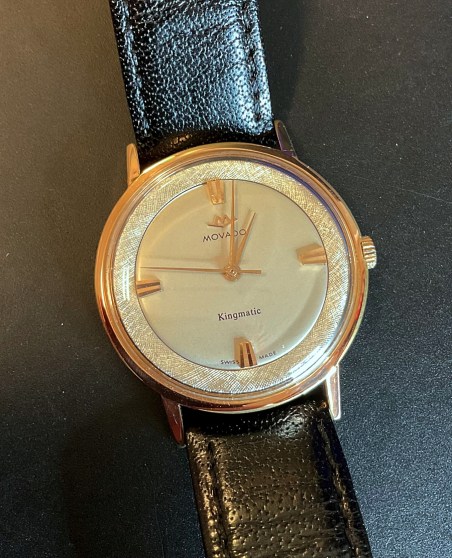
Anyway, as most of my collection, I wear it for two to three weeks every year and perhaps just on a whim at any given time. I attach an image taken today at the end of this Post – and it’s as good now as then.
This is basically an update on the original Post I did and at long last have replaced the image of the movement (took the photo just minutes ago)
An interesting watch Manufacturer Movado and with some styles from the past that have always interested me, this one is such a model – that I couldn’t resist.
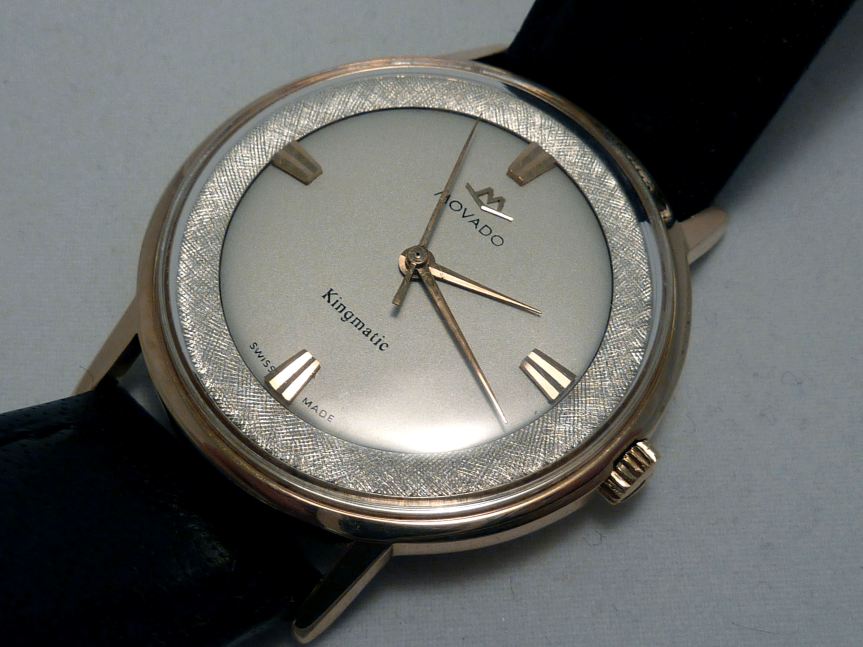
1960’s Movado S Kingmatic Auto Sub Sea model – (image 2013)
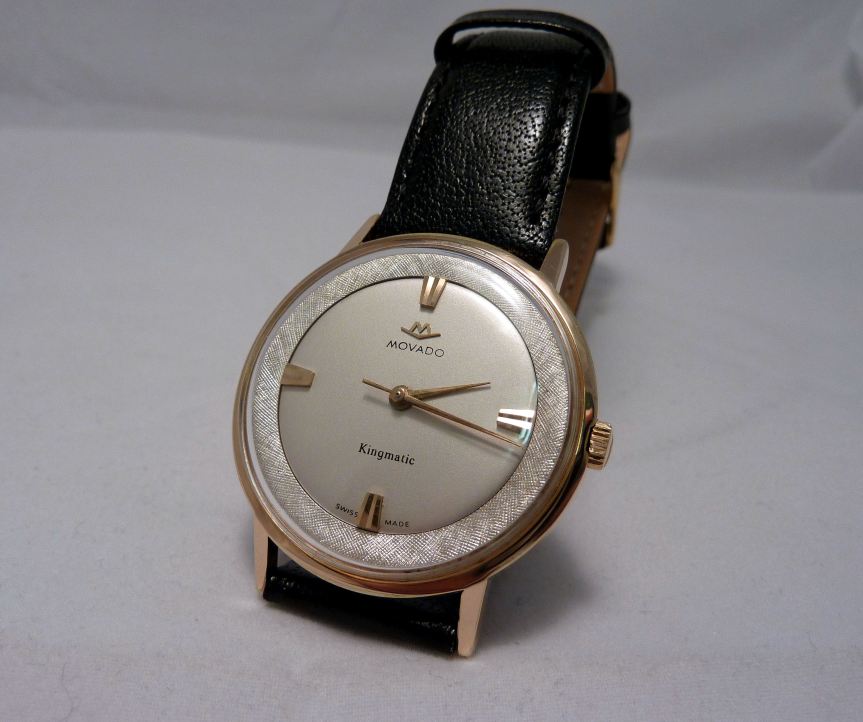
Without doubt one of the nicest dial gents Movado I’ve yet seen, this was a must purchase. 1960’s vintage with a Movado Cal 395 – C, Automatic movement. This is their famous Kingmatic Sub Sea model with 28 jewels and running as sweet as it did when new (as of today 17/03/24) this sort of mechanical marvel never fails to impress me. Over 50 years (60 now) and still perfect it has a neat 34mm diameter gold micron plated case, centre sweep seconds and applied gold markers on 3, 6, 9 and 12.
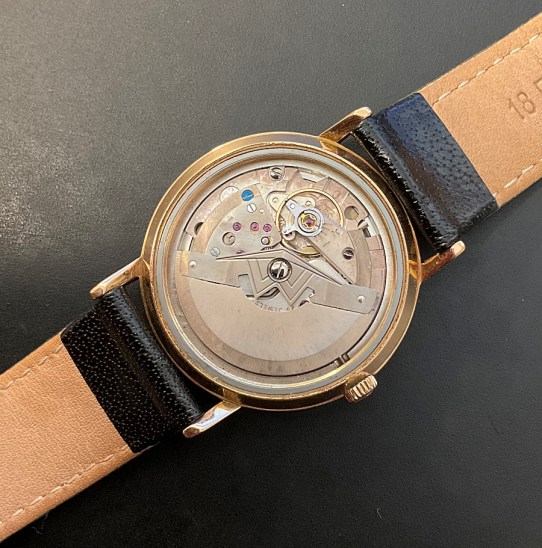
Movado Cal. 395-C 28 jewel movement (image 17/04/24)
As you see (today’s) image shows an immaculate Cal 39 – C, movement with the classic Movado rotor assembly, incabloc shock protection in a neat layout. The Calibre number can be seen under the wheel. Obscured by the rotor it also states Movado Factories, Swiss and 28 jewels. Lovely action too this rotor and for a ‘bumper” quite silent in operation – this is a class item indeed.
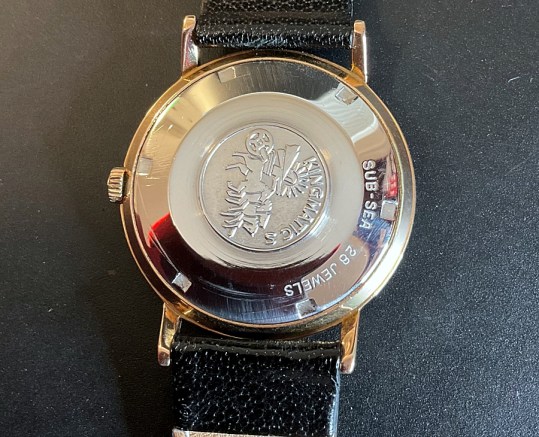
The stainless steel screw back has a full Movado medallion logo set with Kingmatic S and the horses & chariot design in the centre. Sub Sea and 28 jewels are the other markings on the back. The crown is the original Movado logo and the lugs are set to fit an 18mm strap, which in this case is a nice quality though non-original Condor stitched leather variety with gold coloured buckle which sits it very well.
Classic dress Movado Kingmatic – (image 2013)
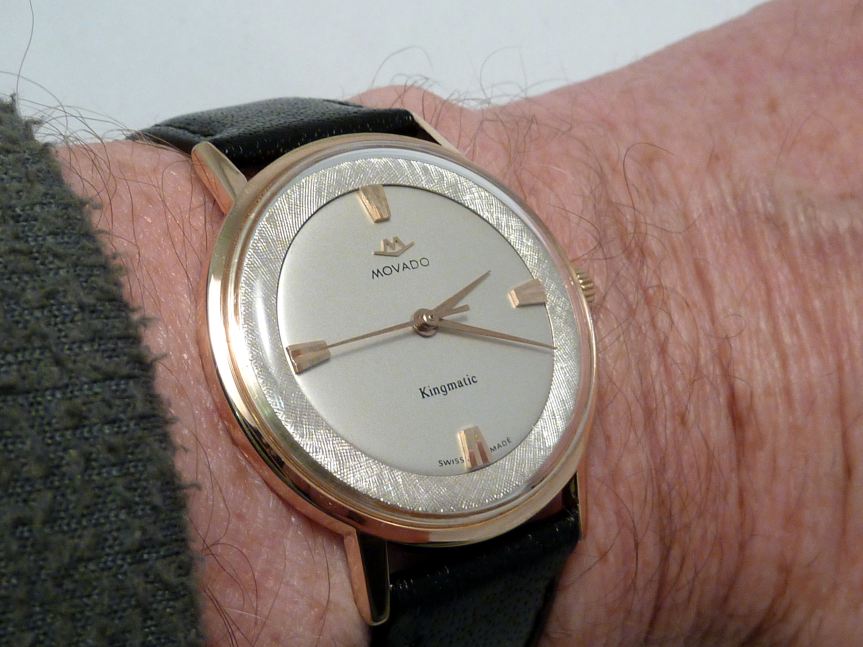
This model like so many of that time is that nice size so favored by many of the classic watch makers @ 34mm which allows it to fit most wrists easily and neatly. For me every thing about this watch is just right – beautiful face, great look, slim, elegant, perfect size, lovely automatic action and a joy to wear.
Looking good at any age – (image 2013)
The Kingmatic automatic model (and the Tempomatic before it) took the watch world by storm when it first came out in around 1962 and the Kingmatic was made probably till around 1967. The Company started off life way back in 1881, the name “Movado” meaning “always in motion” in Esperanto the Company has over 100 patents and over 200 awards and still operating today.
This is now my fourth Movado now and my third mechanical model – I have also a Quartz and all have impressed. The quartz one also has a highly individual dial face and a certain neat quality – and I can now see where the heritage comes from.
This Sub Sea model especially with it’s rather unique face, it’s sleek movement and beautiful condition will certainly be on my wrist on many occasions I’m sure – and that surely is as good a testament you can have for any watch.
Update promise – 11 years after the last photo, this image taken today 17th March 2024 – though with different lighting I hasten to add.
Back then I had a fancy white fabric light box with 3 x spot lights which gave equal light from all angles and took my photos with a big Canon digital camera and with tripod and so on. Today, I simply use an iPad, hand held, then instant wireless link the image to the PC and then to the web site – easy!
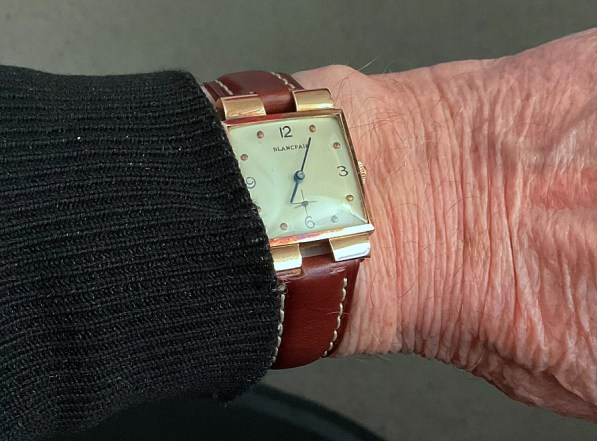
An upmarket vintage model from possibly the oldest watch company in the world, is my nice 1940’s Blancpain, 14k gold gents watch, which is quite a rare thing. It has a signed 17 jewel manual wound movement, circa 1945. The 14k Gold case is by Katz & Ogush of New York and features “fancy hooded lugs” and a nicely sculpted crown which is also quite rare. When I got it some years ago I had to replace the strap and fitted a high quality Rosario stitched leather strap which suits it well.
Gold Blancpain – circa 1945
Overall the watch is in great condition and works perfectly and I have not seen another, though there is an almost identical model referenced in my 2018 edition of Gilbert, Engle & Schugart Guide to Watches (page 679).
The referenced model has full width hooded lugs, whereas this one has split ones, which again is rare.
Note the solid hour markers on the dial are not printed or applied, but are riveted through the dial.
Sculpted crown
Case width 25mm, lug to lug 35mm and the case thickness including the slightly domed crystal (also perfect) is approximately 7mm.
Once again, this shows that many of these vintage models, though dimensionally small by today’s offerings, more often than not, look perfect on an average wrist and are exceptionally comfortable to wear.
It’s nice to have a vintage model from this Company as I also have a more modern model from them too, another one of my favourites – a Blancpain Villeret which I bought around 1990.
With my more upmarket watches I like to have an old and a new (well newer) just as a comparison. Blancpain quality still shines through.
The main reason I collect vintage watches is simply because of their look. And yes, generally they are smaller than today, but not to be confused with ladies models, which when these were produced were very much smaller. But that doesn’t mean they look feminine on a gent’s wrist, not at all, but it does mean that they are amazingly comfortable and to my mind, look great.
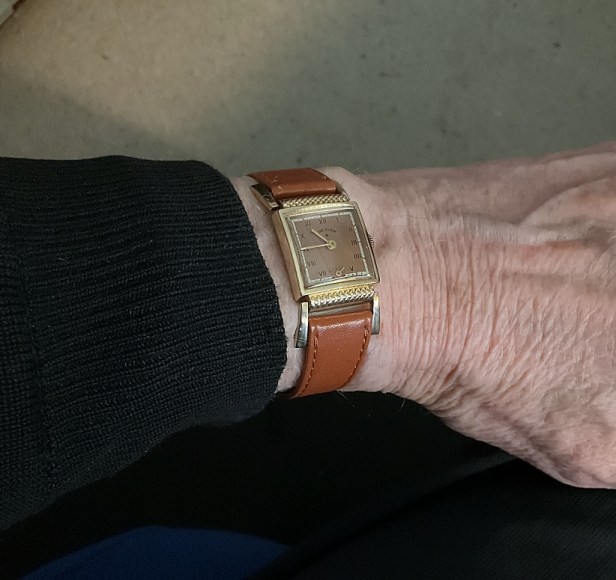
Take this 1947 Lord Elgin, which is not quite as old as I am, but at 76 years old it is still working perfectly, keeps reasonable time and has a power reserve that lasts easily from day to day.
Lord Elgin vintage model from 1947.
This model has the 21 jewel Cal. 670 manual wind movement, adjusted to 3 positions.
It has a lovely copper dial with gold hour and minute hands, plus a sub-seconds dial @6 also with a gold seconds pointer. A minute index is nicely configured around the dial and the detail is really very good indeed.
This model also has wonderful fully articulated “fancy” lugs (a cute and correct quaint term of the day) with nice engraved work at the case ends. The watch is in a Wandsworth Gold Filled case and the entire look is excellent, as is the condition.
Note the “adjusted in 3 positions” – this means that when produced, it actually had an accuracy goal right from the start.
Many watches are not adjusted at all for accuracy, but for these vintage watches it was a good thing. Different levels of accuracies could be graded, such as 2 positions or 5 positions and this means simply that the watch was tested (duh!) in different positions, such as crown down, crown up and so on. Because wearing on a wrist, the watch ends up in many different positions, so it shows an attempt has been made right from the start, to minimise inaccuracy from a positional point of view at least.
There are actually two other main factors affecting accuracy, such as temperature and then the mainspring effect, or “isochronism”, which is caused by the spring unwinding as it runs. For example it might be 2 or 3 seconds fast in the morning, but later in the day maybe 3 or 4 times that. So to try and regulate that “rate” is another way of improving accuracy.
But this watch at least has had some positional adjustments carried out, which is a good indicator of decent quality movement wise.
However, the main point of this Post is much more basic.
I simply wanted to show how good a true vintage sized watch can look on a gents wrist (the gent being me!) 😉 and I think it looks great and it wears great, which was and is still the main reason for my vintage watch collecting.
Note – The dimensions of the watch are 21mm across (add 1mm for the crown) x 45mm total lug to lug including articulation (the case is actually 27mm lug to lug) and the curved case is approximately 7mm thickness including the high domed crystal, which is a feature on many vintage watches of this period.
I’m going to do a few more of the vintage watch Posts, since I re-organised my watch storage ideas recently. I have a pile of leather strapped models waiting to be re-located in new cabinets and I’m cataloguing them too, so they are to hand.
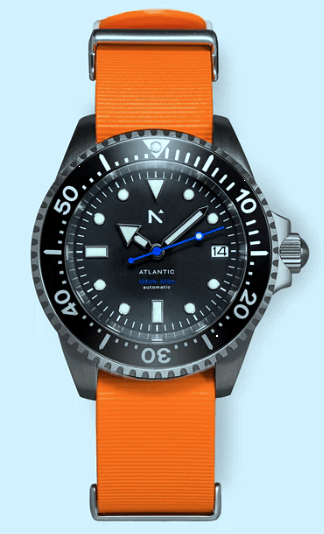
I feature another cost effective Diver’s watch, this time from Rotate North. A relatively new Brand based in Belfast, who offer cost effective dive capable models for tough duty, coupled with general day wear.
Rotate North “Atlantic” diver watch
My preferred model is the Atlantic model which has a 300m Water Resistance rating, so more than enough for the casual scuba diver. The watch also isn’t too large in diameter or thickness which is always a consideration for me. It then doesn’t look out of place if used for every day use.
I like that the dial is relatively uncluttered, uses Super-lumiNova on hands and markers, a date window @3, sapphire crystal and a well formed protected screw down crown. It also features a unidirectional bezel with luminous datum and a solid stainless steel case. It has been knurled sufficiently so turning it is relatively easy, which is quite important and often overlooked by folks looking at watches for diving.
In standard form it appears to comes with an unusual rubber 20mm wide NATO style watch strap. The watch is produced in Germany.
The movement is the well respected Seiko NH35A, 24 jewel Automatic movement with 41hr power reserve and has a centre sweep seconds hand with luminous dot.
The choice of this movement is a good one, as it’s a typical Seiko work horse movement, very popular in the range, with good accuracy and reliability and it can also be hand wound.
Watch dimensions are around 41mm width (46mm incl. crown), which is a sensible and manageable size and the case is 15mm thickness, so a strong solid watch.
Rotate North have two other dive style models –
The Arctic – with a 500m rating, slightly larger at 43mm diameter (48mm incl. crown) and thicker case at 16mm, and an unshrouded crown is @4. My preference is a protected or ‘shrouded’ crown. The case is also thicker so could be a bit chunky for everyday wear.
The Tempest – similar size to the Atlantic but with unshrouded crown @3 and it has an additional 24hr index on the dial . My preference iswithout 24hr index, as it adds dial clutter and again I prefer a shrouded crown.
A note on Bezel knurling –
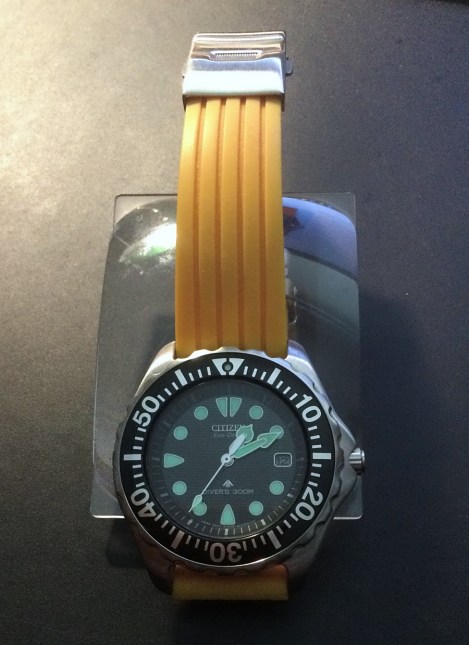
Citizen BN0000.04 Eco-Drive 300m Diver. Compact and does what it says! With great bezel numerals makes for absolute clarity.
Take my Seiko 5 Sports Edition model – looks great in most aspects and yes, can certainly be used for diving, but if for scuba-diving, then knowing how much air time you have left is fairly important. And the bezel knurling on the Sports 5 is not well defined enough to make it easy to set, it’s just too smooth. Maybe a bit picky, but I’m just saying . . . . . Great watch for a bit of snorkelling and general swimming if you don’t really need the bezel feature.
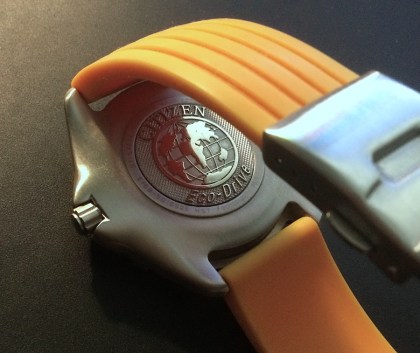
An oldie but goodie is the Citizen BN0000.04 Diver’s model is a classic I’ve had for a few years now. An Eco-Drive movement with Date @3 and with an after market silicon deployment strap.
I love this model as it’s the most compact Diver model I’ve ever seen. It is rated at 300m Water Resistance and features a unique shaped mould like satin finished steel case and well shrouded crown. On top a great contrasting large numeral unidirectional bezel with good knurling so is easy to turn.
Citizen solid sealed body Diver. Note shrouded crown.
Needless to say as it’s Eco-Drive, it’s fully automatic and powered by Solar, so pretty much goes on forever. The dial is very clear to read, with large and very luminous hour and minute hand plus a sweep seconds with luminous dot. The hour markers are also large, well defined and very luminous. In fact the luminous quality of this model is exceptional which is perfect for this relatively small dial.
This is what I call a no nonsense watch. Very well constructed, smooth and sleek on the wrist and very tough indeed. Case dimensions are around 40mm width (43mm incl. crown) and only around 11mm thick at most – as I say, a very neat watch – and the reason I got it in the first place. In fact, it is a brilliant compact Diver and again and this time from Citizen, a model that is just right.
So if small and perfectly formed is your thing – then this is your watch.
Is it still made currently? – I have no idea, but it should be, because it’s very, very good.
I’ve entitled this Post “Basic time” as this is what these quartz watches show off rather well – AND in the case of a couple of them – basic money as well! And I mean cheap!
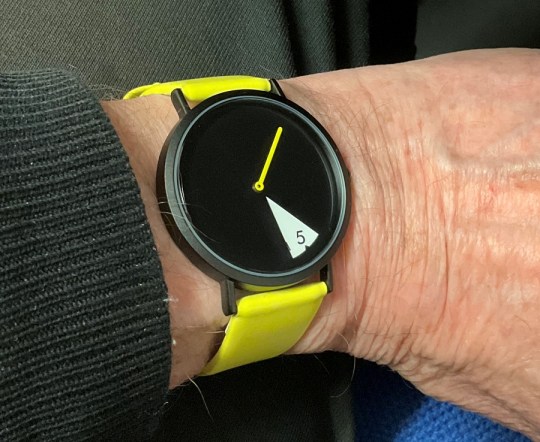
The first and one of the cheapest is the Shengke Creative watch – at under £5.00! Bright and cheerful and very minimalist, bright yellow plastic flexible strap with pin buckle.
Shengke Creative on the wrist – for under a £5.00 note
The dial is a matt black disk with a contrasting white window showing the hours. Minutes are indicated with a hand or pointer and that’s it. No second hand, so you won’t be timing anything with this, but that’s not the point – it simply shows you the rough time, at a glance, which is about as simple as it gets.
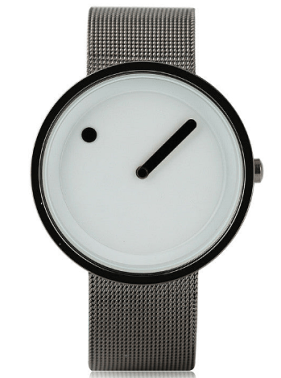
Arguably even more basic is the next one, again at around the same pricing. This is called minimalist, which I’d have to agree with.
Unknown Brand – very minimalistic
Gone are any numerals, being replaced with a simple hour indication black Dot on a revolving disk plus the black pointer minute hand
However, if you want to easily see if the watch is actually working, then a second hand is very useful.
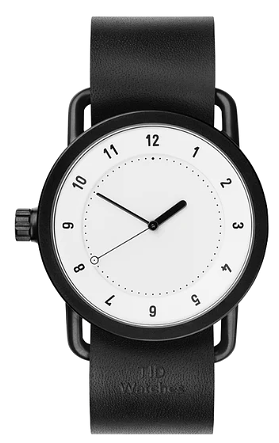
TID minimalist – Sweden
This next model is the TID from Sweden. No disks this time, but more conventional with hour, minute and a centre seconds hand PLUS it has the usual clock face with numerals and so on. But again it is easy to read, simple and tells you the time. Price wise though, not quite as minimalist at around £160.
At a lower price than the TID, you might have (or could, as it’s not a current model now) opted for one of my particular favourites –
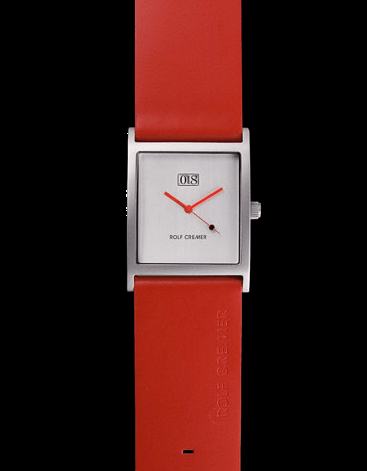
Rolf Cremer Bogen big date.
the Rolf Cremer Bogen watch from Germany. This is quite minimalist AND rather stylish. It is also the one model here with maximum information on the dial coupled with incredible simplicity.
Conventional Hour, minute and centre seconds hands, PLUS a Date window @12, but this is a large double date, which is amazing in such a compact watch and at around £130 when I bought it some years ago – I love it.
My preferred two are the Rolf Cremer, as it fulfils the minimal look with the most information and for me the best style. Second choice is the Shengke Creative as it’s bright, very clear to read at a quick glance and I’ve had this for 3 years (got it from a friend) and as cheap as it was, it’s still working just fine today, without any issues at all.
Since checking out some of the minimalist, handed and disk watches, one thing does stand out.
Often they are NOT that easy to read “at a glance”, which for me rather defeats the object. Sometimes you can be too minimum or try to depict the passage of time in an overly shorthand manner that just doesn’t work.
But the ones featured here seem to manage that trick pretty well and at really low prices, definitely not to be ignored.
Note– the Rolf Cremer Bogen I bought a few years ago and looking at their current range I don’t see it or another big date watch, which is a shame. It was certainly a winner for me. I also note – how could I not – the prices today are way up on just a few years ago and not the bargain they were.
And that’s the thing with Diver’s watches – they look darned good at the poolside or even at the dinner table and maybe if you’ve bought clever – in the Sea too.
Often they’re oversize or at least the hands and numerals are broad and bright too. Hopefully they glow bright in the dark (or should do) of solid construction and will shrug off damage and it goes without saying, they MUST be water resistant to hundreds of meters depth? Or do they?
Back in the day when I used to scuba dive, the deepest I got down to was around 30 odd meters and even then, rarely, and this when I was much younger and my lungs still worked! 😉 Much deeper than that, you were into decompression territory, which was not my game at all.
So the first question is – What depth rating do you really need on your Diver’s watch? I mean, I’ve seen a few that manage many, many hundreds of meters and no, you don’t need one of those, as these are really specialist devices and a bit more than a scuba holiday, splash around the pool watch.
For light recreational diving I reckon (my opinion) a decent dive model should have a minimum of 100m, though my preference would be 200m. These will easily take care of most recreational dives and the odd nut. They will certainly allow pool work and the odd sea adventure for the non professional.
The second question is– Mechanical or Quartz – my opinion is – either.
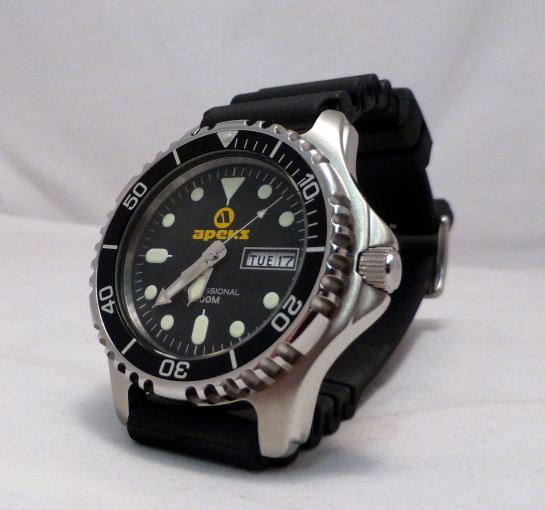
One of my favourites is my old Apeks Professional 200 AP0406 (quartz) – it’s proved itself for years personally in scuba situations – It was very inexpensive and has never let me down.
Great luminosity, very clear to read above and below and it’s a very neat watch too. Note– the knurling on the bezel is serious, nice and figured and easy to grip. The bezel is unidirectional, well lettered and with good contrast, so you can easily estimate how much tank time you’ve got left.
Battery life is around 3 years and luminous dial qualities are excellent (note – I have more in depth – pardon the pun – Posts on this watch somewhere on the site)
So, how do you figure when the battery is about to die on you is to use common sense. I swap my battery every 2 and a half years IF I’m using the watch as intended. If I’m using it simply as a daily beater, as I do with the Apeks, then every 3 years, before it stops – it’s not a matter of life and death.
For me, these days and basically as a daily wear watch, Quartz has it’s attractions, price of course being the main one, because this watch was really NOT expensive for what you get. And for my scuba diving, such as it was, it has proved itself time and time again.
However, if I wanted an alternative to quartz, I’d have to definitely consider as my very first Automatic movement Dive watch choice – I’d definitely (and I have long ago) pick out the Seiko.
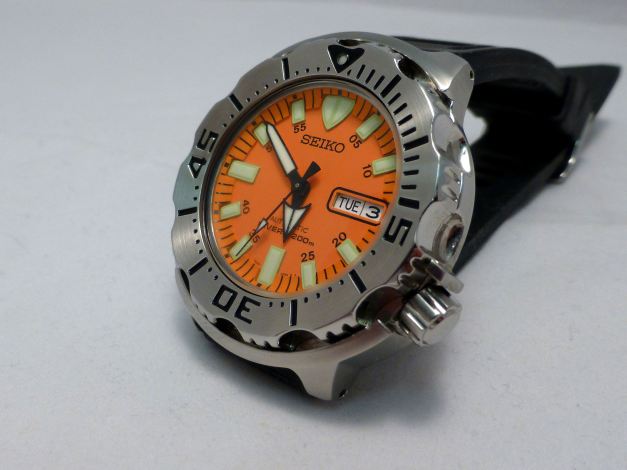
Specifically, the Seiko Orange Monster, which is another VERY popular recreational diver model which I also own and use.
It features an Automatic (not quartz) movement and basically as long as I’m moving my arm occasionally, my Orange Monster ticks along just fine. My Monster is a Mk 1 and features the 21 jewel mechanical automatic Seiko 7S26 movement and with the additional Day and Date window shows it’s versatility as a daily wear and for me the day/date is useful, as being long retired I rarely know what day it is! The day and date are easily altered on the first click of the crown. This movement is non-hacking (in other words when you pull out the crown the seconds hand keeps going, as opposed to stopping the seconds hand on say 12, for precise time adjustment). For me I prefer non-hacking which may actually add to reliability and the 7S26 is without doubt, a VERY reliable movement.
Note the Monster also has a very efficient auto winding (rotor) mechanism and if you haven’t worn the watch for a while, it basically only requires you to waggle it in a horizontal manner a minute or two, wear it and it’s pretty much set for the day. Fully wound it easily manages more than 40 hours. In practice my one here managed 45hours! A really great practical watch.
Seiko Diver (Orange Monster) Mk 1 – When they made this one, they got it just right!
Later models (Mk 2) feature (12 years after mine) the 24 jewel Cal 4R36 auto movement could be manually wound and I understand the Mk 3 had a 6R15 movement with increased power reserve of 50hrs. Apart from these changes, the Monster has only received minor cosmetic alterations since it first came out over 2o years ago – a testament to a model that got it absolutely right first time.
I certainly like the Monster as it’s VERY bright, so good to read underwater and low light and is built like the proverbial brick outhouse! Big heavily figured bezel, large clear dial, great luminosity and solid construction, make this a very, very popular choice for many.
For me either of the two models featured here would probably still be my starter model if looking for a versatile day/diver watch or even taking diving just a tad more seriously.
They both do what they say very well, be it Seiko quartz or Seiko automatic, as both movements are very reliable and difficult to beat and regardless if your first diver or not, these two will last a lifetime and more.
Now I know some folks will say I have featured these before and that is true. But there are watches that for many reasons have proved to be so right, it’s always worth introducing them to new audiences. So no apologies from me.
But there are many others out there these days and maybe I’ll find another one that manages to get the basics right.
And that’s important – and not always the case, so I’m hoping there are more around and if so I’ll feature it or them on a future Divers Part 2.
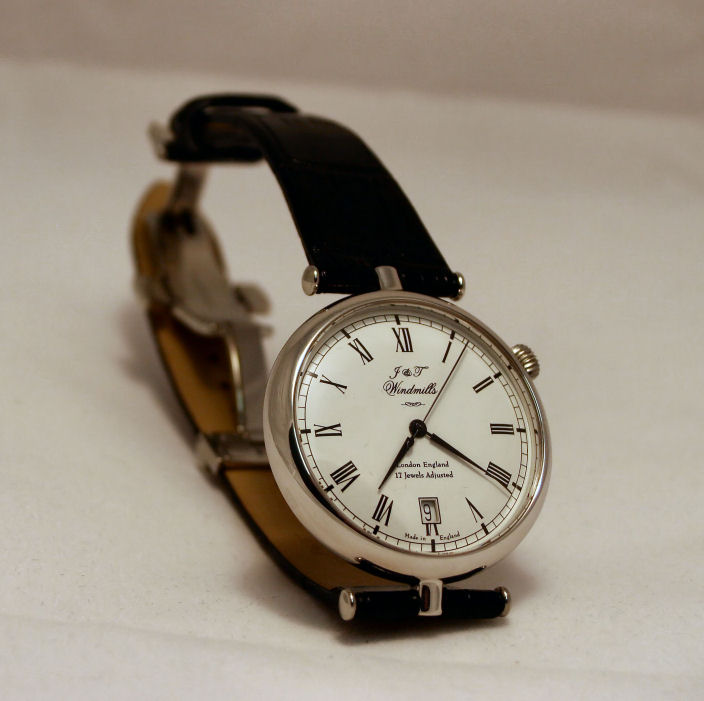
My collection has grown somewhat since getting this particular watch, which I see is still being produced today. This is the J&T Windmills Threadneedle model 10004/01 with hand wound 17 jewel adjusted movement. I understand the movement is the Swiss Sellita SW200, in their own hallmarked Sterling Silver case.
I understand the Dreyfuss Group, owned by China Haidian, are the owners of the Brand name now, though I’m not sure if that was the case when I bought this one back in 2009.
The Windmills “Threadneedle” manual wind, sterling silver cased.
It is in fact a rather stylish watch, harking back to the days of the original J&T Windmills of London pocket watches, reflecting the dial styles of the originals. The dial states “made in England” as opposed to “assembled in England”, though it seems barely relevant these days as so many components have varied and tortuous sources. Suffice to say it’s a Swiss movement and the whole watch is assembled in the UK.
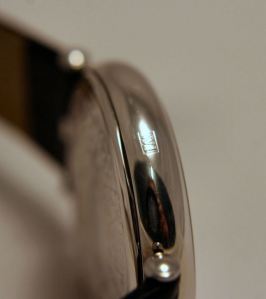
Certainly the J&T Windmills watch looks pretty decent, especially with the nicely rounded gleam of a Sterling Silver case and those singular articulated lugs and offset ‘onion’ crown @ 2. (my personal preference would be straight spring bars).
17 jewels adjusted, hand wound.
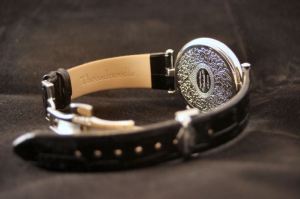
The shape of the case itself is both sophisticated and elegantly slim (7mm) with beautifully rounded and polished sides. The description “sophisticated” is evidenced by the fully decorated back, taken from the original Windmills engravings of old. Quite striking actually and subtle in that it’s hidden from sight to all but the wearer.
Decorated back with individual watch numberThe original WI “Windmills” Sterling silver hallmark.
The dial is classic pocketwatch or clock style, so reflecting the origins of the Company it is honouring.
I like the overall look of the dial face with long and dark fine shaped hour and minute hands and a I do like a fine overhung centre sweep seconds hand.
Both minute and second hands align and meet the first inner curve of the numeral markers perfectly. The hour hand meets perfectly the inner edge of the roman numerals, thus making a precise reading of the time assured. This, I really do like – and such a simple feature that many manufacturers could and should take the trouble to emulate.
Slightly elongated Roman numerals in black and a neat date aperture @6, which is large enough to give clarity without compromising the elegance of the whole, complete the frontage of this very stylish watch. I note in the current model, the date window is @3.
Back to the Made in England reference.
To have the nomenclature “made in” or “X made” is basically a matter of where, what and how. And importantly how much of the where, what and how is in the Country so defined.
Here in the UK the Trades Description Act requires certain parameters to have been met – namely “… goods shall be deemed to have been manufactured or produced in the country in which they last underwent a treatment or process resulting in a substantial change”.
And in this case a judication was actually made a year or so ago and these are some of the facts disclosed.
Quote –
The J&T here is designed in the United Kingdom – in London. Prototypes are developed in China and subsequent samples are refined in their Essex, England facility. The movement is sourced from Switzerland movement – this is a “raw” movement set where a complete set of the components of a watch of which all or part of the components are not assembled or partly assembled (marketed in this form). In the case of this particular mechanical display movement the dial and hands are not included. The watches are assembled and quality controlled by specialist watchmakers at the UK assembly facility. J&T watchmakers decorate the movement with bespoke Windmills “plates”, which is a manually intensive task, seat the dial on the movement and fix and set the watch hands in a careful and time consuming process.
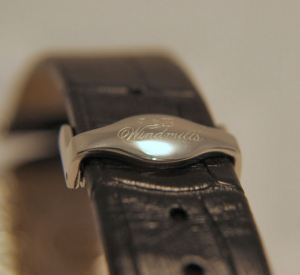
Double deployment engraved “Windmills”
After testing the full “casing up” (assembly) process is undertaken where watchmakers insert the movement into the case, fit the crown to the stem and wind the watch fully, and after a further 48-hour testing process they approve the watch for packaging and despatch. So, as the value of components sourced abroad is only 34% of the ex-works price, value-wise the watch can genuinely be described as “Made in England” and as said, there are a few Swiss Mades that might be in a similar position if challenged.
It is true that the British Horological Federation (BHF) confirmed that the use of foreign movements was common practice in the watch and clock trade, and that labour and parts would provide substantial added value to the final product.
So a British watch promoting British heritage, re-launched if you will and named in honour of the revered watch and Clock making family J&T Windmills of the 19th century. A tried and tested trend used by a few others – and not a bad result.
Nice addition to my collection.
The watch included a fine patent leather and a deployment fitting. The strap was not overlong as too many are today and with watch dimensions of just 38mm diameter and an approximate 7.5mm depth (the sapphire crystal is slightly domed). It is slim and neat to wear and will easily slide under a sleeve.
On the wrist – perfect!
Accuracy is commensurate with Swiss quartz, so no surprises there.
My only real issue is with the deployment buckle, which though in keeping with the watch style, signed and so on, is a double deployment fitting, which I personally find very fiddly. A single deployment for me would have been so much more practical. The deployment advantage? – it’s said that it protects the strap from premature wear and that maybe true, but for me a simple pin buckle strap will with wear, mould itself to your wrist and I much prefer that any day. Anyway, this one is quite comfortable (once you get it on, that is . . .).
However –
I remember not long after getting the watch, as I was winding it, the crown and stem simply fell off into my hand! Disaster! Not what I expected at all.
Made me doubt both the assembly procedure and their Quality Control and I was very disappointed. So, after emailing them, I sent it back under guarantee and rather than a repair, I was sent a replacement (different number). Very commendable I hear you say, but why did it take them 11 weeks before replacing it, which with my pessimistic nature, to me smacked of lead times from – perhaps China? OR – optimistically, perhaps just a very busy newish Brand company, who knows?
However, this replacement watch has performed exactly as it should, no issues at all and overall I’m pleased with it.
But that double deployment, though very nice and shiny as it is, is still a real pain to get the watch on your wrist. So, as the strap is actually a fine leather one, I have modified it to take a simple pin buckle. I removed the deployment, notched the short watch head end which allowed me to fit a polished stainless 14mm buckle with it’s spring bar and it is now perfect. It feels so much better, the watch/strap lies flatter on the wrist – in short – to my mind they would be better not bothering with that particular deployment. The watch to my mind has suddenly showed a proper classic style that wasn’t quite right before, but is now.
It will now be on my short rotation wrist wear plan (I have some 200 watches in my collection and I rotate wearing them), instead of just now and again, as at last it feels right.
So, overall I like the watch now with the quality strap is, for me, used as it should be. The watch functions as it should, it’s very nice to wear and regardless of where it’s made, assembled or whatever – I like it and its proved (after a slight hitch) itself to be a decent buy.





 Watch space
You must be logged in to post a comment.