Forgot to Post this one the other day – purely as I like the look of it. Very modern, colourful and OK for size.
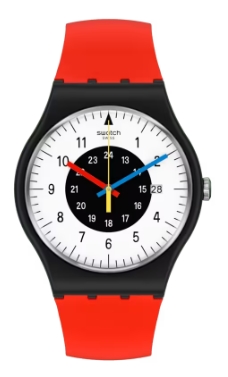
Swatch Rouge and Noir Quartz
This is the Rouge and Noir (red and black) Bio-ceramic Quartz model SO32B401-STD. Black case with a Matte red strap, loop and buckle in ceramic bio etc, so nice and light.
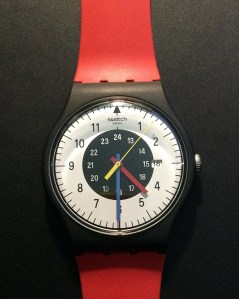
It has a vibrant dial/face in white with black print and rather sudden multi-coloured hands. I like the overhang style of the bright yellow centre seconds , short enough not to confuse when reading the time, but very noticeable as a mobile seconds reference.
You certainly know the watch is working!
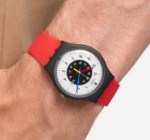
Swatch Rouge and Noir quartz on the wrist
The Water resistance is as usual fairly minimal standard at 3Bar, so splashes are OK, but don’t jump in the shower with it and the dimensions are perfect for most folks at 41mm, 9.85 depth and lug/lug at 47mm. You don’t need extra size to see this watch!
I really like the overall look of this model – the colours work great – no neon though (they have these too) which I personally find overpowering, but great to look at on the wrist.
The strap fitting is the Swatch format, so not that easy to change unless you go to Swatch for a replacement. However, it can be done with a simple silicon strap IF you’re prepared to fiddle and cut an bit – I’ve done it in the past (I have a Post on it somewhere) and I was very successful with my efforts.
Anyway, I digress – this model very OK priced at £82.00 – and includes free postage (UK) and I have to say I’m rather tempted.
I find it a bit surreal that this model is part of what they call the 1984 reloaded collection – so even though Swatch started in 1983 or whenever, this is a retro model! Maybe I’m just getting old! 😉
Update – Here are some images of the actual watch, taken today 18th –
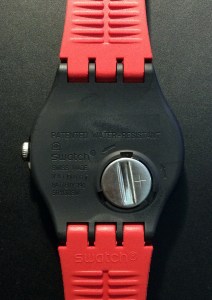
Note the back of the watch and the proprietary Swatch battery hatch and the text quoting the battery type, which is always useful, so you can order one before taking the old one out, which is sensible. However, a silicon strap for me, might have been preferable to the bio stuff, which feels a bit plasticky, though it is flexible.
All in all, though – a nice little colourful watch though I’d caution that care has to to taken with bio material – feel is important and tricky to get right.
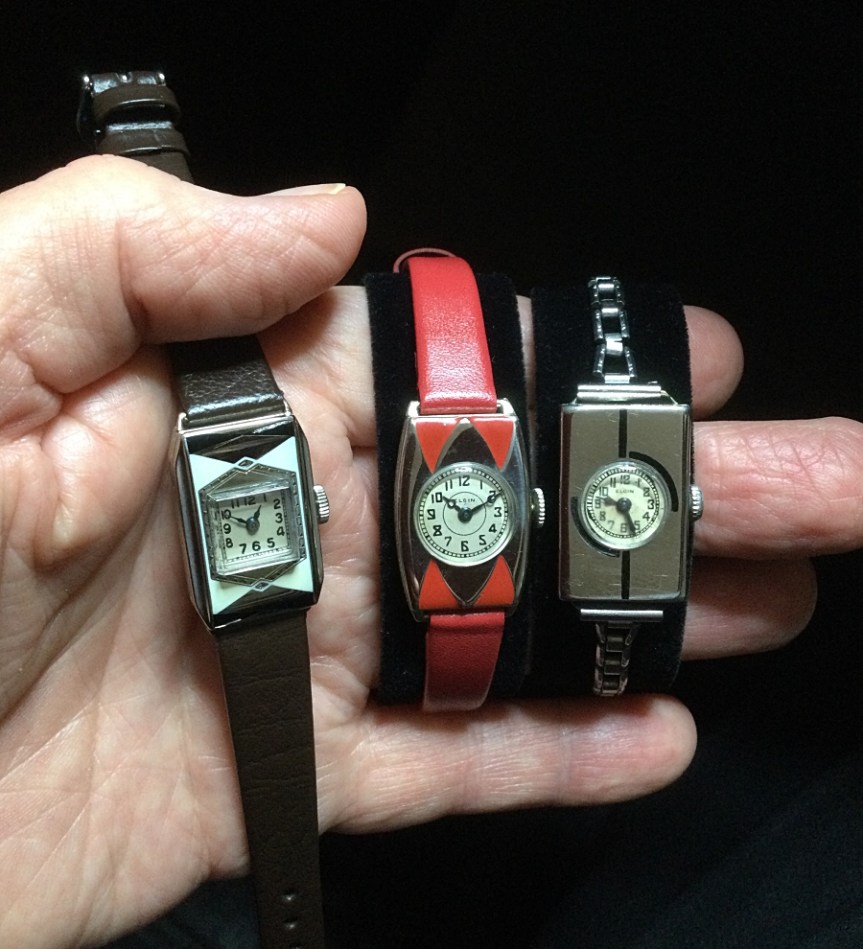
There’s something about Art Deco watches and enamel that just go so well together and as I was digging around in my Wife’s collection I found these.
A trio of Elgin Parisiennes from the ’30’s – perfect!
A nice little trio of Elgin Parisienne models from the 1930’s, each of which is a neat design of watch and coloured hard enamel decoration. Brought out as a marketing idea by Elgin, these were designed by mostly Lucien LeLong and were giver specific names of Haute Couture designers of the day in Paris
Names such as Louisboulonger, Agnes, Jenny and Premet etc. and some whilst featuring wonderful designs of hard coloured enamels also were often cased in 14k Gold filled cases, sometimes with semi-precious gems added within the overall design. And they sold really well in those days and quite affordable too, even then.
These are usually powered by the Elgin 488 mechanical 7 jewel movements with Breguet hairsprings and my Wife has maybe six of the Elgins, plus a few Gruens, Bulova, Fortis, Benrus and if I recall right, Mildus? and a few others whose names escape me entirely, but all of them are decorated with coloured hard enamel.
What always fascinates me is that as watches, they all still work and work rather well and the enamel colours are as bright today, as the day they were made. After all most were made around 90 – yes 90 years ago, rarely serviced and they’re still ticking along – Wow!
In short supply these days and I should take the time collate them properly and manage a Post featuring all of them, which should look pretty good. I hasten to add that she wears each and every one of them, in rotation and although the Pandemic lockdown situation currently has curtailed her social activities somewhat, they still get wrist time.
But once we’re out of this nightmare, then perhaps the ‘Parisiennes’ and others of the day, will be on proper display again.
Anyway, just to brighten up the site, I thought I take a quick snap of this trio, as they were the nearest to hand. I think they look good and so wearable even today, as I find many of the current ladies models look rather dull and lacking any pizzazz, so nice to get them out every so often, just to remind me of past times.
What I love about these watches is that they are NOT specifically “cocktail” watches (I hate the term). They are not festooned with sparkly diamond bits surrounding often over-elaborate mini dials. The Parisiennes are everyday wear watches and very often with some superb enamel work for added colour. And yes, they look great at any so called cocktail. And recently I met a 19 year old who has one – who delights in telling everyone that it’s over 5 times her age! And she doesn’t need a wall socket to charge it either!
In my last Post I referenced a few of the Bauhaus styled watches around at the moment. Each trying to emulate the philosophy of the German Bauhaus movement earlier this century and showing how this could be represented in watches. And the trouble with the Bauhaus criteria of Form, function and structure, results in a minimalist style, which does not allow much in the way of variation. So, many of the watches, by definition, can look very similar.
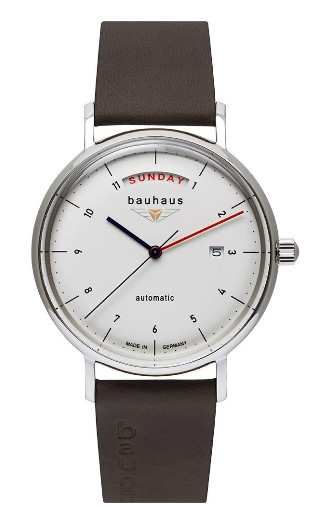
Bauhaus Classic 2162-1 Auto Calendar (stock image)
However, as a retired person, whilst I like the simplicity of a straight timekeeper, I do like to know what the date is and if possible, the day too. Those of you who are retired, know that weekends and weekdays are all the same – no differentiation – as our working week is long gone. So, how to fit this in to my love of Bauhaus style watches, when their dials are often taken to semi minimalist extremes.
And this shouldn’t really be a problem, as Bauhaus is NOT truly minimalist, it is more what I would call, ‘functional simplicity’. It needs what it needs to provide it’s function, clearly, and without too much in the way of that which is not needed. If you get my meaning.
And for me, my own favourite, the Bauhaus Classic 2162-1 Automatic Day/Date watch does it rather well and for reasons not immediately obvious.
It’s a decent size without being too large, at 41mm diameter and 13mm depth. The case is really very fine in polished 316L stainless steel with a 5 bar or 50m Water Resistance. The dial is somewhat unique in that it has two-tone hands – the minute one, being in red, plus a full size centre seconds sweep hand and a date only window @3. AND it has that nice, wide, full Day indication @12. So much better that the usual abbreviated style. I confess to always having a fascination for the full centre seconds mechanical sweep hand, rather than a sub seconds layout, which you barely notice.
The numeral fonts are also small, so a departure from most of the other Bauhaus offerings, which in this case adds to it’s discretion, and dial text is also quite small and thin and therefore non-intrusive, which I also like. And to make things even better – the entire set up is very clear to read, assisted by the subtle emphasis of the thicker width black hour hand. So not just a clone of so many other Bauhaus watches on offer today at all. In fact a lot of thought has gone into this model.
Bauhaus 2162-1 Automatic (real photo, on my wrist – today!)
The movement is the 21 jewel Automatic Citizen/Miyota 8285, with a 42 hour power reserve. It has quick date setting and supports hand winding too, so all in all, a really excellent choice of movement.
Some descriptions refer to this watch calendar as Fecha, which in this instance I can only guess means the Day is separate from the Date, but I’m no linguist.
The crystal is an Extra Scratch Proof K1 mineral and the watch has an exhibition back, through which you can view the movement. The strap is a medium thick 20mm fine brown calf skin leather and on the wrist it looks very stylish.
There is also a quartz Bauhaus model, the Classic 2140, which has a date only @6.
Bauhaus Classic – Ronda 505 Quartz
It is powered by the well known Swiss Ronda 505 Quartz movement, though personally I find the mechanical automatic is more in keeping with the Bauhaus idea. But it is very affordable and in my opinion, if quartz is not an issue for you, then with it’s very neat and precise dial, it is a real alternative to the Bauhaus rivals listed in my previous Post. And it still features these clever hands.
Both models are Made in Germany in Ruhla, where Iron Annie and Zeppelin watches are also produced. The POINTtec Company manages the entire line and it’s not the first watch I’ve had from them. What I have found is that every watch (6 to date) I’ve had from this stable, has given me many years of exemplary service.
In my own mind, I consider that the Bauhaus brand watches featured here, are a step up in overall design from any of the ones featured in the last Post. Whilst the Nomos Tangente is the best of them, the Bauhaus 2162-1 in my opinion is superior to all of them.
However, both Bauhaus branded models featured here, have something about their under-stated design, which is difficult to beat and the 2161-1 as I say, transcends even the Nomos. The small numeral delicacy and the two-tone asymmetric width hands, just lifts the watch into a much more considered and refined category. And yes – absolutely, to another level. The designers here, have really, really thought about the details and have managed that subtle and elusive ‘something’ extra.
Personal I know, but in the end, that’s what it’s all about and maybe the rivals have forgotten that having virtually the same dial, same fonts, same straight hands and plain white background, maybe isn’t the be-all and end-all of what makes a watch ultimately attractive to the buyer.
There’s always that ‘something’ – that draws you in – and whilst all are attempting to reflect Bauhaus, it maybe takes a little more than just more of the same, or just copying what others are doing.
For me, I think the Bauhaus Classics here manage that ‘something’ – very well indeed.
Addendum –
So, what would I do to improve the above models? Well, to be perfect for me – a slightly enlarged date window and a 28,800 A/h ticker would do it
Splitting hairs and unfair, I know, but . . . . .
Best Bauhaus? – The Bauhaus 2162-1 is my No1 and my No2 has to be the Junkers (see last Post).
A name synonymous with the German art of structure, form and function, so persuasive that way back in 1919 to 1933 in Germany, the School of Fine Arts, espoused that form should follow function, without the unnecessary – in other words, a sort of minimalism. But importantly “without stifling design” – and that phrase so important in the world of truly Bauhaus described watches.
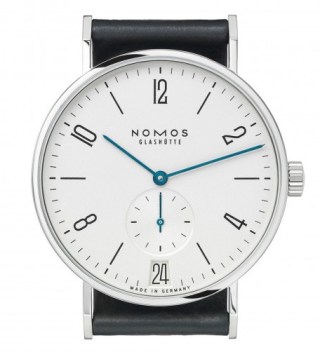
True Bauhaus – the Nomos Tangente Automatic Date watch
The Brand that for sometime now has one of the best of Bauhaus tradition is Nomos – specifically the Glashutte Tangente. And it’s well known as a high quality model that manages to command quite a price too. With it’s in-house mechanical Automatic movement, something of a rarity these days, it also manages to be of a nice size at 39mm diameter. Sapphire crystal, neatly cased in high polished steel, I show it here as the standard to which a new contender has to aspire.
Now the Bauhaus philosophy is quite well catered for in the watch business – rivals to Nomos such as – Stowa, Sternglas, Junghans, Junkers and Seagull come to mind and there are others such as Panzera, Nordgreen or Aristo and so on. Most are not as expensive, though the cheaper are often Quartz powered, which for me doesn’t quite gel with the ideal of Bauhaus – I feel the concepts of Form, Function and Structure without the unnecessary, seems to get lost in the static world of electronics – but maybe that’s just me.
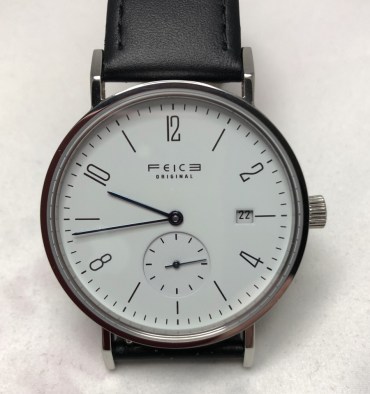
Feice FM201 Bauhaus Automatic – more than a copy?
The Bauhaus concept for me is alive in a way that the solid state world just isn’t. Some, for example interpret the Bauhaus movement as a sort of Danish minimalist design, which (I have some myself) and I always end up personally disappointed, because they are so- minimal – and if I’m honest, a little bit barren, dare I say, like furniture – not that Danish furniture is uncomfortable, but I like to see the comfort too, with comfortable surroundings – but again, is that just me?
And this is where the Bauhaus concept is so interesting, by design and in the feelings it gives the wearer. There’s something both comfortable and comforting – and invariably mine end up on my wrist more than most.
I like them, specifically the automatics. Firstly, as they are alive and secondly, you simply wear them and they are part of you. No batteries, no winding and no fiddling around.
So, although I had heard of them, still a bit of a surprise when I came across the FIECE FM201 – in person, as it were. Bauhaus style, Automatic, with understated Date indication and owing to the derisory price I assumed Quartz. I mean – the Fiece is around £150 – and the Nomos near £2000! Now that! is a hell of a difference!
I can understand some of the price differential, as the Fiece sports a Chinese modified movement. Those clever Sea-Gull people at Tianjin in China managing the tricky business of combining mass market methods with increasingly decent movement quality – not easy.
So, as it often happens, it all comes down to Quality v Price.
Of course, much depends on your definition of quality. To some – if it ticks and keeps decent time – then that might be good enough. To others, it’s about “look” and finish and detail and what’s inside and so on – very subjective indeed. And in this particular instance we dare not forget that it’s all about the Bauhaus philosophy too – which is about Form and Function and Structure, and no unnecessary bits – Gets tricky doesn’t it?
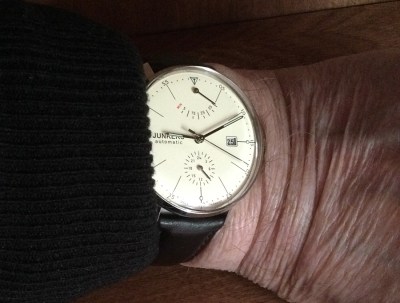
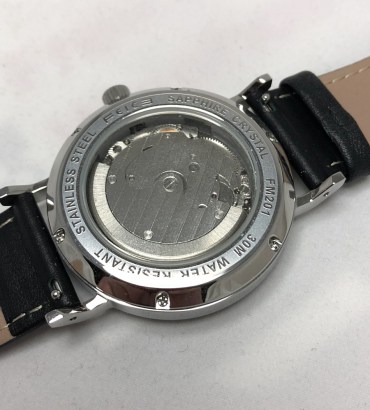
My Junkers ‘100yr’ Bauhaus, with Miyota Auto 9132 calibre, 28,800 A/h – a favourite classic for me.Feice FM201 with Sea-Gull Auto movement
As to Sea-Gull movements, I used to have reservations, in the past, when their assembly procedures were not so good. In those days you might get a good one, or a not so good one, though ironically the movements were very good. I do remember they benefitted from a good clean and service, which instantly elevated them right up there with the Swiss ETA calibres.
However, changed days now and their movements are well respected indeed and have come a long way from the Citizen/Miyota origins – incidentally my own Junkers Bauhaus, shown here features a very good Miyota 9132, 28,800A/h Calibre.
Both Miyota and Sea-Gull have become synonymous with mass availability of excellent automatic movements and can really challenge the ubiquitous Swiss ETA2824-2 automatics.
I applaud them both, as Quality, Quantity and Price are a tricky balance to manage, so no mean feat.
BUT, that’s not the topic for here – suffice to say that “Made in China” doesn’t always mean cheap and cheerful. What it can show is that very decent watches are now widely available to everyone – and that’s a good thing.
But for Fiece, the idea of using the Bauhaus concept and promoting globally and espousing – Form, Function and a certain marketing seriousness, hasn’t hindered them in their mass market approach and by increasing quality is a real bonus. They have carefully followed others with this trend and with some success.
Their Bauhaus ‘homage’ models are attractive enough for me to check them out – and so, I bought the Fiece FM201, and it’s definitely better than expected.
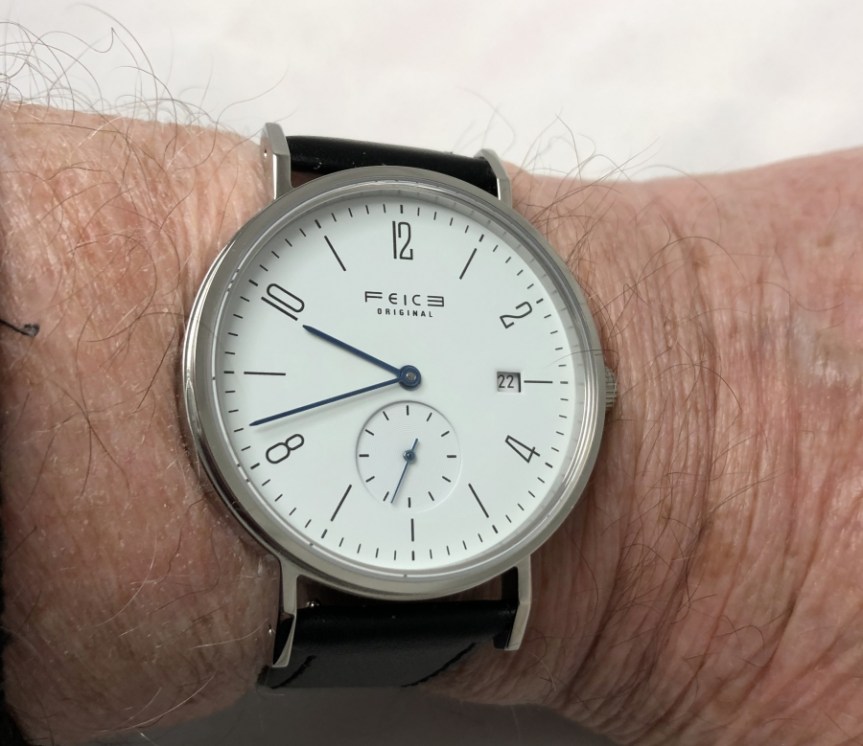
My Feice FM201 Bauhaus 38mm on wrist – Budget or Bargain?
In comparison to the Nomos, the dial text/font clarity and detail is good, as is the Date aperture (though smaller than my Junkers). The hands maybe not quite as delicate, but also good and maybe overall, the dial isn’t quite as – shall I say – ‘fine’, but it’s still very good.
But as always, my observations are subjective. As to the movement – well OK Nomos is certainly highly regarded, but the Fiece FM201 Sea-Gull is pretty decent and with no internal traces of fingers or dust or skin flakes. It also has some evidence of oil (that’s good), so it appears the old Sea-Gull shortcomings of the past, may well be long gone.
Or have I just been lucky? No, I suspect today, they have definitely raised their game.
And as to how it looks on the wrist and for timekeeping – it looks pretty darned good – and it certainly does look ‘Bauhaus’.
So – Budget or bargain?
Well, I would have to say – bargain. It has the Bauhaus look, it’s nice to look at, it works well, suits the wrist and it wasn’t expensive – so what’s not to like!
Of course, there will be detractors who will accuse yet another Brand of producing another “homage” or even a “copy” (and let’s face it, there are many models out there that are close copies of others – right from the top down). Some are near fake category, but that’s taking it too far and such an accusation only valid if their offering was “made to deceive”.
Personally, I like some of those listed here and there are some good Bauhaus styles around. However, with each trying to have that “look”, the result shows that their options are somewhat limited in how they look in reality, so copy accusations are easy to assume, rightly or wrongly.
Me? I’m just a punter, a guy who likes to buy and wear pleasing watches and I like Bauhaus style. So, from my point of view it’s all academic. Selfishly, it simply means I have a greater choice of models and Brands to choose from and in a wide price range too – and it is just that – personal choice.
The Bauhaus concept has no doubt spawned an attractive range of similar styled watches (you either like ’em or you don’t) – and there are bargains to be had.
Addendum –
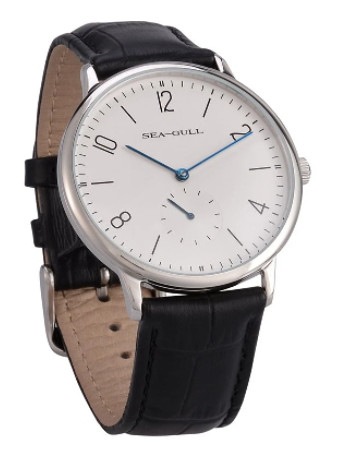
It should be noted that Tianjin Sea-Gull watches also make their own Bauhaus watch – which is shown here – and it is very well priced too – this is the Automatic D819.612 without date. Nice size at 39mm and 9mm depth with Sapphire crystal – slightly slimmer than the Feice but I like them both.
Latest – However – I do have another Bauhaus, not shown here, which I will feature in another Post quite soon, that for me, has a certain ‘something’ to it, that really appeals – so watch this space!
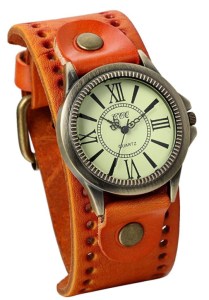
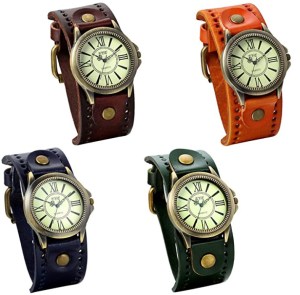
For those who are not really into watches, but are into wrist cuffs, the featured JewelryWe watches (4 colourways) should fit the brief. Known imaginatively as Watch Cuffs, it really is the price that’s truly amazing – and that’s maybe around £10 each. . . .
Cuff watch
The leather strap/cuff of each is a different colour and from a fashion conscious guy, really quite smart – and it tells him the time without referring to his Smart Phone – now isn’t that a novelty!
The watches themselves are pretty basic, quartz and the metal is just, well – metal – but they do tell the time and I have to say, they actually look pretty good. They each weigh just 54 grams, some 1.5 inches diameter and the dials are quite clear and protected with eh – glass. What I’m saying is, these are basic timekeepers, but as with almost any quartz powered movement these days, they are quite accurate enough for day to day wear.
JewelryWe wrist watch cuffs.
Anyway as wrist watch cuffs or straps, I like them and I like the fact that they are really NOT expensive and are not silly looking (some are) and they are what they are and if you have a damaged wrist – and I sprained mine the other day, they are great as a brace, so a nice coincidence that I spotted them in Amazon.
Actually there are quite a few different styles and Brands there, though these basic versions suit me fine and in fact the more I see them, the more I’m getting in to them. Reminds me of a long time ago, when a lot younger and I actually remember wearing wrist leathers. Of course way back then I also used to ride motor bikes – a fact that was brought to mind the other day, when an old pal of mine turned up on a brand new Husqvarna 400cc motorbike – I mean this guy’s no chicken, but acting like a teenager with two tails and loving it.
Now he didn’t have a wrist cuff on, but before he left, he was sporting a watch cuff – one of the set of 4 I’d just gone and bought!
And then he looked really cool!
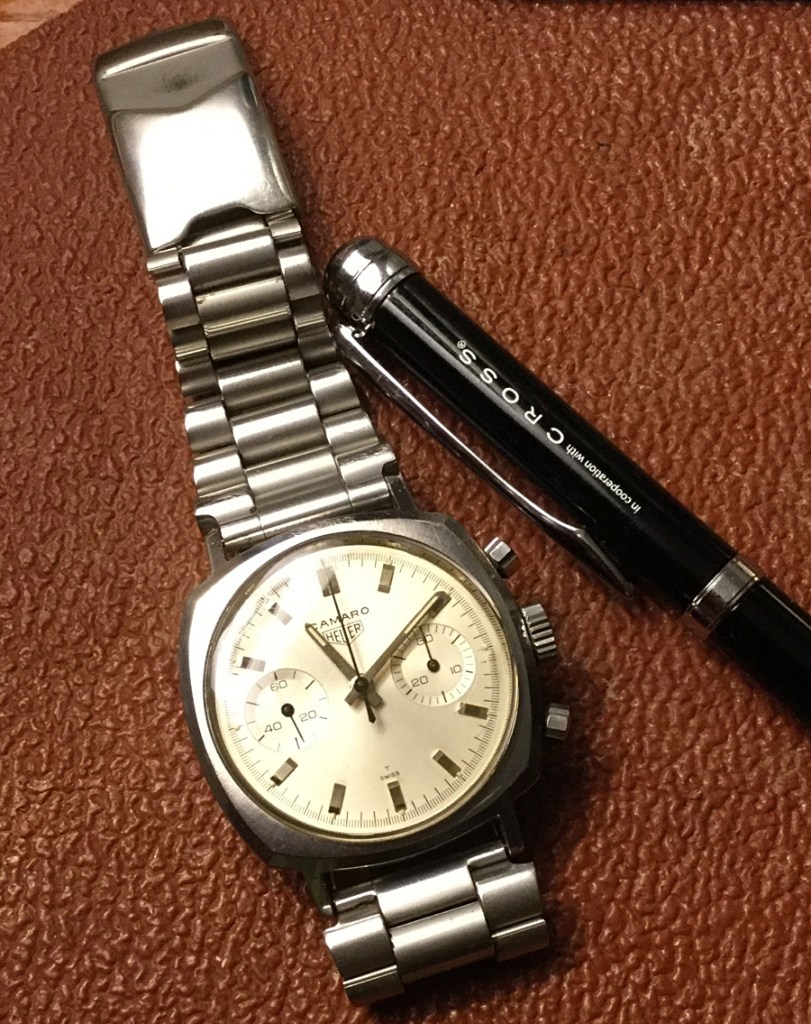
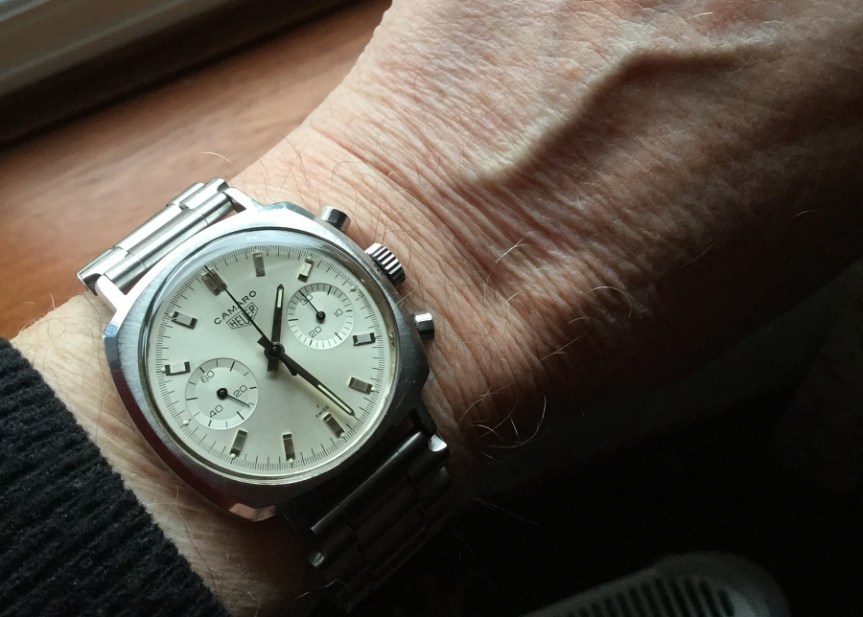
Thought I’d show off my old Heuer Camaro 7743, a 1960’s classic if there ever was. Totally as bought, with it’s original and completely unscratched and un-stretched stainless bracelet fitting to the odd sized 19 mm lugs. Pleased about that, as so often these bracelets scratch up badly – this one however, is pristine.
Classic of the Sixties, Cushion cased Stainless Heuer Camaro 7743.
In fact the entire watch, which is the Camaro 30, 2 register chronometer version, with running seconds and 30 minute sub-dials is in pretty decent condition. The stainless 37 mm diameter cushion case shows off it’s sunburst upper surface, which is still well detailed. It is of course a manual wind model with the Cal Valjoux 7733 movement (one of the nicer movements out there even today) and a Plexiglass crystal. The applied index markers with luminous batons are in perfect condition, as are the main luminescent infill hour and minute hands. A nicely configured black seconds chrono hand completes the dial assembly. The sub-dials are especially neat as they incorporate a circular background pattern. In short, this is a real classic watch dial set up and looks rather better balanced that many watches today.
Heuer Camaro 30 7743 classic timepiece from the sixties. Great on the wrist!
The pushers are the castellated version, so slightly later in production, which only lasted 4 years. The centre crown winder manages on full wind around 45 hours power reserve, which is very impressive. The stainless steel screw back is plain with no markings, the model number being engraved on the case side between the lugs.
The solid cushion case, even at 37mm, which is perhaps considered small today, looks great on any wrist and sits so well, it is a delight to wear.
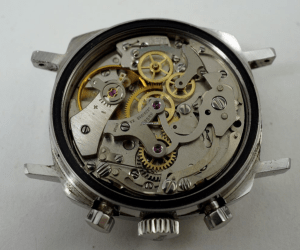
I have never removed the back, so the water resistance is unlikely to have been compromised and unless the watch has a movement problem, I’ll probably never break in to it, but I show here a stock image of a typical 7733 movement, though I fancy my one might look even better.
Valjoux 7733 Chrono movement – Image from Chrono24
It is a fact that there are really not many of this model around in really good condition, which surprises me, though with Plexiglass crystal, it’s a material that’s easily scratched. Mine has not completely escaped either, as there are two shallow scratches on the glass, but fortunately neither detract from the beauty of this watch.
I love it when a 50 year old watch gets my attention once again and springs to life from my display cabinet. This one is I think destined for my wrist for the rest of the year and long overdue. It’s great to wear, great to look at and it functions today as well as it did all those years ago. It is also extremely accurate and it’s proved a decent investment too – not always the case when it comes to watches.
It is also the ONLY Heuer I own (a bit like my Rolex collection – one from 1960, and one from 1920’s).
Here’s a neat Ladies Sorna model from the 1970’s – the Sorna Jump. Another Watch Company long gone and not too much known of them. Swiss of course and originally from Grenchen, they used to manufacture watches under the brand names of Sorna, Sorina, Sornana and a few others with similar sounding names. From what I can find out they disappeared in 1994, though a new Sorna in Germany today also make Trias watches. Whether they bought the name I could not say.
Sorna ladies “Jump” watch – described as “digital” though not as we know it today.
Suffice to say, this particular model was born at the same time as the Hudsons as an attempt to stem the flow of cheaper Quartz watches from the East. By using mechanical movements as before they hoped to tempt the buyer with a digital look but using conventional components. Once again using Ebauche movements with hour and minute disc as opposed to hands, the hour either “jumped” into view at the last minute of the hour ended or slowly slid into view, depending on the mechanism employed. Thus providing a “digital” watch, though not as we would know it today.
Note the high contrast numerals – easy to see on a small watch.
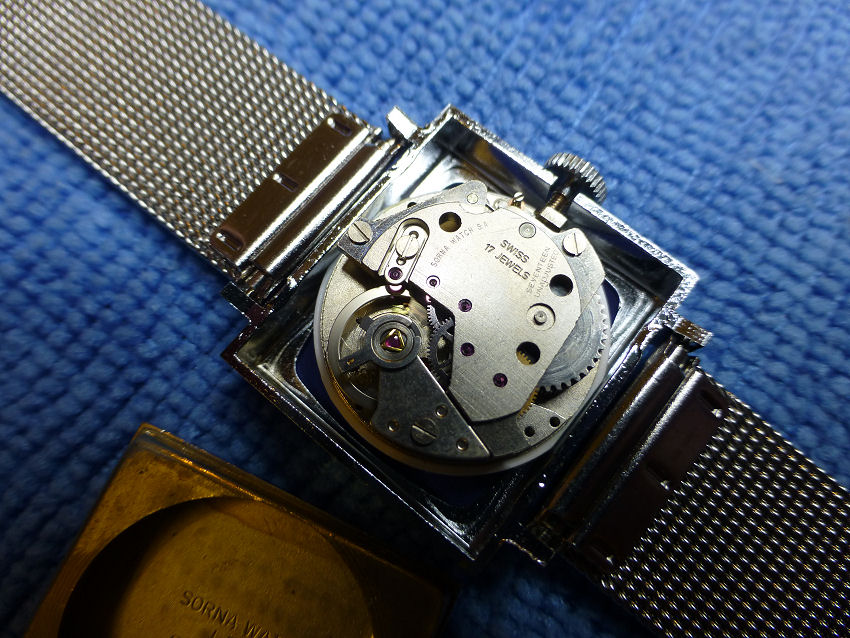
I like this particular model as it has the Hour highlighted in white against black. This makes it stand out better than most especially as it is a smaller sized watch. Note this is a reasonable manual wind movement too with 17 jewels. Many other “jump” style watches often featured simple 1 jewel movements – so this is quite a decent watch.
Neat Sorna signed Swiss 17 jewel movement in perfect as new condition.
I have another high gloss, high colour leather strap for this watch and as my Wife is as fickle as I am regarding straps and bracelets, I won’t know until I change this bracelet to see which one will get her approval. I can see her choosing the alternative matching blue conventional leather buckle strap – but it would be dangerous to second guess her!
Well I was right NOT to second guess, so I’ll not even show the strap – suffice to say she picked the bracelet!
A few of these NOS (new old stock) models are appearing today and for a collector like me are almost a certain buy. Watches like this from the 1970’s are slap bang in the middle of the worst period for Swiss watches as the cheap, accurate Quartz revolution from Asia hit them hard. Often the smaller Company or suppliers could move and adapt to not only compete with this new threat but importantly still manage to utilize their existing mechanical movements.
The Hudson Instalite (by Itraco) – 17 jewel pin lever “Jump” watch.
Hence the birth of the mechanical “digital”, Digit Wheel or “Jump” watch, which managed the appearance of a Quartz digital watch, but with a more or less conventional mechanical movement.
Some were true “Jump” designs where the Hour digit only moved or “jumped” forward at the last second of the Minute Counter digit. Others sort of gradually slid into position as the changing of the Hour approached, though these often caused a little confusion when not fully changed, being sort of stuck in no-man’s land between hours. This model falls into this category – at the hour and 55 seconds, it’s sometimes tricky to tell which hour it actually is!
Quite a few different Brands appeared at this time such as Gigandet, Damas, Lanco, Lasser and others.
The Hudson Instalite “Jump” hour – actually minimalist in construction, but very 1970’s.
The model featured here was sold for retail by Hudson for the US market, though the Brand was actually manufactured by Itraco of Zurich (Itraco, Samba & Hudson) and features the Ebauches Bettlach EB8461 17 jewel pin lever mechanical wheel digit movement with a pretty decent 40hr reserve .
The Hudson Watch Co. was registered by Antoine Castelberg of Chaux-de-Fonds and New York in 1884. Other names were marketed via Hudson in the early 1970’s, such as Adelphi, Carlton, Gisa, Globe, J Godat Geneve and others. In fact the list of “lost” names and Brands is extensive and to be certain of who made what, or who sold what and under what name and where and at that time is a near impossible task.
Suffice to say, this model is the Hudson logo’d Instalite model, which I consider one of the better ones. I have also seen the same watch with “Fashion-Time” and “Secory” and apart from slight cosmetic changes are obviously the same model. I understand that one of those variations did alter the movement to give that true “jump” hour and I have a feeling the movement was also an EB movement but calibre 8481 series.
The battery access for the “Instalite” accessed via this left sliding hatch. Access to the movement requires the back removed. The “slots” are simply grips to assist in sliding.
The term “Instalite” is in reference to the battery powered dial light which illuminates the dial digits rather well in this case and operated via the push button @1 above the central crown. The battery is easily accessible via the dark colored plastic sliding rear cover, which is separate from the movement, which itself can be seen only with the entire 2 piece metal “snap” back removed.
Various movements from Ebauches Bettlach were used in this model depending on the year, but all are similar in operation. It’s fair to say Bettlach E after amalgamating many of the independent Swiss makers as a defence against the Quartz revolution, were focused more on the lower end. Historically Ebauches Bettlach SA was formed in 1926 and ended in 1980 as it finally merged into the Swatch Group under ETA, which aligned pretty much with Bettlach’s core aim from it’s inception. ( for details see under – https://www.watch-wiki.net/index.php?title=Ebauches_SA ).
Fits the wrist pretty well and very readable too. I have fitted a complimentary leather strap.
I have a few of these “jump” models, as for me they represent an important yet too easily forgotten milestone in the Swiss watch history – and many are rather unique and cleverly innovative for the time. They really provided a stopgap rescue for much of the Industry at a time where the Swiss Watch industry as a whole was under serious threat.
I hope the images show to best advantage, these intriguing watches which by the way are a delight to wear. The size is ideal and they sit well on the wrist, even an average one such as mine (6.5″).
This watch came with an after market steel mesh bracelet, but if you read this site regularly you will know I just love changing straps and bracelets to see the effect. It can sometimes make or break the wear-ability and often is surprising, which is half the fun! As shown I have fitted a brown leather strap which softens the look and for me is more comfortable.
Another 1970’s variation from Switzerland is the Tressa watch. This is a nice NOS model which as you would expect is in absolutely pristine condition, never having been worn in it’s entire life.
Powered by an AS 5206 (A Schild) Automatic mechanical movement with Day and Date, this is perfectly at home today as a day or dress watch.
Nicely finished in highly polished stainless steel case with a gold plated bezel surrounding a mineral crystal. Lovely electric blue geometric dial decoration with quick set date via a push pin @4 and a clear Day/Date window @3.
Tressa 1970’s Lux Crystal 21J Automatic
As with many of th 1970’s watches, the watch actually came with a Tressa stainless steel bracelet, but I’ve changed it. You may ask why and the answer is that so often mid range Brands from that period seemed to struggle sourcing decent straps and bands. The original one whilst also NOS and infinitely adjustable, is simply NOT comfortable as it catches my wrist hairs! So I paired it with a complimentary color leather buckle strap, as shown.
I would note that rough bracelets are not confined just to cheaper Brands, as I have a Cartier model that is just as bad (worse actually) so it’s in good company!
Stunning electric blue geometric dial decoration, makes this version noticed.
AS movements have been around an awful long time and in fact were the largest movement maker in Switzerland by 1920, though in the 1970’s after the Asian onslaught, they merged into ETA in 1979. They were and still are very well regarded as a reliable movement with Brand customers almost from A to Z and derivatives are still used today.
Tressa on the other hand have been around for a shorter period, coming to reasonable prominence from their base in Bienne Switzerland in the mid 1960’s and over the next 20 years till 1987 sold mostly to the Eastern market. During that time they almost exclusively used AS movements.
Bankrupt in 1987, I understand Rado took over their remaining assets though some years later (vague details only exist) under the umbrella of Zeon Watch of Basel between 2000 and 2005 old stocks of AS520x movements and watches were finally cleared from their inventory. The main competition in their heyday prior to then was from the likes of Sicura and Orient who served the same market with similar styles (I understand the CEO of Sicura was involved in the early days of Tressa).
In my Tressa the crown/hand adjustment is a quite stiff and whilst could be a characteristic it’s more likely a lack of lubrication after some 40+ years in a box! but it operates just fine. The Date is changed with a pin under the crown @4 and the dial design is rather smart (reminds me of the first solar powered, but of course isn’t). The broad Hour and Minute hands are easily seen and the sweep seconds Hand has a red marker tip.
Looks good on the wrist and already has drawn comments. It fits my 6.5″ wrist perfectly.
I also think it has some presence and it looks good on the wrist and features a great color combination that works very well.
The Tressa Lux Crystal is quite a neat size at just 42 mm lug to lug, 36 mm across (x crown) and only 12.9 mm depth, also comes with a few different dial colours and designs and in today’s world works very well as a fashion piece. Depending on the color you choose it can be, as they say, mixed and matched, with shirts and ties in most colours, which is a plus. I’ve seen one in a superb green dial center which I particularly like – and seeing I’m in my 1970’s thing at the moment, I’m sorely tempted. These are still available NOS, which is amazing after all this time and at reasonable prices too.
So it might well be worth it to seek them out as they have an individuality that’s sadly lacking with modern watches. Of course that’s the 1970’s for you – it was a time of not only technical revolution, but also real social invention and this Tressa model was born out of that time.






 Watch space
You must be logged in to post a comment.