My Tissot Two Timer

Interesting watch, the Tissot Two Timer (D.377) introduced by Tissot in 1986 and this one dated around that date.  By the number of different configurations, this Tissot model interestingly reflects both the Swatch ideals (Tissot joined Swatch as a founding member in 1983) and a competitor to the new Asian digital reality of the time, but in Swiss style.  In my small collection of these, I Post this one first as it’s quite a rare one, purely owing to it’s funky overlay dial.  The TTT (as I call them) models were relatively new tech for the time, as they were Ana-Digi models with an unusual feature of using just a single multi-functional crown.  The control module sets and adjusts the analogue time and the digital functions, which indicate in the single line digital display and by analogue hands.
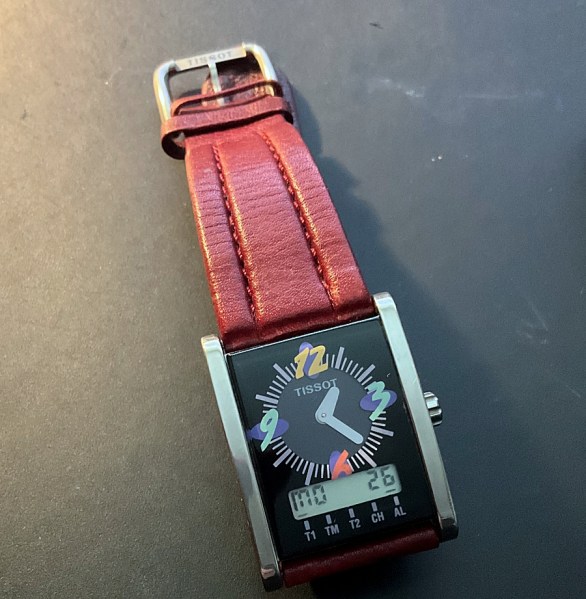
Tissot Two Timer 1980’s Analogue/Digital Alarm/chrono (note – Alarm is shown as set)

The (adjustable) digital functions featured are; Digital Time, Seconds & Date, Weekday & Date (auto-calendar), Timer, 2nd Time Zone, Chronograph and, Alarm.  Each is selected and adjusted by the single crown, which is still today a bit of a rarity.  Analogue and digital can be synchronised too and the digital display can also be switched OFF.
I have just a few models that utilise single crown multifunctionality apart from the Two Timers.  One that immediately comes to mind is my 1999 Breitling Aerospace, which may well use the same or very similar module.  So, this very affordable 40 year old vintage watch, is in very good company.

As said this module uses a single crown adjustment system which although effective, is tricky to manage and if you’ve just bought the watch. You will need the instructions, believe me!

Basically there are 3 crown positions. Press the crown IN once (position A1 – spring action) it selects the main function changes and can also switch the Alarm on or off.  Crown position A (normal) rotates either way and moves the line marker under the digits to select the required function.
Position B – (one click OUT) is used to alter the digits on the function selected – then again rotate the crown in either direction. Note that a fast crown rotation moves hours and months & slow rotation alters minutes and days.

So, quite tricky to get the hang of. I found that slow is just that – a nice steady turn and fast is – fast!  I would say instructions should be to hand and perseverance is required – but the system does work, believe me.  The trouble is that next time you have to adjust it after replacing the battery, you will likely have forgotten what to do – so don’t lose the instructions!


Anyway, on this Two Timer, all functions operate flawlessly and the digital display is as good as it gets with no bleeding or fading, which is a real bonus on any vintage watch with a digital display (a weakness of early digitals).
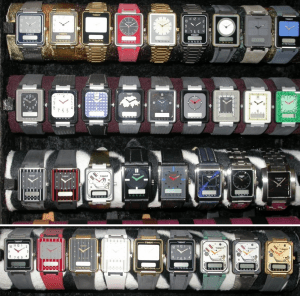
Image shows a Tissot Two Timers collection for sale in 2007

However, the main reason for my interest in this particular 1980’s – 1990’s Tissot Two Timer model is because of it’s rarity.

And this is totally owing to it’s colourful and rather funky overlay dial layout as it is VERY unusual.  A fact that’s very obvious by it’s absence in this great picture of a fabulous Tissot Two Timer collection offered for sale some years ago. Do I see this dial?  No.

Whilst I’ve also seen many variations on the theme with around 20 different 1st generation Two Timers up to maybe 1995, plus more variations with the 2nd generation models – I’ve only seen this particular one once before and as these pre-owned models change ownership every so often – who knows, maybe this is the one?

Update – I have actually seen one with this dial for sale in Singapore since I Posted this.

For anyone interested in Tissot Two Timer models, especially the 1st generation ones, there are a few (and just a few) of pre-owned ones around, mostly the more common dial layouts, such as the vertical striped face or skeleton. Though these tend to be the 2nd generation models which seem popular.  However, fully working 1st gen’s pre-owned ones are much more scarce.
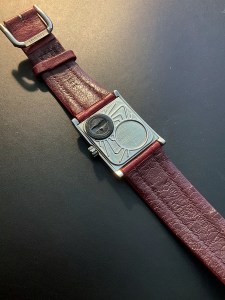
Note the small battery hatch – similar to Swatch – a 20 pence coin fits the slot.

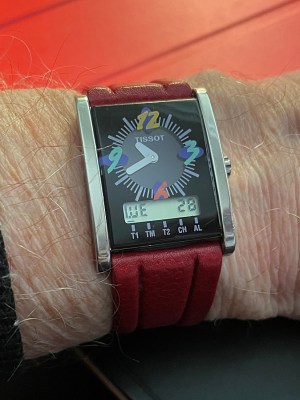
As said, this particular model is a rather colourful and quirky dial layout with thick white coloured (I call loony) hands plus an overlay of quite jazzy numerals and markers – I love its different look from the many others I’ve seen.  So I’m very pleased to have it. Plus, it has the original stitched leather strap as well and whilst obviously worn, it’s still OK to wear.  However, I do have another strap I obtained recently if and when this one gives up.  I note later versions have moved from leather to rubber options – which doesn’t do it for me I’m afraid

The watch is quartz powered (7 jewels) and the battery (SR920SW) is accessible via a battery hatch (note – 3ATM with the correct seal) on the rear (see image). And the all important crown is well knurled which makes it easier to turn for adjustments. Note the battery cover is often a plastic one and the slot is quite wide – I find here in the UK a 20 pence coin (7 sided) is perfect and prevents damage to the plastic. (don’t be tempted to get one without the battery cover – as these are very difficult to source).

Watch dimension are really good at around 28mm width (add crown just under 30mm) and the case thickness is very neat at around 7mm. The case is also curved with a flat back, so looks very neat on the wrist.
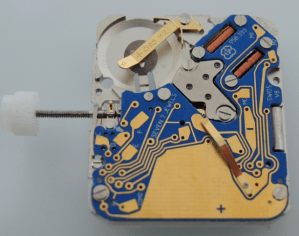
ETA 958-333 7 jewel module (available), but unknown if it would be a direct replacement.
My funky Two Timer on the wrist

So, as often the case, I find many vintage models preferable for all sorts of reasons – and fortunately, as said, they can still be found (but not always) at reasonable prices. Beware Two Timers for big prices – they shouldn’t be).

A little unsure as to the movement module used in this Two Timer, but it appears to be a variation of or similar to, the ETA 988.332 module in my Breitling Aerospace. Perhaps the ETA 958.300 series with a single digital window.

The module is part of the Swiss ETA Flatline series and information can be found online.  However, little information appears available after 2009 and although I have seen complete 958-333 modules, I would not assume these can be used as a replacement for this particular model.

A few other watch brands have utilised the ETA Flatline series of modules in addition to Breitling, such as Bell & Ross, Rado, Victorinox, Chrono and Butler, so obviously quite well regarded.
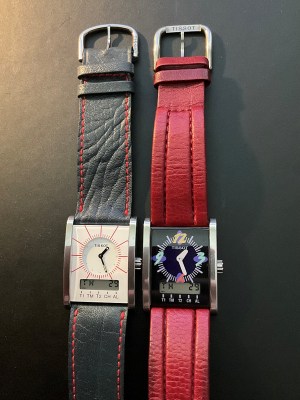
2 x Two Timers, same model, different year.
Strap, buckle and dial cosmetic change.

The Tissot Two Timer was never an expensive model, but it was in my view an important one as it not only competed, but matched Asian competition at that time.  Along with the introduction of the new Swatch Brand (Tissot being a founder member) this offered a proper well established quality Swiss Brand to customers at a crisis time in the European (Swiss watch) Industry.

So, to Tissot – Founded in 1853 in Le Locle in Switzerland, then allied to Omega – becoming the Omega Tissot Brand from around 1929. They further expanded with the amalgamation in 1983 of what was known as the SSIH-ASUAG & SMH (the Swiss names are too long winded for me to spell out) and finally SMH became a new Group known as the Swatch Group.  Today, of course a huge player in the watch industry, with a membership of many major and still independent Swiss Brands, such as Tissot themselves of course.

Anyway, that’s my funky Tissot Two Timer and I love it, both for it’s 1980’s modernist design and to my mind, under-stated place in the watch world and the fact that on the wrist, it just looks great! And I do prefer it to their previous ana/digi models which were not to the same standard.

I also show here in this image, another of my Tissot Two Timer models. This is another 1st gen D.377 model, not quite the same year, with another dial layout, strap and buckle and a different look.  Note – Later generation of the D. series have an altered case and lug design which necessitates a non-standard strap, often rubber. Also the battery hatch is no longer used, so the back is more conventional and uses screws to access the battery (maybe a better idea as often battery covers go missing).

Note 1 – Instructions are available here – https://www.manualslib.com/download/863198/Tissot-Twotimer.
And Here – which has a full set of instructions in .pdf format

Note 2 – Two Timer modules feature an auto-calendar, though this year (2024) being a leap year, with 29 days in February, I manually changed the date accordingly.

UPDATED – this Post was updated January 12th 2025
Back in the day

A revisited Post I did many moons ago, which was itself a revised Post from much earlier times, of an auction many years ago, when my watch collecting was still something new.  And I’m Posting it here just as a reminder of the fun auction and watch collecting can be, even if you’re not mega rich, but you do have hopefully within your position in life, some modest goals and dreams.

Well, it was one of those days where you manage to do what you said you’d never do – and that’s impulse bidding at an auction.  I mean there you are zeroing in on that little vintage model you’ve been after for ages, the estimate is just about do-able and you’ve got the cash in your pocket and Bam!  Just your luck!

The bids are all of a sudden thick and fast, jumping between 5 or 6 damned phone lines and the floor bidders have suddenly woken up, to say the least – through the roof in fact and so far above your budget (stratospheric actually!) that you feel really quite inadequate – and completely out of your league.  And before you know it, your day, so full of expectations is no more.   Gone in a flash of someone else’s money and your item well out of reach – and just a silly, naive dream, as if . . . .

And then, just as you were about to go off for a shell-shocked sulk and a cup of coffee, the next item’s up – it’s been added to the auction – and, Hello? one that you’d never even noticed, such was your tunnel vision towards the previous one – and suddenly there’s this absolute gem – it’s there – right in front of you. . . . .Gerald02xc

Wow! – I’ve been looking for any one of HIS – for ages!  And the estimate is what?  That’s not too bad you know – just maybe I could wing it and swing it!  Then you think – oh oh, what’s wrong with it?  Maybe it’s a “come and buy me” estimate to lead you on . . But no time to check it out . .  . damn . . . . just typical!

Nothing much said in the description and that estimate seems awfully low, so big decision – do I take the chance?

And looking around I don’t see that anybody else has spotted it either, after the excitement of the one I missed.  Half of them are still talking about the last one – so maybe. just maybe they haven’t seen it. After all, it was sandwiched between a series of big names, and that’s what most of the Dealers here were obviously snapping up – to resell at inflated big City prices.
You know the usual Omegas and Rolex’s (are they really that good?) and then Tag and the Muller – you get my drift.  The inflated name game. But this one is just, well, sitting there, an addition to the published catalogue and almost hidden by the weight of the buzz names – so maybe . . . just maybe . . . .

Sod it! – I’ll have a go – what’s to lose?  And this is a true collector’s illness – well I didn’t get the lot I came for, so I’ve saved money, haven’t I?  So as I say, what’s to lose?

Well the first bid is just plain silly, derisory really and after that, it just creeps up.  This, of course, in itself can be deceiving as it could suddenly take off, but sometimes, just sometimes it bombs and maybe without a reserve somebody gets themselves a real bargain.  And that’s my hope here.  So, wary of that possibility I quickly jump in don’t I – I mean it’s the obvious thing to do – because – you never know . . . and then after just a few bids and before you know it – it’s all over and the auctioneer is looking at the buyer, saying SOLD to . . . . . and I’m looking around like an idiot – SOLD to – as I catch his eye – Yes! it is – That’s MY number! – as I fumble with my auction “paddle” which was stuck in my jacket, ripping the pocket as I struggled to get hold of it and hold it up!

Wow!  This is just so brilliant.  I’ve just paid – HOW MUCH? (I can still hear the echo from my Wife’s shriek!) for something NOT on the menu and the auction is carrying on as if it never happened.  Is this a dream or what?  And was that my bank manager at the back of the auction house?  Smirking as he turned away? I’m sure it was . . . . I never knew he even went to auctions . . .!

Anyway – it was no dream and you might just wonder what on earth I bought after all this excitement.  Well here’s a clue or two . . . .

The watch was designed and signed by a guy who was perhaps one the best designers of watches – ever. In 1966 he designed the Universal Geneve Golden shadow range of watches, then in 1972 designed the Audemars Piquet Royal Oak and in 1976 the Patek Philippe’s Nautilus, then cases and dials of the Omega’s Constellations and
Seamasters.  So quite a pedigree!  He also contributed to the designs for the Ingéneur, The Pasha Cartier and the 222 Vacheron Constantin, Piaget, Chopard, and so on and on . . . .

He had his own Watch Company from 1969 till 1998 and another from 2001 under a different name.   All his watch models are quirky, unique and novel, very technical and high specification and often quite expensive.  Octagonal cases he particularly liked and played around with, even producing a Mickey Mouse model or two just for fun.

My model is from circa 1995, so bang in the middle of his best production period – and it’s actually quite rare!  There’s only a handful been sold at auctions in the last 10 years and this one changed hands twice before it got to me.  I love it as it shows off his unique style and is a perfect introduction into the Genta world.

OK, the watch goes as soon as it’s touched – always a good sign.  The quick date pusher works perfectly – OK.   I also noted that I couldn’t figure out how to set the Alarm time tried the upper crown but without success.  However managed to get instructions online and it was simple simple, so all OK.  Read on further to find out how.

The case is in very good condition – a tiny dint in the sapphire glass – OK,  a screw missing from the stainless steel back (should be six only 5) – OK and the original leather strap (with tolerable wear) and deployment is for a large wrist – OK.  So, it all looks fixable . . . . . .Phew!    Note – the missing screw has since been fitted.

So after all that – here are a few images of my impulse buy.

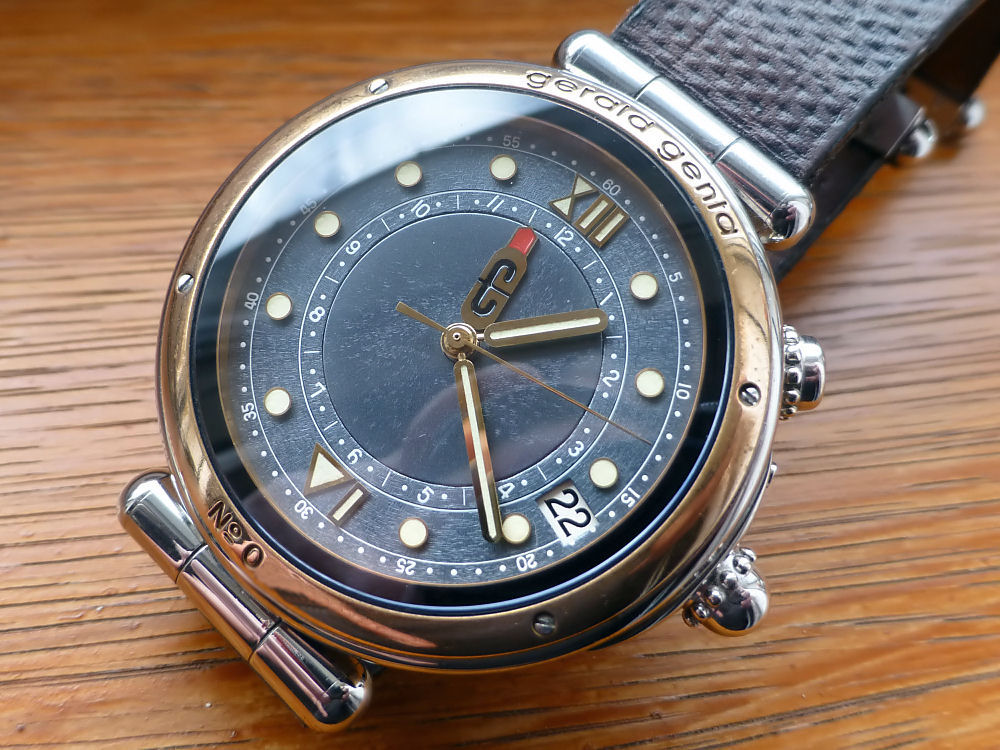
Gerald Genta Bartolomeo Stainless Automatic Alarm Calendar.
Gerald Genta Bartolomeo
Stainless Automatic Alarm Calendar.
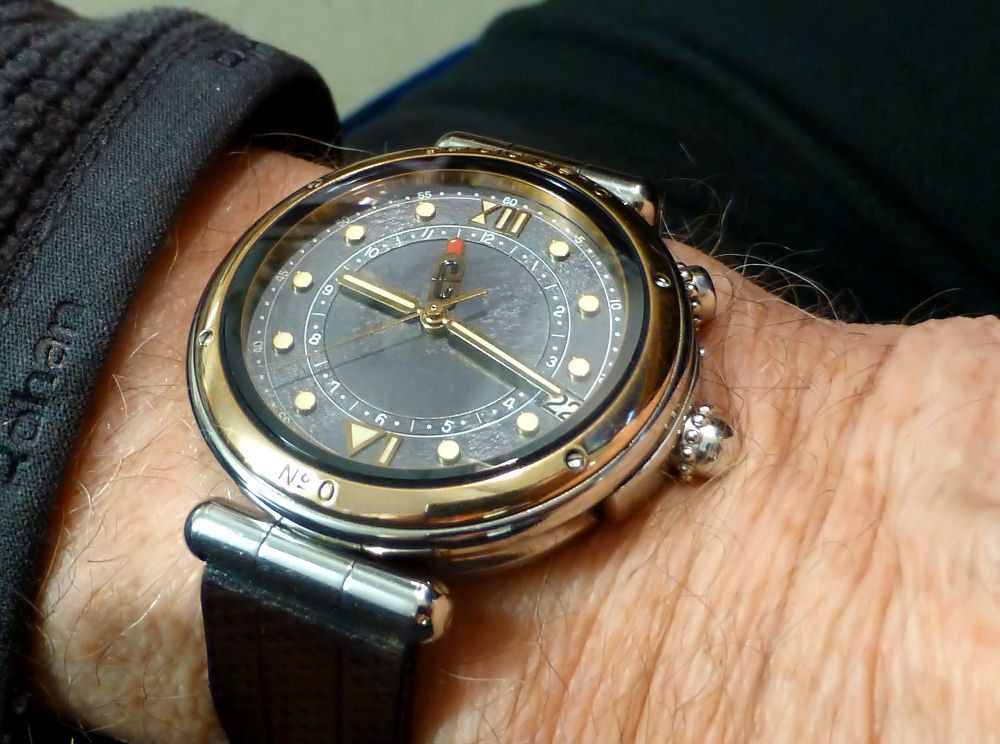
Bartolomeo 40mm diameter Alarm on the wrist

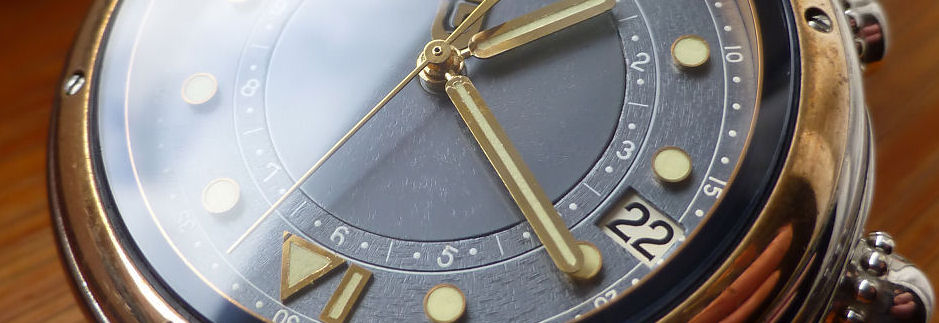
So, this is a Gerald Genta Bartolomeo Alarm Calendar watch with slate dial, gold filled numerals and markers, gold hour, minute and seconds hands plus a GG logo in gold on the red tipped Alarm pointer, which is on a central disc.

The Alarm function is by a central rotating disk and operated  and set by the secondary capped 3 position Crown at between 1 & 2 o’clock.

The watch has an automatic Omega Cal. 980 19 jewel movement, so no winding required.

The time is set by the main/centre crown @3.

The mechanical Alarm is activated by upper crown(between 1 & 2) when pulled out one click.  With the upper crown pulled out two clicks, it disengages the main crown from the hour and minute hands, which allows the main crown to set/move the Alarm pointer hand (disc) – in either direction. Pushing in the upper crown, re-engages the main crown to the hour and minute hands, as normal.
The alarm is as I said, mechanical and the sound is produced by a small hammer striking a gong attached to the movement. It is what I would call (and Omega said this too) a discrete sound and rather nice in comparison to the modern digital ones.

The watch (although automatic) can also be manually wound using the main crown.

Also of note is the fact this Alarm does not require winding – this is done automatically with the normal auto movement (one winding barrel suffices) and is operational again within an hour in normal wearing.

This is almost the same as the Omega Memomatic which shares the same 980 movement. The difference being the Memomatic has a second disc on the dial which indicates minutes, which allows it uniquely to be set precisely to the minute.

The clearly defined dial layout features a large Date aperture between 3 & 4 o’clock and there is a small quick set date adjuster, just below the 2 o’clock position on a small raised case mount, in the form of a small pusher.

The two piece slate dial has applied gilt luminous dot markers, with white minute markers plus gilt baton luminous filled hands.  The bronze coloured bezel is secured with 4 screws.  The crystal is Sapphire and slightly domed.  The watch case is stainless steel, as is the back with said securing screws with the serial number & model details inscribed plus brand logo.  The Gerard Genta logo is also featured on the red tipped Alarm pointer, which form part of the central slate disc on the dial.

The Gerald Genta original T bar leather strap has the original signed stainless steel double deployment clasp.  Case diameter is 40mm ex. crowns. and 13mm thickness.

The very few previous auction sales I’ve seen for this model have been considerably higher, though metal specification obviously a factor.   But I’m very happy I’ve got a bit of a bargain for what is a relatively rare model, so I’m really pleased with my impulse buy!

Gerald Genta watches are seen as an iconic brand and to actually have one is an unexpected surprise and a pleasure – and my Wife has forgiven me since she set eyes on it – she now likes it as much as I do.

Anyway, I suppose it’s all relevant – and whilst maybe a bargain, it was still quite expensive for me at the time.

But as my better half says, “Well you’re a watch collector dear. And we don’t want any old rubbish, do we?”

Update – The watch is still going strong and it never fails to make me smile when I pick it up after a dormant period (I don’t have winders) and it smoothly continues it’s seconds sweep, as if it was never idle. You don’t even have to waggle it a bit – nope – it just starts as you pick it up – what could be better?

Latest (April 2024) – I recently had the watch fully serviced – with a 2 year guarantee no less, no issues found and as good as it was when made – I am very pleased.