
I suppose Swatch watches are known more for their very affordable, reliable and good quality Swiss Quartz models, which started off life back in 1983 as a result of the Quartz revolution, basically from Asia and the inherent danger to the Swiss mechanical models at that time. A response was required and hence the Swatch appeared – sometimes referred to, or maybe popularly called, the Second Watch or SWatch. A model that was colourful, very affordable and also very reliable and with great Swiss Quartz timekeeping too.
However, back in the early days Swiss watches really were famous for mechanical movements, not Quartz, so a few years after the Swatch revolution, for that’s what it was, they also produced Swatch watches with mechanical movements, manual and automatic and always of a dependable high quality.
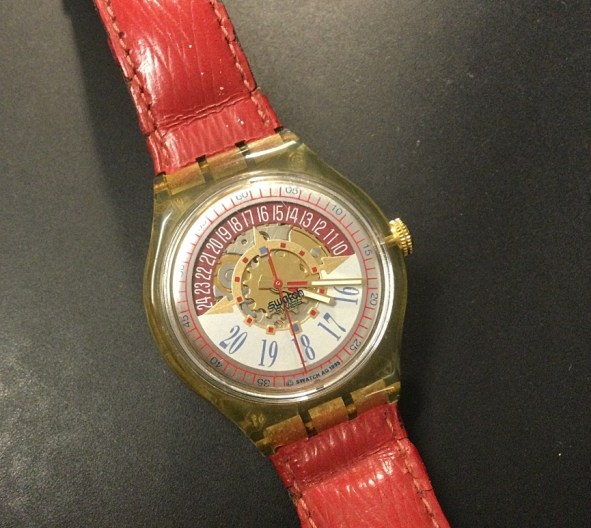
The Terra Cotta (SAK402) is part of Swatch’s “Original Automatic” family, a legacy watch if you will, which appeared in 1996, and this one completely original – with a very decent 23 jewel automatic Swiss movement. This is visible through the full “exhibition” clear back. The plastic case is 36.7mm diameter which is a rarity in itself and not a case size currently available.
On the dial, there’s a neat viewable Date indicator, via a wheel and pointer arrangement, that just sets it apart from the mainstream. And yes, a simple change to the more common date window, but rather nice, as viewing it, you can sort of confirm your place in the month.
The red coloured centre seconds hand, defines it’s movement heritage, as it doesn’t tick each second as a quartz movement does, but rather has a smoother “sweeping” motion, with a smooth rapid tick.
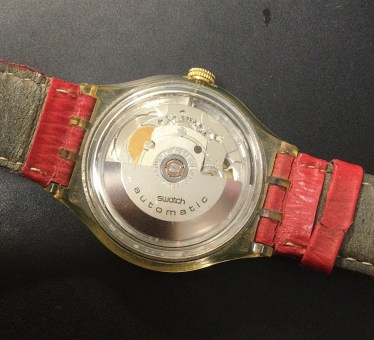
The original strap on this model is of red leather (not plastic), which rather compliments the dial colour and although a bit frayed now, is still OK to wear. I like that as it shows this watch was wrist worn and loved – and to me, this means it was a “daily beater” for the owner and that’s a big plus in my book.
This one may well have been a “home buddy” as it came by way of Zurich in Switzerland and now it’s on the travel trail with me. Though later this year it’ll be back in it’s old stomping ground, as I tend to visit the middle countries of Europe every year. There are no better places for good watch hunting, new or pre-owned.
These were and still are produced in amazing colours and styles and most were Water Resistant, even the Quartz models with their small “hatch” fit battery.
The cases were made of light weight plastic, so almost unnoticeable on the wrist, were it not for the bright colourways they use in an almost infinite range of patterns and dials. Today they often use “Bio materials”, allegedly more kind to the planet, but the philosophy remains the same. And movement wise, so confident are they these days, some movements are completely case sealed – no repairs possible – and in the rare event it stops, throw it away and get another one.
While I’m on about Swatch, I checked out another model that came to my notice, though tempted, have not bought (yet?)
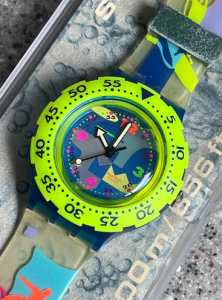
This is the SwatchOverTheWaves, a diver style Quartz powered model – with an amazing 200m Water Resistance. I just love the colour combinations, which seem to work very well.
It will certainly be seen as a statement piece either in or out of the water!
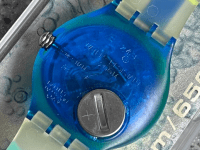
So, whatever the reason Swatch are still managing to produce affordable models, both quartz and mechanical, in amazing colours and styles and most, believe it or not, are indeed Water Resistant, which I find surprising with that small “hatch” rear fit battery.
A success story no doubt and when you might assume a high price for a Swiss watch, these are very, very affordable. They’ve not only managed to compete but some would say surpassed that original fear in the early 1980’s that they would be over-run, by this new cheap technology.
Not so – and in my opinion, Swiss watches still reign supreme. In fact it’s a delight to browse through the current and vintage ranges available today as there’s always something new – and something you can afford!
Note – If you need to change a Swatch strap, make sure you get the correct size and remember they are not held in by “spring bars”. Swatch straps are sometimes measured (but not always) from the outside edge of the outer strap loops or between the outer edge of the case lugs.
However, it is fact that straps can also be measured simply at the widest part, where it meets the case – so be very careful which method is used by the retailer.
To remove the strap, you need a small pointer, such as the small round end of a watch strap removal tool (or Swatch’s own tool) – make sure it’s a slightly smaller diameter than the “straight pin” which will slide through the case lug, the centre case lugs and the strap’s three loops – then gently, from one end, push out the pin. Either use pliers or the Swatch tool to grab the other end and finally pull it out.
Note, I said ‘gently’ – It is important especially if a vintage Swatch watch as if it has a plastic case, it may be brittle, so could easily crack, so don’t force it, but gently does it. Once the pin is out, put the new strap in position, then ‘gently’ push in the pin again. You may have to wiggle the strap slightly as you push it into place, through the first plastic case lug, then the two guides covering the centre of the strap – all in a line, then into the last case lug. Make sure the pin is not protruding and that should be it.
You can also see how to manage this on many U tube videos – such as this one – https://www.youtube.com/watch?v=n6wj95R9BXE
BUT – word of warning –
When it comes to an old vintage Swatch model (such as the Terra Cotta) , the original strap fitting with the trademark 3 x loops lug fitting may be similar – it could be smaller.
And the issue here is, that newer strap loops are larger and wider and may NOT line up or fit in with the original case/lug separations. They are also much thicker at the lug end, than vintage ones, so even if you managed to cut/modify the new strap to fit, so you could refit the retaining lug pin – it could look oversize and clumsy.
In the case of my Terra Cotta here – I’m fortunate the original strap has still got a bit of life in it, so I will not be trying to change it any time soon.
(another option of course is to find a true vintage Swatch for a cheap price and if it has a decent strap – consider swapping the strap)
Anyway, if it does fall apart – I’ll look at my options then and not before.

 Watch space
You must be logged in to post a comment.