
And that’s the thing with Diver’s watches – they look darned good at the poolside or even at the dinner table and maybe if you’ve bought clever – in the Sea too.
Often they’re oversize or at least the hands and numerals are broad and bright too. Hopefully they glow bright in the dark (or should do) of solid construction and will shrug off damage and it goes without saying, they MUST be water resistant to hundreds of meters depth? Or do they?
Back in the day when I used to scuba dive, the deepest I got down to was around 30 odd meters and even then, rarely, and this when I was much younger and my lungs still worked! 😉 Much deeper than that, you were into decompression territory, which was not my game at all.
So the first question is – What depth rating do you really need on your Diver’s watch? I mean, I’ve seen a few that manage many, many hundreds of meters and no, you don’t need one of those, as these are really specialist devices and a bit more than a scuba holiday, splash around the pool watch.
For light recreational diving I reckon (my opinion) a decent dive model should have a minimum of 100m, though my preference would be 200m. These will easily take care of most recreational dives and the odd nut. They will certainly allow pool work and the odd sea adventure for the non professional.
The second question is – Mechanical or Quartz – my opinion is – either.
One of my favourites is my old Apeks Professional 200 AP0406 (quartz) – it’s proved itself for years personally in scuba situations – It was very inexpensive and has never let me down.
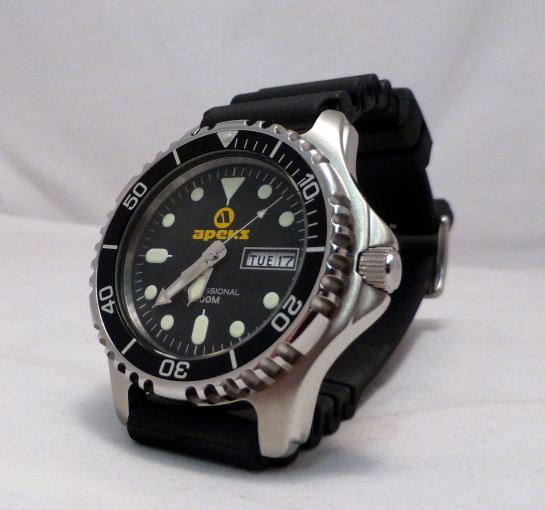
Great luminosity, very clear to read above and below and it’s a very neat watch too.
Note – the knurling on the bezel is serious, nice and figured and easy to grip. The bezel is unidirectional, well lettered and with good contrast, so you can easily estimate how much tank time you’ve got left.
Battery life is around 3 years and luminous dial qualities are excellent (note – I have more in depth – pardon the pun – Posts on this watch somewhere on the site)
So, how do you figure when the battery is about to die on you is to use common sense. I swap my battery every 2 and a half years IF I’m using the watch as intended. If I’m using it simply as a daily beater, as I do with the Apeks, then every 3 years, before it stops – it’s not a matter of life and death.
For me, these days and basically as a daily wear watch, Quartz has it’s attractions, price of course being the main one, because this watch was really NOT expensive for what you get. And for my scuba diving, such as it was, it has proved itself time and time again.
However, if I wanted an alternative to quartz, I’d have to definitely consider as my very first Automatic movement Dive watch choice – I’d definitely (and I have long ago) pick out the Seiko.
Specifically, the Seiko Orange Monster, which is another VERY popular recreational diver model which I also own and use.
It features an Automatic (not quartz) movement and basically as long as I’m moving my arm occasionally, my Orange Monster ticks along just fine. My Monster is a Mk 1 and features the 21 jewel mechanical automatic Seiko 7S26 movement and with the additional Day and Date window shows it’s versatility as a daily wear and for me the day/date is useful, as being long retired I rarely know what day it is! The day and date are easily altered on the first click of the crown. This movement is non-hacking (in other words when you pull out the crown the seconds hand keeps going, as opposed to stopping the seconds hand on say 12, for precise time adjustment). For me I prefer non-hacking which may actually add to reliability and the 7S26 is without doubt, a VERY reliable movement.
Note the Monster also has a very efficient auto winding (rotor) mechanism and if you haven’t worn the watch for a while, it basically only requires you to waggle it in a horizontal manner a minute or two, wear it and it’s pretty much set for the day. Fully wound it easily manages more than 40 hours. In practice my one here managed 45hours! A really great practical watch.
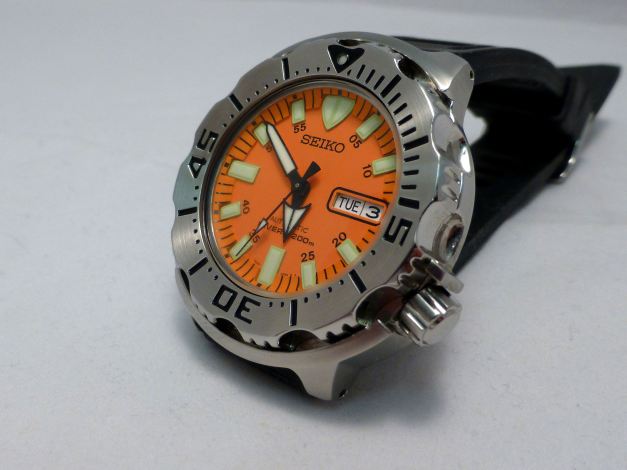
Later models (Mk 2) feature (12 years after mine) the 24 jewel Cal 4R36 auto movement could be manually wound and I understand the Mk 3 had a 6R15 movement with increased power reserve of 50hrs. Apart from these changes, the Monster has only received minor cosmetic alterations since it first came out over 2o years ago – a testament to a model that got it absolutely right first time.
I certainly like the Monster as it’s VERY bright, so good to read underwater and low light and is built like the proverbial brick outhouse! Big heavily figured bezel, large clear dial, great luminosity and solid construction, make this a very, very popular choice for many.
For me either of the two models featured here would probably still be my starter model if looking for a versatile day/diver watch or even taking diving just a tad more seriously.
They both do what they say very well, be it Seiko quartz or Seiko automatic, as both movements are very reliable and difficult to beat and regardless if your first diver or not, these two will last a lifetime and more.
Now I know some folks will say I have featured these before and that is true. But there are watches that for many reasons have proved to be so right, it’s always worth introducing them to new audiences. So no apologies from me.
But there are many others out there these days and maybe I’ll find another one that manages to get the basics right.
And that’s important – and not always the case, so I’m hoping there are more around and if so I’ll feature it or them on a future Divers Part 2.


 Watch space
You must be logged in to post a comment.