Another pair of those “modern” watches that are really outwith my “quick glance” category – ie: models where telling the time can sometimes take a little bit of time!
First off today is this rather unique watch from 666 Barcelona – called the Barcelona Urban Dual Time Zone Automatic-Circle watch!
666 Barcelona Urban – 3 dials, 2 Time Zones
Now OK I’ve already got a splitting headache coming on, yet it does work in an odd way (if you’re partial to migraines) as it uses a 3 or is it 4 dial, if not quite conventional display, in a slightly different manner from the normal.
Quite cleverly it displays the Minutes with the large thick centre hand and the two sort of sub-dial either side tell the Hours in two different Time Zones. The smaller dial at the bottom shows Seconds – which is actually quite neat when you think about it. And that’s my problem of course, you do have to think about it, as you have to estimate the hour and minutes against the very outer edge 0 – 60 track markings, with hands that are just a bit short as accurate pointers.
The watch dimensions are 53mm x 45mm wide x 10mm depth, so a decent size, though even at that, if you’ve forgotten you spectacles, you’d be quicker just asking someone the time – it might be easier!
Now I think the left Time Zone reads 1:05 and the right Time Zone reads about 7:35, but I’m not really sure. I feel I want to get a ruler and extend the hands nearer to the outer time track, but hardly practical.
666 Barcelona Urban with 2 Time Zones
This next image shows different times – I think the left one is the standard sale time of 10:10 and the right one is 7:10? – even with the straight on view this is pretty tricky to judge. So as a not so “quick glance” watch – it’s a winner.
Which is a pity as perversely I quite like it! even though that migraine is simply NOT going away!
But the next model is moving ever towards epilepsy!
The JCDC Castelbajac designed “Space cowboy” watch seems to be a contradiction in terms – and by that I mean “design” and “watch” seem distinctly at odds with each other. The prime function of the watch concept seems to have gone walk about and for me is really quite relevant, as I struggle to even see the hands against this childlike scribble on the dial background
JCDC Castelbajac design “Gone with the wind”
With the conflicting black lines of the sketch? and the black hands I find that to read the time is just about impossible. I do believe the three year old daughter of a neighbor of mine could easily improve this by having a go with the artist paint set she got for Christmas – I really do.
So once again it’s pretty obvious this model also doesn’t pass my “quick glance” test . . . . . . . not even close!
Note – I hasten to add here that the opinions expressed are entirely my own, subjective as they no doubt are, but nevertheless are personal. There may well be folks out there who disagree and regard these models highly and of course I fully respect their opinions too.
If they would be so kind as to let me know the name of their optometrist, I would eternally grateful. ;-
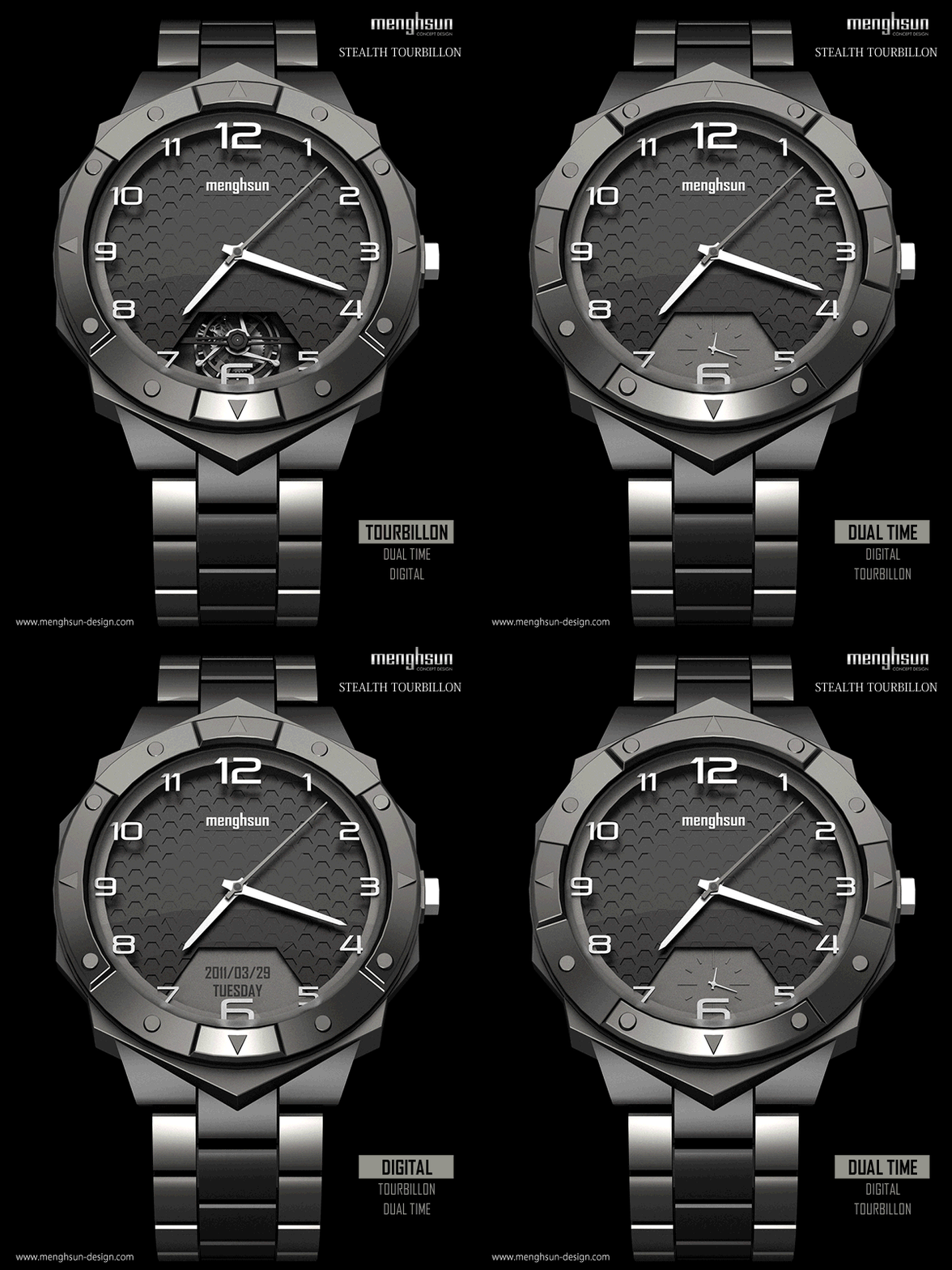
Well this is definitely different – OK a concept watch presently and stealth owing to the angular case patterns apparently. Though lowering it’s radar signature doesn’t seem quite apt for a watch!
In this titanium alloy model, rotation of the bezel activates capacitive touch sensor buttons under the four directional arrows, which alters the display as shown on the image. Dual time, Date, Alarm Compass and perhaps even Altimeter – the possibilities seem amazing.
Which leads me on to the actual subject of this weeks Post – Stealth watches, what are they?
According to the Thesaurus at reference.com –
stealth mid-13c., “theft, action or practice of stealing,” from O.E. *stælþ, which is related to stelen (see steal), from P.Gmc. *stælitho (cf. O.N. stulþr). Sense of “secret action” developed c.1300, but the word also retained its etymological sense into 18c. Got a boost as an adj. from stealth fighter, stealth bomber, radar-evading U.S. military aircraft, activated 1983.
So pretty simple then 😉
The Redline Stealth – press the red button and retire immediately!
Anyway I seem to have heard and seen quite a large number of “stealth” watches, though what this term actually means regarding a watch is somewhat varied and open to interpretation. Aeronautical folks would say that it means that whatever has been “stealthed” will avoid radar detection by reducing it’s surface signature. Breaking up the outline with angular planes so that radar struggles to detect it. OK I get that, but applied to a watch?Or it might mean that it’s black or gray and almost impossible to see, by not only casual passers by, but perhaps even the wearer!
Citizen Stealth – any color as long as it’s gray!
Another interpretation is a hidden on demand digital LED display on an otherwise analog dial watch – press the button (why are they always “detonator” red?) and hey presto, there’s a bright LED digital display – OK – actually I can go along with that one.
And I thought I knew what Stealth was!
But “seriously” I think that maybe the most common take on “Stealth” does appear to be a black case, black dial with gray numerals – or is it difficult to see blue numerals, I could be wrong . . .!
Then there is the fascinating fact that although some watches are advertised by dealers and sellers alike, as “Stealth”, the actual manufacturers don’t always describe it as such.
Citizen Stealth – I just hope it’s luminous!
So it seems that it’s another of those emotive words used to sell the watch to the fanciful buyer, or one who just loves that “look” on their wrist for a bit of fun! Like Commando, Infantry, Covert and so on, but whatever the interpretation of this “Stealth” term one thing is absolutely sure, it promotes some extraordinarily fun looking watches!
The Gulper Shark – you can’t help wanting to press the plunger!
But beware if you’re looking for quality then it might be better to view the term with an open mind, as it’s not always synonymous!
Shark – Gulper analog – PRESS the red and LED pops up.
I’m also not going to say anything about these models as regards quality or function, but simply show this collection of models to feast your eyes on.
These particular models are or have been described as Stealth and the last one, the Gulper Shark (what a name!) so described on just one obscure cached web page – but the red detonator button absolutely does it for me – I simply can’t wait to press it! 😉
And as a serious watch collector I wouldn’t be seen dead wearing such a thing – would I?
Oh yes I would – the RED detonator does it – it’s brilliant!!!!
Here is an amazing concept watch called Stealth Tourbillon, inspired by stealth fighters. Featuring sharp lines and edges, the watch is crafted with titanium alloy. The highlight of the concept is its ability to switch modes from analog to digital. You change functions by rotating the face dial. Switching to the Dual Time module shifts the focus to the different time zones. In the Digital Module the user can set the date and alarm and access many other functions like compass and pressure meter.
Here is an amazing concept watch called Stealth Tourbillon, inspired by stealth fighters. Featuring sharp lines and edges, the watch is crafted with titanium alloy. The highlight of the concept is its ability to switch modes from analog to digital. You change functions by rotating the face dial. Switching to the Dual Time module shifts the focus to the different time zones. In the Digital Module the user can set the date and alarm and access many other functions like compass and pressure meter.
Have you ever wondered why some watches seem to fit your wrist and others don’t? With the prevalence of ever larger watches today it can then be a real downer once you’ve found that great watch, to find it’s just too big – you look geeky and your friends laugh behind your back – “Gee, Marty, What IS that on your wrist, Man?”
It’s true to say that year on year watches have increased in size and where in the 1940′s a small rectangular model for gents would be small even for a Ladies watch today. When round models became more fashionable just 30 mm diameter was common, then what I call the Patek Philippe size, 36 mm became the “norm”. Over more recent years 40 mm has been very acceptable and today, well 45 mm and upwards is becoming commonplace.
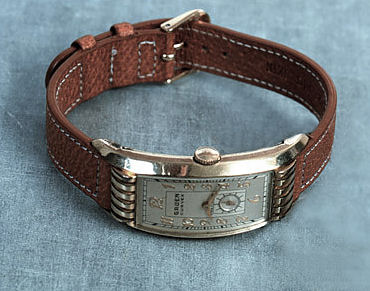
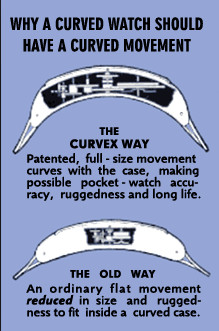
However the odd thing is that the average wrist size has hardly altered in all that time and the average (World) wrist circumference is only 6.5″ – or 165 mm and nowhere near as big as many think. And as the image on the left shows, there was a recognition even in the 1930′s and ’40′s that watches could be rather too large for the wrist, hence the wonderful Gruen “Curvex” model shown. To assist fitting to the wrist curve Gruen actually made the movement on different planes, thus “curving” the total mechanical train system. I think Watchmakers of that time would be amazed at the size of watches today that seemingly have no consideration whatsoever of wrist size.
In regards to wearing a watch that is “sized” sensibly, I’m sometimes amused when I hear some guy saying that wearing a small watch – say 38 mm diameter is proportionately silly. Looks like a kids watch I hear him say. Makes me wonder where he gets his idea of proportion from? Put another way, it’s funny that I never had any snide comments like that when I wore my 36 mm diameter Patek Philippe – not one!
Now OK it’s partly about personal taste, but mostly it’s influenced by two things – the first is what the watch manufacturer produces, or in other words what is available to buy. And second is fashion and what “style” are we wearing this year.
But still the majority of us wear watches (though kids today use their Smartphones) and we very often use the internet to get search out our new watch. We check the model of interest, note any measurements given, then decide on whether it’ll fit or not. The trouble is that often the dimensions you need to make that assessment are not given. Typically the watch model blurb might note the diameter in millimeters (mm) and perhaps the height or thickness, which whilst an indicator is not really what you need. I would note that the diameter mainly refers to the width across to the crown, east to west. Indeed it’s often noted as with or without crown (not with or without lugs).
Lug to lug – need to know!
There’s rarely a reference unless your lucky, of the lug to lug measurement and that’s possibly the most important dimension of all. Because that’s effectively across your wrist, not along it as diameter “width”. You basically need a combination of two particular dimensions and then you will have a true indicator of fit. However it is also very useful to know what size your wrist is . . . or your wrist circumference.
Watch case dimensions can be given as (1) diameter or width, (2) height or how thick it is. The first one, the diameter or width is not too important, though obviously if far too large, it will look like a wall clock on your wrist. Now the diameter width can be reasonably large, but invariably influenced by crowns, lugs and strap/bracelet fitment. The second dimension, the height is useful, as it gives an indication of “under the cuff” wearing (under a shirt sleeve for example) and it can certainly have a bearing if the watch overall is a bit larger than you’d normally wear, as if it’s not too thick, it’ll not look too clunky on your wrist.
However when we come to the lug to lug dimension, for some unaccountable reason it always leads to confusion.
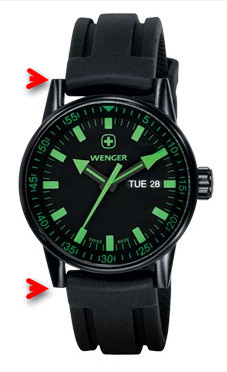
Lug to lug dimension – approximately 6mm total larger than diameter.
Yet it’s so very simple – It is the total distance between the top edge of the top lugs to the bottom edge of the lower lugs. Top to bottom. And because this is where the strap or bracelet will start from the case spring bars and start it’s journey around your wrist, it is the most important dimension of all.
If the lug to lug distance is too large, the watch case basically overhangs the width of your wrist and the strap will not immediately go around your wrist, but rather drop vertically from the case overhang, down the sides of your wrist and then around. In other words the lugs will overlap and overhang your wrist and in those circumstances the watch is just too big (however there are ways to reduce the oversize look – see later).
Wrist size and lug to lug.
Now my wrist circumference is approximately 170 mm ( so just above the World average, surprisingly) and most of my modern watches are no larger than about 50 mm lug to lug. At that size or preferably under, the watch sits on top of my wrist as does the strap/bracelet for the first few mm then wraps around the wrist – perfect fit. And it looks right.
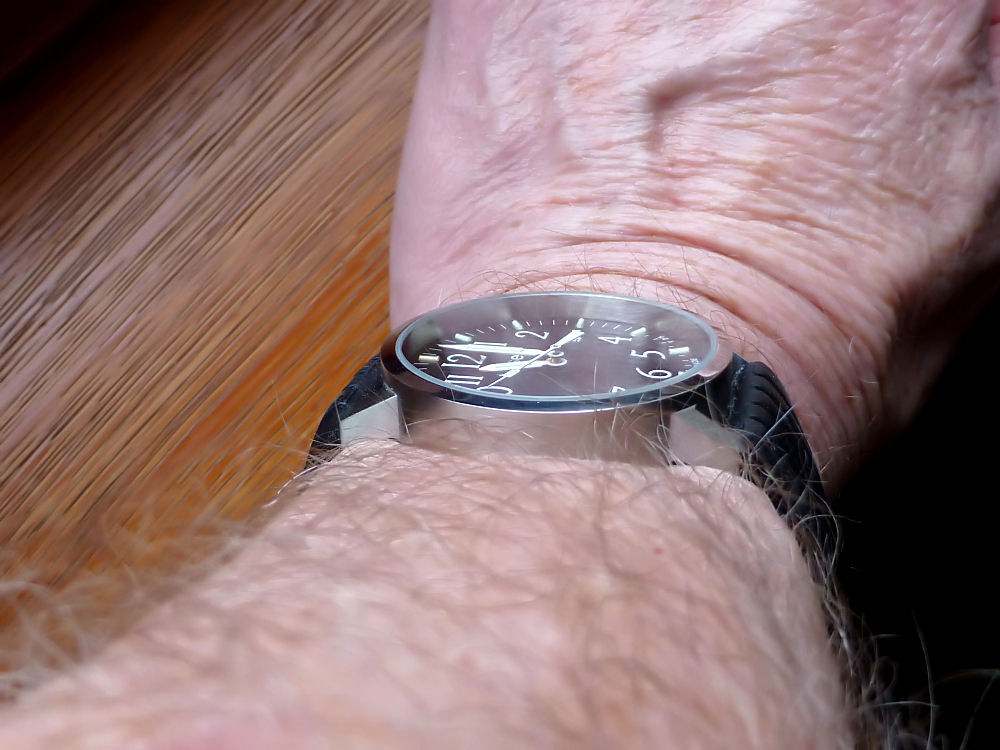
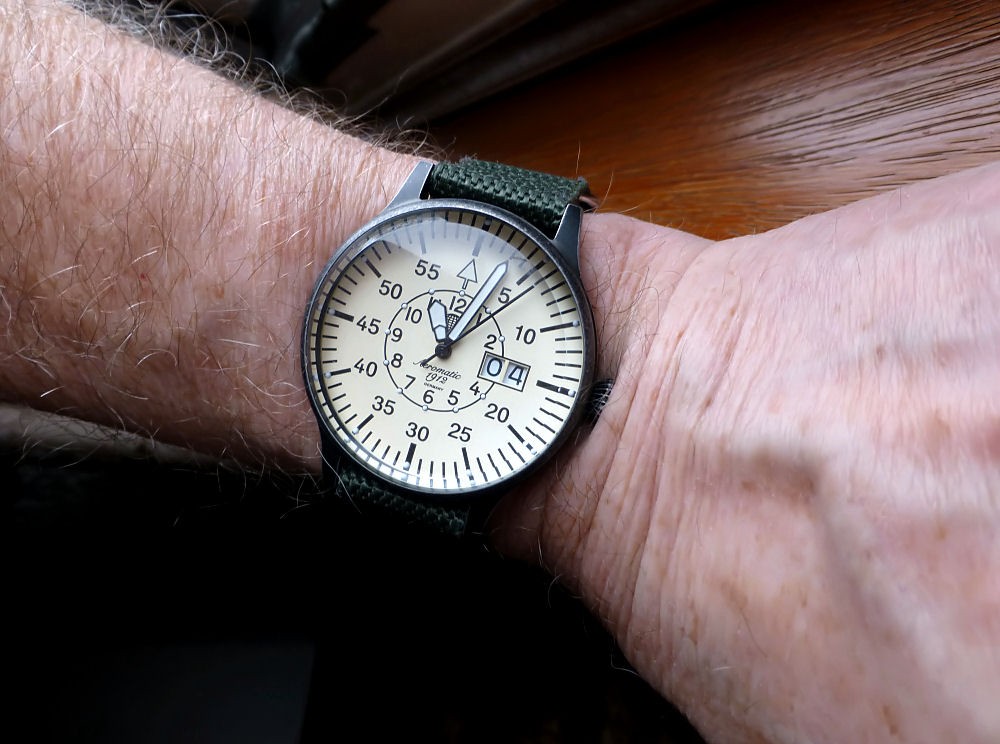
However the largest watches I own are (Fossil, Pulsar, Aeromatic, Casio) and all are oversize for me at roughly 53 or 54 mm or larger lug to lug. I can get away with 54 mm just, as it’s relatively thin and it sits low on my wrist and came with a very flexible soft silicon strap. Another when I first got it was hopeless, as the strap was really thick and stiff, which effectively made the watch even larger – I replaced it with a very soft flexible silicon one and it hugs the wrist so well now, it looks fine. The third one I again changed the strap to a Fast wrap – and what a difference that made (Aeromatic). Yes it’s big, but it looks OK (see image), so in these instances unencumbered by a large, heavy and stiff or molded straps – I got away with it. So a tip for those who end up with that larger than ideal model – check out alternative straps – they might solve your problem. I was defeated however with a Citizen Attesa. Lovely watch and one I always wanted but it was 56 mm lug to lug and not possible to change the strap/bracelet and it was just too darned big. I sold it on Ebay.
With my 170 mm wrist I also have to be wary of rectangular watches, as some can easily be 60 mm lug to lug, which is impossible for me to wear. Also care should be taken when considering any model with incorporated bespoke straps or bracelets, such as G-Shocks for example, as they effectively can be very large lug to lug AND have a preset, molded, stiff curve strap/band arrangement, which will almost certainly not match the circumference of my wrist. And no use for me.
So if you can avoid fiddling around by ensuring you get closer to the right size for your wrist right at the start, this has to be good.
A rough guide –
A reasonable approximation to what size watch will suit anyone is to reckon on 27% to 29% of your wrist size.
The guide in my case is (170 mm x 27%) = 46mm. Which is (for me) the ideal lug to lug size for a good wrist fit.
I can allow an addition of +12% (up to around 52mm) and still look comfortable. Consideration can also be made for lug shape and size, whether curved down and so on, but usually over that size a strap change might be in order or maybe I should look at another model.
OK it’s not a hard and fast rule by any means and is an indication only. Most men probably fall into the range of 27% to perhaps 29% of wrist circumference as the ideal lug to lug. Of course once you’ve got your size in mm or inches worked out, then it’s easy. Optionally rather than fiddle about with % figures, simply check the lug to lug of your favorite daily beater – ie: the watch you wear every day and if it’s 52 mm then that’s your ideal lug to lug watch size.
And what if when looking at watches on the net no lug to lug dimensions are given? –
Well as most lugs project from a watch case diameter by anywhere from 2 to 4 mm – so unless these are really oversize lugs, which should be obvious, that figure x 2 will give the approximate lug to lug size and you’ll not be far wrong.
So a watch with a given 45 mm diameter with the average lug projection of say 2 x 3 mm, will be approximately 51 mm lug to lug.
Articulated lugs – This Laco will fit most wrists.
So there you have it. Not an exact science by any means as folks wear their watches in different ways anyway. Some love them loose like a large bracelet where the watch swings around, others like myself like them neat and taut to the wrist. Others tend to like big and chunky regardless of whether it fits or not as long as it look macho and if that’s your thing, then that’s fine too.
Over the past few years the trend has certainly been for ever larger models, which is a little odd when you consider most electronic modules are reducing in size, so I suspect it has little to do with technology and everything to do with fashion. Though I’ve noticed recently that this trend may be changing and indeed some well known brands are actively reducing model sizes, even down to 39/40 mm.
I just wonder if sales figures are driving this change – after all if the watch is too big, you effectively rule out about half the world’s population.
Wall clocks are for walls . . . . . . perhaps this should be a new slogan! 😉
Well it was one of those days where you manage to do what you said you’d never do – and that’s impulse bidding at an auction. I mean there you are zeroing in on that little vintage model you’ve been after for ages, the estimate is £80 to £140 and you’ve got the cash in your pocket and Bam! the bids suddenly thick and fast between 5 or 6 phone lines and the internet goes cosmic, through the roof and so far above your budget that you feel really quite inadequate – out of your league. And before you know it, your day, full of expectations that it was, is no more. Gone in a flash of someone else’s money and your item well out of reach.
Then, would you believe it and before you can even go off for a shell-shocked sulk and a cup of coffee, the next item’s up and, Hello? one that you’d never even noticed, such was your tunnel vision towards the previous one – and suddenly there’s this absolute gem – it’s there – right in front of you. . . .
Wow – I’ve been looking for any one of HIS – for ages! And the estimate is what? That’s not too bad you know – just maybe I could wing it and swing it! Then you think – oh oh, what’s wrong with it? Maybe it’s a “come and buy me” estimate to lead you on . . But no time to check it out . . . damn . . . .
Nothing much said in the description and that estimate seems awfully low, so big decision – do I take the chance?
And looking around I don’t see that anybody else has actually spotted it either – after all I didn’t, sandwiched as it was between the big boys or should I say the big name boys, because that’s what the Dealers here were obviously snapping up – to resell at inflated big City prices to their retail suited pals. You know the usual Omega (there are soooo many of the darned things), the Rolex’s (are they really that good?) and then Tag and the Muller – you get my drift. But this one is just, well, sitting there, almost hidden by the weight of the buzz names – so maybe . . . just maybe . . . .
Sod it! – I’ll have a go – what’s to lose?
Well the first bid is just plain silly, derisory really and after that it basically just creeps up. This in itself can be deceiving as it could suddenly take off, but sometimes, just sometimes it bombs and often without a reserve somebody gets themselves a real bargain. And that’s my hope here. So wary of that possibility I quickly jump in don’t I – I mean it’s the obvious thing to do – because – you never know . . . and then, bid, bid, bid and before you know it – it’s all over and the auctioneer is looking at the buyer, saying SOLD to . . . . . and I’m looking around me like an idiot – SOLD to – as I catch his eye – Yes! it is – Moi! Yours truly – as I fumble with my auction “paddle” which was stuck in my jacket, ripping the pocket as I struggled to get hold of it and hold it up!
Wow! This is just so brilliant. I’ve just paid …..HOW MUCH? ( I can still hear the echo from my Wife’s shriek!) for something NOT on the menu – and the lot number, whatever it was is off the large screen and the auction is going on without me. Is this a dream or what? And was that my bank manager smirking as he turned away at the back of the auction house – I’m sure it was . . . . I never knew he even went to auctions . . .!
Anyway – it was no dream and you might just wonder what on earth I bought after all this excitement. Well here’s a clue or two . . . .
The watch was designed and signed by a guy who was perhaps one the best designers of watches – ever. In 1966 he designed the Universal Geneve Golden shadow range of watches, then in 1972 designed the Audemars Piguet Royal Oak and in 1976 the Patek Philippe’s Nautilus, then cases and dials of the Omega’s Constellation and Seamaster watches. So quite a pedigree! He also contributed to the designs for the Ingéneur, The Pasha Cartier and the 222 Vacheron Constantin, Piaget, Chopard, and so on and on . . . .
He had his own Watch Company from 1981 till 1998 and another from 2001 under a different name. All his watch models are quirky, unique and novel, very technical and high specification and often quite expensive. Octagonal cases he particularly liked and played around with, even producing a Mickey Mouse model or two just for fun.
My model was from 1995 so bang in the middle of his best production period – and it’s actually quite rare! There’s only a handful been sold at auctions in the last 10 years and this one changed hands twice before it got to me. In fact apparently not many were produced, so is very much a limited model. So I better check this out – now in my hand.
OK, the watch goes as soon as it’s touched – always a good sign. The quick date pusher works perfectly – OK. Oh oh – the alarm stem is and feels completely disconnected, so no rotation of the alarm disc, winding or setting- OK? BUT – maybe I don’t understand how to set the alarm. Often these watches have a sequence to follow to move the alarm set pointer – so I’ll have to investigate further before passing judgment. The case is in very good condition – a tiny dint in the sapphire glass – OK, a screw missing from the stainless steel back (should be six only 5) – OK and the original leather strap (with tolerable wear) and deployment is for a large wrist – OK. Soo it all looks fixable . . . . . .Phew!
So after all that – here are a few images of my impulse buy.
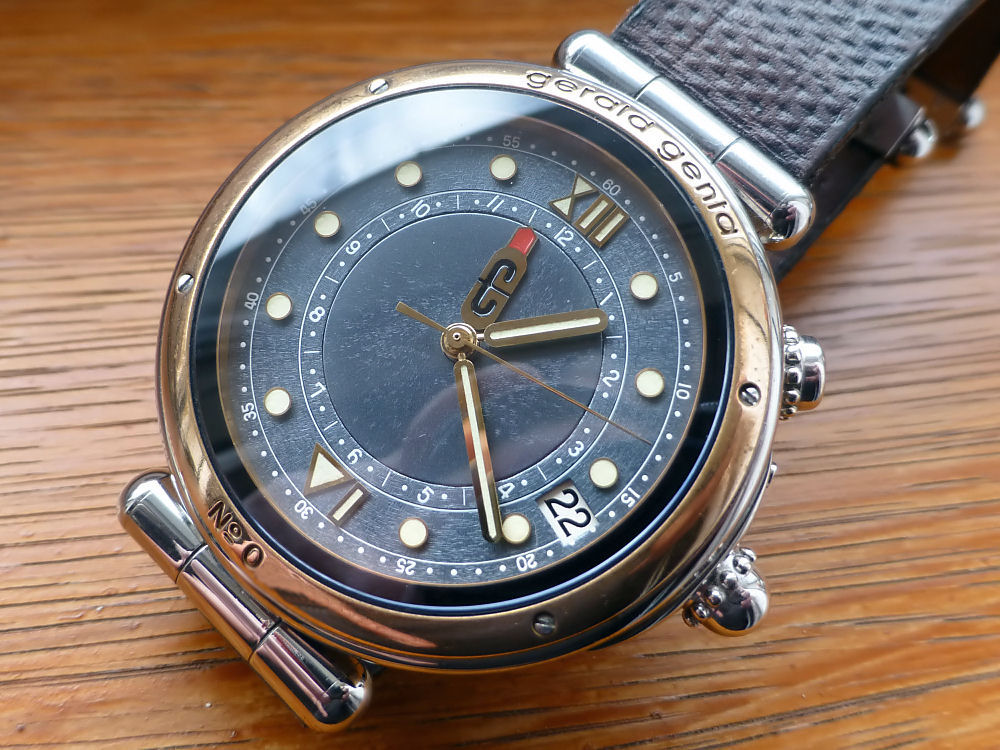
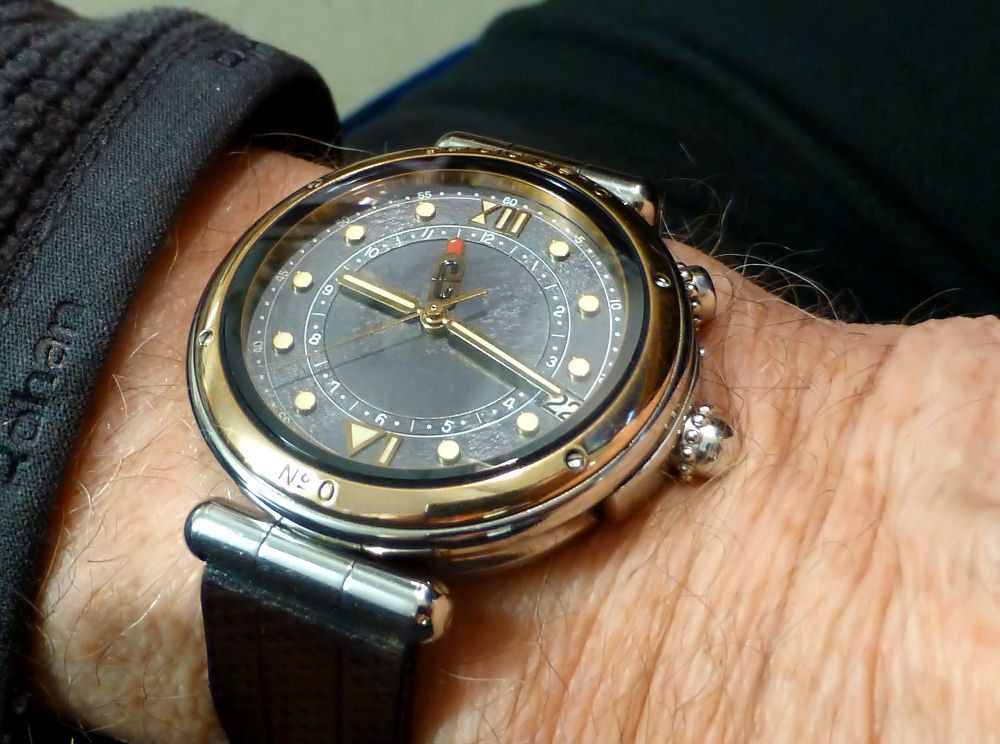
Gerald Genta Bartolomeo Stainless Automatic Alarm Calendar.Bartolomeo 40mm diameter Alarm on the wrist
So this is a Gerald Genta Bartolomeo Alarm Calendar watch with slate dial, gold filled numerals and markers, gold hour, minute and seconds hands plus a GG logo in gold on the red tipped Alarm pointer.
The Alarm function is by a central rotating disk and operated and set by the secondary capped 3 position Crown at between 1 & 2 o’clock.
The watch has an automatic Omega Cal.980 movement so no winding required. The time is set by the main capped Crown at 3 o’clock. A Date aperture is between 3 & 4 o’clock and there is a quick set date adjuster just below the 2 o’clock position on a raised Crown mount in the form of a small pusher.
The dial indicators are luminous filled (perhaps Tritium) and the gold colored bezel is secured with 4 screws. The crystal is sapphire and slightly domed. The watch case appears to be stainless steel as is the back with 6 securing screws and serial & model details inscribed plus the Gerald Genta logo. The Gerald Genta original T bar leather strap has a signed stainless steel double deployment clasp and the watch diameter is around 40mm ex. crowns.
A point to note is the case materials used are not known. I’m unable to find detailed information on this model, so whether stainless, gilt or solid gold, the case and bezel materials are a bit of a mystery. Without metal marks I assume a stainless steel case and unknown bezel. However and whatever, the price I paid is still a pleasant surprise. The very few previous auction sales I’ve seen for this model have been considerably higher, though metal specification obviously a factor. But I’m pretty happy and a bit of a bargain considering it’s quite a rare model, so I’m really pleased with my impulse buy!
Gerald Genta watches are an iconic brand and to actually have one is an unexpected surprise and a pleasure – and my Wife has forgiven me since she set eyes on it – she liked it as much as I do.
I was looking around for a good digital watch that had a conventional strap or bracelet, as you know I have thing about “bands” as they are sometimes called. The reason being that too many digital watches that may well feature a good functions set, invariably come with, and in my opinion let down, by having a bespoke rubber/resin/PU style fitted band fitted and some are even integral to the case.
Typical moulded bespoke band/strap arrangement
And when looking at pre-owned digital watches that are for sale, the strap/band or whatever, is usually a replacement from possibly another watch in the series. The original more often than not became brittle, split and then replaced. Trouble is the watch is now obsolete, the strap is not available or if it is, all too often at an inflated price – hence an alternative is found and fitted as best you can. And that’s the big problem with these, apart from the fact although you love the watch, you might not actually like the band too much, or it may be too long, too thick, hard on the wrist or whatever – you’re stuck with it.
Bespoke strap, but not so easy to replace and look right
So I tend these days to look for a digital multifunction model that has standard lugs and pins every time, because then straps are never a problem. Of the big two, Casio and Timex, fortunately the latter has quite a number of models that feature just that – a conventional strap fixing system – not bespoke. So that’s good, certainly for me, as in general I find Timex digital function settings and operating modes more intuitive than Casio. But that’s maybe just me.
With your everyday daily beater, the ability to have easily changeable straps is even more important, so again I prefer to have a standard lug and strap/bracelet fitting. You might, for example, fancy a change of look and would like to fit a NATO style or G10 military strap, as they slip under the pins and are easy to fit to any size wrist. But though very successful even these have issues. They often can be rather long and not easily or neatly shortened and I well remember in the old days, cutting the strap then using my lighter to “seal” the end to prevent fraying). Also fastening can be awkward with the strap rings and often you have a double strap between the watch and the wrist making the watch effectively thicker. I used to cut off the “loop” so only one strap was under the watch.
Silicon deployment straps on the other hand are a great favorite of mine as they are very comfortable and fast to wear. Of course they need to fit to a watch with the conventional lug and pin arrangement and I often use them to replace the supplied straps or bracelets. The issue of course is that to fit them to your wrist, you have to cut the silicon rubber strap at set points along the strap, so it would not suit someone else if they had larger wrists for example. However, not a problem for me as if I sell the watch on, I simply replace the original strap. The advantage to the new buyer is he gets a brand new unused and original strap with his new purchase.
Some strap examples. Silicon deployment, Butterfly and Fast Wrap Velcro.
But for sheer ease of use and practicality the Velcro Fast Wrap strap is to me one of the absolute best solution to everyday watch wear.
It seems to me that Timex maybe pioneered to the mainstream the idea of the next generation of NATO style straps by introducing the oh so simple Fast Wrap and in particular my favorite, the Velcro Fast Wrap. Incredibly easy to fit to standard lugs and will fit instantly to any wrist, regardless of size. And this is a perfect fit, none of this between holes situation as with a conventional leather or PU strap with buckle and pin. It simply feeds through the lug pins, pulled to fit and smoothed down – job done – every time! And let’s see a pickpocket steal that! Because it takes a sustained pull to part the Velcro with that well known velcro riiiiiip sound!
Classic Timex Fast Wrap Velcro – best for your daily beater
So what I’m saying is for those daily beater situations a good cheap Velcro Fast Wrap strap beats them all – conventional leather buckle strap, the bracelet, the deployment and clasps, the pull through, Butterfly and the NATO – all of them.
I show here one of my Timex vintage models with it’s original Timex Fast Wrap Velcro and also the much larger Aeromatic with an independent “Sports” Fast Wrap Velcro strap which made that watch so much better to wear than the original.
Different sizes – no problem – Fast Wraps manage it all.
The supplied strap was far too hard, stiff and uncomfortable – but as the watch had standard lugs and pins – this was easy to replace and now this watch gets a lot more wrist time than ever before.
Note – that as in fitting a NATO strap, the strap fits under the watch case and often with 2 parts of the strap. If you feel this makes the watch too thick on the wrist, you can depending on the strap, cut this loop part off –
See the image of my Aeromatic above which shows the back of the watch (the one on the left) – note the black part above and below the case, but the part against the case back is green. This is because the double part or the black part that should be there has been removed, cut off, as it was not required. The Aeromatic model has a fairly thick case to start with so I simply cut that loop out.
To “wrap” this up (sorry!) here are a few images of Fast Wrap Velcro straps that are available – and there are lots around at very reasonable prices. There is no doubt that the Velcro Fast Wrap is a very practical solution to straps and bracelets that maybe don’t work for you – BUT – you must have a model that has the conventional lug and pin arrangement.
However to find a digital watch today that has that convention is becoming harder, as the after market sales of these bespoke straps are terrific (and cynical in my opinion) money earners indeed to the watch company. However standard lug/pin fit watches are around. (I have 8 of them). Now of course not all 8 have been changed to Fast Wrap as the supplied straps of some are fine, but those that weren’t quite so good – were changed to either silicon deployments or increasingly Velcro Fast Wraps and they work every time!
The Apollo Fast Wrap – a favourite of mine.Velcro Fast Wrap, neat and fits all wristsMainstream brand Fast WrapThe “Sports” Fast Wrap Velcro strap – as fitted to my Aeromatic
Unfortunately, today you’ve got to look very carefully to find a British watch – and this would have been unthinkable 200 years ago, when Great Britain produced over 200,000 pieces, or half the world’s supply. Though we are talking of another world in terms of watchmaking, as most all of them would be hand made. This incredible fact I picked up the other day when checking out the great-british-watch.co.uk web site run by Colin Andrews, who knows a thing or two about watches and watchmaking. If you want to know more about him and British Watchmakers, then HERE is where you can find this excellent site and some great information.
It is indeed fact that to find a true “Made in Britain” watch is not that easy and in my watch collection I only have a few models, which apart from one are vintage models. So as this is about British Made, I thought I’d re-post an excerpt from an older 2010 feature I wrote on one particular model, which is as good today as the day it was made.
A simple and stylish English under-statement of timekeeping – a Smiths Astral gold plate Gents watch from the 1950′s.
Smiths Astral 17j
An elegant watch indeed and with “Made in England” below the 6 makes it a rarity these days. Produced by the Smiths Watch Company in the 1950′s it shows all the best attributes of English watchmaking.
Lovely blued steel hands on a virtually unmarked clear dial plus a red filled tip centre seconds hand and with neat raised numerals – it is quite simply – a classic.
Not a UK built or assembled watch with a Swiss movement, but an English watch built with an English movement too – and in reality a darned good one at that – so a bit unique in my opinion. AND as it happens this one is pretty much original and in superb condition – another plus.
I’m sure this one will receive quite a bit of wrist time which is always a good sign as my philosophy on watch collecting is simple – if I get it I have to wear it.
——————————————————————————
So back to today –
That was an excerpt from my article about the Smiths Astral watch I posted in 2010. I can also confirm that has been worn quite regularly ever since. In fact it shares equal wrist time with my vintage Swiss Blancpain dress watch and both a delight to wear.
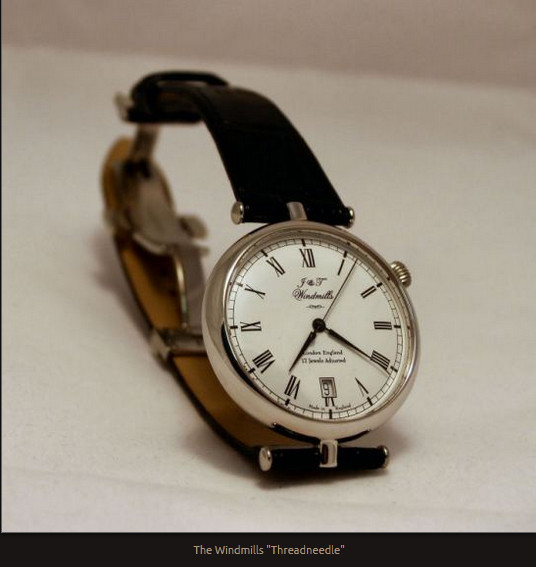
I also have a non vintage 60% “Made in England” J&T Windmills watch, which within it’s elegant solid silver case sports a Swiss ébauche movement.
For the uninitiated an ébauche (blank) is a generic movement from vendors such as Swiss ETA or Sellita, who supply clients who don’t have in-house movements (and let’s be honest, few do). The client assembles and fits this movement to their watch, often modifying certain elements for their own purposes.
So the J&T designed in the UK, has a Swiss hand wound movement and is UK assembled and worked. I bought it in 2009 and it’s an elegant model with an interesting and original Windmills design dial.
J T Windmills “Threadneedle” Made in England model (60%)
Today as I understand it there are only two (2) true 100% “Made in Britain” watchmakers (according to great-british-watch.co.uk) plus around half a dozen others with varying percentages of British parts or manufacture.
So perhaps seeking a 100% “Made in Britain” watch brand is being unrealistic. A 100% “Made in Anywhere” watch is just about as rare! However finding a watch maker who sources from good quality components and assembles, perhaps modifies and produces an own Brand watch is something else – and easier to find.
After all there are relatively few Watch Makers who do produce 100% of their own models. Parts are often out-sourced, perhaps too the watch case, dial and movements. Movements are sourced from Japan to India to Switzerland and China, then assembled in the home country (as the J&T Windmills) and far from being the precedent, it’s very much the normal.
So what about British Watchmakers – are there any and if so – are they any good?
Well we have J & T Windmills with about 60% Made in Britain, so pretty much on a par with the Swiss edict, but we can do better than that . . .
Our only 100% British watchmaker (as I understand it) is Bremont, located in Henley on Thames in England.
Not as well known as Swiss brands perhaps and relatively new with their first watch appearing in 2007 after 5 years in development. They tend to specialize in mechanical Military and Aviation inspired chronometer models.
Bremont Alti-B Chrono Made in Britain
They do however assemble and manufacture as much as they can in the UK and quoting from their web site –
“Bremont is on a long term staged investment program to develop mechanical watch manufacturing expertise in the UK”, so are very committed to being very much a British Made company”.
Prices are from around £2000 upwards, so not “man in the street” range, but for quality/price ratio, their watch models appear to represent extremely good value.
Bremont and the other UK Watch Manufacturers I’ve come across I hope to feature in a new series of Posts “Independent British Artists” in the very near future.
So – Made in Britain watches do exist, from designed & assembled to 100% British Made – but you really have to look for them.
Note – It’s interesting that so many watch brands today are simply smart designer watch cases and dials, with a low cost Japanese or Asian quartz movement dropped in and that’s it. Then market the product under “whatever” Watch Company – and job done.
And I should emphasize here that there is absolutely nothing wrong in doing just that.
But when it comes to Britain, maybe it’s something to do with heritage, when the British decide to come up with a British Watch company – it seems we have to be the best, top quality, innovative, inventive (after all we used to be!) and all about true watchmaking, using mechanical movements and not a quartz among them . . . . Now is that British or what?
Despite the new and current watches that appear every month, I often find myself looking back at some of the older models and realizing that I’d maybe lost out on some classics. For I confess there are many reasons I find find some of them far more appealing than current models.
If I look at Citizen for example one reason might be that many of the older models featured dial designs that were both simpler, easier to understand and read and use practically. They were also economical with inappropriate colors and managed to achieve a balance between data overload and clarity – in other words they avoided “dial clutter”.
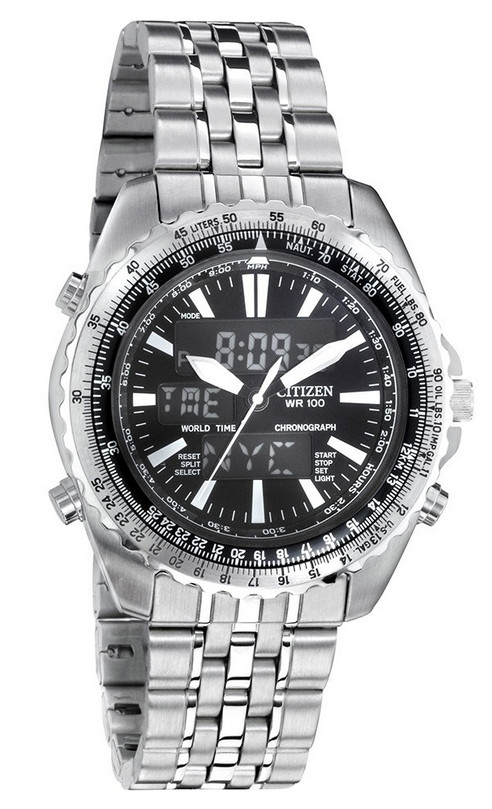
Citizen JQ8250-52E World Time (Wingman 11 or 111)
And “balance” is a good description and not only regarding data clutter, but in the overall look of the watch. For example, the size ratio of case to wrist and to dial, the bezel to dial and how the overall thickness of the watch doesn’t compromise the wrist fit.
As an example I highlight the Citizen JQ8250-52E to the left here, which would be interesting alone for the fact that this watch is 43.5mm x 11mm – an achievement I wish they could manage today! But when I look at the overall “balance” of this model it really is very, very good. Note the slightly dated bracelet fit, but importantly note that it can easily be changed for a strap, Nato or whatever and then it truly starts to look the part. It coincidentally affirms my contention that in many cases bracelet/strap changing can dramatically change a watch from the ordinary to something special. Like a frame around a painting.
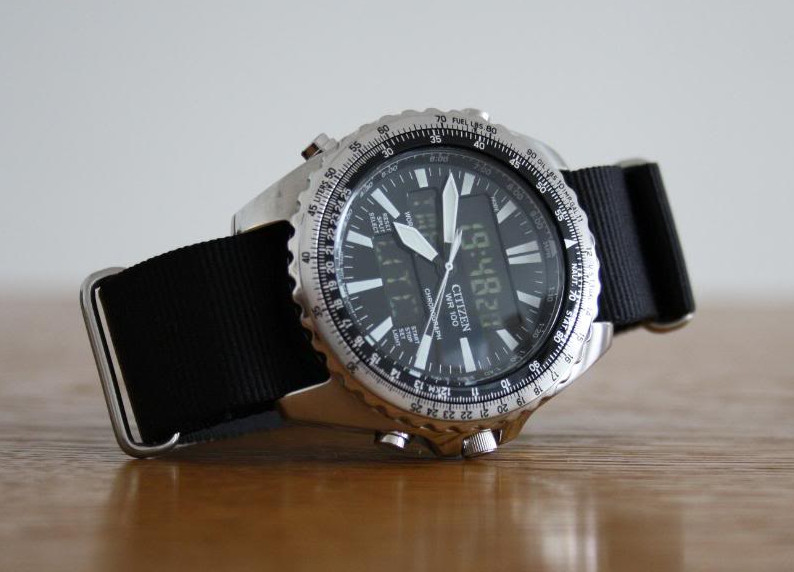
JQ8250 with Nato – (watchyouseek) transformation!
I attach here an image of a Nato strapped version (watchyouseek.com) – the Nato strap shows off the “balance” to perfection. Note too the broad diver like hands which again balance the dial layout. So often chronographs have slim hands and lose visibility as a result. This version features the C460 Quartz movement, Ana-digi, two alarms, world time, stopwatch/chronograph, countdown timer, EL backlight and three LCD displays. It is 100m Depth Rated, domed mineral crystal, luminous hands and markers, bi-directional slide rule bezel with fuel consumption markings and a 20mm wide bracelet (or strap) to standard lug pins.
Now I don’t know about you, but for me this model has that balanced look of a Classic – it looks and feels just right.
But conversely another Citizen model in the same family is the JQ8995-56E and whilst it has a similar a function set, ana-digi display, you would think that it should have the same “look” – well it doesn’t – not at all. For some reason it just doesn’t have that “balance”.
Citizen JQ005-56E
The bezel appears far too large and the same size hour and minute hands are too thin for the size of the dial – somewhere here the ratios just don’t work. And here’s this idea of having to add color, where color is not needed. It simply distracts, which I’m sure was not the intention. Now don’t get me wrong here – I mean it looks OK . . . . but nothing else and it certainly doesn’t look a Classic. It might look a little better with a Nato strap I would imagine, but overall it doesn’t work for me.
And neither I’m afraid do a good number of the current crop from Citizen. And from the above examples it is very evident that a fine line exists between data, clarity, size and function – even a color here and there can make or break how a model will turn out. A bit of a muddle with overdone clutter or a Classic?
It’s not easy, but my advice for what it’s worth, if you see a model that just shrieks Classic and it has that “balance” – don’t assume the next model will be better – don’t hesitate at all – buy it!
The G-Shock range from Casio is such an iconic one I’m constantly on the lookout for “the” one that will suit me best. But unfortunately so far this year here in the UK anyway, I’ve been disappointed. Invariably the models are too big and too often overloaded with “dial clutter”, with one exception perhaps – the PRW3000 Triple ABC model I featured recently and which would fit the bill, IF I could get hold of one! It manages to get ABC functions (and most of the alphabet!) into a smaller watch case, which is my “grail” as far as Casio G-Shocks are concerned.
I really wish Casio would re-introduce the GW2500B-1A or any variation of this model, which appeared a good few years ago now (2008-9?) which in my opinion was and still is better than the current “Aviator” series, for the simplest of reasons – it is smaller. As someone else said in a previous Casio review, why do I need a wall clock on my wrist! This model is about as small as you can get with these functions, so far.
The GW2500B-1A
So the first point, as said – it is smaller than the usual G-Shocks – and that is a real plus when it comes to G-Shocks. Secondly it arguably (definitely, in my opinion) has the best dial configuration of Analogue and Digital data display of any G-Shock. It’s neater buttons and sleeker case make it a much nicer watch to handle. I also noted the crystal is recessed in the case so has some protection. The analogue hands arrangement is super simple and effective – large luminous hands, a 12/24 hour sub-dial with a neat red indicator hand, plus the usual Selector sub-dial which is also neat and clear to read. Digital displays are again, simple. Basically one at the top and one at the bottom (like Breitling, Tissot and Victorinox) with pretty good contrast and quite large enough to read.
For me this is one of the best dial set ups Casio have ever managed.
As to the features – well it has a lot of them. Radio Control and Solar Power are the main ones. World Time, (you can display your home time and destination time and swap between analogue and digital display of each, which is useful when traveling). Neo-brite hands and numeral/markers and 200m Depth Rated. LED dial light, 4 daily alarms plus snooze alarm, 1-60min Countdown Timer plus optional repeat, 1/100 sec Stopwatch, full Auto Calendar to 2099, Power Indicator and dimensions of 46.9mm width x 15.8 height. Plus the usual Casio resin strap.
Of course there are a few niggles, but not enough to stop me getting my hands on this model IF I could. The LED dial light is fine but doesn’t back light the digital displays. Though at night I can’t see me needing to know much other than the time anyway (it’s got lume for that). The Stopwatch is not 1/1000 sec, but again for me 1/100 sec is fine. So nothing major to worry about.
But an updated version of this model could be something very special. I’m told the latest modules are slightly smaller, so potentially an update on this series maybe, just maybe, could produce a watch that’s smaller than it’s predecessor – now wouldn’t that be something! Well for me anyway!
Anyway I live in hope!
Note – The current Aviator models (GW3500-1A2) are once again larger at nearly 50mm diameter – and with increased “dial clutter” – this is NOT good!
The new Casio Aviator – larger and more dial clutter
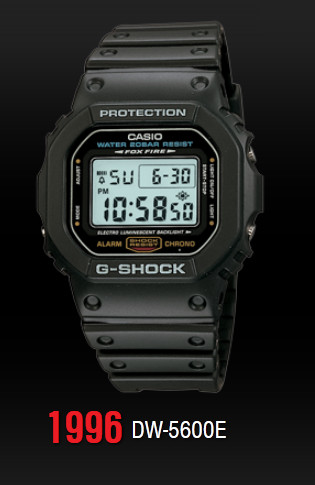
It’s amazing how popular these rugged “G” shockproof style watches have become over the years, with their “tough” resin case design and macho looks. When they first appeared I was pretty impressed at this super tough case idea, though at the time wasn’t sure about the digital display. I found previous digital displays hard to read in sunlight so resisted, sticking to my analogue Seiko automatic, picked up in Singapore for a few dollars, which was my daily beater in those days. I did however succumb to the lure of the “G” and today I do have a “G” Shock Casio DW-5600-E, which whilst it has the look of the original, it’s digital module updated by nearly 15 years and with an EL back light, so a little more modern.
However I really want to ask the question of these plastic, resin cased “G-Shock” and other Shock style watches – Are they really tougher? Boy’s toys or Fashion?
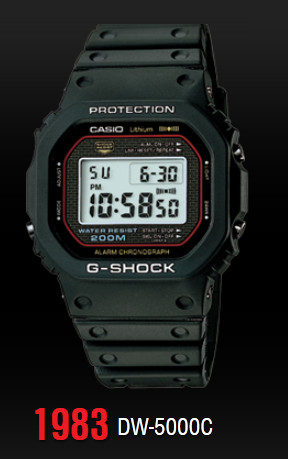
The original G-Shock, the Casio DW-5000C first appeared in 1983 – designed by Casio Design Head Kikuo Ibe, with the brief that the new model should meet the “Triple 10 Concept”. Which was a 10 year battery life, a Water Resistance to 10 bar and finally, able to survive a drop of 10m on to a hard surface.
Now it is not as some think, just a resin cased plastic watch. It can have up to 10 layers of protection, urethane rubber outer, applied over a stainless steel case (yes there is one under there), hardened mineral crystal, a “floating urethane cradle” in which sits the quartz module. Even flexible cable connections to both the module and the various button controls are used and all to minimize shock. The original model actually has a screw down stainless steel back, though that changed in later models.
Such was the success of the Casio “G” Shock that over 19 million had been sold by 1998 and it has gone from strength to strength ever since (70 million would you believe). Now I’m not questioning the fantastic success or the undoubted fact that it was and is a great concept, but maybe I have a sneaking suspicion that like every great marketing idea, the market is often “created” and then placed in the minds of the customer. Most of the great products have done just that – Coca Cola, Corn Flakes (Kellogs), Beanz meanz Heinz and so on. It’s all about Brands and making the Consumer want what you have to sell.
I had to have one – so picked the nearest to the original.
Well “G” Shock – is certainly a classic brand – a series of “rugged” and “tough” timepieces, designed specifically for the active man – or so everyone was told. The tried and tested marketing technique, trigger words (Shock, rugged, tough, active man, etc) in the adverts and photographs and showing you the MUST HAVE features. And an awful lot of folk had to have it, then and today.
Now the fact you might not need it at all and dare I say, because you might have a conventional timepiece survivor on your wrist already. Let’s face it – watches are small, usually steel cased and externally already pretty tough. If it’s mechanical as long as it’s movement has Incabloc or similar – you have some shock protection. And if it’s quartz then let’s be honest, with few or no moving parts there’s little to worry about. Add a half decent Water Resistance, look after your watch as best you can and that’s about it.
So is it a case of Technology for the sake of Technology perhaps?
Well No has to be the answer – because things move on, everything improves, techniques, materials, movements, modules – everything – and that’s progress.
I like this version as it gets away from the angular, but still well protected.
However, taking a step back here and from personal experience – my old standard 1970’s automatic Seiko 5 Day, Date (luminous, 5bar?, screw back) had been with me many years and in quite a few conflicts around the world – “muck and bullets” as we used to say, that is “tough” environments – and would you believe, it survived somewhat better than I did. A little scratched maybe (again like me) but still keeping good time and with the same strap it came with (the “resin” straps of some “G” shocks can easily break in a year of 24/7 wear). And I’m not talking of a once in a lifetime “tour”, but maybe over 20 years, where my watch and I jumped from one pile of rubble to another and from jungles to sand and back again. But that’s another story for another place.
What I’m saying is that it was a fairly common steel Seiko mechanical automatic model with analogue hands and a leather strap and yet somehow it managed over all these years and in situations that would test most things.
How would it fare on the Triple 10 concept?
Well 10 year battery – no problem – being automatic.
Water Resistance only 5bar (maybe)- but it managed and although submerged a few times, it never let in water or indeed condensation.
And as to dropping it on to concrete from 10m? Well I did a few “drops” myself, but as the watch was attached to me, you could say that I was the “shock” protection!
And I survived . . . . 😉
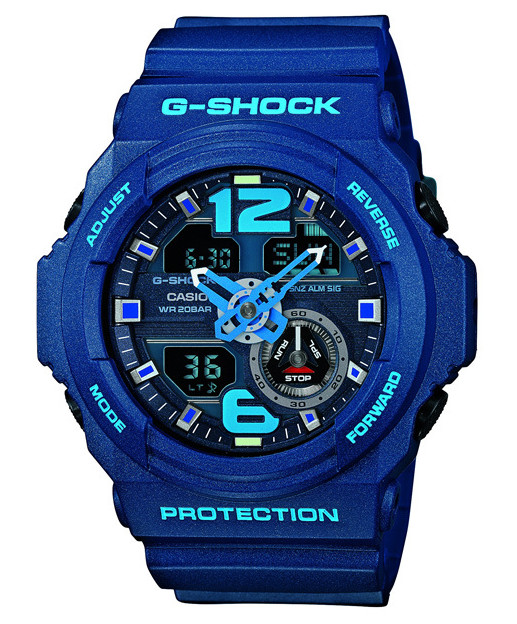
And so to the future – this is one of the big case models for 2104 – the GA-310
The Casio GA-310 – still G-Shock, but better access to controls.
Bit of a statement this one, though if I can get past the color, I like the fact the control buttons are not quite so well shrouded and larger, which means that I can probably find them in amongst the protections around the case, without looking at the watch. Something I still find hard to do with my DW-5600E.
Anyway as to the question – Are they tough? well the answer is yes absolutely.
But if I’m honest I haven’t had any of my watches so damaged over the years to have stopped working, though one did fall about 100 feet once from a cooling tower, bounced off this guys shoulder, who was on the ground looking up (he was lucky!) and landed on his kit bag. When I got down, he handed me the watch and said “You was lucky, mate, it’s still going”. It was an old Timex Atlantis and I think my brother’s still got it!
A watch nut acquaintance of mine arrived back from holiday the other day, waltzed into my place and bragged about his new watch. He only gave me a fleeting glimpse of it as he waved his arm around, saying this was the absolute best watch he’d ever owned.
Intrigued of course I asked to see it and even though I just had the slightest peek, I said it looked like he’d got himself an Aviator classic. “Oh, he said, you don’t have one too, do you?”
Well I’ve got this one here I replied and dug out my old AstroAvia Classic Aviator Alarm watch that I’ve had for a number of years. Now I wouldn’t say it’s the very best watch I’ve ever owned, but it is in practical terms, a pretty decent watch and one that I intend to keep for a long time yet.
Anyway the watch on his wrist was marked on the dial as Ernst Benz, which to me, being a bit cynical in my old age, sounds like one of those made up Swiss German classic marques, that more often than not turn out to be (in my experience) a vastly expensive product with little actual pedigree, or indeed watch specification detail (or any), but lots of dialogue about how good it is. Looking up Herr Ernst Benz I confess to being unsure as to the tie up with a watch brand, but hey why not! I do have a watch in my display cabinet with my own name on the dial too!
Benz and AstroAvia
Now my friend oddly enough after seeing my old Astro suddenly went all coy on how much his Benz cost! Of course if I’m honest, just because the brand was and is pretty much unknown to me, doesn’t make my cynicism justified – I could be quite wrong and it could indeed be a super quality classic.
However looking closely at it – I’ve got to say it doesn’t appear anything special – it’s a fairly common mechanical automatic chrono, probably a 7750 series or 2824/36 movement or similar (I have many of these), the case and dial design is in ubiquitous “Aviator” style and hardly special, the numerals, printing, hands, dial and case quality and finish are comparable and when we put both watches together, they look pretty similar.
Of course in reality they are not the same and there are differences for sure – mechanical automatic v quartz, Sapphire v Hardened Mineral crystal and “maybe” quality differences and so on, but we’re not talking gold or platinum here, or super complications, but a stainless cased working chronograph. The cost differential may well be taken up in part by the mechanical v quartz, though other than that aspect, I don’t see much else. However that said it is fact that mechanical 7750 and 2824 movements models can be anywhere from £600 to £thousands, depending on who they are, marketing hype and fashion. Factually though it’s OK, but personally I’d be looking elsewhere money wise.
My old AstroAvia has a Japanese Quartz (OS2 or YM62 usually) has never let me down, the hands mechanics and complications work fine and is just what I need from a practical daily beater, which why I bought it in the first place. I do recall I favored Quartz over mechanical as more often than not, chronograph complications in everyday wear, considering knocks and so on usually fare better. (See my post of March 2010). It also came with a bracelet and a quality leather strap!
However as the image, they do have a certain similarity – that aviator style and whilst I am very happy with my AstroAvia purchase, I’m not too sure if my old friend is quite so happy after I mentioned it’s £180 price tag.
He never did tell me how much he paid, but checking up on a few of the Benz model prices and which after seeing them, I’d consider this more orientated towards fashion than anything else.
And as to my title “Chalk and Cheese?”, well it certainly makes this old pessimist wonder.













 Watch space
You must be logged in to post a comment.