
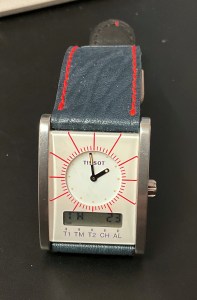
After Posting my 1986 (38 years old) dual display 7 jewel quartz Tissot Two Timer (D377) I Post here another one I have. And this is also an original first edition model, before the advent of the altered case lugs and bespoke strap configuration and four screw back plate, but with a similar but different dial layout.
As said in my first Post on the Tissot Two Timer – this model was introduced as a higher quality Swiss alternative to the often variable quality analogue/digital watches coming from Asia.
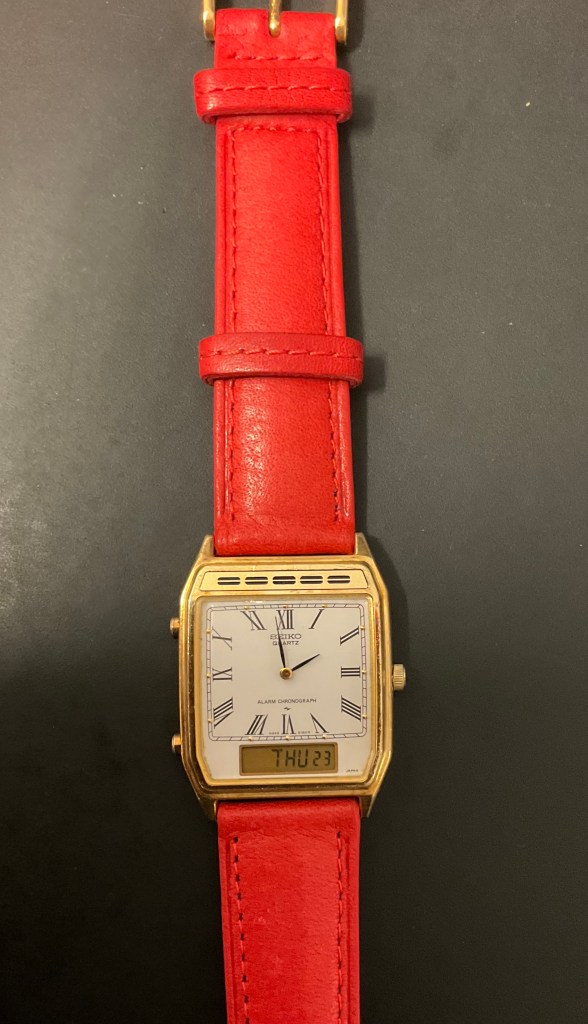
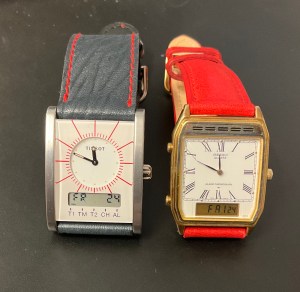
And as Seiko were one of the major producers of this concept (plus Citizen, Casio and a few lesser brands) I thought I’d manage a quick and brief comparison between my Swiss Tissot and my Seiko H249-5130 model of the same era. Both have very similar functions and date of manufacture just 5 years apart. The Seiko 1981 and the Tissot 1986.
Both models are pleasing to the eye and both have an analogue handed dial plus a single line digital display.
The Tissot Two Timer is a high quality cased model in fine, smooth stainless steel. Sleek dimensions at just 8.5mm depth with a curved top plate and Sapphire crystal and a case width of 27mm and lug to lug of 37mm, with a high quality 22mm wide Tissot leather & stainless buckle strap. As a neat dress watch it is pretty much perfect. (note the plain strap means it’s easily swapped, unlike its later version). The case quality of this particular watch is as new, no scratches, perfect. There are also no buttons or pushers on this model, as it employs a good sized stainless steel crown for all adjustments.
The Seiko case is of an ‘SGP’ or Seiko Gold Plate base metal, un-curved with a flat crystal. It is very thin at just 6.7mm, around 27mm case width and lug to lug of 37mm. On this model the ‘thin’ Gold plating is just holding on with just noticeable (close up) wear showing, but is still pretty good for it’s age of 44 years. The case back is stainless steel. The SGP case finish, whilst it can look good when new, does tend to wear and flake over time. And this one is showing it’s age now (Gilt has a max lifespan of 30 years?) but can’t compare to an un-plated stainless steel case of the Tissot.
The Two Timer features a battery hatch (eventually introduced to Swatch) and is as good now as it was when new. A bonus too that its rubber seal is intact, so it should still be Water Resistant to 3ATM or 30m (slightly better than splash proof, but not full immersion). Certainly good enough for a dress watch. (however, if you buy any pre-owned watch with a battery hatch – check it has the seal before getting it wet!). And note this stainless steel case back does not open.
The Seiko has a stainless steel back, but is a ‘snap’ fit – so I wouldn’t class it as Water Resistant, but will probably manage the odd splash – maybe.
The Tissot employs the single crown system, controlling time settings and all functions both digital and analogue. It is also very smooth and precise. This Tissot single crown system is about as good as it gets and whilst there are no push buttons, the crown does have a push function.
The Seiko has a rather small centre crown on the right and 2 push buttons on the left of the case. They are also in gold tone and both pushers have a slight issue of weakened springs, which was and always has been an issue with early ‘pushers’, though so far both work, albeit a little slowly and sometimes require a few attempts.
The analogue dial displays of both watches are clear to read, though the Tissot has more contrast and digit separation is better and the Tissot dial area and display are slightly larger overall. The Seiko gives up some of the space for the Alarm speaker, though in practice the Tissot has the louder Alarm.
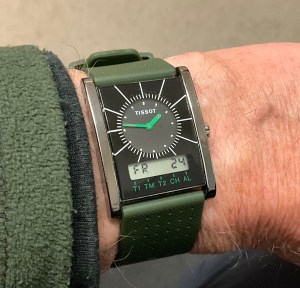
There’s no doubt that the Two Timer model has a sleek wrist hugging design and produced with so many face designs, it seems to have a wonderfully fresh look every time I see one. And not many models can boast that versatility apart from maybe Swatch today, which is unsurprising as Tissot was a founder member of Swatch back in the day (and still a member today).
As to design – the Seiko, whilst the latest thing back then with a dial and display combination, somehow looks a little dated now, whereas the Tissot is very much of today. In fact it is difficult to realise the Tissot is 38 years old, basically owing to the overall design, build quality, materials and look plus comfort and functionality are quite a step up from this particular Seiko.
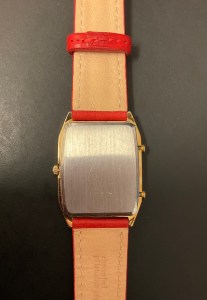
And the Tissot Two Timer is maybe a bit of an oddity – produced to fill a gap, yet shows it’s superb Swiss heritage so well. The overall design and build quality a testament to Swiss design and watch construction. Also Tissot’s LCD digital display is clearly superior to the Seiko of this period and I know that Seiko, Citizen, Casio, Zeon and other analogue and digital Asian models in those days were not without issues.
However, considering the period, both watches have a raft of functions – such as – Home time, 2nd time or zone, Quartz movement/module, analogue hands and digital displays either linked or viewed separately, indications of Day, Date, Month, running Seconds, a Chronometer, Alarm, AM & PM indication, 12/24 hour selection. Very similar in fact. And in the case of the Tissot, functions are controlled by a single crown, which was quite an advance on what was an Asian digital watch revolution at the time.
My opinion, for what it’s worth, is the Tissot Two Timer is and has always been a bit of an ‘under-the-radar’ model. In fact, I’d say an understated classic, as it stands up so well even today. And I have not come across another Ana/Digi watch of that period with a better timeless look to it.
However, as said at the start, this comparison is perhaps a little skewed, as the Seiko was made in 1981, the Tissot in 1986. And 5 years is a long time in watch development, but regardless of the advancements, the Swiss Tissot Two Timer stands above any comparable Asian models of that time in both design and function.
And of course, model wise there are later Seiko, Casio and Citizen models around that likely better this particular Seiko H249 series, but my conclusion remains.
Just a word on the single crown control –
Ever since the Crown of a watch was introduced back in the early 1880’s, it was a revolution. John Arnold an English watchmaker first thought of some sort of knob to replace key wound watches of the day. Then Breguet took the concept further, allowing the Crown to manage more functions. So, the concept of looking at new ways to expand the Crown’s capability is not new, but with the Tissot Two Timer, the Crown reached new levels yet again. Especially in regards digital function, which is a complication all of it’s own making.
Anyway, whilst it all seems rather complicated – and of course, it is (a bit like an inkjet printer – it prints – but boy! it IS complicated). The trick however, is to manage the “user interface” to make it useable.
But for the watch Crown user, once done a few times – it really isn’t and there is a logic to it.
Generally – with most multifunction digital models, it is a case of selecting the function, either pulling out the crown or pushing a button will cause the digits to flash. Then either using pushers or crown, alter them to suit, then shove the crown or pushers back to the neutral position.
But as with all of them, unless you wear the watch frequently, it’s easy to forget what to do. And in fact, there are many modern digitals today that can get you frustrated.
On this Tissot there is a first and basic procedure that starts it all. And this is whether you’ve got one that’s displaying wrong or you’ve just changed the battery.
First thing to do – is synchronise the analogue and the digital displays.
And if you remember this first bit, then usually you start to remember what you’re doing (basically get things flashing, adjust and so on as above).
So, to synchronise –
And in this order – we first want a blank digital display by simply turning the Crown any way. Once the display is blank (off), pull OUT the Crown – this switches ON the time display. Then turn the Crown (this moves the hands – so you move them to match the digital time). Once the hands and the digits show the same time, simply push IN the Crown again. You are now synchronised!
Now you can set the correct time – With the Crown IN as you’ve just done, turn the Crown again until T1 on the display has a small cursor line below it and a digital time indicates. Pull out the Crown and the hours and minutes flash – and turn it – this time the hands and the digits will move together. (moving the crown slowly moves it minute by minute and FAST motors the hands quickly – like in hour jumps!). Set the correct time approximately, OR if you need to set it to the second, the seconds display will flash for another minute to give you time to set it exactly to the second. Then push in the Crown again.
And that’s the very basic bit , or what I usually remember bit, done!
Personally I don’t set it ‘to the second’ – let’s face it I’m retired! who needs seconds! Roughly to around the minute is fine for me.
And for the rest of the adjustments like Day, Date, Month, blah blah blah – get the instructions out! Then forget it all for the next 4 years or so until the battery pegs out! Then hopefully you might remember the basic bit – (blank display, pull out the Crown and move ”em all at once – yes?) the basic bit! above – then for the rest of it, you might have to find the instructions!
And finally – the best Tissot Two timer instructions I’ve found are here.
 Watch space
You must be logged in to post a comment.