
Interesting watch, the Tissot Two Timer (D.377) introduced by Tissot in 1986 and this one dated around that date. By the number of different configurations, this Tissot model interestingly reflects both the Swatch ideals (Tissot joined Swatch as a founding member in 1983) and a competitor to the new Asian digital reality of the time, but in Swiss style. In my small collection of these, I Post this one first as it’s quite a rare one, purely owing to it’s funky overlay dial. The TTT (as I call them) models were relatively new tech for the time, as they were Ana-Digi models with an unusual feature of using just a single multi-functional crown. The control module sets and adjusts the analogue time and the digital functions, which indicate in the single line digital display and by analogue hands.
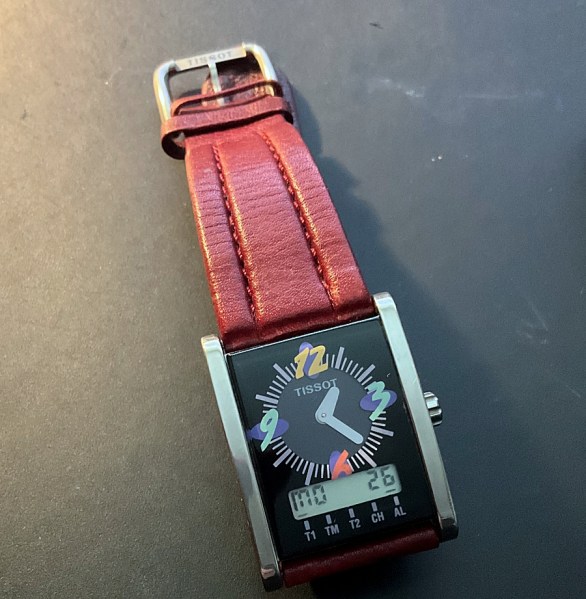
The (adjustable) digital functions featured are; Digital Time, Seconds & Date, Weekday & Date (auto-calendar), Timer, 2nd Time Zone, Chronograph and, Alarm. Each is selected and adjusted by the single crown, which is still today a bit of a rarity. Analogue and digital can be synchronised too and the digital display can also be switched OFF.
I have just a few models that utilise single crown multifunctionality apart from the Two Timers. One that immediately comes to mind is my 1999 Breitling Aerospace, which may well use the same or very similar module. So, this very affordable 40 year old vintage watch, is in very good company.
As said this module uses a single crown adjustment system which although effective, is tricky to manage and if you’ve just bought the watch. You will need the instructions, believe me!
Basically there are 3 crown positions. Press the crown IN once (position A1 – spring action) it selects the main function changes and can also switch the Alarm on or off. Crown position A (normal) rotates either way and moves the line marker under the digits to select the required function.
Position B – (one click OUT) is used to alter the digits on the function selected – then again rotate the crown in either direction. Note that a fast crown rotation moves hours and months & slow rotation alters minutes and days.
So, quite tricky to get the hang of. I found that slow is just that – a nice steady turn and fast is – fast! I would say instructions should be to hand and perseverance is required – but the system does work, believe me. The trouble is that next time you have to adjust it after replacing the battery, you will likely have forgotten what to do – so don’t lose the instructions!
Anyway, on this Two Timer, all functions operate flawlessly and the digital display is as good as it gets with no bleeding or fading, which is a real bonus on any vintage watch with a digital display (a weakness of early digitals).
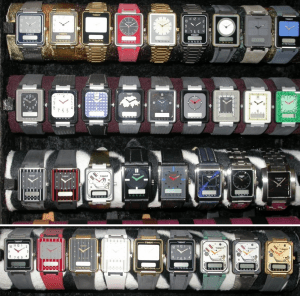
However, the main reason for my interest in this particular 1980’s – 1990’s Tissot Two Timer model is because of it’s rarity.
And this is totally owing to it’s colourful and rather funky overlay dial layout as it is VERY unusual. A fact that’s very obvious by it’s absence in this great picture of a fabulous Tissot Two Timer collection offered for sale some years ago. Do I see this dial? No.
Whilst I’ve also seen many variations on the theme with around 20 different 1st generation Two Timers up to maybe 1995, plus more variations with the 2nd generation models – I’ve only seen this particular one once before and as these pre-owned models change ownership every so often – who knows, maybe this is the one?
Update – I have actually seen one with this dial for sale in Singapore since I Posted this.
For anyone interested in Tissot Two Timer models, especially the 1st generation ones, there are a few (and just a few) of pre-owned ones around, mostly the more common dial layouts, such as the vertical striped face or skeleton. Though these tend to be the 2nd generation models which seem popular. However, fully working 1st gen’s pre-owned ones are much more scarce.
As said, this particular model is a rather colourful and quirky dial layout with thick white coloured (I call loony) hands plus an overlay of quite jazzy numerals and markers – I love its different look from the many others I’ve seen. So I’m very pleased to have it. Plus, it has the original stitched leather strap as well and whilst obviously worn, it’s still OK to wear. However, I do have another strap I obtained recently if and when this one gives up. I note later versions have moved from leather to rubber options – which doesn’t do it for me I’m afraid
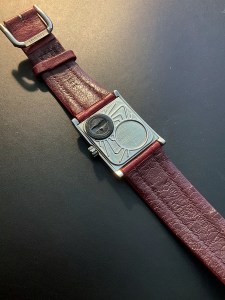
The watch is quartz powered (7 jewels) and the battery (SR920SW) is accessible via a battery hatch (note – 3ATM with the correct seal) on the rear (see image). And the all important crown is well knurled which makes it easier to turn for adjustments. Note the battery cover is often a plastic one and the slot is quite wide – I find here in the UK a 20 pence coin (7 sided) is perfect and prevents damage to the plastic. (don’t be tempted to get one without the battery cover – as these are very difficult to source).
Watch dimension are really good at around 28mm width (add crown just under 30mm) and the case thickness is very neat at around 7mm. The case is also curved with a flat back, so looks very neat on the wrist.
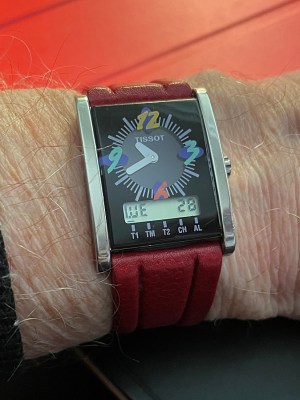
So, as often the case, I find many vintage models preferable for all sorts of reasons – and fortunately, as said, they can still be found (but not always) at reasonable prices. Beware Two Timers for big prices – they shouldn’t be).
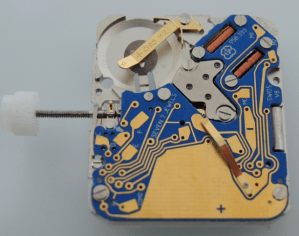
A little unsure as to the movement module used in this Two Timer, but it appears to be a variation of or similar to, the ETA 988.332 module in my Breitling Aerospace. Perhaps the ETA 958.300 series with a single digital window.
The module is part of the Swiss ETA Flatline series and information can be found online. However, little information appears available after 2009 and although I have seen complete 958-333 modules, I would not assume these can be used as a replacement for this particular model.
A few other watch brands have utilised the ETA Flatline series of modules in addition to Breitling, such as Bell & Ross, Rado, Victorinox, Chrono and Butler, so obviously quite well regarded.
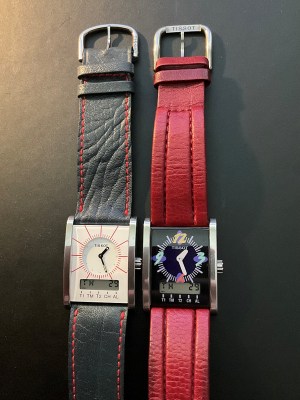
Strap, buckle and dial cosmetic change.
The Tissot Two Timer was never an expensive model, but it was in my view an important one as it not only competed, but matched Asian competition at that time. Along with the introduction of the new Swatch Brand (Tissot being a founder member) this offered a proper well established quality Swiss Brand to customers at a crisis time in the European (Swiss watch) Industry.
So, to Tissot – Founded in 1853 in Le Locle in Switzerland, then allied to Omega – becoming the Omega Tissot Brand from around 1929. They further expanded with the amalgamation in 1983 of what was known as the SSIH-ASUAG & SMH (the Swiss names are too long winded for me to spell out) and finally SMH became a new Group known as the Swatch Group. Today, of course a huge player in the watch industry, with a membership of many major and still independent Swiss Brands, such as Tissot themselves of course.
Anyway, that’s my funky Tissot Two Timer and I love it, both for it’s 1980’s modernist design and to my mind, under-stated place in the watch world and the fact that on the wrist, it just looks great! And I do prefer it to their previous ana/digi models which were not to the same standard.
I also show here in this image, another of my Tissot Two Timer models. This is another 1st gen D.377 model, not quite the same year, with another dial layout, strap and buckle and a different look. Note – Later generation of the D. series have an altered case and lug design which necessitates a non-standard strap, often rubber. Also the battery hatch is no longer used, so the back is more conventional and uses screws to access the battery (maybe a better idea as often battery covers go missing).
Note 1 – Instructions are available here – https://www.manualslib.com/download/863198/Tissot-Twotimer.
And Here – which has a full set of instructions in .pdf format
Note 2 – Two Timer modules feature an auto-calendar, though this year (2024) being a leap year, with 29 days in February, I manually changed the date accordingly.
UPDATED – this Post was updated January 12th 2025
 Watch space
You must be logged in to post a comment.