Out of reach? I’ll wait.

Once again arguably the best Protrek Casio yet is NOT available here in the UK.  The model PRW3000 series improves on the current range and uses the Ver 3. Triple Sensor (Altimeter/Barometer, Thermometer & Compass), it’s solar powered and Radio Controlled with Multi-Band 6 Atomic Timekeeping, with a 100m Water Resistance case.

PRW-3000 series from Casio Pro-Tec
PRW-3000 series from Casio Protrek

Owing to the improved and updated modules the direction sensor is smaller (plus improved power consumption) means that the overall dimensions of this model are at last reduced.  And if familiar with my web site you well know this is an ongoing issue I have with watches today.  At 47mm diameter x 56mm x 12.3 height and only 62g weight, this is at least moving nearer the normal wrist size, without looking like a Marvel comic character.

Accuracy too has been improved with Altitude measured in 1m increments and the display compass readings have 60 seconds of continuous measurement.  Added to that there is a Barometric Pressure Tendency Alarm that alerts the wearer to sudden changes in pressure readings – more like GPS units.

As I understand it – can only be purchased from outlets in the Far East and if you need one, then that’s what you will have to do – and run the gauntlet of customs delays, high customs Duty and VAT charges and perhaps an overpriced model at the end of it all.

Of course some will ask if an ABC model is worth all the hassle at all and perhaps rightly so.  If into trekking or mountaineering, then you are presumably pretty efficient with map and compass already and maybe have a GPS unit, which after all gives the same data (possibly more accurately as it’s not as confined space wise?) plus a positional indication moving map.
And that’s a valid point – most GPS units are very, very good at horizontal positioning, which is arguably the most important aspect for the majority of recreational walkers, as opposed to serious mountaineering.  It actually tells you where you are!  The ABC watch of course doesn’t have that function!

And there are the gadget freaks who simply must have the model as it’s the latest high tech wrist fashion.  How often have I seen a Tube video of someone showing off his ABC and saying – “Well I know I’m at 400ft, though the watch says  320ft – not too bad is it?”  My own thoughts are he’s used the wrong description – not too bad?  I think a better one would be “utterly useless”.  Or being charitable – perhaps he doesn’t yet know how to calibrate the thing.

And that IS a point.  With all ABC watches you have to calibrate them .  The Compass and the Altimeter, Barometric pressure and so on, all have to be calibrated otherwise the unit will NOT be accurate.  And if as in Scotland where the atmospheric pressure changes often by the minute (our weather is unpredictable to say the least) you might as well forget it, as most readings will be worse than useless.
However if using GPS with a barometric/altimeter and pressure is changing due to weather and not elevation change, at least on some units you have the option of selecting “fixed elevation” mode when it then uses the GPS only for elevation data.  But I don’t think you can do this on a wrist watch – yet.

I’ve decided already not to rush to the Far East for one just yet.  I’m thinking why do I need one?  Maybe I’ll wait for a few UK or USA reviews (not the hype) and consider carefully if I really want one at all.
And when you sit and think about it – time is actually on your side.  These units will surely get better and who knows – v4 might just be around the corner – accuracy and calibration factors could improve out of all recognition next week or month!
Imagine Calibration could even be a totally automatic process for Altitude, Pressure and Compass!   Carrying around a 90 page instruction booklet is not my idea of fun!   The ultimate goal has to be – buy it, strap it on and go!

Now OK just supposition on my part of course and don’t let my hangups stop you rushing out and getting one, from wherever.  But personally even with the latest ABC’s, I have to admit to viewing them in the gadget category, albeit a “work in progress”  –  so I’m quite happy to wait.

Deployment as replacement

Regular followers of my blog will know that I have thing for comfort regarding watches.  So often watches come with less than perfect straps and bracelets that whilst perhaps, and even this is debatable, are made to “look” good and compliment the model in question, but unfortunately simply do not fit  the wrist properly.  Or more accurately – they don’t fit or suit my or perhaps your wrist!

This is especially true of the “utility” watches I own and I quite often replace the supplied fittings.  Perhaps they are very thick or stiff leather, or heavy wavelike rubber more suited for wearing over neoprene wet suits or sometimes a plastic or textile poor quality affair that either becomes brittle or  unravels.  So I tend to replace these with a silicon rubber deployment strap.  These are fairly low cost, easily available and generally made to a similar standard and once fitted are very easy to use and extremely comfortable.  I tend to prefer a twin button release version with a safety overlap clasp as shown here.

Typical silicon/rubber deployment fold-over strap.

The strap basically is made of silicon rubber and slightly tapers down from the lug ends to the deployment clasp.  There are around 14 slot holes across the strap that accept the spring bar and can be cut to fit the length required.  Note on the ends are supplied new spring bars protruding out from the lug fixing ends as you see above.

Deployment and fold-over safety clasp

Now fitting these is by no means “rocket science” and is quite simple.

Note twin button release

The straps come with two spring bars, obviously the right length, as you will have first checked the distance between the lugs (the strap width) and ordered for example, a 20mm deployment strap.  They are generally available as 18mm, 20mm, 22mm and 24mm, though it may be possible to get others outside this range, this tends to be the usual.

As you can see the strap fits to the deployment mechanism also with small spring bars and there are usually 3 alternative positions on the deployment fitting which allows you to adjust the strap for a more perfect fit once you’ve cut the strap to the approximate size required.

I usually remove the old strap and fit both the free ends of the new deployment to the watch using either the new spring bars or the old ones, whichever fits best – note sometimes the original watch fittings may be either too thin or too thick, so I prefer myself to use the new ones. Once you’ve fitted the strap it will of course, unless you have Neanderthal wrists, be far too big and loose.  Simply wrap your other hand around it and squeeze it to your wrist to see how it should look.  This will give you an idea how much to cut from both sides and to make sure the positioning of the flat metal work is against the centre of the inside of the wrist.  You then use your scissors and cut down the edge of the slotted holes in one side of the strap (take care not to run too close to the edge of the groove – you may cut into the hole itself).

If this is the first time you’ve attempted this, take less off than you think at first, because you can cut more off as you go along, trying it out on your wrist as you go.

Once you’ve cut one side check the other and cut it to size as required.  I’ll repeat that you should try to make sure that the deployment clasp is positioned more or less against the centre part of your wrist and not off to one side – this would not be comfortable at all.

Where to scissor cut the strap.
Cut points - select a point to suit you on each side of the watch.
Cut points – select a point to suit you on each side of the watch.

It is important however to get the right end of the strap to the correct lugs on the watch.  Looking at the watch from the front with the 12 at the top, the top lugs should be fitted to the end of the strap which has the deployment swivel and button release mechanism – AS IMAGE ABOVE.

This can be seen in all the watches in the next image.

Look for the 12 o’clock position of each model shown here and note how the deployment swivel end fitting is attached to that lug side (note – these are shown for a left wrist watch wearer).

Examples of deployment fitted watches

So as said, no rocket science here, but care should still be taken.  Always cut the strap, if this is the first time you’ve done this, a bit at a time.  Once youv’e done both ends, try it – if it’s still too big, decide which side is the one to cut a little more from and try again. You can always shorten a little more as you go – too much and you’ll end up buying another strap!  But if you’ve never tried a silicon rubber deployment strap, why not try it.  They’re available on Ebay for example and don’t break the bank.  Also with so many of what I call “utility” black faced, sports, divers style and military watches around, these suit them very well – but importantly once fitted these will also now be really comfortable to wear.  Note they are available in different colors, though black is the most common.  They also come in various textures, though for me I always seem to end up with the same one – with the parallel lines.

A simple post this time and perhaps a little bit simplistic for many, but you would be surprised at how many watch wearers have sold off watches as not suitable, when it was actually the strap and not the watch.

So if you’re lucky enough to get a new watch for Christmas and you discover that the strap or bracelet just isn’t right – don’t despair – maybe a change of strap might just solve the problem.  Anyway good luck. . . .!

Note – Not all watches can take standard replacement straps – some are special fittings or integral to the particular watch.  Check that a standard spring bar lug and strap fitting is possible before trying the above.

//

Strapped Santos

Recently I acquired via family sources, this nice little Quartz Cartier watch which has been through the wars a bit and I know, I know it should have a bracelet.  However the one fitted had been partly torn off in an accident, badly damaged and beyond repair.  Luckily the lugs of the watch were relatively unscathed with only minor damage and some small marks to the case.

This model is a Santos Steel & Gold W20060D6 quartz version I believe which was re-issued probably as a “homage” to the original 1904 model.  Roman numerals with blue steel sword shaped hands and with a date window @6.  The movement is a Swiss Quartz Calibre 687 and running perfectly once I fitted a new battery.  A nice neat size of watch too with a square face of 29mm x 29mm actually which suits me very well.

So what to do?  Either source a Cartier bracelet which would be very expensive or find an alternative.
The answer was easy for me as I’ve always disliked the Santos bracelet (I actually I don’t like many Cartier bracelets) – and the Santos I’d owned myself some years ago used to hurt my wrist as it was too sharp and after 12 months of  a raw wrist I sold it on.

Now to replace with an alternative bracelet is almost  impossible unless specially made as the bracelet fitting is very tricky.  The fixing pin is hard against the case body, very unusual and fits into a little recess on the very end of the bracelet.

I thought OK – if I’m going to keep the watch it has to have a strap?  Well this initially looked a little difficult owing to the fixing problem – the bracelet securing pin holes in the lugs were far, far too close to the case.  The existing pins were unusable being badly distorted owing to the damage and even if they had been OK they were too thick to use, as even bent it would not have been possible to fit a strap between them and the case body.

I solved the problem quite easily in the end by using a much thinner steel wire (a paper clip actually) than the original pins and cut them at a length to slightly protrude from the lug holes at either side.  I then bent the wire outwards from the case between the lugs enough to allow an open ended strap to slide between the wire and the case.  This bending of the pin effectively shortened the pin by pulling the pin ends inwards slightly, thus making them fit just inside the holes without protruding which was perfect.  My open ended strap then managed to fit with a bit of juggling and this is the result.  The strap is a great high quality camel grain leather one I found at Watchworx.

As said I never like the look of Cartier bracelets generally and personally think the watches look far better with a strap. Which is why I prefer more recent Cartier watches like the Santos 2007 for example as they are proper strap watches, having the strap fixing holes in the correct place.  However I have to admit a sneaking preference for this older model with it’s classic style blued steel sword hands rather than the infill hands of the newer ones.

So all in all I’m pretty pleased and now have a colorful little dress watch, albeit a bit of a “homer” if being critical and one that suits me quite nicely.  A good day all round!

Oh just a point about lugs and bracelets etc.

These days I always check the case construction of any watch I’m interested in to see if it can possibly be fitted with a standard strap.  It is noticeable that many bracelet models have the cases modified in some way and profiled for the particular bracelet or strap and often with oddly shaped lug fixings that make it impossible to change.

Their are literally hundreds of watch styles and models out there that have really quite unique straps or bracelets.  All sorts of strap or bracelet styles, maybe rubber or resin or composites of some kind and whilst they may look great and perhaps compliment the watch – what happens if they wear out or break? (rubber ones used to go brittle and break on me after about a year).  If the model is an older model it can be well nigh impossible to get an original replacement and owing to that odd case/lug arrangement it’s pretty  impossible to get any kind of replacement at all!
Couple this with the fact that many watches in the market place may have little or no after sales support, the watch ends up effectively useless as no OEM bracelet will actually be available anyway.

I don’t have any of the “sport” watches with those sort of  “built-in composite straps” as I find there is simply no way to replace the strap nor get any kind of replacement at all.  To me this is where “fashion” more often than not does away with “function” completely and is a non starter.

So I check the case/lug construction and make sure that the case has what I regard as a standard lug arrangement.  Just sometimes though you do manage to find the odd watch that manages to provide form and function.  There are quite a few around of course which co-incidentally leads me nicely to the fact that my next post  features just such a watch.
This one perhaps unusually has up to 3 different versions and offered with the choice of bracelet, rubber or leather, which seems to me to be the most wonderfully enlightened and sensible idea.

Standard lugs you see – so important.

Lost images

I noted recently that quite a few of my watch pictures had vanished from the site.  Over the next few days I’ll replace those that I can which will make then make sense of some of the reviews and articles again.

Apologies for the mess.

2010 in review

The stats helper monkeys at WordPress.com mulled over how this blog did in 2010, and here’s a high level summary of its overall blog health:

Healthy blog!

The Blog-Health-o-Meter™ reads Fresher than ever.

Crunchy numbers

Featured imageA Boeing 747-400 passenger jet can hold 416 passengers. This blog was viewed about 13,000 times in 2010. That’s about 31 full 747s.

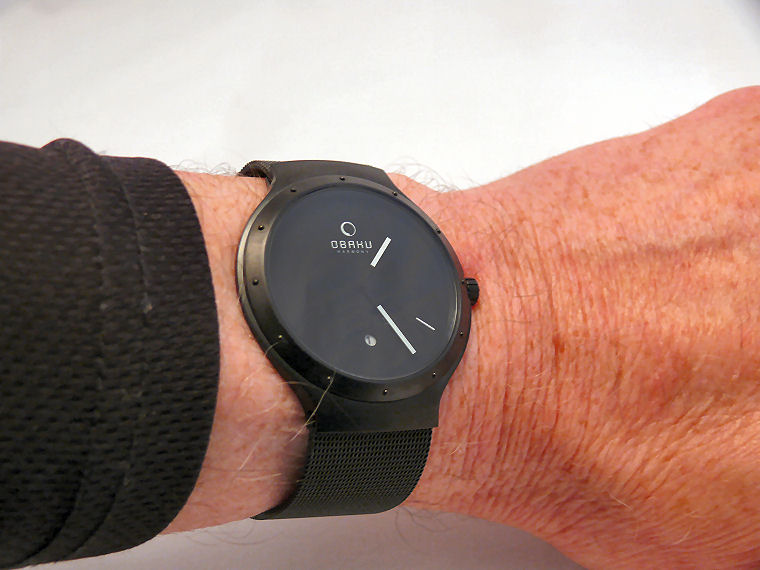
The busiest day of the year was December 16th with 114 views. The most popular post that day was Obaku.

—————————————————————————————————————

Well I have to say I’m quietly pleased at the stats as the site was and is really just an outlet for a guy who’s interest and watch collecting fills in some time in his retirement. To be able to write about it and share whatever stuff I come across and of course post real reviews of real watches, with real pictures (not enhanced computer outlines) and watches too that are mostly affordable is also great fun.

One of the wonders of the “world wide web” is no better highlighted by the stats above – I mean with around 13,000! folks logging in and viewing my modest entries is amazing – it makes it all worthwhile.

Many many thanks and a Happy New year to these great folks at WordPress – I’m looking forward to 2011 now – absolutely!

Update Aero

Well after a few weeks with this latest watch I have to report that any reservations I had or indeed criticism of it are utterly unfounded!

I have not had this watch OFF my wrist since!  It is working flawlessly and to my surprise is keeping VERY good time indeed – in fact much better than I initially thought would be the case with a relatively low priced Far Eastern mechanical automatic movement.
In the luminous department, whilst it is better than the whole face lighting of the last Aeromatic, it’s about average, but the contrast is better in daylight.

So all in all I am VERY pleased with this model and for the price it is difficult to see how it can be beaten!

My next review is a Quartz Eco watch which took my fancy some time ago and for the smaller wrist it is pretty good.